

Your baby is frowning at you right now.Not randomly — not as a muscle twitch or a reflex. At 14 weeks pregnant, your lemon-sized baby is making actual facial expressions — frowning, squinting, grimacing — driven by real nerve impulses from a brain that has grown sophisticated enough to communicate directly with facial muscles.
Those expressions have no emotional content yet, but the neurological hardware is real: the circuit connecting ‘brain fires’ to ‘face moves’ is being established this week, and it will be running at full power the moment your baby enters the world.
Week 14 is also the week the spleen steps up — taking over red blood cell production from the liver, which carried that job since Week 11. The neck appears for the first time, defined enough for the chin to lift off the chest. Hair follicles are opening, eyebrows are beginning, and your baby’s arms are lengthening toward the proportions they’ll hold at birth. The second trimester is in full stride.
At Babyslover, here’s everything about 14 weeks pregnant — your baby’s remarkable new developments, what your body is doing, skin changes to prepare for, and exactly what to action this week.
Coming from last week? Our 13 weeks pregnant guide covered the peach-sized baby, unique fingerprints, and the golden period beginning.

| 📋 Quick Summary — Week 14 of Pregnancy | |
| Week | Week 14 of 40 — Second Trimester, Week 2 🌟 |
| Trimester | Second Trimester (Weeks 13-26) — the golden period |
| Baby Size | 🍋 Lemon — ~87mm (3.4 inches) |
| Baby Weight | ~45 grams (1.5 oz) — nearly doubled from Week 13! |
| KEY MILESTONES | 😮 Facial expressions (squinting, frowning, grimacing) driven by BRAIN impulses • 🩸 Spleen takes over red blood cell production • 👶 Neck defined — chin lifts from chest • 💇 Hair follicles + eyebrows + scalp hair beginning • 💪 Arms lengthening toward birth proportions |
| Symptoms | Nausea fading, energy returning, mask of pregnancy (chloasma), varicose veins may begin, round ligament pain, hair & nail growth, pregnancy glow |
| Heart Rate | ~145-170 bpm — strong and steady |
| This Week | 📅 BOOK your 20-week anatomy scan NOW — popular slots fill weeks in advance! |
Contents
- 1 What’s Happening in Your Body at 14 Weeks Pregnant
- 2 🌱 Baby Development at 14 Weeks Pregnant
- 3 14 Weeks Pregnant Symptoms — What’s Normal Now
- 4 What to Eat at 14 Weeks Pregnant
- 5 📅 The 20-Week Anatomy Scan — Book It NOW at Week 14
- 6 Quad Screen — Optional Screening Available From Week 15
- 7 For Your Partner — Week 14 Practicalities
- 8 When to Call Your Doctor at 14 Weeks Pregnant
- 9 Your Week 14 Pregnancy Checklist
- 10 Frequently Asked Questions — 14 Weeks Pregnant
- 11 The Emotional Reality of Week 14 — Settling Into the Pregnancy
- 12 👶 What Happens Next — 15 Weeks Pregnant Preview
- 13 Week 14: The Lemon That Learned to Frown
What’s Happening in Your Body at 14 Weeks Pregnant
Week 14 brings a continuation of the positive shifts that began at Week 12-13, along with some new physical changes that are specific to the second trimester’s rising estrogen levels.
The Bump Is Becoming Visible
Your uterus is now comfortably above the pubic bone and continuing to rise into the abdomen. At 14 weeks, many women notice their bump for the first time — though first-time moms often don’t have a clearly visible bump until Weeks 16-20, while women who have been pregnant before may show noticeably earlier. What most women do notice at 14 weeks is that clothing is feeling different around the waist — waistbands that fit two weeks ago may be uncomfortable now. This is both the uterus and the relaxin hormone’s effect on ligaments and connective tissue, which softens everything to accommodate the expanding pregnancy.
Chloasma — The Mask of Pregnancy
Brownish, uneven patches on the forehead, cheeks, upper lip, and nose — called chloasma or the ‘mask of pregnancy’ — may appear or darken significantly around Week 14. This is caused by the same melanin-stimulating hormones responsible for the linea nigra and darkened areolas. Chloasma is dramatically worsened by sun exposure: UV light activates melanin production, and the pregnancy hormones have already primed your melanocytes to over-respond. Daily SPF 30+ on the face from Week 14 onward is the single most effective way to limit chloasma’s development. It typically fades significantly within a few months postpartum — but UV damage without SPF during pregnancy can leave pigmentation that takes much longer to resolve.
Hair and Nails — The Estrogen Dividend
Rising estrogen slows the normal hair-shedding cycle — hair that would typically fall out daily stays in the growth phase longer. The result is the famous pregnancy hair: thicker, shinier, and growing faster than at any other point in your life. Nails follow the same pattern — stronger, faster-growing, sometimes more brittle at the tips due to the rapid growth. After delivery, when estrogen drops sharply, all that retained hair sheds simultaneously in a process called postpartum telogen effluvium — a normal but alarming amount of hair loss that typically resolves by 6-12 months postpartum.
Varicose Veins — May Begin This Week
Increased blood volume, softened vein walls (from progesterone), and the growing uterus pressing on pelvic veins can all contribute to varicose veins — swollen, visible, sometimes tender veins most commonly appearing on the legs and vulva during the second trimester. Staying active, elevating your legs when resting, avoiding crossing your legs when sitting, and wearing compression socks can all reduce discomfort and slow progression. Varicose veins often improve significantly after delivery but may not completely resolve.
Round Ligament Pain — More Intense Now
As the uterus grows rapidly upward, the round ligaments — two fibrous cords that support the uterus — are being stretched faster than they can comfortably accommodate. Round ligament pain presents as sharp, sudden, brief pain in the lower abdomen or groin — often triggered by sudden movement, coughing, sneezing, or rolling over in bed. It is entirely harmless and one of the most common second-trimester complaints. Moving more slowly and deliberately when changing positions, supporting the abdomen with your hands when you sneeze, and gentle stretching of the hip flexors all help.
Constipation — Getting More Challenging
Progesterone’s relaxing effect on smooth muscle slows the entire gastrointestinal tract — and as the uterus grows, it adds physical pressure on the intestines. Constipation that was manageable in the first trimester often becomes more noticeable around Week 14. Fiber, hydration, and gentle movement are the most effective interventions: aim for 25-30g of fiber daily, 8-10 glasses of water, and daily walking. If constipation is severe, ask your OB about pregnancy-safe stool softeners — straining during bowel movements can worsen hemorrhoids, which are also more common in the second trimester.
🌱 Baby Development at 14 Weeks Pregnant
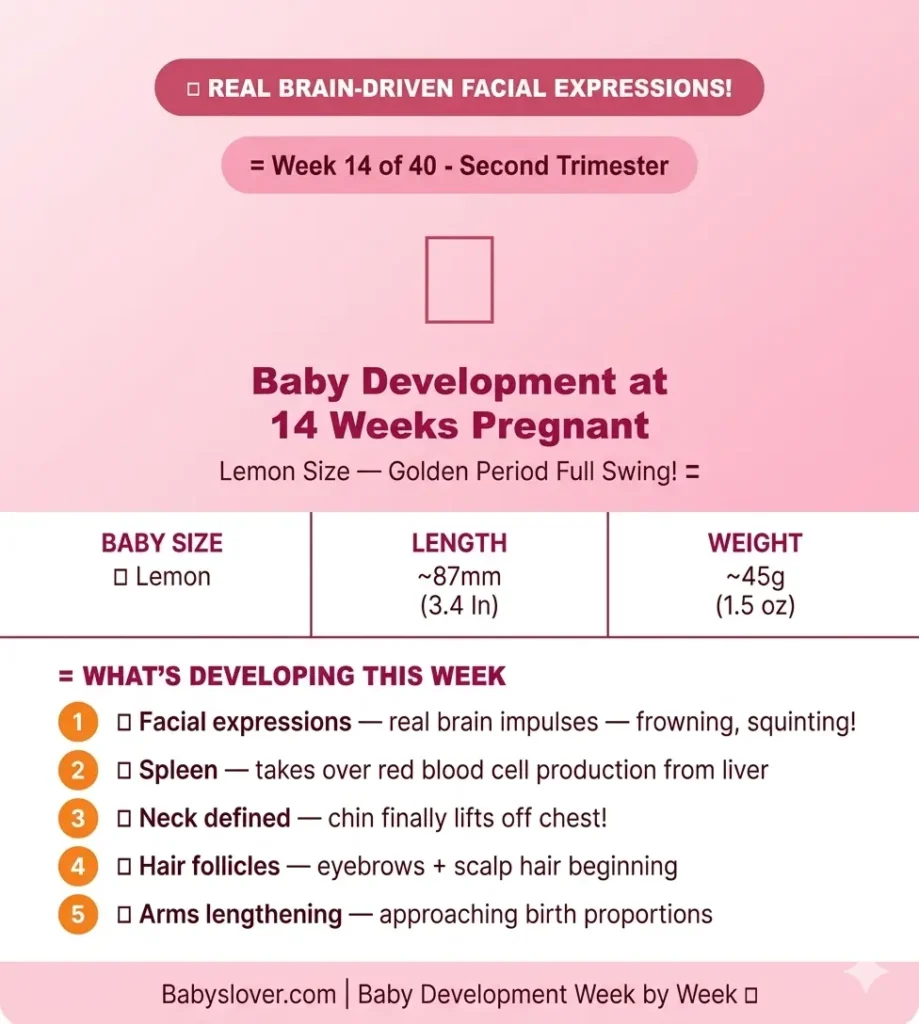
At 14 weeks pregnant, your baby measures approximately 87mm — the size of a lemon — and weighs about 45 grams. That weight has nearly doubled from Week 13’s 23 grams — the second trimester growth rate is extraordinary. The head-to-body proportion continues improving, with the body now clearly longer than the head. And the face — already fully formed — is doing something this week that no face has ever done quite so early in its life.

| 🌱 Baby Development at 14 Weeks Pregnant | |
| Baby Size | 🍋 Lemon — ~87mm (3.4 inches) |
| Weight | ~45 grams (1.5 oz) — nearly doubled from Week 13! |
| Head Proportion | Continuing to decrease — body growing faster than head |
| Heart Rate | ~145-170 bpm — consistent, strong |
| KEY MILESTONE | 😮 REAL brain-driven FACIAL EXPRESSIONS — frowning, squinting, grimacing via nerve impulses! |
What Is Developing at Week 14
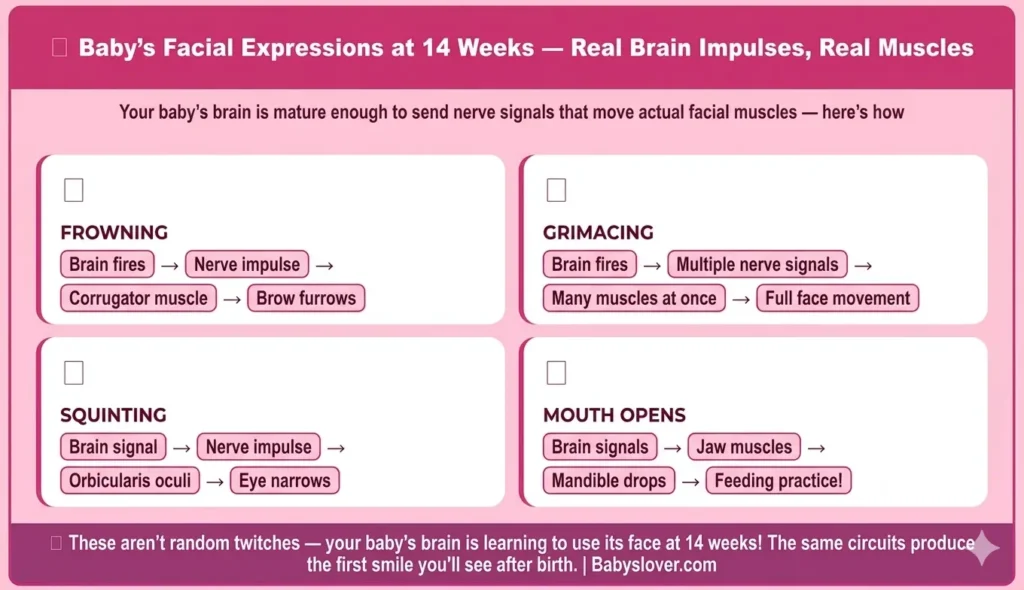
- 😮 Facial expressions — real brain impulses, real facial muscles: This is the headline development of Week 14. Your baby’s brain has grown sophisticated enough to begin sending regular nerve impulses to the facial muscles — and those muscles are responding. The result: your baby is frowning, squinting, and grimacing inside the amniotic sac right now. This is not emotional expression — your baby has no emotional framework yet. But the neurological circuit being established is exactly the same one that will produce your baby’s very first smile, first look of recognition, and first expression of distress. The hardware for human facial communication is being wired this week.
- 🩸 Spleen takes over red blood cell production from liver: From Week 11 through Week 13, your baby’s liver was the primary factory for red blood cells — a process called hepatic erythropoiesis. This week, the spleen steps in and takes over that role. The spleen will remain the primary red blood cell producer until the bone marrow fully assumes the job around Week 28-32. This handover marks a maturation of the baby’s hematopoietic system — each organ taking on its permanent adult function in sequence. The liver, relieved of blood cell production, now focuses entirely on its permanent job: producing bile for fat digestion.
- 👶 Neck defined — chin finally lifts from chest: In the earliest weeks of fetal development, the baby’s head sat directly on the torso with almost no discernible neck. By Week 14, the neck has lengthened enough that the chin lifts away from the chest for the first time — giving the baby’s profile a distinctly more human appearance on ultrasound. The neck muscles are strengthening and the cervical spine is increasingly defined. This is the anatomical foundation for the head control your baby will work toward in the first weeks of life after birth.
- 💇 Hair follicles forming — eyebrows and scalp hair beginning: Hair follicles are opening this week across the scalp and above the eyes, and the first fine hairs are beginning to emerge. Your baby’s eyebrows are starting to form — currently just the finest wisps, but laying the structure for one of the most expressive features of the human face. Scalp hair is also beginning, though its color and texture will likely change completely after birth as the postnatal hair grows in. Whether your baby is born bald or with a full head of hair is largely genetic — and will be settled in the next few months.
- 💪 Arms lengthening — approaching birth proportions: Your baby’s arms have been growing steadily since the limb buds first appeared at Week 5, but this week they lengthen noticeably relative to body size — moving toward the proportions they’ll hold at birth. The hands are fully formed with distinct fingers, developing fingernails, and the functional grip reflex. The arms are capable of a wide range of movement — reaching, bending at the elbow, bringing hands to face — and your baby is using all of these movements actively in the amniotic fluid.
- 🧪 Sex organs developing — becoming clearer: For baby girls, the ovaries are beginning to migrate into their final position in the pelvis this week. For baby boys, the prostate gland is continuing to develop. External genitalia are becoming more differentiated and visible on ultrasound, though a definitive sex determination from ultrasound is still easier and more accurate at the 20-week anatomy scan. If you had NIPT blood testing at Week 10-12, you already have a highly accurate sex result. If not, the anatomy scan at Week 20 is the most reliable ultrasound method.
- 🫁 Liver producing bile — digestive system advancing: Your baby’s liver has handed off red blood cell production to the spleen and is now focused entirely on its permanent function: producing bile. Bile is the digestive fluid that will be essential for breaking down fats in your baby’s intestines once feeding begins after birth. The bile ducts, gallbladder, and the connection to the intestinal tract are all functional. The digestive system — from swallowing amniotic fluid through the intestinal processing cycle — is actively practicing at 14 weeks.
- 🧴 Skin beginning to thicken: The translucent, see-through quality of Week 11’s skin is gradually changing. By Week 14, the skin is beginning to thicken with additional cell layers, and subcutaneous fat deposits — which will eventually give your baby its characteristic newborn plumpness — are beginning their very early development. The lanugo covering the body continues to serve as an anchor for the vernix caseosa that will develop over the coming weeks. The combination of lanugo, vernix, and thickening skin forms the baby’s complete dermal protection system for the remainder of pregnancy.
💡 Fun fact: Your baby is making facial expressions that no one can see yet — but they’re real, they’re neurologically driven, and they’re practicing the very circuits that will produce the first smile you see after birth. Every frown at 14 weeks is the brain learning to use the face it built. 😊
14 Weeks Pregnant Symptoms — What’s Normal Now
Week 14 sits in the sweet spot of the second trimester — most first-trimester symptoms have meaningfully improved, while the more challenging third-trimester symptoms are still many weeks away. Here’s what’s normal at 14 weeks pregnant:
🤢 Morning Sickness — Fading for Most
The majority of women experience meaningful relief from nausea by Week 14. If you’re still feeling sick at 14 weeks, you are not behind schedule — some women experience nausea through Weeks 16-20, and a smaller number throughout the entire pregnancy. If nausea is severe and persistent past Week 14 (vomiting multiple times daily, inability to keep fluids down), discuss this with your OB — hyperemesis gravidarum at this stage benefits from medical treatment.
⚡ Energy — Meaningfully Improved
Most women are feeling noticeably more energetic by Week 14 — the placenta is running the pregnancy efficiently, hCG is declining, and the bone-deep first-trimester fatigue is lifting. If you’re not feeling better yet, give it a few more weeks. The shift is real for almost everyone by Weeks 14-16.
✨ Pregnancy Glow — The Estrogen Effect
The famous ‘pregnancy glow’ — a luminous, flushed, clear complexion — is real and peaks in the second trimester. It’s caused by increased blood volume and rising estrogen, which together bring more blood to the skin’s surface and accelerate skin cell turnover. Some women experience the opposite — pregnancy acne — as sebaceous glands become more active. Both are hormonal and both are normal.
😟 Chloasma — Melasma / Mask of Pregnancy
Dark, brownish patches on the forehead, upper lip, and cheeks — called chloasma or melasma — may appear or intensify around Week 14. This is the most common pigmentation change of the second trimester and affects up to 70% of pregnant women. Daily SPF 30+ on the face is the most effective prevention. Avoid harsh brightening treatments during pregnancy — retinoids, hydroquinone, and chemical peels are generally not recommended.
🦟 Varicose Veins — Now Possible
Progesterone softening of vein walls + increased blood volume + uterine pressure on pelvic veins = varicose veins beginning in the second trimester. Most common on the backs of calves and thighs. Compression socks (15-20 mmHg), regular walking, leg elevation when resting, and avoiding standing for long periods all help. Vulvar varicosities — swollen veins on the vulva — are also common in pregnancy and uncomfortable but harmless.
🤧 Pregnancy Rhinitis — Still Here
Hormonal nasal congestion that started or worsened in the second trimester continues. Safe options: saline rinse or spray, bedroom humidifier, slightly elevated sleeping position. Avoid decongestant sprays unless your OB specifically approves them. Most cases resolve within 2 weeks of delivery.
💭 14 Weeks Pregnant With No Symptoms
No symptoms at 14 weeks is completely normal. By this point in the second trimester, many women feel quite well — good energy, manageable appetite, minimal discomfort. Feeling good is not a warning sign. Your prenatal appointments, fundal height measurements, and ultrasound scans are the appropriate monitors of your pregnancy’s health.
What to Eat at 14 Weeks Pregnant
| Nutrient | Why Critical at Week 14 | Best Sources |
| Iron | Spleen now making red blood cells — needs iron for hemoglobin. Blood volume still rising | Lean meat, spinach, lentils, fortified cereals + vitamin C for absorption |
| Calcium | Ossification advancing throughout skeleton — calcium demand is increasing with baby’s size | Dairy, fortified plant milk, kale, sardines, almonds |
| Fiber | Constipation worsening in Q2 — fiber is the safest, most effective intervention | Whole grains, fruits, vegetables, legumes — plus 8-10 glasses water |
| DHA Omega-3 | Brain neural connections forming at speed — DHA is the primary structural fat for brain tissue | Cooked salmon, sardines, walnuts, DHA supplement in prenatal vitamin |
| Vitamin C | Supports iron absorption + immune function + collagen for skin (helps with stretch marks!) | Oranges, bell peppers, strawberries, kiwi, tomatoes, broccoli |
| Vitamin D | Calcium absorption + bone development. Most pregnant women are deficient without supplementation | Fortified dairy/plant milk, egg yolks, cooked salmon, supplement |
With appetite fully restored by Week 14, this is the week to establish the second-trimester eating pattern that will serve you through Week 26. Per the CDC, the second trimester requires approximately 340 extra calories per day above pre-pregnancy maintenance — enough to meaningfully increase nutritional density, not enough to ‘eat for two’ in the way the old guidance suggested. Our best prenatal vitamins guide covers the most complete formulas for the second trimester, including those with the most bioavailable iron and DHA forms.
📅 The 20-Week Anatomy Scan — Book It NOW at Week 14
Here’s something most first-time parents don’t realize at Week 14: the 20-week anatomy scan — the most comprehensive look at your baby’s anatomy and the appointment where most parents learn the sex — is one of the most in-demand prenatal appointments at major medical centers. Popular times fill up weeks in advance.
At Week 14, you are approximately 6 weeks away from your anatomy scan window (Weeks 18-22). Booking now gives you the best choice of appointment times, sonographers, and days of the week. Waiting until Week 18 or later can mean you’re scrambling for slots during a window that passes quickly.
- Call your OB’s office or the imaging center this week to schedule your anatomy scan
- Aim for Weeks 19-20 for the clearest, most complete anatomical views
- The anatomy scan is typically 45-60 minutes long — longer than any previous scan
- Ask whether 3D/4D images are offered — many parents want these as keepsakes
- Decide now whether you want to know the sex — so you’re not making that decision in the waiting room
💡 Book the 20-week anatomy scan this week. It is the most important prenatal appointment between your first-trimester scan and your birth. Don’t leave it until Week 18 — the best slots are gone by then at most busy centers.
Quad Screen — Optional Screening Available From Week 15
From Week 15 onward (and typically offered through Week 22), you may be offered a quad screen — a blood test that measures four substances in your blood to assess statistical risk for Down syndrome, trisomy 18, neural tube defects, and abdominal wall defects.
The quad screen is optional, not diagnostic — it provides statistical risk information, not a diagnosis. Its accuracy is approximately 80% for Down syndrome detection. If you had NIPT blood testing earlier in your pregnancy, the quad screen provides overlapping (though different) information — ask your OB whether it adds meaningful value for your specific situation. Discuss the quad screen decision with your OB at your next appointment if you haven’t already.
For Your Partner — Week 14 Practicalities
Week 14 is a good week for partners to take on some concrete practical tasks that benefit the whole pregnancy. Here’s what’s meaningful this week:
- Book the 20-week anatomy scan together: This is typically a shared appointment — most parents want their partner present for the anatomy scan. Book it this week and put it in both calendars. It’s the appointment where you’ll likely learn the sex, see the most detailed baby images yet, and hear the comprehensive report on your baby’s anatomy. Clear your calendar for this one.
- Dental visit nudge: Pregnancy gingivitis — bleeding, swollen, tender gums — is common and can worsen throughout the second trimester. Untreated gum disease has been associated with preterm labor risk. A dental cleaning during pregnancy is safe and recommended. If your partner hasn’t been since before the pregnancy, this week is a good time for a gentle reminder — and offering to book the appointment makes it easy.
- Sunscreen for the chloasma: If your partner’s chloasma is appearing or darkening, having daily SPF 30+ moisturizer available is genuinely practical support. Many pregnant women find applying face sunscreen daily is a habit they haven’t had before — having a good product ready (and remembering to mention it as important) makes a difference to how severe the pigmentation becomes.
- Compression socks for varicose veins: If leg heaviness, visible veins, or discomfort is starting, a good pair of graduated compression socks (15-20 mmHg) is one of the most practically helpful gifts of the second trimester. Order them this week so they’re ready.
- Have the birth plan conversation — when and where: You now have approximately 26 weeks before the due date. Hospital? Birth center? Midwife-led? The conversations are far more relaxed at Week 14 than they will be at Week 34. Start with basics: what does your partner’s ideal birth environment look like? What matters most? Begin from curiosity, not logistics, and the logistics will follow naturally. Our hospital bag checklist for mom gives you both a practical preview of what you’re preparing for.
When to Call Your Doctor at 14 Weeks Pregnant
- Heavy vaginal bleeding — soaking a pad or passing clots: Light pink spotting after sex or physical activity can be normal. Heavy red bleeding requires same-day OB contact.
- Severe or persistent abdominal pain — beyond brief round ligament twinges: Round ligament pain is sharp and brief. Persistent, severe, or one-sided abdominal pain should be evaluated.
- Fever above 100.4°F / 38°C: Infections in pregnancy need prompt evaluation and treatment.
- Painful urination, urgency, or blood in urine: UTIs are common in pregnancy and must be treated with antibiotics — don’t wait.
- One-sided calf pain, swelling, redness or warmth: Deep vein thrombosis risk is elevated in pregnancy. These symptoms require same-day evaluation.
- Severe headache with visual changes: Seek prompt evaluation — though preeclampsia is rare at 14 weeks, severe headache with visual symptoms should not be managed at home.
Your Week 14 Pregnancy Checklist
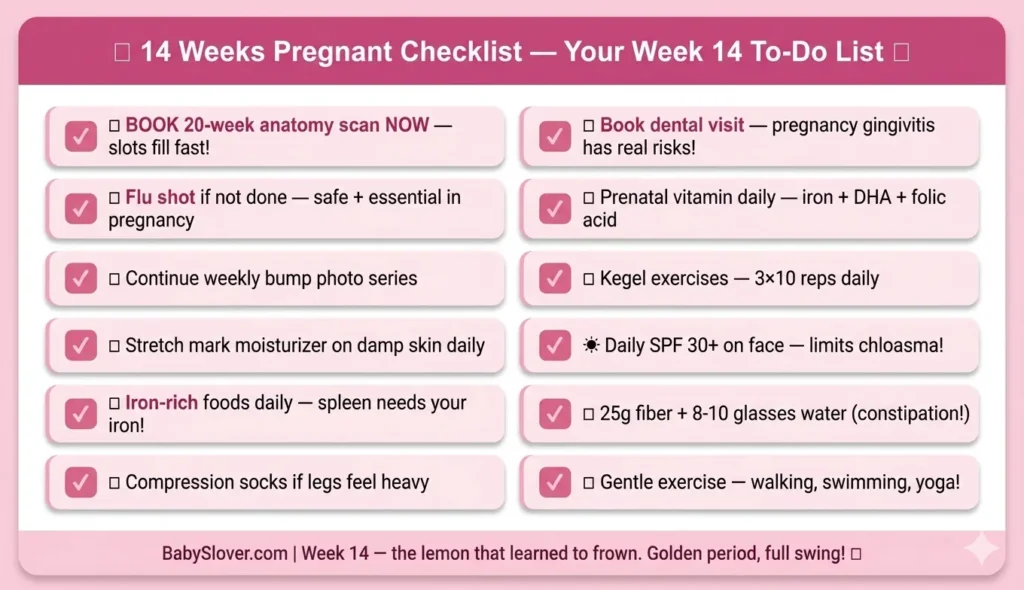
- ☑ 📅 BOOK your 20-week anatomy scan NOW — best slots fill fast!
- ☑ 🦷 Book dental visit — pregnancy gingivitis, untreated, has real risks
- ☑ 💉 Flu shot if not done — safe and recommended throughout pregnancy per CDC
- ☑ 💊 Prenatal vitamin daily — iron, DHA, folic acid, calcium, vitamin D
- ☑ 📸 Continue weekly bump photo series — same outfit, same wall
- ☑ 🏋️ Kegel exercises — 3 sets of 10 per day, every day
- ☑ 🧴 Stretch mark moisturizer daily on damp skin — start the habit now
- ☑ ☀️ Daily SPF 30+ on face — limits chloasma significantly
- ☑ 🥗 Iron-rich foods daily — spleen is making blood and it needs YOUR iron
- ☑ 💧 Fiber + hydration daily — 25g fiber + 8-10 glasses water for constipation
- ☑ 🧦 Compression socks if legs are heavy or varicose veins appearing
- ☑ 🏃 Continue exercise — gentle walking, swimming, prenatal yoga all safe
Frequently Asked Questions — 14 Weeks Pregnant
What does 14 weeks pregnant feel like?
Most women describe 14 weeks pregnant as one of the better weeks of pregnancy. Nausea has typically faded or become much more manageable, energy is returning, the bump is starting to feel real, and the severe anxiety of the first trimester has eased. Some women experience the ‘pregnancy glow’ peak this week. New symptoms like round ligament pain, chloasma, and varicose veins may be appearing — but they’re manageable compared to the first trimester.
How big is my baby at 14 weeks pregnant?
At 14 weeks pregnant, your baby is approximately 87mm long — the size of a lemon — and weighs about 45 grams. The weight has nearly doubled from Week 13, reflecting the rapid growth acceleration of the second trimester. The body is growing faster than the head, and the proportions are becoming increasingly balanced.
Can you feel baby move at 14 weeks pregnant?
Your baby is very active at 14 weeks — stretching, turning, kicking, making facial expressions. However, you almost certainly cannot feel it yet at 14 weeks. First-time moms typically feel fetal movement — called quickening — between Weeks 18-22. Women who have been pregnant before may feel it somewhat earlier, around Weeks 14-16. The movements are happening — they’re just too small and the amniotic cushion too thick to register through the abdominal wall yet.
Can you find out the sex at 14 weeks?
Possibly, but not reliably from ultrasound. At 14 weeks, external genitalia are differentiating but are not yet definitively distinguishable on ultrasound for most sonographers. NIPT blood testing (available from Week 10) provides approximately 99% accurate sex determination from a blood test. The 20-week anatomy scan provides the most reliable ultrasound sex confirmation. If you’re curious about sex before the anatomy scan and haven’t done NIPT, ask your OB about the quad screen (available from Week 15) — though sex determination is not its primary purpose.
Is chloasma normal at 14 weeks pregnant?
Yes — chloasma (also called melasma or the ‘mask of pregnancy’) affects up to 70% of pregnant women and typically appears or worsens in the second trimester due to melanin-stimulating hormones. It is entirely harmless and typically fades significantly after delivery. Daily SPF 30+ on the face limits its development. Avoid retinoids and hydroquinone during pregnancy.
Why does my baby make facial expressions at 14 weeks?
Your baby’s brain has matured to the point where it is sending regular nerve impulses to the facial muscles — and those muscles are responding. The squinting, frowning, and grimacing at 14 weeks are not emotional expressions but neurological exercises: the brain is learning to communicate with the face. These same neurological circuits will produce your baby’s first smile, first cry, and first look of recognition after birth. The wiring is being laid now, at lemon size, in complete darkness.
What screening tests are available at 14 weeks pregnant?
If you haven’t already had NIPT (available from Week 10) or an NT scan with first-trimester blood test (available Weeks 10-14), those windows are now closing or closed. From Week 15, the quad screen becomes available — a blood test screening for Down syndrome, trisomy 18, neural tube defects, and abdominal wall defects. The quad screen is optional and provides statistical risk information rather than a diagnosis. Discuss your specific screening decisions with your OB.
When should I book my 20-week anatomy scan?
Book it this week — at Week 14. The anatomy scan is performed between Weeks 18-22, with Weeks 19-20 being optimal for anatomical visualization. Popular slots at busy imaging centers fill up weeks in advance. Booking 5-6 weeks ahead (i.e., at Week 14) gives you the best choice of appointment times and the clearest scan window.
The Emotional Reality of Week 14 — Settling Into the Pregnancy
There’s a specific kind of settling that happens around Week 14.
The acute anxiety of the first trimester — ‘is everything okay, is it still there, will this week be different’ — begins to quiet down. The pregnancy has reached a statistical safety that is meaningfully different from Week 5 or Week 8. Your body feels recognizably like a pregnant body now. The secret is out. The bump is coming. And somewhere inside, a lemon-sized person is frowning and squinting and practicing faces it doesn’t even know it’s making yet.
Week 14 often feels like the first week you can begin to actually plan. Not just survive — plan. The nursery research. The name conversations. The imaging appointment that’s now booked in the calendar.
The first trimester asked you to hold on. The second trimester is asking you to settle in. You have 26 more weeks — and most of what’s coming is better than what came before.
At Babyslover, we’re glad you’re here.
👶 What Happens Next — 15 Weeks Pregnant Preview
The second trimester continues — here’s what’s coming with 15 weeks pregnant:
- Baby grows to apple/naval orange size — ~100mm, about 70 grams
- Bones forming faster — skeleton visible on X-ray now!
- Baby may sense light through closed eyelids — first light sensitivity
- Toenails beginning to develop — fingers have them, now toes too
- Taste buds fully functional — baby tasting everything you eat!
- Amniotic fluid temperature controlled — baby’s environment fully regulated
- Quad screen window opens — optional chromosomal screening blood test
Keep following our complete pregnancy week by week guide for every milestone from first trimester through birth. The best weeks of pregnancy are unfolding now!
Week 14: The Lemon That Learned to Frown
Being 14 weeks pregnant means carrying a lemon-sized human whose brain is now firing nerve impulses to facial muscles — producing the first real, neurologically-driven expressions of a face that has never had a thought, never felt a feeling, but is already learning the mechanics of communicating both. Whose spleen has taken over the blood cell factory. Whose neck finally holds the head up. Whose arms are growing toward the proportions they’ll hold when you first place them over your shoulder.
The second trimester is here. The symptoms are fading. The baby is real — lemon-sized, frowning, practicing for a life full of faces it has yet to make.
Book that anatomy scan. Put on the SPF. Take the weekly photo. And keep reading our pregnancy tips for first time moms — written for exactly where you are right now. 💗
1 thought on “14 Weeks Pregnant: Baby Size, Symptoms & Development”