

Your baby is wearing its first coat. Not metaphorically. At 17 weeks pregnant, a white, waxy, cheese-like substance called vernix caseosa is beginning to form over your baby’s delicate skin — a coating produced by shed skin cells and sebum that will protect the baby’s surface from the effects of prolonged immersion in amniotic fluid. Without it, 23 more weeks of submersion in fluid would cause the skin to chap, crack, and deteriorate. The vernix is the solution, and it starts this week.
Week 17 is also when the skeleton makes its most significant structural shift — from the flexible cartilage that allowed the fetus to form and fold in its earliest weeks, to hardened bone that will carry the weight of a person for the rest of their life. The first fat deposits are forming under the skin — tiny stores of adipose tissue with not one but three essential biological jobs. And your baby now has fingerprints — not just on the fingers, but on the toes as well.
At Babyslover, here is everything about 17 weeks pregnant: your baby’s remarkable new layers inside and out, the new symptoms arriving this week, and what to focus on right now.
Just read about last week? Our 16 weeks pregnant guide covered quickening, your baby’s hearing, and the babymoon window.

| 📋 Quick Summary — Week 17 of Pregnancy | |
| Week | Week 17 of 40 — Second Trimester, Week 5 🌟 |
| Trimester | Second Trimester — golden period continuing |
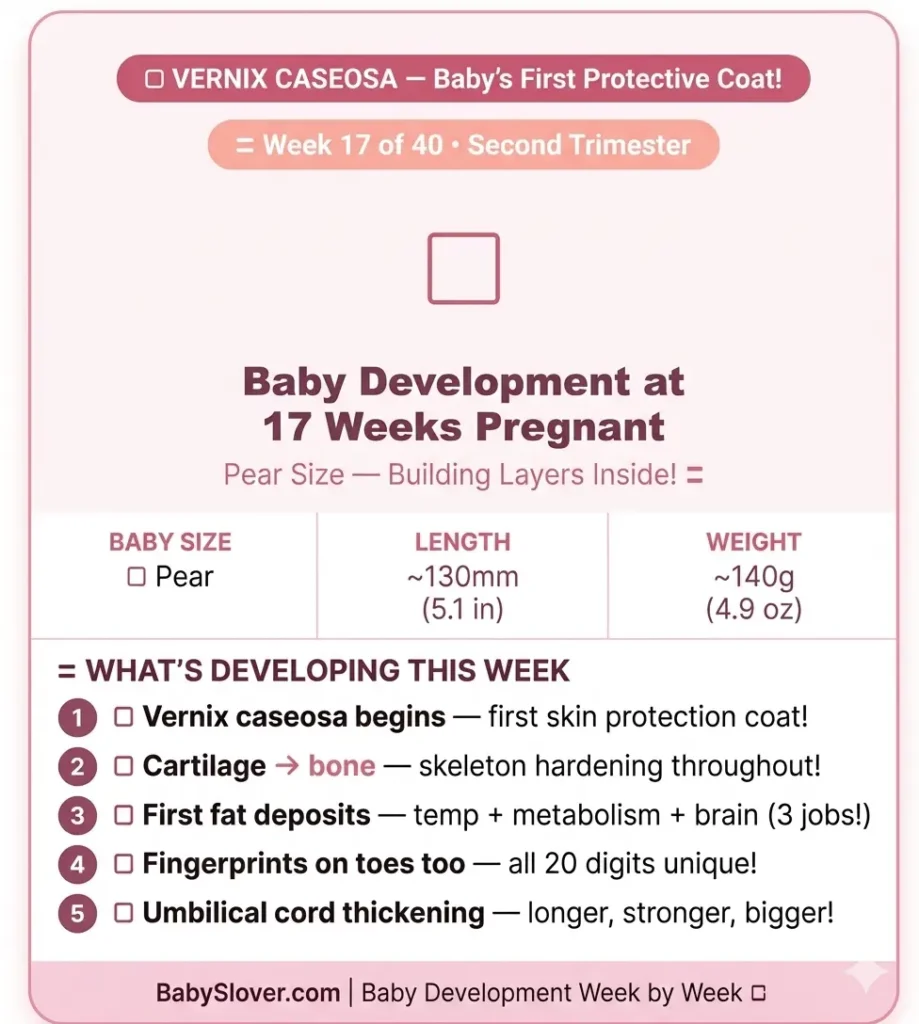
| Baby Size | 🍐 Pear — ~130mm (5.1 inches) |
| Baby Weight | ~140 grams (4.9 oz) — growing fast! |
| KEY MILESTONES | 🧥 VERNIX CASEOSA begins — baby’s first skin protection! • 🦴 Skeleton cartilage → hardened bone • 🧈 First fat deposits (temp + metabolism + BRAIN) • 💦 Sweat glands forming • 👣 Fingerprints on fingers AND toes • 🪢 Umbilical cord thickening and strengthening |
| Symptoms | Ravenous appetite surge, vivid pregnancy dreams, snoring begins, stretch marks may appear, balance challenges, groin/round ligament pain, feeling warmer than usual, heartburn ongoing |
| Heart Rate | ~140-160 bpm |
| This Week | 🦴 Double down on calcium + vitamin D — baby’s skeleton is hardening bone this week and needs the raw material! |
Contents
- 1 Baby Development at 17 Weeks Pregnant
- 2 What’s Happening in Your Body at 17 Weeks Pregnant
- 3 What to Eat at 17 Weeks Pregnant — Building Bones and Baby Fat
- 4 For Your Partner — Week 17 Practical Actions
- 5 When to Call Your Doctor at 17 Weeks Pregnant
- 6 Your Week 17 Pregnancy Checklist
- 7 Frequently Asked Questions — 17 Weeks Pregnant
- 8 💗 The Emotional Reality of Week 17 — Building Layers
- 9 👶 What Happens Next — 18 Weeks Pregnant Preview
- 10 Week 17: The Pear That Is Putting On Its First Coat
Baby Development at 17 Weeks Pregnant
At 17 weeks pregnant, your baby measures approximately 130mm — the size of a pear — and weighs around 140 grams. The growth rate continues at remarkable pace — nearly 10 grams added every day during this window. The baby’s body is becoming more proportional, more defined, and more layered — both literally, with new skin coatings and fat stores, and structurally, as soft cartilage becomes hard bone. This week, several of the most significant developmental shifts of the second trimester happen simultaneously.

| 🌱 Baby Development at 17 Weeks Pregnant | |
| Baby Size | 🍐 Pear — ~130mm (5.1 inches) |
| Weight | ~140 grams (4.9 oz) |
| Skin | Thin and translucent — veins still visible through skin |
| Movement | Rolling, somersaulting, bending knees/elbows/knuckles |
| KEY MILESTONE | 🧥 VERNIX CASEOSA begins forming — baby’s first protective coating against amniotic fluid damage! |
What Is Developing at Week 17
- 🧥 Vernix caseosa — baby’s first coat begins: Vernix caseosa is one of the most fascinating and practical developments of the second trimester. This white, waxy, cheese-like substance — made from shed skin cells (desquamated epithelial cells), lanugo hair, and sebum secreted by the sebaceous glands — begins forming over the baby’s skin this week. Its purpose is purely protective: the baby will spend approximately 23 more weeks submerged in amniotic fluid, and prolonged exposure to that fluid without protection would cause the delicate skin to macerate, chap, and crack. The vernix is the waterproof barrier that prevents this. It is anchored to the skin by the fine lanugo hair covering the body, and it thickens significantly from now through Week 28 before gradually thinning as the pregnancy approaches term. Babies born prematurely may still be heavily coated in vernix; full-term babies typically have most of it absorbed or shed, though many are born with patches remaining — particularly in skin folds.
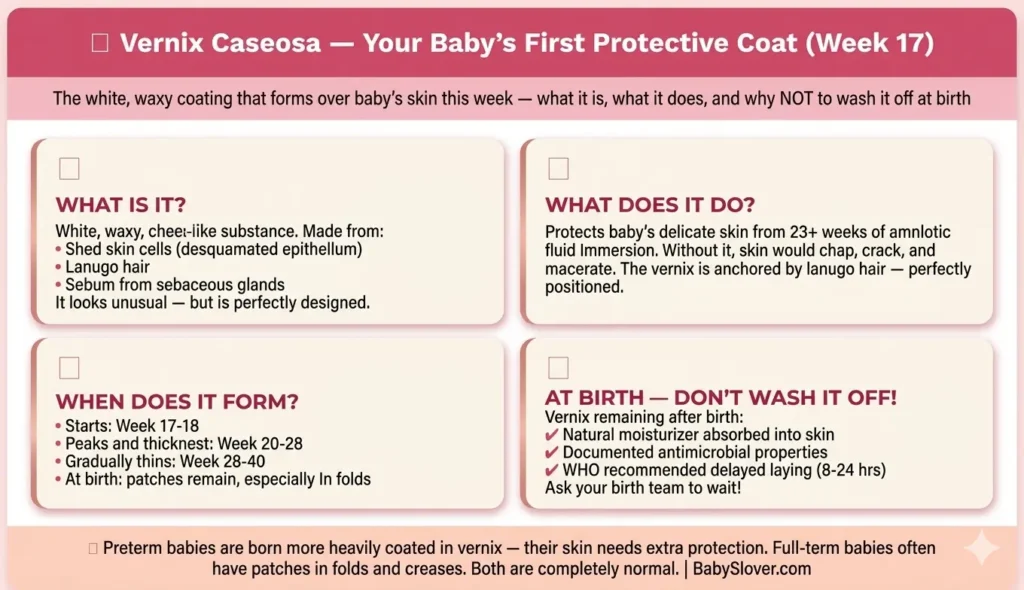
💡 Birth team tip: When your baby is born, ask the midwife or OB to delay the first bath for at least 8-24 hours. Vernix remaining on the skin after birth acts as a natural moisturizer and has documented antimicrobial properties — it continues protecting the skin as it transitions from amniotic fluid to air. The World Health Organization recommends delayed bathing for this reason.
- 🦴 Skeleton hardening — cartilage converting to bone: From the earliest weeks of development, your baby’s skeleton was built from flexible cartilage — a temporary scaffolding that allowed the body to form, curve, and develop in the tight space of the uterus. From Week 17, the process of converting that cartilage to hardened bone accelerates across the entire skeleton simultaneously. Ossification centers — points in each bone where mineralization begins and spreads outward — are now active throughout the skull, vertebrae, ribs, and all four limbs. The mineral deposited in each bone is primarily calcium phosphate, which is why calcium and vitamin D intake in the second trimester has direct structural consequences: the material for every bone your baby will have for life is being laid down right now. Long bones calcify from the center outward, with cartilaginous growth plates remaining at the ends to allow continued lengthening — the same growth plates that eventually fuse in adolescence, signaling the end of height growth.
- 🧈 First fat deposits — three jobs, not one: Beginning at Week 17, small deposits of adipose tissue — body fat — are accumulating beneath the baby’s skin. This is the development that gives newborns their characteristic roundness and softness — without fat, the baby looks angular and skeletal, as very premature babies do. But baby fat is not merely cosmetic. It has three distinct biological functions:
- 🌡️ Temperature regulation: Newborns cannot shiver to generate heat the way adults can — they rely on metabolizing brown adipose tissue (a specialized fat) to produce warmth in the first days of life. The fat deposited from Week 17 onward is building this essential system.
- ⚡ Metabolic fuel: The fat stores accumulated in the womb provide the primary energy source during the transition period after birth — before breastfeeding or formula feeding is fully established, the baby is metabolizing fat reserves laid down in the last trimester.
- 🧠 Brain development: DHA and other essential fatty acids stored in adipose tissue are directly incorporated into neural tissue — the fat deposited now will literally become part of the brain’s structural composition. This is why DHA intake during the second and third trimesters has documented effects on neonatal brain development outcomes.
- 💦 Sweat glands forming: The skin’s thermoregulatory infrastructure is being built this week — sweat glands are beginning to develop throughout the body. In newborns, the sweat glands are immature and not fully functional for the first few weeks of life — which is part of why newborns struggle with temperature regulation and need to be kept warm. But the structural development of the glands begins at Week 17 as part of the skin’s comprehensive layering process.
- 👣 Fingerprints on fingers AND toes: By Week 17, the unique ridge patterns that form fingerprints are establishing themselves on both the fingers and the toes. These dermal ridges — formed by the interaction of genetic blueprint and the specific physical forces on each individual fingertip and toe during development — produce a pattern that is unique to your baby and permanent for life. Even identical twins, who share the same DNA, develop different fingerprint patterns because those patterns are shaped by physical conditions as much as genetics. The toeprints forming at 17 weeks are as unique as the fingerprints — and newborn footprints taken at the hospital are as individually identifying as any fingerprint.
- 🪢 Umbilical cord thickening and strengthening: As your baby grows and its nutritional and oxygen demands increase, the umbilical cord is growing longer, thicker, and stronger to meet those demands. By the end of pregnancy the cord will be approximately 50-60cm long. The cord carries two umbilical arteries (transporting deoxygenated blood and waste from baby to placenta) and one umbilical vein (carrying oxygenated, nutrient-rich blood from placenta to baby), all protected by a gelatinous substance called Wharton’s jelly. This week’s thickening reflects the dramatically increased blood flow volume being handled as the baby grows.
- 🤸 Rolling, flexing, somersaulting: Your baby is using its increasing muscular strength and the space of the amniotic sac to move with expanding freedom. Knees, elbows, and knuckles bend and flex with easy coordination. The baby can roll, somersault, bring hands to mouth, and grip the umbilical cord. These movements are constant — the baby is active for periods, then sleeps, following a sleep-wake cycle that may or may not align with yours. Loud sounds can startle the baby awake; your movements and position changes are felt. The movements you’ll eventually feel as definitive kicks are happening continuously — just at a size and with an amniotic cushion that makes them difficult to perceive yet.
💡 Fun fact: Your baby’s toeprints are as unique as their fingerprints — and both are forming this week. The ridge patterns on every finger and toe are determined by the interaction of DNA and the specific physical pressures on each digit during development. Even identical twins have different prints. Your baby’s identity, in the most literal physical sense, is being permanently established at pear size. 👣
What’s Happening in Your Body at 17 Weeks Pregnant
🍽️ Appetite Surge — Suddenly Ravenous
If you find yourself hungry more often, eating more than usual, and craving food between meals with a new intensity at Week 17 — this is biologically expected and perfectly normal. The first trimester often suppresses appetite through nausea; by Week 17, the appetite correction is in full swing. The baby’s growth is accelerating, the placenta’s demands on your body are increasing, and your metabolic rate has risen. The body responds with hunger signals. The second trimester requires approximately 340 extra calories per day above pre-pregnancy baseline — the equivalent of a glass of milk, a piece of fruit, and a handful of nuts. Not ‘eating for two’ in any meaningful sense, but a real and appropriate caloric increase that the appetite surge is correctly signaling.
😴 Vivid Dreams — The Second Trimester’s Sleep Theater
Pregnancy is associated with unusually vivid, emotionally intense, and often strange dreams — and Week 17 is typically in the peak window. The causes are multiple: hormonal changes affect REM sleep architecture, pregnancy-related anxiety and anticipation are active during sleep, more frequent waking to use the bathroom disrupts sleep cycles in ways that increase dream recall, and the emotional processing load of pregnancy is enormous. Many women report dreaming about the baby, the birth, motherhood, and relationships during this period. Disturbing dreams are common and don’t reflect unconscious fears about your fitness as a parent — they reflect a brain working hard to process an enormous life transition. A sleep journal, noting recurring themes, can actually be a useful processing tool during this period.
😤 Snoring — Now Possible
Snoring during pregnancy is common and typically begins or worsens in the second trimester. The cause is the same hormonal nasal congestion that causes pregnancy rhinitis: progesterone and estrogen expand blood vessels in the nasal mucosa, causing swelling that narrows the nasal airway and creates the vibration of snoring. Weight gain distributes around the throat and neck, further narrowing the airway during sleep. Management: side sleeping (particularly left side), a bedroom humidifier, and nasal dilator strips. If snoring is very loud, disruptive, or accompanied by pauses in breathing and gasping, mention it to your OB — pregnancy-related sleep apnea is real, under-diagnosed, and has associations with gestational hypertension and preeclampsia risk.
⚖️ Balance Challenges — Center of Gravity Shifting
As your uterus rises further into the abdomen and the bump becomes more prominent, your center of gravity is shifting forward — the body’s balance point is no longer where it was. This manifests as increased instability on uneven ground, stairs, or when moving quickly; a tendency to lean slightly backward to compensate; and an increased risk of trips and falls. Wearing supportive, flat footwear, moving deliberately when navigating stairs or uneven surfaces, holding handrails, and avoiding sudden directional changes all reduce fall risk. Falls are a concern in pregnancy because abdominal trauma can affect the placenta — if you fall and experience abdominal pain, cramping, or bleeding, contact your OB promptly.
🌡️ Running Warmer Than Usual
Feeling hotter than everyone else in the room? This is a classic second-trimester experience. Your metabolic rate is elevated, blood volume is approximately 40-50% higher than normal (more blood = more heat), and the body’s thermoregulatory response to all of this is to push more heat to the surface — which is why skin looks rosier and feels warmer during the second trimester. Dressing in breathable, natural fabrics, keeping well hydrated, and using a fan at night all help. Avoid hot tubs and saunas throughout pregnancy — core temperature elevation above 102°F / 39°C has been associated with neural tube defect risk (primarily in the first trimester, but the precaution extends through pregnancy).
📍 Stretch Marks — Now Appearing for Many
By Week 17, the bump’s growth rate is fast enough that stretch marks — called striae gravidarum — may be appearing on the abdomen, hips, thighs, and breasts. They appear first as red, pink, or purple lines (reflecting the stretched and slightly inflamed dermis underneath), then fade to silver-white after delivery. Genetics is the primary determinant of stretch mark severity — if your mother had extensive stretch marks, you’re more likely to as well. Moisturizing with oils or butter (coconut oil, shea butter, cocoa butter, vitamin E oil) on damp skin after showering may reduce itching and improve skin suppleness, though the evidence that it prevents stretch marks entirely is limited. Keeping well hydrated maintains skin elasticity from the inside. Stretch marks are extremely common — affecting up to 90% of pregnant women — and always fade significantly with time.
What to Eat at 17 Weeks Pregnant — Building Bones and Baby Fat
This week’s developments — skeleton hardening and fat deposits forming — put calcium, vitamin D, and healthy fats at the top of the nutritional priority list.
| Nutrient | Why Critical at Week 17 | Best Sources |
| Calcium | SKELETON HARDENING this week — every gram of bone mineral comes from your dietary calcium | Dairy, fortified plant milk, kale, broccoli, almonds, sardines, calcium supplement |
| Vitamin D | Calcium cannot be absorbed without vitamin D — bone building stalls without adequate D | Fortified milk, egg yolks, cooked salmon, 10-15 mins sunshine, vitamin D supplement |
| DHA Omega-3 | FAT DEPOSITS FORMING — DHA is incorporated directly into brain adipose tissue, with documented brain development effects | Cooked salmon, sardines, walnuts, chia seeds, DHA supplement in prenatal vitamin |
| Protein | Rapid growth continuing — every new cell in skeleton, fat tissue, and cord requires protein scaffolding | Lean meat, eggs, Greek yogurt, legumes, tofu, cottage cheese — 70-100g/day |
| Magnesium | Leg cramps worsening as uterus grows + bone mineralization requires magnesium alongside calcium | Almonds, pumpkin seeds, dark leafy greens, whole grains, dark chocolate (small amounts!) |
| Fiber + Water | Constipation and heartburn both ongoing — fiber and hydration are safest long-term approach | 25-30g fiber daily + 8-10 glasses water — whole grains, legumes, vegetables, fruits |
The appetite surge at Week 17 is a good sign — your body is correctly signaling its increased needs. The key is channeling that hunger into nutritionally dense choices rather than empty calories. Greek yogurt (protein + calcium + probiotics), whole eggs (protein + DHA + vitamin D), and cooked salmon (protein + DHA + vitamin D + calcium) are three of the highest-value foods for this specific week’s developmental priorities. Our best prenatal vitamins guide covers the most complete second-trimester formulas — the period when DHA and vitamin D-calcium combinations matter most.
For Your Partner — Week 17 Practical Actions
- The sleep environment: Snoring, vivid dreams, difficulty getting comfortable, frequent bathroom trips — your partner’s sleep quality is declining through no fault of her own. The most practical contributions: ensuring the room is cool, offering the pregnancy pillow without being asked, not commenting on snoring in a way that adds embarrassment, and understanding that her sleep interruptions may affect morning mood and energy. If you’re a light sleeper, a white noise machine is a worthwhile investment for both of you.
- The balance conversation: Falls in pregnancy are a real concern — as the center of gravity shifts forward, coordination and stability change. Practically: offer your arm on stairs and uneven surfaces, remove trip hazards from the home (rugs, cables, clutter at foot level), make sure bathroom floors are non-slip. This is not over-caution — abdominal trauma from falls can affect the placenta.
- Stretch mark support: Stretch marks are sensitive. The kindest approach: don’t comment on them unless she brings it up, and if she does, listen before you speak. Offering to apply moisturizer to her back (the spots she can’t easily reach herself) is one of the more genuinely helpful and affectionate practical contributions of the second trimester.
- The appetite: Her hunger at Week 17 is real and biologically appropriate. Having nutritious food readily available — fresh fruit, nuts, yogurt, cheese, eggs — supports both the appetite and the nutritional quality. Cooking protein and calcium-rich meals and having healthy snacks stocked means the surge in hunger gets channeled into the right places.
- Anatomy scan is close: The 20-week anatomy scan is approximately three weeks away for most women at Week 17. Confirm the date, clear your calendar, and have the gender-reveal conversation finalized before the appointment so the decision is made calmly rather than in the waiting room. Our hospital bag checklist for mom gives you both a picture of the full preparation arc you’re building toward.
When to Call Your Doctor at 17 Weeks Pregnant
- Heavy vaginal bleeding: Soaking a pad or passing clots — same-day OB contact.
- Severe abdominal pain: Persistent or severe pain — distinct from brief round ligament twinges or groin stretching — requires evaluation.
- Fever above 100.4°F / 38°C: Contact OB promptly — infection in pregnancy requires evaluation and treatment.
- Painful urination or UTI symptoms: UTIs must be treated with antibiotics in pregnancy — don’t wait for them to resolve.
- A fall with abdominal impact: If you fall and hit your abdomen, or experience any pain, cramping, or bleeding after a fall, contact your OB the same day — even if you feel fine. Placental abruption after trauma can present with delayed symptoms.
- Very loud snoring with breath pauses: Possible pregnancy sleep apnea — mention to your OB at your next appointment. If symptoms are severe, request earlier evaluation.
- Severe headache with visual changes: Seek prompt evaluation.
Your Week 17 Pregnancy Checklist
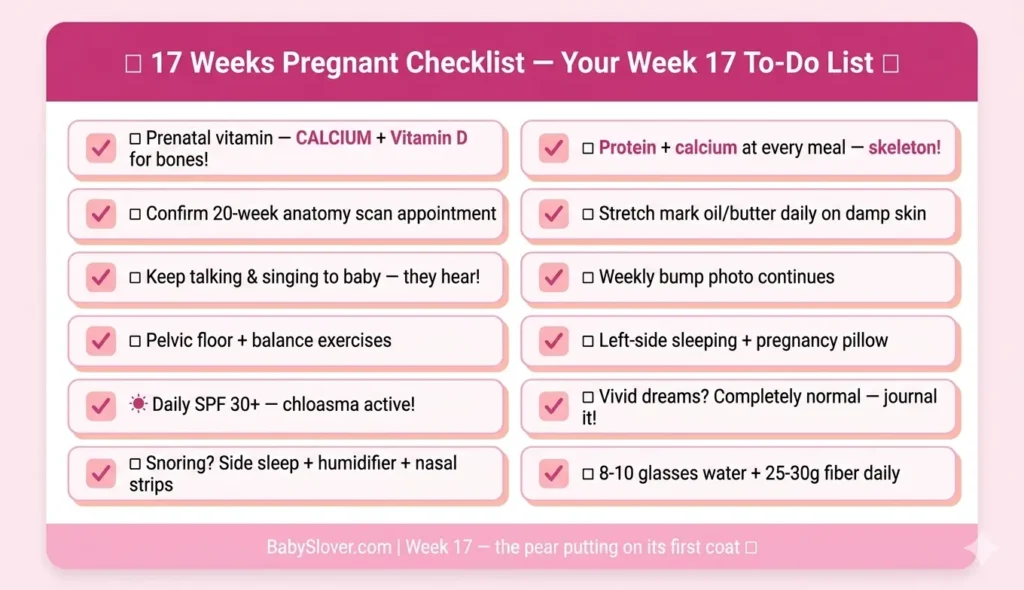
- ☑ 💊 Prenatal vitamin daily — CALCIUM + Vitamin D for hardening skeleton!
- ☑ 🥩 Protein + calcium at every meal — bones and fat deposits both need them
- ☑ 📅 Confirm 20-week anatomy scan appointment is on the calendar
- ☑ 🧴 Stretch mark oil or butter daily on damp skin — belly, hips, thighs, breasts
- ☑ 🗣️ Keep talking and singing to baby — hearing fully active!
- ☑ 📸 Weekly bump photo series — same outfit, same wall
- ☑ 🏋️ Pelvic floor + balance exercises — center of gravity is shifting
- ☑ 🌙 Left-side sleeping + pregnancy pillow
- ☑ ☀️ Daily SPF 30+ on face — chloasma is still active
- ☑ 😴 Vivid dreams? Normal — try a sleep journal for particularly memorable ones
- ☑ 😤 Snoring starting? Side sleeping + humidifier + nasal strips
- ☑ 💧 8-10 glasses water + 25-30g fiber daily
Frequently Asked Questions — 17 Weeks Pregnant
What does 17 weeks pregnant feel like?
Being 17 weeks pregnant typically feels like the best stretch of the entire pregnancy for many women. Energy is good, morning sickness is resolved, the bump is visible and real, and the third-trimester discomforts are still many weeks away. New arrivals this week — a ravenous appetite, vivid dreams, feeling warmer than usual, possible first stretch marks — are manageable and expected. Many women describe a particular sense of settledness and even excitement at Week 17.
What is vernix caseosa and when does it appear?
Vernix caseosa is the white, waxy, protective coating that begins forming on your baby’s skin at around Week 17-18. Made of shed skin cells, lanugo hair, and sebum, it protects delicate fetal skin from prolonged exposure to amniotic fluid. It thickens through the second trimester and gradually thins toward Week 40. Some babies are born with patches of vernix remaining — especially in skin folds — which is entirely normal. Delaying the first bath by 8-24 hours allows the remaining vernix to absorb into the skin, where it continues to provide moisturizing and antimicrobial benefit.
How big is my baby at 17 weeks pregnant?
At 17 weeks pregnant, your baby is approximately 130mm long (5.1 inches) — the size of a pear — and weighs about 140 grams (nearly 5 ounces). Growth continues at about 10 grams per day during this window. By the 20-week anatomy scan just three weeks away, the baby will be approximately 250-260mm — nearly double the current length.
Why are my dreams so vivid at 17 weeks pregnant?
Vivid, emotionally intense, sometimes disturbing pregnancy dreams peak in the second trimester and are completely normal. Causes include hormonal effects on REM sleep, frequent nighttime waking that increases dream recall, and the brain’s intensive processing of the emotional weight of pregnancy. Disturbing content in pregnancy dreams does not reflect your fitness as a parent — it reflects a brain working hard. A sleep journal can help process recurring themes. Most women find this aspect of pregnancy more interesting in retrospect than it feels in the moment.
Is snoring normal during pregnancy?
Yes — snoring is common in pregnancy, particularly from the second trimester onward. Hormonal nasal congestion narrows the airway; weight gain around the throat adds to it. Side sleeping, a humidifier, and nasal dilator strips all help. If snoring is very loud and accompanied by pauses in breathing and gasping (symptoms of sleep apnea), mention it to your OB — pregnancy sleep apnea is real and has associations with elevated blood pressure and preeclampsia risk.
When do stretch marks appear in pregnancy?
Stretch marks most commonly begin appearing in the second trimester — often between Weeks 13-20 as growth accelerates. They appear first as red, pink, or purple lines on the abdomen, hips, thighs, and breasts, then fade to silver-white over months after delivery. Genetics is the primary determinant of stretch mark severity. Moisturizing with oil or butter on damp skin reduces itching and may improve elasticity, though preventing them entirely is not reliably achievable. They are extremely common — affecting the majority of pregnant women.
What are the three jobs of baby fat?
The fat deposits beginning at Week 17 have three distinct biological functions that most competitors don’t explain: temperature regulation (newborns cannot shiver and rely on metabolizing brown fat for warmth), metabolic fuel (fat stores provide energy during the transition period after birth before feeding is established), and brain development (DHA and essential fatty acids stored in adipose tissue are directly incorporated into neural tissue — your baby’s brain is literally partly made of the healthy fats you eat now).
Is it normal to feel off-balance at 17 weeks pregnant?
Yes — balance changes are normal from the second trimester onward as the growing bump shifts the center of gravity forward. This makes uneven ground, stairs, and sudden movements harder to navigate safely. Flat, supportive footwear; holding handrails; moving deliberately; and removing home trip hazards (rugs, cables) all reduce fall risk. If you do fall with abdominal impact, contact your OB the same day even if you feel fine.
💗 The Emotional Reality of Week 17 — Building Layers
There’s something quietly profound about Week 17’s developments. The vernix. The bones. The fat. The fingerprints on the toes. All of it is invisible to you — happening inside, in the pear-sized darkness, without any sensation you can directly attribute to it.
But each of these invisible developments is your baby becoming more definitively itself. Not just growing bigger — growing more protected, more structured, more uniquely identified. The fingerprints forming this week are the ones that will appear on every surface your child ever touches, the ones that will never change, the ones that existed only in potential until this week.
Week 17 asks you to take that on faith — to trust that the invisible work is being done with the same care and precision as the milestones you can see and hear on an ultrasound screen. It is. The pear inside you is building layers, inside and out, that will last a lifetime.
At Babyslover, we think that’s worth sitting with — the quiet, invisible thoroughness of what’s happening right now. 💗
👶 What Happens Next — 18 Weeks Pregnant Preview
The anatomy scan is just around the corner — here’s what’s coming with 18 weeks pregnant:
- Baby grows to bell pepper / sweet potato size — ~142mm, ~190 grams
- LANUGO — fine downy hair now covering entire body to anchor the vernix
- Sleep-wake cycle now more defined — baby may be wakened by loud sounds!
- Fingerprints now completely formed and permanent on all digits
- Nervous system myelination begins — nerve signals traveling faster
- For girls: uterus and vaginal canal forming; for boys: testes beginning descent
- Quickening — first movements felt — most common week for first-time moms!
Keep following our complete pregnancy week by week guide — the anatomy scan is almost here.
Week 17: The Pear That Is Putting On Its First Coat
Being 17 weeks pregnant means carrying a pear-sized person who is wearing its first coat — a white, waxy, protective layer being built from its own shed skin cells. Whose bones are converting from flexible cartilage to mineral-dense hardened structure, laying down the skeleton that will stand for a lifetime. Whose first fat deposits are forming with three simultaneous jobs: to keep it warm, to fuel its first days, and to build its brain.
Whose fingerprints — on the fingers and on the toes — are being permanently set this week. So that every surface it ever touches will leave a mark that is entirely and exclusively its.
The anatomy scan is three weeks away. The kicks are coming. The layers are building. For everything ahead, our pregnancy tips for first time moms guide is with you every week.
1 thought on “17 Weeks Pregnant: Baby Size, Symptoms & Development”