

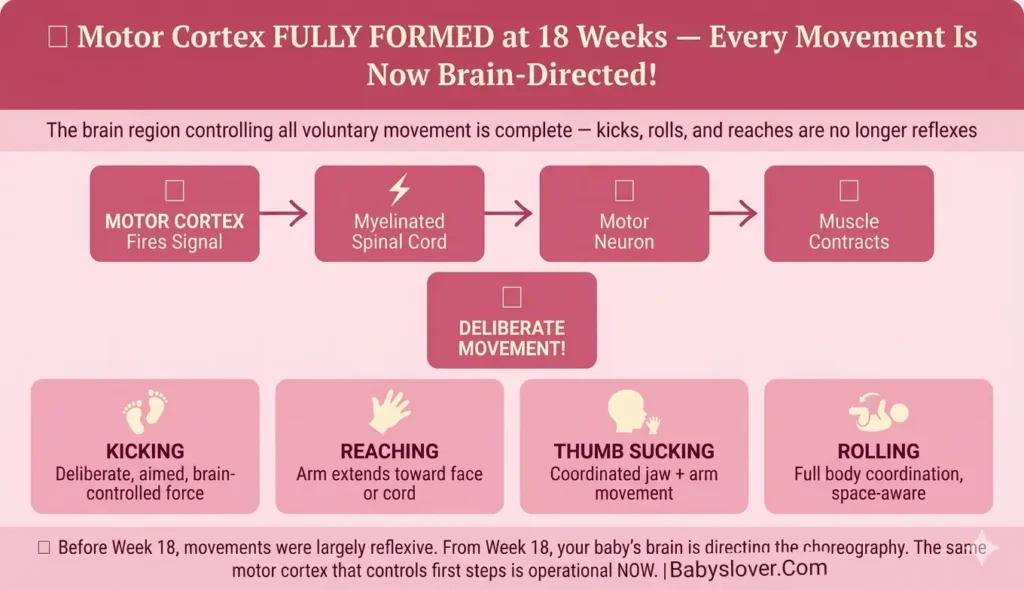
Every kick your baby makes from now is under brain command. At 18 weeks pregnant, the part of the brain that controls all voluntary movement — the motor cortex — is fully formed, according to the American College of Obstetricians and Gynecologists. The kicks, rolls, reaches, and somersaults happening inside you right now are no longer purely reflexive — they are increasingly directed by a completed motor brain region that is actively learning to coordinate a moving body.
When your baby kicks this week, the signal originates in the brain, travels through the spinal cord, reaches the muscle, and the leg extends. The same neural pathway that will control your baby’s first steps is operational at sweet-potato size.
Week 18 is also when lanugo — the fine, downy hair — now covers the entire body from head to toe (its primary job is to anchor the protective vernix caseosa), meconium is already forming in the intestinal tract, the sleep-wake cycle is established and responsive to outside sounds, and the anatomy scan is just two weeks away. At Babyslover, here is everything about 18 weeks pregnant: your baby’s fully formed motor brain, all the remarkable developments this week, how to prepare for the anatomy scan, and what to do right now.
Coming from last week? Our 17 weeks pregnant guide covered vernix caseosa beginning, the skeleton hardening from cartilage to bone, and the first fat deposits forming.

| 📋 Quick Summary — Week 18 of Pregnancy | |
| Week | Week 18 of 40 — Second Trimester, Week 6 🌟 |
| Trimester | Second Trimester — golden period |
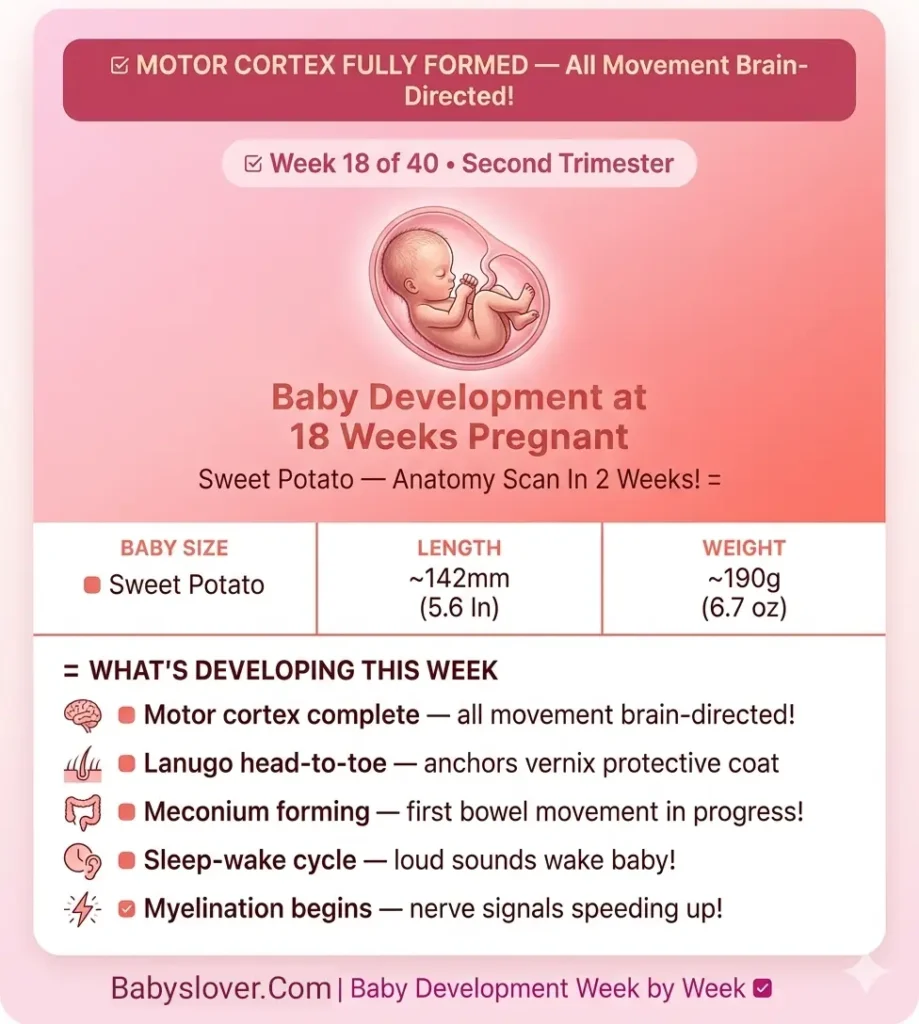
| Baby Size | 🍠 Sweet potato — ~142mm (5.6 inches) |
| Baby Weight | ~190 grams (6.7 oz) — nearly 4× Week 13! |
| KEY MILESTONES | 🧠 MOTOR CORTEX fully formed — all movement brain-directed! • 🐑 LANUGO covers entire body head-to-toe • 💩 MECONIUM forming in intestinal tract (first poop!) • 😴 Sleep-wake cycle defined — loud sounds wake baby! • ⚡ MYELINATION begins — nerve signals accelerating • 👁️ Eyebrows and lashes appearing |
| Symptoms | Back pain worsening, leg cramps arriving, stronger round ligament pain, heartburn ongoing, appetite surge, possible carpal tunnel, varicose veins, increased vaginal discharge |
| Heart Rate | ~120-160 bpm — audible with stethoscope from outside! |
| This Week | 📅 ANATOMY SCAN in 2 weeks — finalize gender reveal decision and write your scan questions NOW! |
Contents
- 1 🌱 Baby Development at 18 Weeks Pregnant
- 2 📅 Anatomy Scan Preparation — 2 Weeks Away
- 3 What’s Happening in Your Body at 18 Weeks Pregnant
- 4 What to Eat at 18 Weeks Pregnant — Fueling the Myelinating Nervous System
- 5 For Your Partner — Week 18 Meaningful Actions
- 6 When to Call Your Doctor at 18 Weeks Pregnant
- 7 Your Week 18 Pregnancy Checklist
- 8 Frequently Asked Questions — 18 Weeks Pregnant
- 9 💗 The Emotional Reality of Week 18 — Almost Halfway
- 10 👶 What Happens Next — 19 & 20 Weeks Pregnant Preview
- 11 Week 18: The Sweet Potato With a Fully Formed Motor Brain
🌱 Baby Development at 18 Weeks Pregnant
At 18 weeks pregnant, your baby measures approximately 142mm — the size of a sweet potato — and weighs about 190 grams. The growth rate remains extraordinary: from this week through the anatomy scan at Week 20, the baby adds approximately 50 grams every week. But this week’s story is less about size and more about brain architecture — specifically, the completion of the brain region that will control every deliberate physical movement your baby ever makes.

| 🌱 Baby Development at 18 Weeks Pregnant | |
| Baby Size | 🍠 Sweet potato — ~142mm (5.6 inches) |
| Weight | ~190 grams (6.7 oz) |
| Key Brain Milestone | Motor cortex FULLY FORMED — all voluntary movement now brain-directed (ACOG) |
| Skin Coverage | Lanugo fine hair now covers entire body head-to-toe |
| KEY MILESTONE | 🧠 MOTOR CORTEX COMPLETE — the brain region controlling ALL voluntary movement is fully formed this week! |
What Is Developing at Week 18
- 🧠 Motor cortex fully formed — brain now directs all movement: Per the American College of Obstetricians and Gynecologists, the part of the brain responsible for controlling motor movements is fully formed at Week 18. The motor cortex — a strip of neural tissue running across the top of the brain — is the command center for all voluntary physical movement. From Week 18 onward, your baby’s kicks, rolls, reaches, and stretches are increasingly directed by this completed brain region rather than being purely reflexive. The motor cortex sends signals down the spinal cord to peripheral motor neurons, which then trigger specific muscle groups. The system is not yet perfectly coordinated — that refinement takes years of practice after birth — but the hardware is complete. Every movement milestone your baby will hit in the first years of life — grasping, crawling, standing, walking — will run through this same motor cortex that finished forming this week.
- 🐑 Lanugo covers entire body head-to-toe — and its real job is anchoring vernix: By Week 18, the fine, downy lanugo hair that began forming at Week 14-15 now covers the baby’s entire body — face, arms, legs, torso, back. Most people know lanugo provides some warmth insulation, but its primary architectural function is actually to anchor the vernix caseosa to the skin. Without lanugo to grip it in place, the waxy vernix coating would simply float off into the amniotic fluid. The lanugo holds it against the skin like velcro, ensuring continuous waterproof protection throughout the remaining weeks of amniotic immersion. Both lanugo and vernix gradually shed and thin as the pregnancy approaches term — most full-term babies have lost the majority of both by Week 36-40.
- 💩 Meconium forming — baby’s first bowel movement is already in progress: Here is something most pregnancy guides don’t mention at Week 18: your baby’s first bowel movement — meconium — is already forming in the intestinal tract. Meconium is a thick, dark, tar-like substance composed of swallowed amniotic fluid components, shed intestinal cells, mucus, bile, and water that has accumulated in the digestive tract. It has been building since the digestive system became functional, and it continues accumulating through the entire remainder of pregnancy. It is not excreted before birth under normal circumstances — the anal sphincter remains closed. After birth, meconium is typically passed in the first 24-48 hours. The presence of meconium in the amniotic fluid before birth (called meconium aspiration) can occasionally occur and is a clinical sign your OB monitors for.
- 😴 Sleep-wake cycle defined and responsive: Your baby now has a regular and defined sleep-wake cycle — periods of activity alternating with periods of sleep. Crucially, the cycle is now responsive to the external environment: loud sounds can wake a sleeping baby, and your own movements — rolling over, standing up, walking briskly — can also rouse it. The sleep periods are increasingly characterized by rapid eye movement (REM) activity — the same brain state associated with dreaming in adults, and believed to play a role in fetal neural development and memory consolidation. Some researchers believe fetal REM sleep is a critical component of the neural ‘wiring’ process happening throughout the second trimester.
- ⚡ Myelination begins — nerve signals getting faster: Myelin is the white fatty sheath that wraps around nerve fibers, dramatically increasing the speed and efficiency of neural signal transmission. Think of myelin as the insulation around an electrical wire — without it, signals leak and slow; with it, they travel at up to 70 meters per second. From Week 18, the spinal cord begins its myelination process, which will continue into childhood and even early adulthood (the prefrontal cortex, the last brain region to fully myelinate, doesn’t complete the process until approximately age 25). Myelination of the spinal cord at Week 18 means the signals between the motor cortex and the muscles are now traveling more efficiently — which is part of why movements are becoming noticeably more coordinated from this week forward.
- 👁️ Eyebrows and eyelashes appearing: The hair follicles above the eyes and along the eyelid margins have now produced enough lanugo-fine hair to be visible as eyebrows and eyelashes on detailed ultrasound. These are still very fine — finer than any hair your baby will ever have after birth — but the follicular positions are permanently established. The eyebrow shape, arch position, and density are being set now. Eyelashes, one of the most expressive features of the human face, are in place above the still-fused eyelids. The face at 18 weeks is increasingly the face that will emerge at birth.
- 🫀 Heartbeat audible with a stethoscope: By Week 18, your baby’s heartbeat — beating at approximately 120-160 bpm — is now strong enough to be audible through a standard stethoscope placed on the mother’s abdomen. Your OB or midwife will be listening for it at your prenatal appointments. Some partners use a fetal stethoscope (a specialized non-electric acoustic stethoscope) at home to listen — though finding the position can require patience, when found, it is one of the most bonding experiences of the second trimester. Fetal Dopplers (electric ultrasound devices) can reliably detect the heartbeat from Week 10-12, but the stethoscope milestone at Week 18 means no technology is required — just proximity and a quiet room.
- 👧 For baby girls — uterus and vaginal canal now formed: For baby girls, the uterus and vaginal canal are now completely formed — the same uterus that, decades from now, may carry its own pregnancies. The ovaries are in their permanent position in the pelvis, containing all the eggs your daughter will ever have. Female babies are born with their complete lifetime supply of eggs — approximately 1-2 million — all of which were present in the ovaries by the fetal period. By puberty, that number will have reduced to approximately 300,000-500,000 through natural attrition. The baby girl you’re carrying at 18 weeks already carries the potential for your future grandchildren.
💡 Fun fact: A baby girl at 18 weeks is already carrying the eggs that could become your grandchildren. All of her lifetime egg supply — 1-2 million oocytes — is present in her ovaries right now. Three generations of your family tree exist simultaneously in your womb this week. 🤯
📅 Anatomy Scan Preparation — 2 Weeks Away
The 20-week anatomy scan — the most comprehensive prenatal assessment of your pregnancy — is approximately two weeks away. Here is how to prepare now so the appointment delivers everything it can:
What the Anatomy Scan Checks
The anatomy scan is not just a chance to see your baby — it is a systematic medical examination of your baby’s anatomy and your placenta’s health. A trained sonographer will methodically assess:
- Brain: both hemispheres, cerebellum, ventricles, neural tube closure
- Heart: four chambers, major outflow vessels, rhythm
- Face: lip, palate (cleft screening), nose, eyes
- Spine: full vertebral column from cervical to sacral
- Abdomen: stomach, intestines, kidneys, bladder, abdominal wall closure
- Limbs: all four, with bone lengths measured (humerus, femur)
- Sex organs: external genitalia (if you want to know)
- Placenta: position, appearance, previa screening
- Amniotic fluid: volume assessment
- Biometric measurements: head circumference, biparietal diameter, abdominal circumference, femur length — used to calculate estimated fetal weight and confirm gestational age
Questions to Ask at the Anatomy Scan
- Is everything within normal range for gestational age?
- Where is the placenta positioned? Is there any sign of placenta previa?
- How is the amniotic fluid volume?
- What is the estimated fetal weight at this scan?
- Are there any findings that require follow-up or referral?
- Will we receive the images, and in what format?
- If gender is revealed: how confident is the determination at this gestation?
Gender Reveal — Decide Now
If you want to know the sex at the anatomy scan, make that decision now — before you’re in the waiting room. Couples who haven’t discussed it beforehand sometimes find themselves making a highly emotional decision under pressure in the moment. Decide together: Do you want to know? Do you want the sonographer to tell you directly, or to write it in a sealed envelope for a reveal later? Some parents ask the sonographer to tell them at the end of the scan, after all the medical measurements are complete, so the clinical portion isn’t rushed by anticipation.
💡 The anatomy scan is one appointment you want to approach calmly and informed. Write your questions down before you go. Know your gender preference in advance. And plan something quiet and meaningful for afterward — this appointment marks a genuine milestone. 💗
What’s Happening in Your Body at 18 Weeks Pregnant
🦵 Leg Cramps — Arriving in Force
Sudden, sharp, painful cramps in the calf muscles — usually occurring at night — become common from Week 18 onward as the uterus grows and puts increasing pressure on the blood vessels and nerves supplying the legs. Contributing factors include magnesium and calcium imbalance, dehydration, and reduced circulation from prolonged standing or sitting. Management: stretch the calf by flexing the foot upward before bed; stay well hydrated; eat magnesium-rich foods (almonds, pumpkin seeds, leafy greens); walk daily to maintain leg circulation. If a calf cramp is accompanied by persistent swelling, redness, and warmth — not just the brief post-cramp soreness — contact your OB to rule out deep vein thrombosis, which has elevated risk in pregnancy.
🤲 Carpal Tunnel — The Wrist Symptom Nobody Expects
Numbness, tingling, and achiness in the hands and wrists — particularly at night and in the morning — is caused by fluid retention compressing the median nerve in the carpal tunnel. This is a genuine, medically recognized pregnancy symptom that affects approximately 60% of pregnant women to some degree, and it typically worsens through the third trimester. Management: wrist splints worn at night (maintaining a neutral wrist position relieves compression), elevating the hands when resting, and avoiding positions that flex the wrist. Symptoms usually resolve within weeks of delivery as fluid levels normalize. If symptoms are severe, your OB may refer to occupational therapy for additional support.
📈 Fundal Height — Measuring the Bump
From this point in the pregnancy, fundal height — the measurement in centimeters from the pubic bone to the top of the uterus — is measured at every prenatal appointment. After Week 20, fundal height in centimeters should roughly correspond to the number of weeks pregnant (a 22cm measurement at 22 weeks, for example). Measurements that track consistently above or below expectations — by more than 3cm — are investigated further, as they can indicate differences in fetal size, amniotic fluid volume, or positioning. Your OB is beginning to track this curve from Week 18 onward.
🚰 Increased Vaginal Discharge
An increase in leukorrhea — thin, milky white, mild-smelling vaginal discharge — is normal throughout the second trimester and typically increases from Week 18 onward. It is caused by increased blood flow to the vaginal area and elevated estrogen. Normal leukorrhea is white or cream-colored, has a mild or no odor, and is not accompanied by itching or burning. Contact your OB if discharge is yellow, green, gray, or strongly malodorous, or if it is accompanied by itching, burning, or irritation — these may indicate infection requiring treatment.
💤 Insomnia Beginning
Sleep quality often begins its long second-trimester decline around Week 18 — driven by physical discomfort (growing bump, round ligament pain, back ache), more frequent bathroom trips, leg cramps, and an increasingly active baby who may be most vigorous during your quiet nighttime hours. Building a consistent bedtime routine, maintaining cool room temperature, using the pregnancy pillow consistently, and avoiding screens for 30 minutes before bed are the most effective structural interventions. Napping during the day when possible is a legitimate and medically endorsed strategy for managing second-trimester sleep debt — your body has no medical requirement to consolidate all sleep into a single nighttime block.
What to Eat at 18 Weeks Pregnant — Fueling the Myelinating Nervous System
This week’s myelination milestone makes DHA and healthy fat intake particularly important — myelin is a fatty sheath, and the material for it comes from dietary fat. Combined with the ongoing skeleton-hardening, rapid growth, and expanding blood volume, the nutritional priorities at Week 18 are comprehensive.
| Nutrient | Why Critical at Week 18 | Best Sources |
| DHA Omega-3 | MYELINATION begins — myelin sheath is a fatty substance, DHA is the primary structural fat for neural tissue | Cooked salmon (2x/week), sardines, walnuts, chia seeds, DHA supplement in prenatal |
| Magnesium | LEG CRAMPS — magnesium deficiency is a primary driver. Also required for bone mineralization alongside calcium | Almonds, pumpkin seeds, dark leafy greens, whole grains, avocado, dark chocolate (small) |
| Iron | Blood volume still expanding — hemoglobin production ongoing. Also reduces fatigue and supports oxygenation | Lean meat, spinach, lentils, tofu, fortified cereals + vitamin C for absorption |
| Calcium | Skeleton hardening continuing + leg cramp management both require adequate calcium. Absorption requires vitamin D | Dairy, fortified plant milk, kale, almonds, sardines, calcium supplement |
| Protein | Baby adding ~10g/day — every new neuron, muscle fiber, and bone cell requires protein scaffolding | Eggs, Greek yogurt, lean meat, legumes, cottage cheese — aim 70-100g/day |
| Fiber + Water | Constipation, heartburn, carpal tunnel fluid management — hydration and fiber are the safest long-term strategy | 25-30g fiber + 8-10 glasses water daily — whole grains, fruits, vegetables |
The DHA row is the most important this week — myelination is a fat-intensive process and the quality of the myelin sheath being built now has lasting effects on neural signal speed. Cooked salmon twice a week is the single highest-impact dietary action for this week’s specific development. Our best prenatal vitamins guide covers the formulas with the most effective DHA and iron combinations for the second trimester.
For Your Partner — Week 18 Meaningful Actions
- Listen for the heartbeat: By Week 18, a standard stethoscope placed on the lower abdomen — in a quiet room, with patience — can sometimes detect the heartbeat. This is genuinely worth trying this week. A fetal Doppler (available at pharmacies and online) is more reliable. Hearing the heartbeat is one of the most concretely connecting experiences of the second trimester for partners who otherwise can’t feel or see what’s happening. If you can hear it, the reality of the baby becomes unmistakably present.
- Anatomy scan preparation — together: Two weeks from now is the most important prenatal appointment of the second trimester. Prepare together: review what the scan checks, write questions you both want to ask, and finalize the gender reveal decision in a calm, private conversation now — not under pressure in the waiting room. Partners who arrive informed make the most of the appointment and are better positioned to handle any findings that require follow-up.
- Leg cramp response: Middle-of-the-night leg cramps are intensely painful and can wake both of you abruptly. The effective response: help her flex the foot upward (dorsiflexion) — this stretches the calf muscle and resolves the cramp within 30-60 seconds. Massaging the calf muscle after the cramp helps with residual soreness. Knowing this response in advance means a 3am cramp is handled efficiently rather than panically.
- Wrist splints for carpal tunnel: If your partner is experiencing hand tingling or wrist pain at night, wrist splints worn during sleep are the most effective and immediately impactful intervention. They’re inexpensive, available at pharmacies, and the difference in sleep quality they provide is notable. Offering to research and purchase them this week is a practical contribution with a tangible outcome.
- Sleep environment optimization: Insomnia is beginning. The room temperature, the pillow arrangement, the bathroom trip frequency, the leg cramps — all of these affect sleep quality through no fault of hers. Keep the room cool, move quietly when she wakes, and understand that her sleep architecture is genuinely disrupted. Our hospital bag checklist for mom gives a useful preview of the preparation arc you’re building toward together.
When to Call Your Doctor at 18 Weeks Pregnant
- Heavy vaginal bleeding: Soaking a pad or passing clots requires same-day contact.
- Persistent, severe abdominal pain: Distinct from round ligament twinges — needs evaluation.
- Fever above 100.4°F / 38°C: Prompt OB contact.
- Calf pain with swelling, redness, or warmth: DVT has elevated risk in pregnancy — same-day evaluation needed. Distinguish from ordinary leg cramps by persistence, localization, and the accompanying swelling.
- Amniotic fluid leaking: A sudden gush or continuous slow leak of clear fluid requires immediate evaluation. Distinguishable from urine by its persistence and inability to control with pelvic floor muscles.
- No fetal movement after Week 22: At 18 weeks, not feeling movement is normal. Once movement is established and consistent (typically Week 22+), a significant decrease should prompt OB contact.
- Severe headache with visual changes: Seek prompt evaluation.
Your Week 18 Pregnancy Checklist
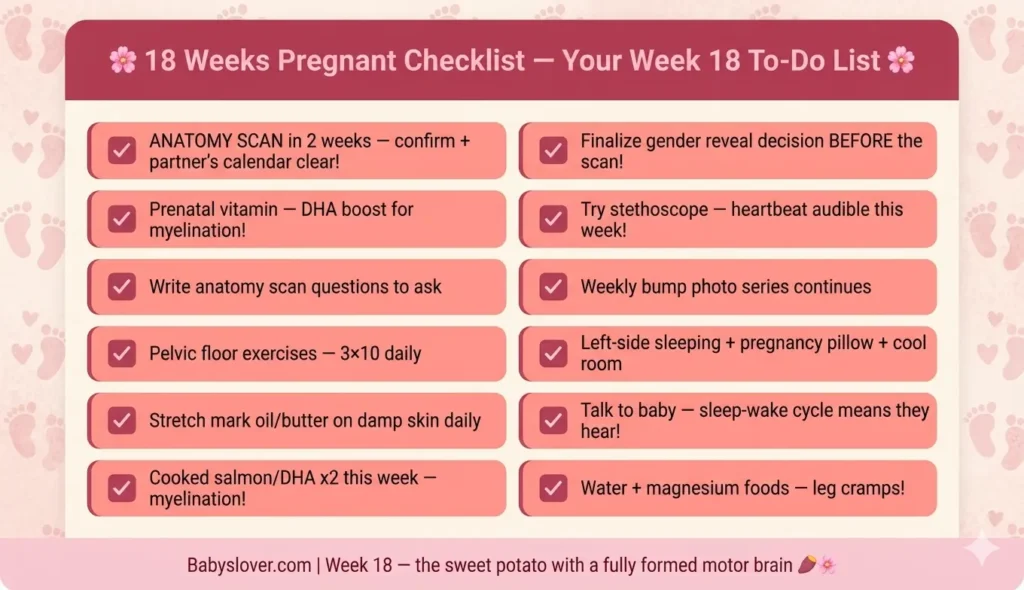
- ☑ 📅 ANATOMY SCAN in 2 weeks — confirm appointment, clear partner’s calendar
- ☑ 💊 Prenatal vitamin daily — DHA boost this week for myelinating nervous system!
- ☑ 🩺 Try stethoscope or fetal Doppler — heartbeat audible from abdomen this week!
- ☑ 👶 Finalize gender reveal decision — before the scan, not in the waiting room!
- ☑ 📝 Write anatomy scan questions to ask the sonographer
- ☑ 📸 Weekly bump photo — same outfit, same wall
- ☑ 🏋️ Pelvic floor exercises — 3 sets of 10 daily
- ☑ 🌙 Left-side sleeping + pregnancy pillow + room cool
- ☑ 🧴 Stretch mark oil/butter daily on damp skin
- ☑ 🗣️ Keep talking to baby — sleep-wake cycle means they can hear you!
- ☑ 🥩 Cooked salmon or DHA-rich food twice this week — myelination!
- ☑ 💧 8-10 glasses water + 25-30g fiber + magnesium-rich foods for leg cramps
Frequently Asked Questions — 18 Weeks Pregnant
What does 18 weeks pregnant feel like?
Being 18 weeks pregnant for most women feels like the sustained golden period of pregnancy — energy is good, the bump is visible and growing, and the anatomy scan’s proximity makes the week feel significant. New arrivals this week — leg cramps, possible wrist tingling, back pain, and beginning insomnia — are manageable. Many women begin to feel or notice quickening flutters around Week 18 for the first time if this is their first pregnancy.
How big is baby at 18 weeks pregnant?
At 18 weeks pregnant, your baby is approximately 142mm long (5.6 inches) — the size of a sweet potato — and weighs about 190 grams (6.7 oz). Growth continues rapidly: by the anatomy scan at Week 20, just two weeks away, the baby will have grown to approximately 250-260mm and weigh around 300 grams.
Is it normal to not feel baby move at 18 weeks?
Completely normal. First-time moms typically feel definitive fetal movement between Weeks 18-22. If you haven’t felt anything yet, your baby is moving — the timing of when you feel it depends on your placenta position, body type, and whether you know what the sensation feels like. If your placenta is anterior (attached to the front uterine wall), it can cushion movements and delay perception significantly. If you’re past Week 22 and still feel nothing, mention it to your OB.
What does the motor cortex do, and why does it matter at 18 weeks?
The motor cortex is the strip of brain tissue that controls all voluntary physical movement — walking, grasping, kicking, writing, every deliberate physical action a person ever takes. According to ACOG, it is fully formed by Week 18 of pregnancy. This means the kicks and rolls your baby makes from this week are increasingly brain-directed — not purely reflexive — and the same neural infrastructure that will eventually control your baby’s first steps is operational right now, at sweet potato size.
Can my partner hear the baby’s heartbeat at 18 weeks?
Yes — by Week 18, the heartbeat is strong enough to be audible through a standard stethoscope placed on the abdomen, though finding the right position takes patience. A fetal Doppler (available at pharmacies) is more reliably successful. Your OB or midwife will listen at prenatal appointments from this point forward. For partners, hearing the heartbeat for the first time is one of the most bonding experiences of the second trimester — it makes the pregnancy concretely real in a way that is otherwise difficult to experience from the outside.
What is meconium and why is it forming at 18 weeks?
Meconium is your baby’s first bowel movement — a thick, dark, tar-like substance that begins forming in the intestinal tract as early as Week 16-18. It is composed of swallowed amniotic fluid components, shed intestinal cells, mucus, bile, and water that accumulates throughout pregnancy. Under normal circumstances it is not expelled before birth — it passes in the first 24-48 hours after delivery. Meconium in the amniotic fluid before birth (meconium aspiration) can occasionally occur and is a clinical situation your OB monitors for — but meconium forming in the intestinal tract at 18 weeks is perfectly normal and expected.
What will the 20-week anatomy scan check?
The 20-week anatomy scan systematically assesses your baby’s brain, heart, face, spine, abdominal organs, limbs, and sex organs. It also evaluates the placenta’s position and amniotic fluid volume. Four biometric measurements — head circumference, biparietal diameter, abdominal circumference, and femur length — are used to estimate fetal weight and confirm gestational age. It is the most comprehensive look at your baby’s anatomy available during pregnancy, and it happens just two weeks from now.
💗 The Emotional Reality of Week 18 — Almost Halfway
Week 18 sits two weeks from the halfway point of pregnancy — and for many women, it is the week that reality shifts in a particular way.
The anatomy scan is close enough to feel imminent. The bump is visible enough that strangers may comment. If you’re going to feel quickening this pregnancy, this is the week it most commonly begins for first-time mothers — and that first flutter, when it comes, changes everything. Because suddenly it isn’t a pregnancy. It’s a baby.
Inside that sweet-potato-sized person, a fully formed motor cortex is sending signals to muscles via a myelinating spinal cord. Lanugo-covered skin is protected by vernix. Meconium is accumulating. Eyebrows are forming above eyes that will open in about ten weeks. A uterus is fully formed inside baby girls who won’t need it for decades.
Week 18 is building a person. Completely, systematically, invisibly. The anatomy scan will show you some of what Week 18 built. The rest will take years to fully reveal itself.
At Babyslover, we’re glad you’re here for all of it. 💗
👶 What Happens Next — 19 & 20 Weeks Pregnant Preview
Two extraordinary weeks are ahead:
- 19 Weeks Pregnant: Mango size — senses region of brain developing! Vernix thickening. Sucking reflex developing. Lanugo complete covering. Baby likely doing backflips!
- 20 Weeks Pregnant — THE ANATOMY SCAN: Banana size — HALFWAY! The most comprehensive look at your baby. Sex confirmed. Four biometric measurements. Brain, heart, spine, face, all four limbs. Brown fat forming. Bone marrow making red blood cells. The appointment you’ve been building toward. 🍌
Keep following our complete pregnancy week by week guide — halfway is two weeks away, and the anatomy scan is going to be unforgettable. 💗
Week 18: The Sweet Potato With a Fully Formed Motor Brain
Being 18 weeks pregnant means carrying a sweet-potato-sized person whose motor cortex is fully formed — the brain region that will one day direct first steps, first writing, first reaching for your face — operational at 142mm. Whose lanugo-covered skin is held in its protective vernix coating. Whose first bowel movement is already building, quietly, in the dark of the intestinal tract. Whose heartbeat your partner can now hear with a stethoscope.
The anatomy scan is two weeks away. The halfway point is two weeks away. The first clear kick may be days away.
Write your questions. Confirm your appointment. Have the gender reveal conversation. And for everything ahead, our pregnancy tips for first time moms guide is with you, week 18 and every week that follows. 💗
1 thought on “18 Weeks Pregnant: Baby Size, Symptoms & Development”