

Five senses. One week. At 19 weeks pregnant, the sensory regions of your baby’s brain are forming complex neural connections for all five senses simultaneously — taste, touch, smell, sight, and hearing — in a single week of brain architecture. This isn’t five separate processes happening sequentially. It’s one concentrated period of sensory wiring where the brain regions dedicated to each sense are building the neural infrastructure that will let your baby experience the world from the moment of birth.
And here is the part that changes how you think about your own meals: the amniotic fluid is your baby’s sensory training ground. Flavor compounds from the food you eat cross the placenta into the amniotic fluid. Your baby swallows that fluid. The developing taste buds and smell receptors wiring up this week are learning flavor profiles from your diet right now — and research shows that what babies taste in utero shapes their post-birth flavor preferences in measurable ways. The curry you had last Thursday. The orange juice this morning. Your baby tasted both.
Week 19 is also when the thumb sucking reflex is being perfected, the vernix thickening across the entire body, kidneys producing the urine that forms a significant portion of amniotic fluid, and scalp hair beginning to grow on a head that is becoming distinctly, recognizably a face. At Babyslover, here is everything about 19 weeks pregnant: your baby’s five-sense brain week, all the week’s developments, and what to focus on right now.
Just finished last week? Our 18 weeks pregnant guide covered the motor cortex completing, lanugo covering the body, and meconium beginning to form.

| 📋 Quick Summary — Week 19 of Pregnancy | |
| Week | Week 19 of 40 — Second Trimester, Week 7 🌟 |
| Trimester | Second Trimester — one week from HALFWAY! |
| Baby Size | 🥭 Mango — ~153mm (6.0 inches) |
| Baby Weight | ~240 grams (8.5 oz) |
| KEY MILESTONES | 🧠 SENSORY BRAIN wiring ALL 5 senses simultaneously! • 👅 Taste & smell detecting amniotic fluid flavors • 👋 Thumb sucking reflex mastered — practicing feeding! • 💧 Kidneys producing urine = major % of amniotic fluid • 🧥 Vernix THICKENING across entire body • 💇 Scalp hair growing from follicles • 👁️ Eye color (iris pigment) setting — may change after birth! |
| Symptoms | Linea nigra may appear, round ligament pain stronger, relaxin loosening all ligaments, back pain worsening, increased vaginal discharge, possible UTI risk elevated, heartburn ongoing, pregnancy brain (momnesia), dizziness on standing |
| Halfway | 🎉 The anatomy scan is NEXT WEEK — confirm appointment! 1 week from the halfway point! 🍌 |
Contents
- 1 🌱 Baby Development at 19 Weeks Pregnant
- 2 What’s Happening in Your Body at 19 Weeks Pregnant
- 3 What to Eat at 19 Weeks Pregnant — Feeding the Developing Senses
- 4 For Your Partner — Week 19 Meaningful Actions
- 5 When to Call Your Doctor at 19 Weeks Pregnant
- 6 Your Week 19 Pregnancy Checklist
- 7 Frequently Asked Questions — 19 Weeks Pregnant
- 8 💗 The Emotional Reality of Week 19 — Almost Halfway
- 9 👶 What Happens Next — 20 Weeks Pregnant Preview
- 10 Week 19: The Mango Tasting Your Meals and Learning Your Voice
🌱 Baby Development at 19 Weeks Pregnant
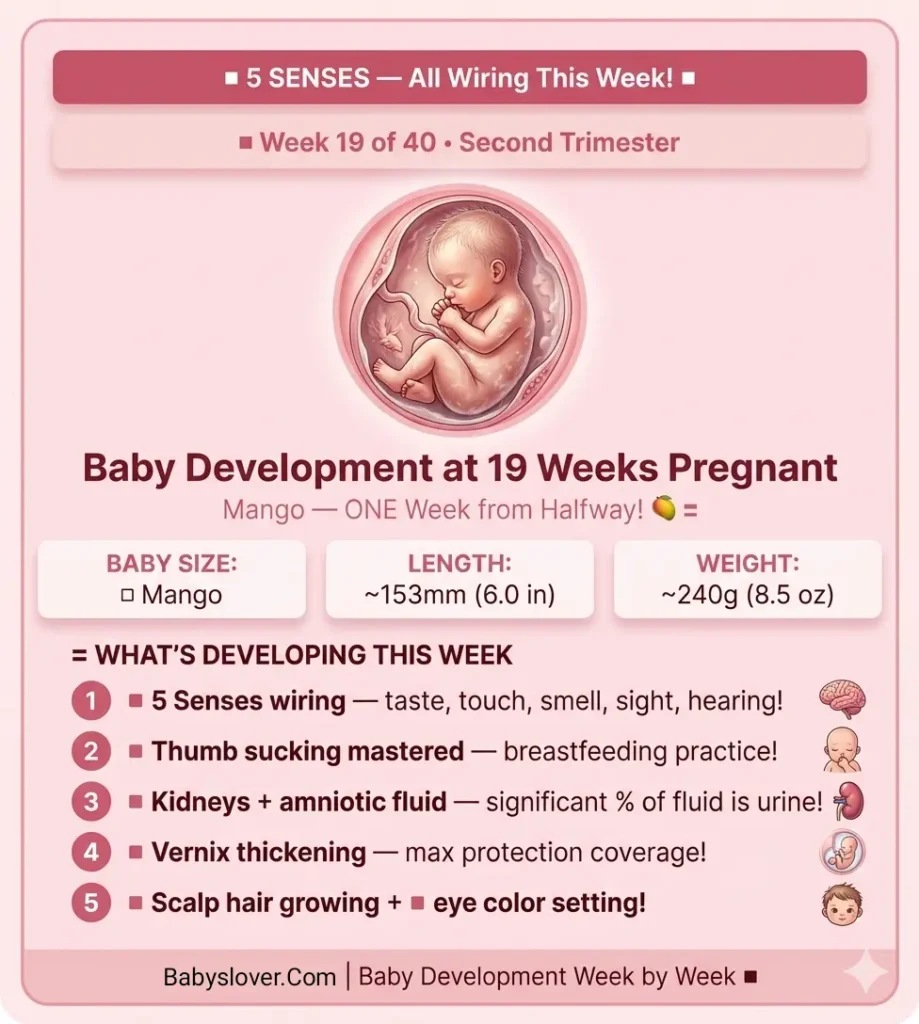
At 19 weeks pregnant, your baby measures approximately 153mm — the size of a mango — and weighs about 240 grams. The baby’s arms and legs have now reached their correct proportional length relative to the body — the brief period where the head seemed disproportionately large and the limbs disproportionately short is over. The baby looks, in its proportions, like the infant it will be at birth. And the brain is doing something this week that stands apart from any single development across the entire second trimester: wiring five different sensory systems simultaneously.

| 🌱 Baby Development at 19 Weeks Pregnant | |
| Baby Size | 🥭 Mango — ~153mm (6.0 inches) |
| Weight | ~240 grams (8.5 oz) |
| Proportions | Arms and legs now at correct proportional length — baby looks like a newborn in miniature |
| KEY MILESTONE | 🧠 SENSORY BRAIN wiring ALL 5 SENSES — taste, touch, smell, sight & hearing forming complex neural connections this week! |
What Is Developing at Week 19
- 🧠 The sensory brain — all 5 senses wiring simultaneously: This is the developmental landmark that defines Week 19. The nerve cells responsible for the five sensory systems — taste, touch, smell, sight, and hearing — are forming complex neural connections in the brain this week. Each sensory system has a dedicated region of the cerebral cortex where incoming sensory signals are processed and interpreted — the gustatory cortex for taste, the olfactory cortex for smell, the somatosensory cortex for touch, the visual cortex for sight, the auditory cortex for hearing. At Week 19, all five of these cortical regions are actively wiring their neural connections simultaneously. This concentrated period of sensory brain development means your baby’s capacity to experience the world through all five senses is being built in a single week. The three that are already actively functional — touch (since Week 8), hearing (since Week 16), and taste/smell (via amniotic fluid) — are becoming more complex and nuanced. Sight, with the eyelids still fused, is developing the retinal infrastructure and light-sensitivity that will activate at birth.
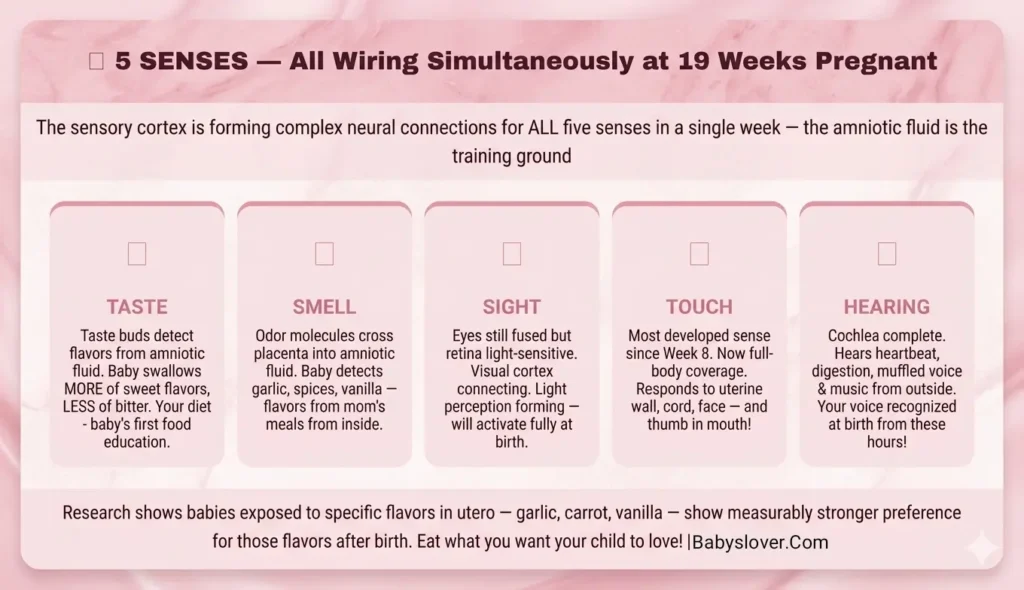
💡 What you eat shapes your baby’s flavor preferences — for life. Flavor compounds from your diet cross the placenta into the amniotic fluid. Your baby swallows that fluid — approximately 1 liter per day by the third trimester. The taste buds and smell receptors wiring up this week are learning to identify flavors from your meals. Research shows that babies exposed to garlic, carrots, vanilla, and other strong flavors in utero show measurably stronger preference for those same flavors after birth. What you eat in the next 21 weeks is your baby’s first food education.
- 👅 Taste and smell — the amniotic fluid flavors: Of the five senses, taste and smell are the two that are most actively experienced in the womb — because the amniotic fluid functions as a constant, changing flavor environment. Your baby’s taste buds — which were structurally complete by Week 15 — are now being connected to the gustatory cortex via maturing neural pathways, and are detecting the flavors present in the fluid: sweet, salty, sour, bitter, and umami compounds all travel from your diet through the placenta and into the amniotic fluid. The olfactory system is similarly connected to the fluid — odor molecules detectable in the liquid provide a continuous smell experience. Studies using ultrasound have shown babies swallowing noticeably more amniotic fluid after mothers consume sweet or strong flavors, and less after bitter flavors — a preference pattern that is already reflecting individual taste development.
- 👂 Hearing — cochlea complete, outside world audible: The cochlea — the inner ear structure responsible for converting sound vibrations into neural signals — is complete, and your baby can hear a significant range of sounds this week. The most consistently heard sounds are the internal body sounds: the rhythmic pulse of your heartbeat (which the baby has been hearing since Week 16), the rush of blood through the placenta, the gurgles and movement of digestion, and your voice conducted directly through body tissues. External sounds — music, other voices, environmental sounds — are heard in a muffled, low-frequency version filtered through the amniotic fluid and uterine wall. Your own voice, because it is also conducted directly through your body, is heard more clearly than external voices. Research on newborns consistently shows recognition of and preference for the mother’s voice — an effect directly attributable to the hours of in-utero listening that begin at this stage.
- 👋 Touch — the most developed sense, becoming more refined: Touch has been functional since Week 8, when the first skin receptors formed around the mouth. By Week 19, touch receptors cover the entire body surface and are connected to the somatosensory cortex via increasingly complex neural pathways. The baby responds to pressure on the uterine wall, to the umbilical cord, to its own face and hands. The thumb sucking behavior mastering this week is itself a touch-taste experience: the thumb in the mouth simultaneously stimulates the oral touch receptors and the taste buds, providing a rich combined sensory input that is also practicing the sucking coordination needed for feeding.
- 👅 Thumb sucking — the most important reflex practice of the second trimester: The sucking reflex is not a newborn reflex that appears at birth — it is developed, practiced, and refined over the final 20 weeks of pregnancy. By Week 19, many babies are actively and frequently sucking their thumbs inside the uterus, as confirmed by detailed ultrasound imaging. The mechanical coordination required for successful sucking is complex: the tongue, jaw muscles, and facial muscles must move in precisely coordinated sequences to create the suction necessary for feeding. Every sucking session in utero is a practice run for the moment the baby needs to feed — and the coordination and strength of the newborn’s feeding reflex is directly related to how much practice has been accumulated in the preceding weeks.
- 💧 Kidneys producing urine — making the amniotic fluid: Here is something most pregnancy guides mention but rarely explain fully: from Week 19 onward, a significant portion of the amniotic fluid is your baby’s urine. The kidneys are now producing urine continuously, excreting it into the amniotic sac. In a healthy pregnancy at this stage, the baby swallows amniotic fluid, the kidneys filter and process the fluid, and urine is returned to the amniotic sac — a continuous recycling loop that the fetal system runs without pause. The volume of amniotic fluid is a key indicator of kidney function and fetal health — too little fluid (oligohydramnios) can indicate kidney problems; too much (polyhydramnios) can indicate swallowing difficulties. Both are assessed at your upcoming anatomy scan.
- 🧥 Vernix thickening — the protective coat at maximum effectiveness: The vernix caseosa that began forming at Week 17 is now thickening across the entire body surface, reaching its peak protective coverage over the next several weeks. The vernix — anchored in place by the lanugo hair covering the body — is waterproofing and protecting the increasingly thickened skin against 21 more weeks of amniotic fluid immersion. The skin beneath the vernix is itself developing additional layers this week — by Week 19, the epidermis (outer skin) and dermis (deeper skin) are both becoming more structured and complex, with the skin beginning to lose some of its translucency as it thickens.
- 💇 Scalp hair growing: The hair follicles on the scalp — established at Week 10-14 along with all body follicles — are now actively producing visible scalp hair. At Week 19, the strands are still very fine and unpigmented, but the pattern and density of hair that will be visible at birth is being established now. Scalp hair development is highly individual and entirely genetically determined — whether your baby arrives with a full head of dark hair, fine wisps, or appears bald depends entirely on the follicular programming established in these weeks.
- 👁️ Eye color — iris pigment setting: The iris — the colored ring around the pupil — is now receiving its initial deposits of melanin pigment. The eye color being set at 19 weeks is the foundational color — but the final eye color may not be apparent until 6-12 months after birth. Most babies of lighter-skinned parents are born with blue or grey eyes that progressively darken as additional melanin deposits in the iris over the first year. Babies of darker-skinned parents are typically born with dark brown eyes that remain stable. The genetics of eye color are complex — more than 16 genes contribute to the final result — and even the foundational color setting happening this week reflects the interaction of multiple inherited factors.
- 👧 For baby girls — 6-7 million egg cells: A baby girl at 19 weeks of gestation has already produced approximately 6-7 million egg cells (oocytes) in her ovaries — more than she will ever have again. From this point onward, the number decreases continuously: by birth it will have reduced to approximately 1-2 million; by puberty to 300,000-500,000; and approximately 300-400 will ever be ovulated across a reproductive lifetime. The extraordinary egg production peak at 19-20 weeks of fetal development is one of the most remarkable and counterintuitive facts in reproductive biology. The girl you are carrying has already reached the maximum reproductive potential she will ever possess.
💡 Fun fact: At 19 weeks, a baby girl has 6-7 million eggs in her ovaries — more than at any other point in her life. By birth, it’s down to 1-2 million. By puberty, 300,000-500,000. Only 300-400 are ever ovulated. The biological peak of her reproductive potential exists right now, at mango size, inside you. 🥭
What’s Happening in Your Body at 19 Weeks Pregnant
🟤 Linea Nigra — The Pregnancy Line
If a dark vertical line has appeared running from your navel downward (or sometimes from navel to pubic bone, or even navel to sternum), this is the linea nigra — Latin for ‘black line.’ It’s caused by the same hormonal effect responsible for the mask of pregnancy (chloasma) and nipple darkening: elevated MSH (melanocyte-stimulating hormone) drives excess melanin production in the skin, and the faint line (linea alba) that always exists down the center of the abdomen becomes visibly pigmented. It is harmless, appears in the majority of pregnancies, and typically fades within a few months of delivery as hormone levels normalize. SPF on the abdomen can prevent it from darkening further in sun exposure, but it cannot be prevented entirely. Embrace it — it is perhaps the most distinctly ‘pregnancy’ marking the body makes.
🦵 Relaxin — Every Joint Is Looser Now
The hormone relaxin — produced throughout pregnancy but increasingly impactful from the second trimester — loosens the ligaments throughout the body to allow the pelvis to expand for birth. The effect is not limited to the pelvis: relaxin affects every joint in the body, which is why ankles, knees, wrists, and hips all feel less stable during pregnancy than they did before. This increased joint mobility has practical consequences: greater susceptibility to ankle rolls on uneven ground, wrist discomfort during activities requiring grip, and back pain from the reduced spinal ligament support. Low-impact exercise — walking, swimming, prenatal yoga — supports the joints without stressing the loosened ligaments.
🔄 Dizziness on Standing — Orthostatic Hypotension
Standing up quickly and experiencing a brief head rush, lightheadedness, or darkening vision is orthostatic hypotension — a common second-trimester experience caused by the expanded blood volume redistributing when position changes. The growing uterus can also compress the inferior vena cava (a major vein) when lying on the back, reducing blood return to the heart and brain. Management: rise slowly from sitting or lying positions; avoid prolonged standing; stay well hydrated; eat small frequent meals rather than large ones (which divert circulation to digestion); wear compression socks if dizziness is frequent. If dizziness is severe, frequent, or accompanied by chest pain or fainting, contact your OB.
🧠 Pregnancy Brain — The Science Behind ‘Momnesia’
Forgetting words mid-sentence. Walking into a room with no memory of why. Missing appointments you were certain you remembered. Pregnancy brain is neurologically real — not imagined, not exaggerated. Brain imaging research has documented structural changes in the maternal brain during pregnancy: gray matter in regions associated with social cognition and theory of mind is actually reduced in volume, while the brain reorganizes toward caregiving-related functions. Memory consolidation is also disrupted by sleep fragmentation, hormonal changes, and the enormous cognitive load of processing a major life transition. The practical response: external memory systems (phone reminders, written lists, calendar alerts) rather than relying on working memory that is genuinely operating at reduced capacity.
🚽 UTI Risk — Elevated from Week 16 Onward
Urinary tract infections are significantly more common during pregnancy, and Week 19 is squarely in the elevated-risk window. The reasons: the growing uterus slows urine flow and makes complete bladder emptying more difficult; progesterone relaxes the urinary tract smooth muscle, reducing the efficiency of the normal antimicrobial flushing mechanism; and the elevated glucose levels in pregnancy urine provide a richer growth medium for bacteria. Symptoms — burning urination, frequency, pelvic discomfort, cloudy or strong-smelling urine — should prompt OB contact. UTIs in pregnancy must be treated with antibiotics because untreated UTIs can ascend to the kidneys (pyelonephritis) and have associations with preterm labor risk. Prevention: stay well hydrated, urinate when the urge arises rather than delaying, wipe front-to-back, and consider a probiotic if your OB approves.
📈 Round Ligament Pain — Stronger This Week
The round ligaments — two thick cords that run from the uterus through the groin to the labia — are under increasing tension as the uterus rises and enlarges. Sharp, shooting pain in the lower abdomen or groin, typically on one side, triggered by sudden position changes (rolling over, standing quickly, sneezing, coughing, laughing) is round ligament pain — completely normal, not dangerous, and typically brief. Prevention: move slowly when changing positions, bend slightly forward when you need to sneeze or cough (reducing the sudden pull on the ligament), and use a pregnancy support belt during longer walking periods. Round ligament pain that is persistent, severe, or accompanied by bleeding or fever needs OB evaluation to rule out other causes.
What to Eat at 19 Weeks Pregnant — Feeding the Developing Senses
This week’s sensory brain development and amniotic fluid flavor education make nutrient-dense, flavorful food more significant than at any previous week. The practical reality: eating a wide variety of healthy, strong-flavored foods now is actively training your baby’s palate for a lifetime of diverse eating.
| Nutrient | Why Critical at Week 19 | Best Sources |
| DHA Omega-3 | SENSORY BRAIN wiring — DHA is the primary structural fat incorporated into all sensory cortex neural connections forming this week | Cooked salmon (2x/week), sardines, walnuts, chia seeds, flaxseed, DHA-enriched prenatal vitamin |
| Iron | Blood volume at peak expansion — hemoglobin synthesis ongoing. Iron also prevents pregnancy-related fatigue and dizziness | Lean red meat, spinach + vitamin C, lentils, fortified cereals, tofu, pumpkin seeds |
| Vitamin A | EYE DEVELOPMENT — retinal development and visual cortex wiring both require adequate vitamin A. Critical for light receptor formation | Sweet potato, carrots, spinach, kale, eggs, fortified dairy. Note: avoid vitamin A supplements (only beta-carotene forms) |
| Zinc | SENSORY DEVELOPMENT broadly — zinc is required for taste bud function and auditory nerve development. Deficiency impairs sensory refinement | Lean beef, pumpkin seeds, lentils, chickpeas, cashews, fortified cereals |
| Calcium + Vit D | Skeleton hardening continues + ear ossicles (the tiny bones of hearing) are calcifying for sound transmission | Dairy, fortified plant milk, kale, almonds, sunlight exposure, vitamin D supplement |
| Varied Flavors | AMNIOTIC FLAVOR EDUCATION — eating garlic, herbs, spices, vegetables trains baby’s developing taste receptors for lifelong dietary variety | Cook with garlic, herbs, spices. Eat varied vegetables. Strong-flavored healthy food is specifically beneficial this week! |
The flavor variety row is unique to Week 19’s developmental context. This is the week when eating adventurously — with nutritious, flavorful food — is a form of parenting. The research showing that in-utero flavor exposure shapes post-birth food preferences is robust and well-replicated. If you want a baby who eats vegetables, eat them now, prepared with herbs and spices, so the taste buds wiring up this week learn them as familiar and acceptable. Our best prenatal vitamins guide covers the formulas with the best DHA and iron combinations for this week’s dual developmental priorities.
For Your Partner — Week 19 Meaningful Actions
- Sing, speak, play music directly to the bump: Your baby’s cochlea is complete and functional this week. External voices are heard in muffled form — but music and voices directed at the abdomen are detectable. Singing directly to the bump, reading aloud, or playing favorite music with a phone or speaker gently resting on the abdomen are all genuinely received by the baby, not symbolically. Research on newborns shows that music and voices consistently heard in utero produce recognition responses after birth — the baby turns toward familiar sounds. The sound environment you create now is the baby’s first acoustic world. Use it well.
- Cook together — and cook flavorfully: Week 19’s flavor-education finding is one of the most actionable pregnancy science facts. Cooking healthy, strongly-flavored meals together this week — dishes with garlic, fresh herbs, varied vegetables, spices — is a contribution that goes beyond nutrition. You’re helping establish the baby’s flavor preferences for life. Making mealtimes a shared activity with strong-flavored, nutritious food has both a bonding and a developmental dimension.
- The anatomy scan is NEXT WEEK: This is the most important prenatal appointment of the entire pregnancy. Confirm the date is absolutely clear in your calendar. Prepare your questions together. Finalize the gender reveal decision. Plan something meaningful for afterward — lunch together, a walk, a moment to absorb what you’ve seen. The anatomy scan shows the baby’s brain, heart, face, spine, and all four limbs. It’s the most complete picture of the pregnancy you’ll have until birth.
- Linea nigra and body changes: The visible body changes of the second trimester — growing bump, linea nigra, darkening skin in some areas, stretch marks — are accumulating. The most important thing a partner can do is not comment on physical changes in a way that introduces self-consciousness where there wasn’t any. If she brings it up, listen and affirm. If she doesn’t, follow her lead. Body confidence during pregnancy is fragile and deeply influenced by close partner responses.
- UTI awareness: If she mentions burning when urinating, unusual frequency, or pelvic discomfort — take it seriously and encourage same-day OB contact. UTIs in pregnancy are not minor inconveniences. They have associations with preterm labor if untreated. Ensuring she has the hospital bag checklist started is also a good practical contribution this week — the anatomy scan is coming and the final trimester is not as far as it feels.
When to Call Your Doctor at 19 Weeks Pregnant
- Heavy vaginal bleeding: Soaking a pad or passing clots — same-day OB contact.
- Burning urination, unusual frequency, or cloudy urine: Possible UTI — prompt OB contact for evaluation and antibiotic treatment if confirmed. Don’t wait for symptoms to worsen.
- Severe abdominal pain: Persistent severe pain distinct from round ligament twinges requires evaluation.
- Fever above 100.4°F / 38°C: Prompt OB contact — especially important if UTI symptoms are also present.
- Severe dizziness, fainting, or loss of balance: Contact OB if dizziness is severe or accompanied by chest pain, headache, or visual changes.
- Fluid leaking from vagina: Any continuous or sudden gush of clear fluid requires same-day evaluation to rule out premature rupture of membranes.
- Round ligament pain that is persistent or severe: Brief sharp twinges are normal. Pain that doesn’t resolve, is accompanied by bleeding, or feels unlike typical round ligament stretching needs evaluation.
Your Week 19 Pregnancy Checklist
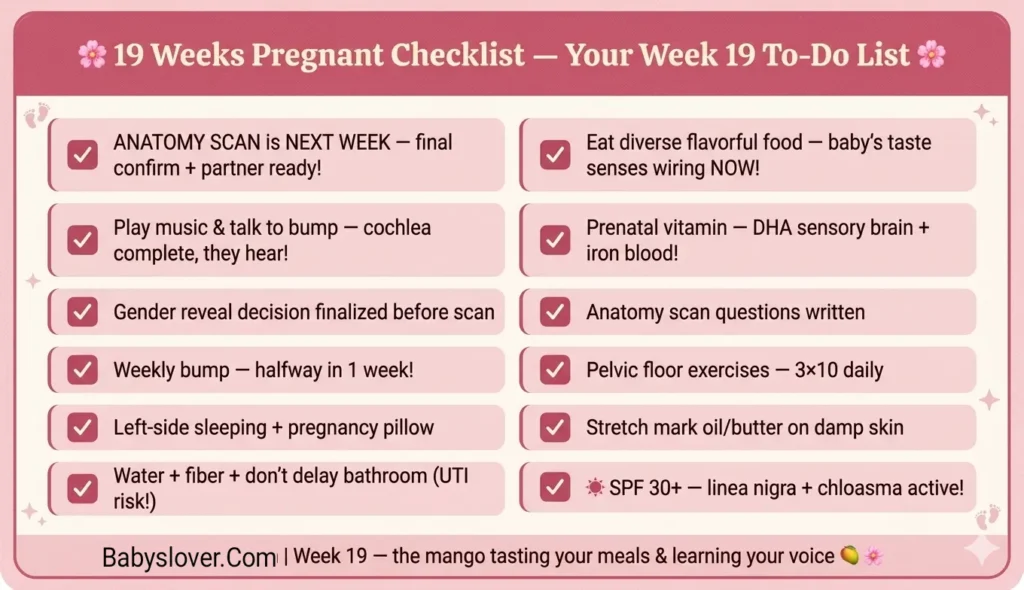
- ☑ 📅 ANATOMY SCAN is NEXT WEEK — final confirmation, partner’s day confirmed!
- ☑ 🧠 Eat diverse, flavorful nutritious food — baby’s taste receptors are wiring NOW!
- ☑ 🎵 Play music and speak directly to bump — cochlea complete, baby hears you!
- ☑ 💊 Prenatal vitamin daily — DHA for sensory brain, iron for blood volume!
- ☑ 👶 Gender reveal decision finalized before anatomy scan
- ☑ 📝 Anatomy scan questions written — what to ask the sonographer
- ☑ 📸 Weekly bump photo — halfway is ONE week away!
- ☑ 🏋️ Pelvic floor exercises — 3 sets of 10 daily
- ☑ 🌙 Left-side sleeping + pregnancy pillow
- ☑ 🧴 Stretch mark oil/butter on damp skin daily — belly, hips, thighs
- ☑ 💧 8-10 glasses water + fiber + UTI prevention: don’t delay bathroom trips!
- ☑ ☀️ SPF 30+ on face and abdomen — linea nigra + chloasma active!
Frequently Asked Questions — 19 Weeks Pregnant
What does 19 weeks pregnant feel like?
Being 19 weeks pregnant typically feels like a sweet spot — energy is good, the bump is growing and visible, and the anatomy scan is imminent. New arrivals at Week 19 include the linea nigra (for many women), strengthened round ligament pain, and possibly increased back discomfort as the center of gravity continues shifting. Quickening — if not felt yet — may arrive any day. The week carries a particular sense of anticipation: one week from halfway, one week from the most important prenatal appointment.
How big is my baby at 19 weeks pregnant?
At 19 weeks pregnant, your baby is approximately 153mm long (6 inches) — the size of a mango — and weighs about 240 grams (8.5 oz). The baby’s arms and legs have now reached their correct proportional length relative to the body — the baby looks, in miniature, like the newborn it will be. By the anatomy scan at Week 20 just one week away, the baby will measure approximately 250-260mm.
Can my baby taste and smell at 19 weeks?
Yes — and the mechanism is the amniotic fluid. Flavor compounds from your diet cross the placenta into the amniotic fluid, and your baby swallows approximately 400-500ml of fluid per day at this stage. The taste buds and smell receptors wiring up this week are detecting those flavors. Research has documented that babies exposed to specific flavors in utero — garlic, carrot, vanilla — show measurable preference for those same flavors after birth. What you eat now is your baby’s first food education.
Is it normal to not feel baby move at 19 weeks?
Completely normal. First-time mothers typically feel definitive fetal movement between Weeks 18-22. At Week 19, movements are still small and may be indistinguishable from gas or digestion if the placenta is anterior (attached to the front uterine wall). If you’ve felt nothing by Week 22, mention it to your OB — but at Week 19, there is no cause for concern. The baby is moving. You will feel it when the movements are strong enough and the position is right.
What is the linea nigra and will it go away?
The linea nigra is the dark vertical line that appears on the abdomen during pregnancy, running from the navel downward (sometimes extending above the navel as well). It’s caused by elevated melanocyte-stimulating hormone (MSH) darkening the faint line (linea alba) that has always been on the abdomen. It appears in the majority of pregnancies, is harmless, and typically fades within a few months after delivery as hormone levels normalize. SPF on the abdomen can prevent additional darkening from sun exposure.
How many eggs does a baby girl have at 19 weeks?
A baby girl at 19 weeks of gestation already has approximately 6-7 million egg cells in her ovaries — more than at any other point in her life. The number decreases continuously from this peak: by birth it will be 1-2 million; by puberty, 300,000-500,000; and approximately 300-400 are ever ovulated across a reproductive lifetime. The biological peak of reproductive potential for a baby girl occurs at Week 19-20 of fetal development.
What is amniotic fluid made of?
From Week 19 onward, amniotic fluid is significantly composed of fetal urine. The baby’s kidneys filter and produce urine, which is excreted into the amniotic sac. The baby then swallows the fluid, the kidneys process it, and the cycle continues. The fluid also contains shed fetal skin cells, lanugo hair, and various proteins and compounds. Amniotic fluid volume is a key indicator of fetal kidney function — too little suggests reduced kidney output, too much may suggest swallowing difficulties. Both are assessed at the 20-week anatomy scan.
When is the 20-week anatomy scan?
Typically scheduled between Weeks 18-22, with Week 20 being the most common timing. For women at 19 weeks pregnant, the anatomy scan is likely next week. It is the most comprehensive prenatal assessment of the pregnancy — checking the baby’s brain, heart, face, spine, abdominal organs, and limbs, as well as the placenta position and amniotic fluid volume. Prepare by writing your questions, finalizing your gender reveal preference, and making sure your partner can attend.
💗 The Emotional Reality of Week 19 — Almost Halfway
One week from halfway. One week from the anatomy scan. And inside, a mango-sized person is learning the flavors of your meals, hearing the sound of your voice, and practicing the sucking that will one day feed from you.
Week 19 is the week the sensory bridge between you and your baby becomes most concrete. Your voice — which your baby has been hearing since Week 16 — is now being processed by an increasingly complex auditory cortex. The food you choose is literally being tasted, through the medium of the amniotic fluid, by taste receptors that are wiring to a gustatory brain region this week. The baby is not separate from your sensory world. The baby is inside it.
The anatomy scan will show you a face. Eyebrows. A beating heart. A spine, complete and correct. Four chambers. Four limbs. Everything your body has been building, this week and every week before it.
One week. At Babyslover, we are very glad you’re here for it. 💗
👶 What Happens Next — 20 Weeks Pregnant Preview
Next week is one of the biggest of the entire pregnancy — 20 weeks pregnant marks the halfway point AND the anatomy scan:
- 🍌 HALFWAY! Baby is banana-sized — ~250mm, ~300 grams
- 🧠 SENSORY CORTEX all 5 senses fully wired — hearing, taste, touch, smell, sight!
- 💅 Fingernails AND toenails now growing to end of digits
- 🦴 Bone marrow now making red blood cells (no longer liver’s job!)
- 🫁 Practice breathing movements — diaphragm contracting in rhythmic patterns
- 🏥 THE ANATOMY SCAN — the most comprehensive view of your baby all pregnancy
- 👫 Gender confirmed on scan (if you want to know!)
Keep following our complete pregnancy week by week guide — halfway and the anatomy scan are one week away. 💗
Week 19: The Mango Tasting Your Meals and Learning Your Voice
Being 19 weeks pregnant means carrying a mango-sized person whose five-sense brain is wiring all at once — building the neural architecture for taste, touch, smell, sight, and hearing in a single concentrated week of development. Whose amniotic fluid carries the flavors of your meals. Whose cochlea is complete enough to hear your voice with a fidelity that newborn research confirms produces recognition at birth. Whose girl-ovaries already hold 6-7 million eggs — more than they’ll ever hold again.
Whose thumb is in the mouth, practicing the sucking that will one day feed from you.
The anatomy scan is next week. Halfway is next week. Eat something flavorful and nutritious today — your baby will taste it. Talk out loud — your baby is listening. For everything ahead, our pregnancy tips for first time moms guide is with you, week 19 and beyond. 💗