
Week 2 is when everything changes — and most people don’t even realize it.
If Week 1 was about your body clearing the slate, Week 2 is where the real magic starts. This is ovulation week. Your most fertile days. The window your body opens once every cycle for a chance at conception.
At Babyslover, we’re walking you through 2 weeks pregnant in detail — what’s happening in your body, the signs that tell you ovulation is near, your fertile window, how conception actually works, and what you can do right now to give yourself the best possible chance. If you missed last week, start with our 1 week pregnant guide first.
| 📋 Quick Summary — Week 2 of Pregnancy | |
| Week | Week 2 of 40 |
| Trimester | First Trimester |
| Baby size | No baby yet — but conception may happen this week! |
| Key event | 🥚 OVULATION — your egg is released around Day 14 |
| Symptoms | Egg-white cervical mucus, mild cramping (mittelschmerz), increased libido, breast tenderness, LH surge |
| Top priority | Track ovulation + have sex every 1-2 days during fertile window |
Contents
- 1 Are You Actually Pregnant at 2 Weeks?
- 2 What’s Happening in Your Body at 2 Weeks Pregnant
- 3 🌱 Baby Development at 2 Weeks Pregnant
- 4 Your Fertile Window — The Best Days to Get Pregnant
- 5 5 Signs of Ovulation to Watch For at 2 Weeks Pregnant
- 6 How to Maximize Your Chances of Conception at 2 Weeks Pregnant
- 7 For Your Partner — Week 2 Is Critical for Sperm Health Too
- 8 2 Weeks Pregnant Symptoms — What’s Actually Normal
- 9 What to Eat at 2 Weeks Pregnant
- 10 When to Call Your Doctor at 2 Weeks Pregnant
- 11 Your Week 2 Pregnancy Checklist — This Week Ka To-Do List
- 12 Frequently Asked Questions — 2 Weeks Pregnant
- 13 👶 What Happens Next — 3 Weeks Pregnant Preview
- 14 Week 2 Is Yours — Make It Count
Are You Actually Pregnant at 2 Weeks?
Like Week 1, being 2 weeks pregnant on the medical calendar doesn’t mean you’re pregnant yet — but you’re closer than ever.
Here’s the key thing to understand: pregnancy is counted from the first day of your last menstrual period (LMP). In a standard 28-day cycle, ovulation happens around Day 14 — which falls right in the middle of what doctors call Week 2. So when you’re ‘2 weeks pregnant’ by the LMP method, you’re actually at the start of your fertile window, and conception is about to become possible.
Think of it this way — Week 2 is the most important week in your entire cycle for getting pregnant. Everything your body did in Week 1 was preparation for this moment.
💡 Even if conception happens during Week 2, pregnancy won’t be detectable on a home test until around Week 4 — when your hCG levels are high enough. So don’t test yet — just focus on timing!
What’s Happening in Your Body at 2 Weeks Pregnant
Your body is doing extraordinary things this week — even if you can’t feel most of them.
🔬 Follicle Development
Inside your ovaries, follicles (tiny fluid-filled sacs each containing an egg) have been growing since Week 1. By the start of Week 2, one dominant follicle has pulled ahead of the rest. This follicle continues producing estrogen, which triggers your uterine lining to thicken and prepares your body for the possibility of implantation.
📈 The LH Surge
Around Day 12-13 of your cycle, your brain releases a surge of luteinizing hormone (LH). This is the LH surge — the signal that tells your ovary it’s time. Within 24-36 hours of the LH surge, the dominant follicle bursts and releases a mature egg. This is ovulation.
🥚 Ovulation — The Main Event
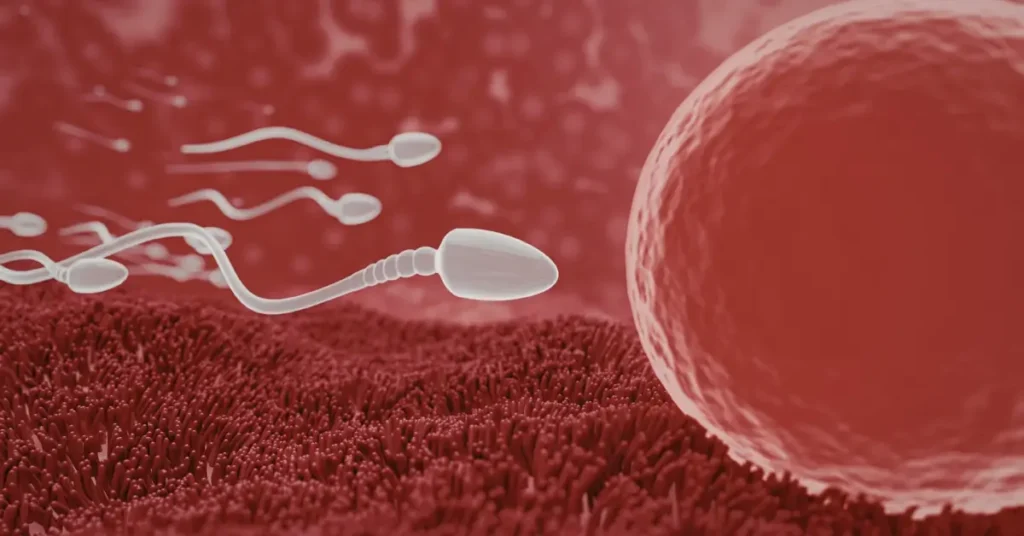
Your ovary releases one egg (rarely two, which is how non-identical twins happen). That egg travels into the fallopian tube, where it must be fertilized within 12 to 24 hours. If sperm is already waiting in the fallopian tube — which is possible since sperm can live up to 5 days — fertilization can occur.
✨ If Fertilization Happens
When a sperm successfully penetrates the egg, fertilization occurs. The fertilized egg — now called a zygote — begins dividing as it travels toward the uterus. Your baby’s entire genetic makeup, including their sex, eye color, and hair color, is determined at the exact moment of fertilization.
🌱 Baby Development at 2 Weeks Pregnant
This is the week everything begins. At 2 weeks pregnant, your baby doesn’t exist yet at the start of the week — but by the end of it, conception may have occurred, and the single most important biological event of your pregnancy journey will have happened.
| 🌱 Baby Development at 2 Weeks Pregnant | |
| Baby Size | Smaller than a poppy seed (if fertilized) |
| Fruit Comparison | 🌱 Poppy seed — if fertilization occurred |
| Weight | Less than 1g |
| Week / Trimester | Week 2 of 40 • First Trimester |
| Stage | Ovulation → Fertilization → Zygote formation |
What Is Developing at Week 2 — Step by Step
- Ovulation — the egg is released: Around Day 14 of your cycle, one dominant follicle bursts and releases a mature egg into the fallopian tube. This egg is about 0.1mm in size — barely visible to the naked eye. It will only survive 12-24 hours unless fertilized.
- Fertilization — if it happens: If sperm meets the egg in the fallopian tube during this 12-24 hour window, fertilization occurs. A single sperm out of millions penetrates the egg’s outer layer. The moment this happens, your baby’s entire genetic blueprint is locked in.
- Baby’s sex is decided right now: At the exact moment of fertilization, your baby’s biological sex is determined — by which type of sperm reaches the egg first. Sperm carrying an X chromosome creates a girl; sperm carrying a Y chromosome creates a boy. Everything else — eye color, hair color, blood type — is also set at this single moment.
- 46 chromosomes — your baby’s complete DNA: Your egg contributed 23 chromosomes and the sperm contributed 23 more. Together, they form 46 chromosomes — the complete human genetic code. This is your unique baby, unlike any other person who has ever lived.
- Zygote begins dividing: The fertilized egg — now called a zygote — immediately begins dividing. One cell becomes two, two become four, four become eight. This rapid cell division continues as the zygote slowly travels down the fallopian tube toward your uterus, a journey that takes 3-4 days.
- No implantation yet: At the end of Week 2, the zygote has not yet implanted into your uterine lining. That won’t happen until around Days 6-10 after fertilization — which falls in Week 3. Right now, your developing embryo is traveling and dividing.
Even though your baby is unimaginably tiny right now — smaller than the period at the end of this sentence — the moment of fertilization is one of the most profound biological events in nature. Everything your child will ever be was set in motion this week.
Your Fertile Window — The Best Days to Get Pregnant
One of the most important things to understand at 2 weeks pregnant is your fertile window. This is the period in your cycle when pregnancy is actually possible.
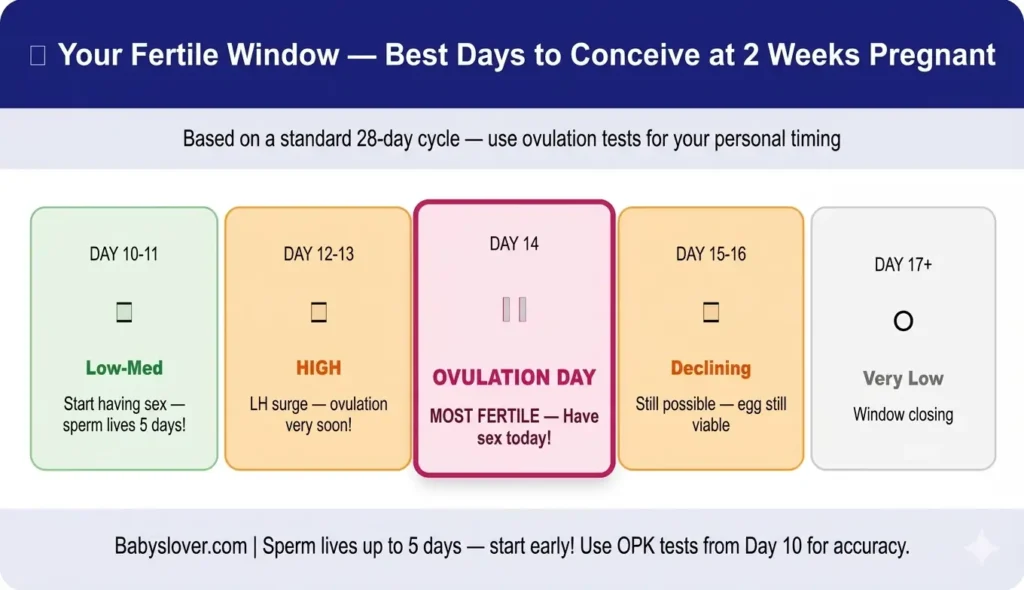
Contrary to what many people think, you’re not fertile on just one day. The fertile window spans about 6 days total — the 5 days before ovulation and the day of ovulation itself. This is because sperm can survive inside your reproductive tract for up to 5 days, waiting for an egg to arrive.
| Cycle Day | Fertility Level | What to Do |
| Day 10-11 | 🟡 Low-Medium | Start having sex — sperm needs to be present early |
| Day 12-13 | 🟠 High | Have sex today — LH surge is happening now |
| Day 14 | 🔴 PEAK — Ovulation Day | MOST IMPORTANT — have sex today if possible |
| Day 15-16 | 🟠 Declining | Still possible — egg may still be viable |
| Day 17+ | ⚪ Very Low | Fertile window closing — wait for next cycle |
Note: This table assumes a standard 28-day cycle. If your cycle is shorter or longer, your ovulation day shifts accordingly. Use a cycle tracking app or ovulation test kit for your personal fertile window. According to ACOG guidelines, having sex every 1-2 days during the fertile window gives the highest probability of conception each cycle.
5 Signs of Ovulation to Watch For at 2 Weeks Pregnant
Knowing your body’s ovulation signals is the secret to timing conception correctly. Here are the clearest signs to watch at 2 weeks pregnant:
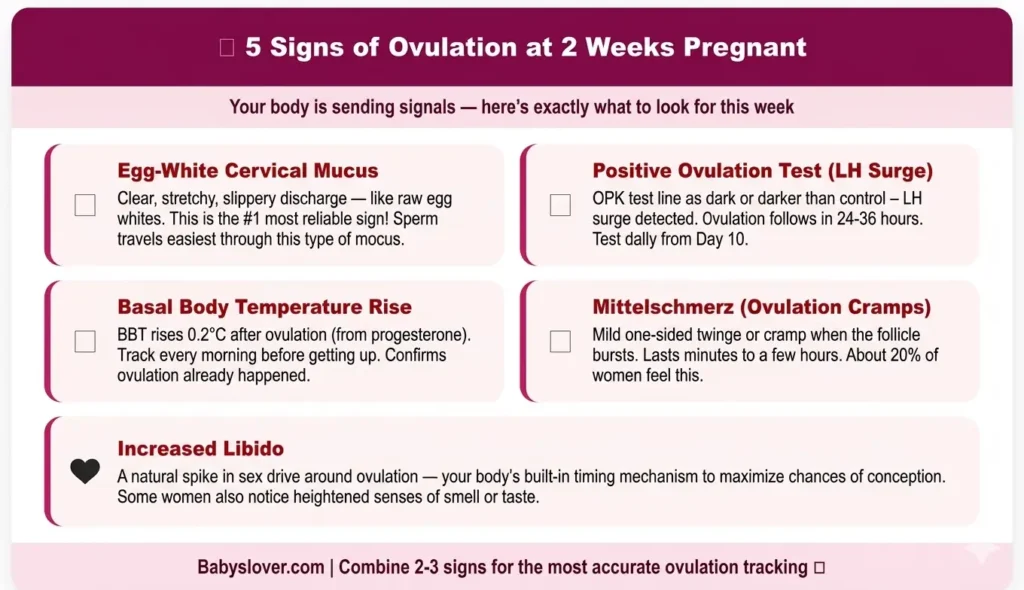
1. 🥚 Egg-White Cervical Mucus (EWCM)
This is the most reliable physical sign of approaching ovulation. As estrogen peaks before ovulation, your cervical mucus transforms from thick and creamy to clear, slippery, and stretchy — exactly like raw egg whites. This type of mucus helps sperm travel easily toward the egg and can keep sperm alive for days.
What to look for: Discharge that stretches between your fingers without breaking. This is your most fertile mucus — if you see it, the fertile window is open.
2. 📈 LH Surge on Ovulation Test
Ovulation predictor kits (OPKs) detect the LH hormone in your urine. When the test line is as dark or darker than the control line — that’s your LH surge, and ovulation typically follows within 24-36 hours. This is one of the most accurate ways to time sex for conception.
Tip: Test at the same time each day (afternoon is best — not first morning urine for LH tests). Start testing from Day 10 of your cycle.
3. 🌡️ Basal Body Temperature (BBT) Rise
Your basal body temperature (BBT) — taken first thing in the morning before getting up — rises slightly after ovulation by about 0.2°C (0.4°F). This rise is caused by progesterone released after the egg is released. According to the Mayo Clinic, tracking BBT over a few cycles helps identify your personal ovulation pattern.
Important: BBT tracking tells you ovulation has already occurred — not that it’s about to happen. So use it alongside other signs, not alone.
4. 💪 Mittelschmerz — Ovulation Cramps
About 20% of women feel a brief, mild pain or twinge on one side of their lower abdomen during ovulation. This is called mittelschmerz (German for ‘middle pain’). It happens when the follicle ruptures and releases the egg. It’s usually one-sided (whichever ovary releases the egg), lasts from a few minutes to a few hours, and is completely normal.
5. ❤️ Increased Sex Drive
Nature is brilliantly designed — many women feel a noticeable increase in libido right at ovulation. This is your body’s way of maximizing the chances of conception. If you suddenly feel more interested in sex around the middle of your cycle, that’s not a coincidence.
How to Maximize Your Chances of Conception at 2 Weeks Pregnant
Have Sex Every 1-2 Days During Your Fertile Window
You don’t need to have sex multiple times a day — in fact, too-frequent sex can lower sperm count. For most couples, having sex every 1-2 days during the fertile window (Days 10-17) gives the best odds. This ensures there’s always fresh, healthy sperm waiting when ovulation occurs.
Don’t Rely on Calendar Alone — Track Your Signs
Not every cycle is a perfect 28 days. Stress, illness, travel, or hormonal shifts can move ovulation earlier or later. The most reliable approach is combining ovulation tests with cervical mucus monitoring so you’re responding to your body’s actual signals, not just a calendar estimate.
Maintain a Healthy Weight
Both underweight and overweight can disrupt ovulation. A healthy BMI supports regular, predictable cycles. If you’re concerned about your weight affecting fertility, talk to your OB-GYN — they can assess and advise before you continue trying.
Keep Taking Your Prenatal Vitamins
If you started prenatal vitamins last week — great, keep going! If not, start today. Folic acid is critical in the very first days after fertilization — long before you’d even get a positive test. Our guide to the best prenatal vitamins can help you find the right one. According to the CDC, 400mcg of folic acid daily is the minimum recommendation for women trying to conceive.
Reduce Stress Where You Can
High stress can disrupt the hormonal signals that trigger ovulation — and can even delay or suppress it in some cycles. We know that’s easier said than done when you’re trying to conceive. Even small things help: a daily 20-minute walk, a yoga class, journaling, or simply prioritizing sleep can make a real difference.
Avoid Fertility-Unfriendly Lubricants
Many standard lubricants (including saliva) can harm sperm motility and make it harder for sperm to reach the egg. If you need lubrication, use fertility-friendly options like Pre-Seed or Conceive Plus — these are designed to be sperm-safe.
For Your Partner — Week 2 Is Critical for Sperm Health Too
This week matters just as much for your partner. Here’s what dad can do to support the best possible chances:
- Have sex consistently but not constantly: Every 1-2 days during the fertile window keeps fresh sperm available. Daily sex is fine, but multiple times a day isn’t necessary and may reduce count.
- Stay cool — literally: Testicles are outside the body because sperm production works best a few degrees below body temperature. Skip hot tubs, saunas, and long hot baths during the fertile window. Switch to boxers.
- Avoid alcohol this week: Even moderate alcohol has been shown to affect sperm DNA quality. Keeping alcohol minimal during the fertile window is a simple way to give sperm the best chance.
- No smoking: Smoking damages sperm DNA and reduces motility. If quitting is in progress — great. If not, at least avoid smoking in the days around ovulation.
- Eat zinc-rich foods: Zinc supports sperm production. Good sources include beef, pumpkin seeds, chickpeas, and cashews. A men’s fertility supplement with zinc and CoQ10 can also support sperm health over time.
- Manage stress: High cortisol levels can affect testosterone and sperm production. Exercise, sleep, and just staying present together as a couple all help.
2 Weeks Pregnant Symptoms — What’s Actually Normal
Many of the 2 weeks pregnant symptoms you may notice are ovulation symptoms — your body giving you clues that the fertile window is open:
- Egg-white cervical mucus: Clear, slippery, stretchy discharge — the most important and reliable ovulation sign.
- Mittelschmerz: Mild one-sided cramping or twinge during ovulation — completely normal, lasts minutes to hours.
- Breast tenderness: Hormonal shifts around ovulation can cause temporary breast sensitivity or fullness.
- Increased libido: A natural rise in sex drive — your body’s built-in conception timing mechanism.
- Light spotting: Some women notice a tiny amount of spotting mid-cycle — this is called ovulation spotting and is normal.
- Bloating: Hormonal changes can cause mild bloating around ovulation.
- Heightened senses: Some women notice a sharper sense of smell or taste around ovulation — linked to estrogen peaks.
- No symptoms at all: Many women feel completely normal and notice nothing — that’s also completely fine. Lack of symptoms doesn’t mean you’re not ovulating.
💡 2 weeks pregnant with no symptoms is very common! Many women ovulate without feeling anything. Use OPKs and track cervical mucus rather than waiting for physical signs.
What to Eat at 2 Weeks Pregnant
Your nutrition during Week 2 is just as important as last week. But this week, focus on foods that specifically support egg quality and hormonal balance:
| Nutrient | Why It Matters This Week | Best Sources |
| Antioxidants | Protect egg quality from oxidative stress | Blueberries, strawberries, spinach, broccoli, walnuts |
| Folic Acid | Critical if fertilization occurs — neural tube protection starts immediately | Leafy greens, lentils, avocado, fortified cereals |
| Healthy Fats | Support hormone production and egg quality | Salmon, avocado, olive oil, walnuts, chia seeds |
| Iron | Supports ovulation — low iron linked to ovulatory dysfunction | Spinach, lentils, red meat, tofu, pumpkin seeds |
| CoQ10 | Improves egg quality — especially for women 35+ | Supplement recommended — naturally in meat, fish, nuts |
What to avoid: alcohol (affects both egg quality and early embryo if fertilization occurs), processed foods, excess sugar, and trans fats. If you took fertility medications this cycle, check with your doctor about any specific dietary adjustments.
If you’re undergoing fertility treatments like Gonal-F or IUI, our guide on signs that Gonal-F is working has helpful information on what to watch for during this phase.
When to Call Your Doctor at 2 Weeks Pregnant
Most of what happens during Week 2 is completely normal. But contact your OB-GYN or fertility specialist if:
- You have very severe mid-cycle pain: Mild mittelschmerz is normal, but intense one-sided pain that doesn’t resolve within a few hours warrants a call.
- You never see egg-white mucus: If you’ve been tracking for several cycles and never notice fertile-quality mucus, mention this to your doctor — it can indicate hormonal imbalance.
- You’ve been trying for 12 months (or 6 months if over 35): This is when fertility testing is recommended by most reproductive specialists.
- Your cycles are very irregular: Cycles shorter than 21 days or longer than 35 days can signal irregular ovulation. Your OB can help investigate.
- You have a known condition like PCOS or endometriosis: These can significantly affect ovulation timing and fertility — and are best managed with specialist support.
Your Week 2 Pregnancy Checklist — This Week Ka To-Do List
- ☑ Start using ovulation test strips from Day 10 of your cycle
- ☑ Track cervical mucus — look for clear, egg-white consistency
- ☑ Take your BBT every morning before getting up (optional but helpful)
- ☑ Have sex every 1-2 days from Day 10 through Day 16
- ☑ Keep taking prenatal vitamins with folic acid every day
- ☑ Switch to fertility-friendly lubricant if needed (Pre-Seed, Conceive Plus)
- ☑ Avoid hot tubs, saunas, and excess heat this week
- ☑ Eat antioxidant-rich foods — berries, leafy greens, healthy fats
- ☑ Limit alcohol and avoid smoking
- ☑ Manage stress — walk, yoga, early bedtime
Frequently Asked Questions — 2 Weeks Pregnant
Can I feel pregnancy symptoms at 2 weeks pregnant?
The symptoms you feel at 2 weeks pregnant are actually ovulation symptoms — not pregnancy symptoms. True pregnancy symptoms (nausea, missed period, sore breasts from hCG) won’t appear until around Week 4-6, after implantation has occurred and hCG levels are rising. At Week 2, any symptoms are ovulation-related.
Can I take a pregnancy test at 2 weeks pregnant?
Testing at 2 weeks is too early to get a reliable result — even if conception happened this week, hCG levels won’t be detectable on a home test until around 10-14 days after fertilization (which is roughly Week 4 of pregnancy). Wait until after your missed period for the most accurate result.
How do I know if I’m ovulating at 2 weeks pregnant?
The most reliable way is to combine two methods: ovulation test strips (OPKs) for the LH surge, and monitoring cervical mucus for the egg-white texture. Together, these give you a very accurate picture of when your fertile window is open. A basal body temperature chart adds a third layer of confirmation.
What is mittelschmerz and is it a sign I’m ovulating?
Mittelschmerz is the mild one-sided cramping or twinge some women feel during ovulation — the word literally means ‘middle pain’ in German. It’s caused by the follicle rupturing to release the egg, and it’s completely normal. Not all women feel it, but if you do, it’s a useful ovulation signal. It should be brief and mild — severe or persistent pain is not normal and warrants a doctor’s call.
How often should we have sex at 2 weeks pregnant to conceive?
Every 1-2 days during your fertile window (approximately Days 10-17) is the most effective approach. Daily sex is also fine. Having sex multiple times a day doesn’t increase your chances and may slightly reduce sperm count. There’s no need to ‘save up’ sperm — fresh sperm is healthier.
What if my cycle isn’t 28 days? When do I ovulate?
Ovulation typically happens 14 days BEFORE your next period — not necessarily on Day 14 of your cycle. If you have a 24-day cycle, you likely ovulate around Day 10. If you have a 32-day cycle, you may ovulate around Day 18. Ovulation tests take the guesswork out of this by detecting the LH surge directly.
Is it normal to have no cervical mucus at 2 weeks pregnant?
Some women don’t notice much change in cervical mucus, especially early in their tracking journey. Staying well hydrated helps mucus production. If you consistently see no egg-white mucus across multiple cycles, mention it to your doctor — it can sometimes indicate low estrogen or hormonal imbalance that can affect fertility.
What if conception doesn’t happen this cycle?
It’s completely normal for conception to take several months even for completely healthy, fertile couples. Statistics show that about 80% of couples conceive within 12 months of regular, unprotected sex. Each cycle gives you a new opportunity. Track your signs, stay consistent, take care of your health, and give yourself grace. If you’re concerned or have been trying for a while, talk to your OB — they can assess both partners and offer guidance.
👶 What Happens Next — 3 Weeks Pregnant Preview
If conception happened during Week 2 — exciting things are already in motion! Here’s a preview of 3 weeks pregnant:
- The fertilized egg (zygote) is dividing rapidly as it travels down the fallopian tube toward your uterus
- By around Day 6-10 after fertilization, the embryo begins implanting into your uterine lining
- This is called implantation — and it’s the moment pregnancy officially begins
- Some women notice very light spotting called implantation bleeding — easily mistaken for a light period
- Your body begins producing hCG (the pregnancy hormone) — but levels are still too low to detect on a test
Head to our pregnancy week by week complete guide to follow every milestone from Week 1 to Week 40!
Week 2 Is Yours — Make It Count
Being 2 weeks pregnant might not feel dramatic — but this week is genuinely one of the most powerful in your entire cycle. Your body is releasing an egg, opening your fertile window, and giving you the best possible opportunity to conceive.
Track your signs, know your window, take care of yourself and your partner, and try to enjoy this part of the journey — even when it feels like a lot of pressure. Conception is a process, not a single moment. You’re doing everything right just by paying attention.
Have questions about Week 2 or trying to conceive? Drop them in the comments — we read every one. And make sure to check out our pregnancy tips for first time moms guide for everything that comes next.
1 thought on “2 Weeks Pregnant: Symptoms Ovulation, Fertile Window & How to Conceive”