

Your baby is now heavier than the placenta. It seems like a small fact — until you sit with it. For the entire first half of pregnancy, the placenta outweighed the baby it was sustaining: a remarkable biological arrangement where the support structure was larger than the person it was supporting.
At 21 weeks pregnant, that relationship permanently reverses. Your carrot-sized baby has crossed the weight of the placenta for the first time, and from this point forward the gap widens every week as the baby enters the rapid growth phase of the second half of pregnancy.
Week 21 is also when the digestive system stops merely practicing swallowing and begins doing something more significant: secreting enzymes that actually break down the amniotic fluid — processing proteins, sugars, and lipids through a functioning gastrointestinal system that is training for its first real food. The bone marrow, which activated for red blood cell production at Week 20, is now producing the full range of blood cells — white blood cells and platelets joining the red blood cells — making the immune and clotting systems operational. And those kicks? The arms and legs are now in correct proportion, the neurons connecting brain to muscle are matured, and cartilage has largely converted to bone. What was fluttering is now jabbing.
At Babyslover, here is everything about 21 weeks pregnant: your baby’s remarkable digestive milestone, all the week’s developments, your body’s new changes, and what to act on right now.
Just read last week? Our 20 weeks pregnant guide covered the anatomy scan in full, bone marrow activation, and the halfway celebration.

| 📋 Quick Summary — Week 21 of Pregnancy | |
| Week | Week 21 of 40 — Second Trimester, Week 9 |
| Trimester | Second Trimester — second half begins! |
| Baby Size | 🥕 Carrot — ~267mm head-to-heel (10.5 inches) |
| Baby Weight | ~360 grams (12.7 oz) — now HEAVIER than the placenta! |
| KEY MILESTONES | ⚖️ BABY NOW HEAVIER THAN PLACENTA — permanent reversal! • 🧫 DIGESTIVE ENZYMES secreting — GI tract breaking down amniotic fluid • 🩸 Bone marrow making ALL blood types — red + white + platelets • 💪 KICKS STRONGER — arms/legs proportional, neurons mature • 💤 Sleep cycles deepening — REM periods increasing • 👁️ Eyebrows defined, scalp hair growing |
| Symptoms | Itchy skin (especially belly), varicose veins appearing, thyroid swelling causing neck tightness, stronger back pain, heartburn worsening, leg cramps, more Braxton Hicks, increased appetite |
| Coming Soon | 🩺 Gestational diabetes screening opens in just 3 weeks (Weeks 24-28) — ask your OB about the glucose challenge test at your next visit! |
Contents
- 1 🌱 Baby Development at 21 Weeks Pregnant
- 2 📅 Gestational Diabetes Screening — Opening in 3 Weeks
- 3 What’s Happening in Your Body at 21 Weeks Pregnant
- 4 👟 Start Noticing Kick Patterns — Not Just Counting
- 5 What to Eat at 21 Weeks Pregnant — Feeding the Blood Factory and the Digesting Baby
- 6 For Your Partner — Week 21 Meaningful Actions
- 7 When to Call Your Doctor at 21 Weeks Pregnant
- 8 Your Week 21 Pregnancy Checklist
- 9 Frequently Asked Questions — 21 Weeks Pregnant
- 10 💗 The Emotional Reality of Week 21 — The Second Half
- 11 👶 What Happens Next — 22 Weeks Pregnant Preview
- 12 Week 21: The Carrot That Outweighed Its Life Support
🌱 Baby Development at 21 Weeks Pregnant
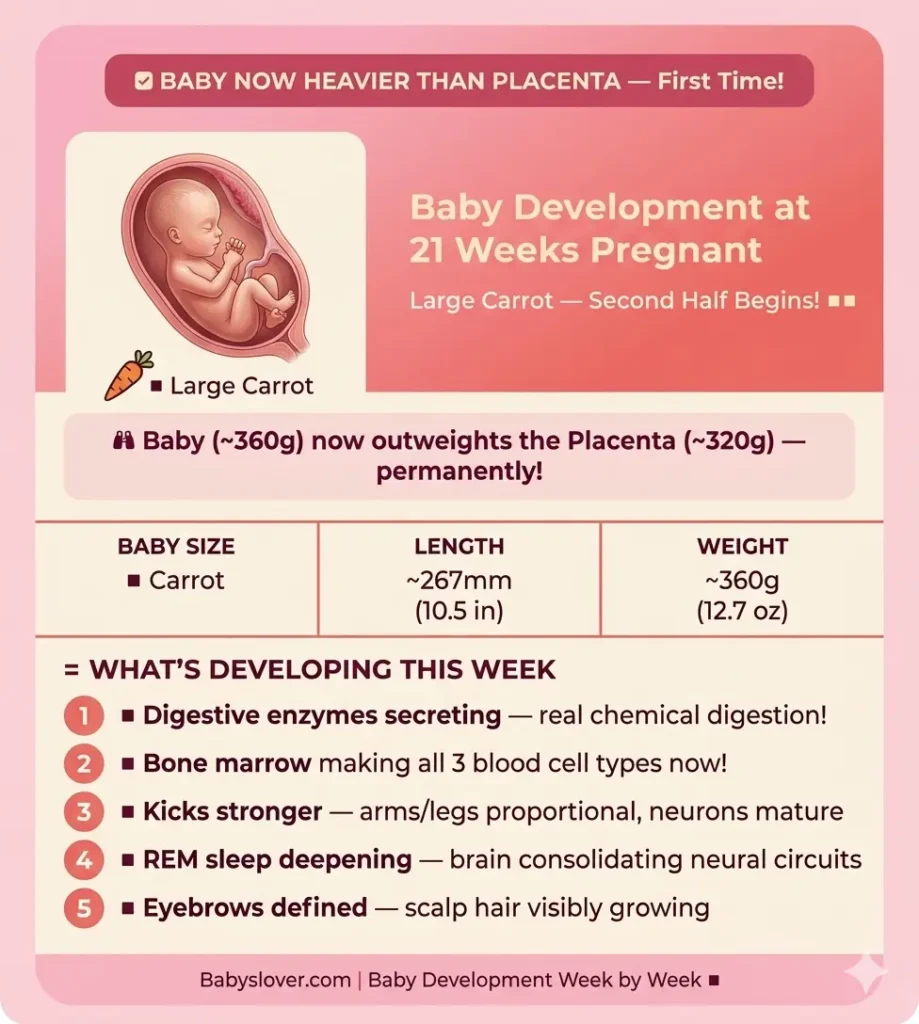
At 21 weeks pregnant, your baby measures approximately 267mm head-to-heel — the length of a large carrot — and weighs about 360 grams. For the first time in the entire pregnancy, that weight exceeds the weight of the placenta that has been sustaining the baby since implantation. The baby is now the dominant structure in the uterus by weight — a relationship that will continue to widen dramatically through the third trimester. The baby’s proportions are now fully normalized: the head, torso, and limbs all in the correct ratios that will be maintained to birth. And this week, the digestive system makes its most significant functional advance.

| 🌱 Baby Development at 21 Weeks Pregnant | |
| Baby Size | 🥕 Carrot — ~267mm head-to-heel (10.5 inches) |
| Weight | ~360 grams (12.7 oz) — heavier than placenta for the first time! |
| KEY MILESTONE | ⚖️ BABY IS NOW HEAVIER THAN THE PLACENTA — a permanent reversal! The support structure is no longer larger than the person it supports. |
What Is Developing at Week 21
- 🧫 Digestive enzymes secreting — the GI tract is actively processing: This is the week that separates practicing swallowing from actual digestion. From Week 21, the stomach and developing pancreas begin secreting digestive enzymes into the gastrointestinal tract — the same enzymes that will break down food after birth. These enzymes act on the amniotic fluid the baby swallows approximately 400-500ml of daily: proteins are broken down into amino acids, simple sugars are processed, and lipids begin to be emulsified. What can be absorbed — water, nutrients, immune factors — is absorbed through the intestinal wall via the developing intestinal villi (finger-like projections that dramatically increase gut surface area). What cannot be absorbed accumulates as meconium — the thick, dark substance building up throughout the large intestine that will become the baby’s first bowel movement in the first 24-48 hours after birth. At Week 21, meconium is being actively produced every time the baby swallows and digests amniotic fluid. By the time of birth, the intestine will hold a significant accumulation built over the final 19+ weeks of active digestion.
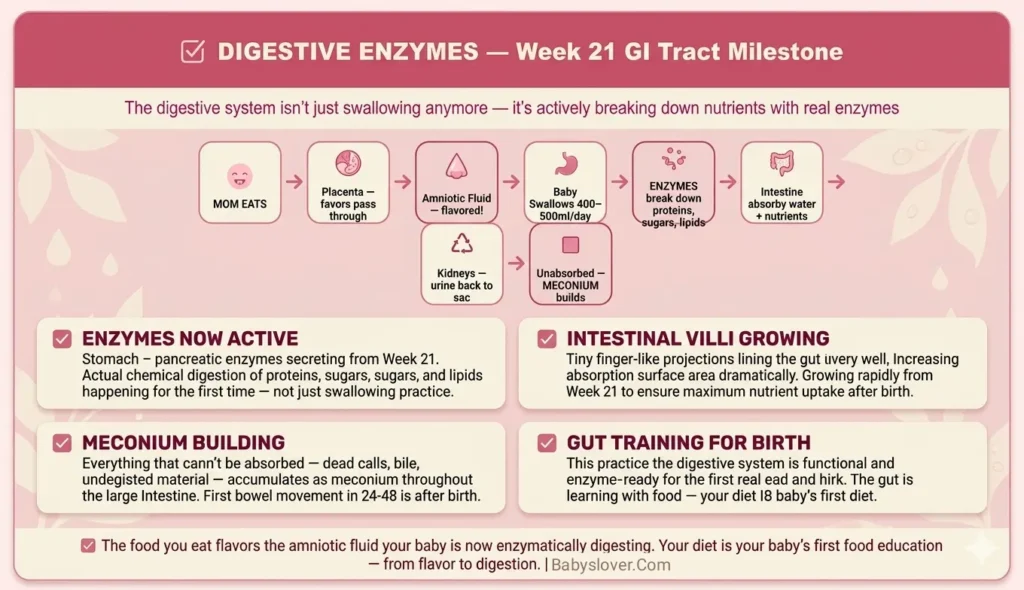
💡 The food you eat flavors the amniotic fluid. Your baby is now enzymatically digesting that flavored fluid. The taste buds wired at Week 19 are detecting the flavors; the digestive enzymes secreting at Week 21 are processing the nutritional components. Your diet is your baby’s first and most complete food education — from flavor preference to digestive enzyme priming. What you eat repeatedly now is what the gut is learning to process efficiently.
- 🩸 Bone marrow now making ALL blood cell types: At Week 20, the bone marrow activated for red blood cell production. By Week 21, the bone marrow has expanded its production to the full range of blood cells: red blood cells (carrying oxygen via hemoglobin), white blood cells (the immune defense cells), and platelets (the clotting cells that stop bleeding). This is the complete hematopoietic function — the marrow is now a fully operational blood factory across all three cell lineages simultaneously. The liver and spleen, which had been contributing to blood cell production throughout the second trimester, are now beginning the process of transferring those functions entirely to the bone marrow, a handoff that will be complete before birth. The baby’s developing immune system — dependent on white blood cell production — is becoming increasingly capable of mounting responses to pathogens, though it remains heavily supplemented by maternal antibodies transferred through the placenta.
- 💪 Kicks noticeably stronger — arms and legs fully proportional: The transition from flutters to genuine kicks happens around Week 21 for most women who are feeling movement, and the reason is architectural: the baby’s arms and legs have reached their correct proportional length relative to the body, the neurons connecting the motor cortex (fully formed since Week 18) to the limb muscles are now mature and myelinating, and cartilage has largely converted to bone in the leg bones — meaning the kicks now have solid bone leverage behind them rather than the flexible cartilage of earlier weeks. The result is a distinctly different sensation: not bubbles or butterflies, but discernible jabs, pushes, and rolling movements with a mechanical quality that leaves no doubt. Partners placing a hand on the abdomen during an active period may be able to feel movement from outside for the first time around Week 21-22.
- 💤 Sleep cycles deepening — REM increasing: The baby’s sleep-wake cycle, established from Week 18, is becoming more structured at Week 21. Sleep periods are increasingly characterized by rapid eye movement (REM) sleep — the neurologically active sleep state associated with neural development and, in adults, with dreaming. In fetal development, REM sleep is believed to play a critical role in brain maturation and memory consolidation — the neural circuits being built and tested during waking periods are potentially consolidated during REM sleep cycles. The baby sleeps approximately 12-14 hours per day at this stage, often in cycles of 20-40 minutes. The sleep cycles may not align with the mother’s — many women notice the baby is most active at night when they are trying to sleep, a pattern that has no physiological significance but is worth noting as preparation for newborn sleep behavior.
- 👁️ Eyebrows defined, scalp hair distinctly growing: By Week 21, the eyebrows are clearly defined structures — fine-haired and positioned correctly above the eyes, giving the face an increasingly readable expression even with the eyelids still fused. Scalp hair is now visibly growing from the follicles, with the density and color pattern established in the coming weeks. The face at 21 weeks is the face that will be born — the features, proportions, and expression-ready musculature are all in place. Detailed 3D/4D ultrasound performed around this time often captures recognizable facial features for the first time.
- ⚖️ Baby now heavier than the placenta: At approximately Week 21, the baby’s weight crosses the weight of the placenta — roughly 350-400 grams — for the first time. This is a milestone that no competitor covers explicitly but that represents a meaningful structural shift in the pregnancy: the person is now larger than its life-support system. The placenta will continue growing through the third trimester (reaching approximately 500-600 grams at term) but will never again be heavier than the baby it sustains. From Week 21, the baby’s weight gain curve accelerates dramatically relative to the placenta.
💡 Fun fact: Your baby is now heavier than the placenta that has been keeping it alive — a reversal that is permanent from this week forward. The placenta continues growing, but it will never outweigh the baby again. At Week 21 the baby weighs ~360g; the placenta ~300-350g. By Week 40: baby ~3,400g, placenta ~500-600g. The gap only widens from here. ⚖️
📅 Gestational Diabetes Screening — Opening in 3 Weeks
Between Weeks 24-28, every pregnant woman is offered screening for gestational diabetes — and Week 21 is the right time to understand what’s coming so the appointment isn’t a surprise. Here is what to expect:
What Is Gestational Diabetes?
Gestational diabetes (GDM) is a form of high blood sugar that develops during pregnancy in women who did not have diabetes before. It occurs when the hormones produced by the placenta — particularly human placental lactogen — interfere with insulin’s ability to regulate blood glucose. The placenta’s hormone production increases throughout the second trimester, which is why GDM typically develops in the second half of pregnancy and is screened for at Weeks 24-28. GDM affects approximately 6-9% of pregnancies in the US. When well-managed, it does not harm the baby — the risks arise when blood sugar remains consistently elevated and unmonitored.
The Glucose Challenge Test — What to Expect
- You drink a sweet glucose drink (50-gram glucose solution) — no fasting required
- One hour later, a blood draw checks your blood glucose level
- If glucose is below threshold (typically 130-140mg/dL depending on OB): screening passed
- If glucose is above threshold: you’re referred for the 3-hour glucose tolerance test (GTT) — a more comprehensive fasting test with multiple blood draws
- A positive 1-hour screen does NOT mean you have GDM — approximately 15-25% of women with a positive screen pass the 3-hour test
Week 21 actions: Ask your OB at your next visit to confirm when your glucose screening is scheduled. Continuing to eat a balanced diet with controlled refined sugar intake between now and Week 24 is a reasonable preparatory step.
What’s Happening in Your Body at 21 Weeks Pregnant
🧴 Itchy Skin — The Belly Stretch
As the uterus expands and the skin stretches to accommodate it, itchiness — especially across the abdomen, hips, and breasts — is one of the most common and underreported second-trimester symptoms. The stretching skin loses moisture and elasticity faster than it can be replaced by normal hydration. Management: moisturizing generously with unscented lotions, aloe vera gel, or oils (coconut oil, shea butter) on damp skin after showering. Staying well hydrated maintains skin moisture from inside. Severe itching — particularly on the palms and soles, or itching without a rash — at any point in the second or third trimester should be reported to your OB promptly, as intense unexplained itching can be a sign of intrahepatic cholestasis of pregnancy (ICP), a liver condition requiring monitoring.
🦵 Varicose Veins — Why They Appear and What to Do
The combination of increased blood volume, the growing uterus putting pressure on the inferior vena cava, and the effects of relaxin on vein walls causes varicose veins — enlarged, visible, sometimes uncomfortable veins — to appear in the legs for many women from the second trimester onward. They are most common in the calves and backs of knees, but can also occur in the vulvar area (vulvar varicosities). They are not dangerous, though they can be uncomfortable. Management: wearing graduated compression socks (put them on before getting out of bed in the morning, before blood pools in the veins), elevating legs when sitting, avoiding prolonged standing, and walking regularly. Varicose veins almost always improve significantly after delivery as blood volume normalizes. Distinguishing varicose veins from DVT: varicose veins are visible, bilateral or diffuse, and not accompanied by localized redness or warmth — DVT typically presents with unilateral calf pain, swelling, redness, and warmth, and requires same-day evaluation.
🦒 Thyroid Swelling — Neck Feeling Tight?
A lesser-known but common pregnancy development: the thyroid gland enlarges by approximately 10-15% during pregnancy in response to increased demands for thyroid hormone. HCG (human chorionic gonadotropin) stimulates thyroid activity throughout the first trimester; from the second trimester, the growing blood volume and fetal thyroid demands increase thyroid production requirements. The visible or tactile swelling of the thyroid gland — located at the base of the front of the neck — may be noticeable as a sense of tightness around the neck or collar area, or as a mildly visible fullness in the lower neck. This is normal physiology. However, symptoms of thyroid dysfunction — extreme fatigue, rapid heartbeat, significant weight loss despite adequate eating, or heat intolerance beyond normal pregnancy warmth — should be discussed with your OB, as both hyperthyroidism and hypothyroidism can develop or worsen during pregnancy and are manageable with monitoring.
😴 Night Kicks — Understanding Baby’s Active Hours
Many women notice their baby is most active at night — particularly between 9pm and midnight — and relatively quiet during daytime hours. This is not because the baby has a reversed sleep cycle. During the day, your movement while walking and going about daily activity acts as a rocking motion that soothes the baby to sleep. When you stop moving and lie down at night, the lulling motion stops and the baby wakes. Additionally, blood glucose levels after evening meals provide a burst of energy substrate that fuels increased activity. This pattern is a useful preview of newborn sleep behavior — and a reminder that movements in the next few weeks should be tracked for patterns rather than absolute counts.
🍽️ Ravenous Appetite — The Growth Surge
By Week 21, many women report significantly increased hunger — a genuine biological signal driven by the baby’s accelerating growth and the expanding metabolic demands of the pregnancy. The second trimester requirement is approximately 340 extra calories per day above pre-pregnancy baseline. The third trimester will add approximately 450 extra calories per day. The key is channeling increased appetite into nutrient-dense choices — the caloric increase is real, but an increase in empty calories doesn’t serve the developmental priorities of this phase. The digestive enzyme development at Week 21 means that what the baby processes from the amniotic fluid reflects your diet with increasing fidelity.
👟 Start Noticing Kick Patterns — Not Just Counting
Week 21 is an appropriate time to begin familiarizing yourself with your baby’s movement patterns — not formal kick counting (which is typically recommended from Week 28), but pattern awareness. Every baby develops consistent tendencies: most active in the evening, quiet after meals, vigorous after exercise, still during sleep cycles. Learning what normal looks like for your baby — established over weeks 21-27 — makes the formal kick counting at Week 28 more meaningful because you’ll have a baseline. At this stage, the important thing to note is that movement is present and regular, even if the timing and intensity vary. First-time mothers with anterior placentas (placenta attached to the front uterine wall) may still be feeling minimal movement — this is completely normal, as the placenta cushions the kicks before they reach the abdominal wall. If you have not felt any movement by Week 22-24, mention it to your OB.
What to Eat at 21 Weeks Pregnant — Feeding the Blood Factory and the Digesting Baby
The bone marrow’s expanded blood cell production and the digestive system’s new enzyme activity make iron, B vitamins, and choline the nutritional priorities of Week 21.
| Nutrient | Why Critical at Week 21 | Best Sources |
| Iron | BONE MARROW making all blood cell types — red + white + platelets. Hemoglobin requires iron for oxygen transport | Lean beef, spinach + vitamin C, lentils, fortified cereals, dark leafy greens. Pair with vitamin C! |
| Choline | BRAIN AND NERVOUS SYSTEM critical — choline is essential for neural tube integrity and memory center (hippocampus) development. Significantly under-consumed during pregnancy | Eggs (especially yolk — best source), beef liver (small amounts), salmon, chicken, dairy, legumes |
| B Vitamins (B1, B6, B12) | Energy production for rapid growth, nervous system development, red blood cell formation (B12), enzyme co-factors for digestion development | Whole grains, eggs, poultry, legumes, dairy, fortified cereals, leafy greens. B12: meat, fish, dairy |
| DHA Omega-3 | Brain architecture continuing — DHA incorporated into all new neural connections forming. Also anti-inflammatory: helps with varicose veins and swelling | Cooked salmon 2x/week, sardines, walnuts, chia, flaxseed, DHA prenatal vitamin |
| Vitamin C | Iron ABSORPTION enhancer — pair with every iron-rich meal. Also collagen synthesis for skin elasticity (stretch mark prevention supportive) | Bell peppers, broccoli, citrus, strawberries, kiwi — eat with iron foods |
| Fiber + Water | Constipation, varicose veins, Braxton Hicks, itchy skin — fiber and hydration are the foundation of symptom management at Week 21 | 25-30g fiber + 8-10 glasses water. Add magnesium-rich foods for leg cramps |
Choline is the most underestimated nutrient in pregnancy — research shows it’s as critical as folate for neural development, yet 90%+ of pregnant women don’t meet the recommended intake of 450mg/day. Two whole eggs provide approximately 300mg — the single most efficient choline delivery food available. Our best prenatal vitamins guide covers which formulas include meaningful choline amounts (most do not) and which DHA and iron combinations are most effective for the second half of pregnancy.
For Your Partner — Week 21 Meaningful Actions
- Try feeling the kicks: By Week 21-22, kicks are often strong enough to be felt from outside the abdomen when timed correctly. Place your hand firmly on the lower abdomen
- (continued) during a period when she says the baby is active. It may take several sessions before you feel it — the baby moves irregularly and the hand position matters. When you do feel it, this experience is one of the most reliably bonding moments of the second trimester for partners, because it converts the abstract (‘there’s a baby in there’) into the concretely physical (‘that is a kick’).
- Gestational diabetes screening — understand it together: The glucose challenge test is coming in 3 weeks. Understanding what it involves — a sweet drink, one hour wait, a blood draw — means she’s not walking into it anxious and unprepared. More importantly: a positive screen does not mean she has gestational diabetes. A significant percentage of women with positive screens pass the follow-up 3-hour test. Knowing this in advance prevents a positive 1-hour result from being treated as a diagnosis before it’s been confirmed.
- Compression socks — practical gift: If varicose veins or significant leg swelling is developing, graduated compression socks are one of the highest-impact low-cost practical contributions of the second half of pregnancy. Research a quality brand and have them ready. The key instruction: put them on before getting out of bed, before blood pools in the veins. Once the feet are already swollen and veins are engorged, the socks are less effective.
- Night kicks — do not take personally: If the baby’s active periods at night are disturbing her sleep and therefore yours — understand the physiology. The baby is not on a reversed schedule; it’s waking when the daytime motion that soothes it stops. There is nothing to be done about it except manage the sleep environment as well as possible. This is also a preview: newborn sleep behavior often follows similar patterns, and couples who understand this in advance approach the newborn period with more equanimity than those who don’t.
- Hospital bag research — begin now: The hospital bag checklist for mom gives a complete picture of what needs to be ready before labor. Week 21 is not too early to read it together and begin a list of what needs to be purchased. The third trimester begins at Week 27 — six weeks from now — and the bag should ideally be ready before Week 36.
When to Call Your Doctor at 21 Weeks Pregnant
- Heavy vaginal bleeding: Soaking a pad or passing clots — same-day OB contact.
- Severe or persistent abdominal pain: Distinct from round ligament twinges or Braxton Hicks — requires evaluation.
- Intense itching without visible rash — especially palms or soles: May indicate intrahepatic cholestasis of pregnancy (ICP) — prompt OB evaluation needed.
- One-sided calf pain with swelling, redness, warmth: DVT risk is elevated in pregnancy — same-day evaluation. Do not confuse with ordinary leg cramps.
- Fever above 100.4°F / 38°C: Prompt OB contact.
- Fluid leaking from vagina: Any persistent gush or trickle of clear fluid — same-day evaluation.
- No fetal movement felt by Week 22-24: If movement has not been established by this point, mention to your OB — especially if no anterior placenta explanation.
- Regular contractions before 37 weeks: Tightenings every 10 minutes or more frequently — OB evaluation needed.
Your Week 21 Pregnancy Checklist
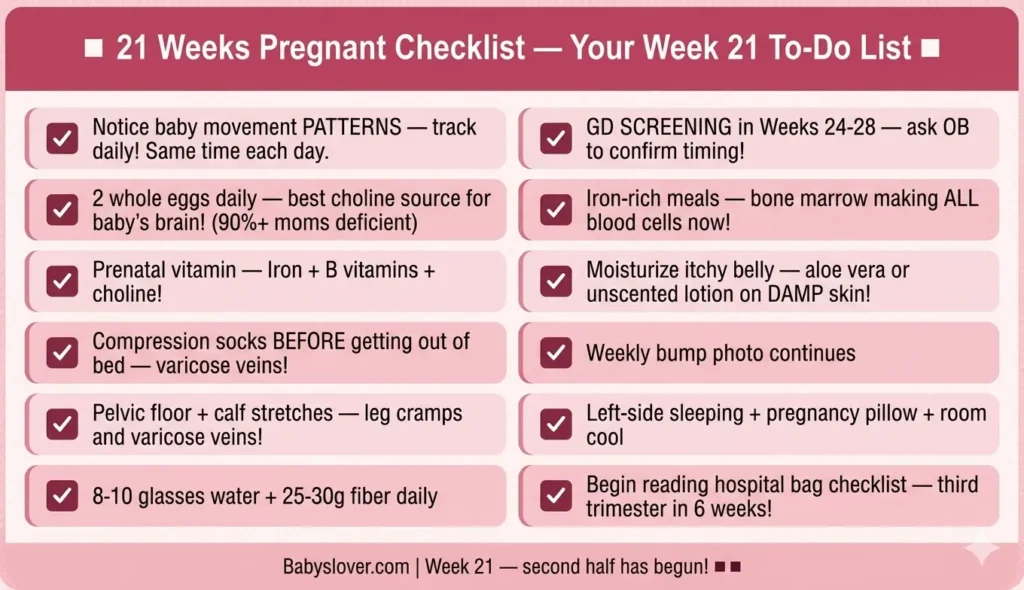
- ☑ 👶 Start noticing baby movement PATTERNS — same time each day, track the rhythm!
- ☑ 🩺 Ask OB about gestational diabetes screening — confirms Weeks 24-28 timing
- ☑ 💊 Prenatal vitamin daily — IRON + B vitamins + choline!
- ☑ 🥚 Two whole eggs daily — best choline source for baby’s brain!
- ☑ 🩸 Iron-rich meals + vitamin C pairing every day
- ☑ 🧴 Moisturize itchy belly skin — aloe vera or unscented lotion on damp skin
- ☑ 🧦 Compression socks before getting out of bed — varicose veins!
- ☑ 📸 Weekly bump photo continues
- ☑ 🏋️ Pelvic floor + calf stretches daily — leg cramps and varicose veins!
- ☑ 🌙 Left-side sleeping + pregnancy pillow + room cool
- ☑ 💧 8-10 glasses water + 25-30g fiber
- ☑ 📋 Begin reading hospital bag checklist — third trimester is 6 weeks away!
Frequently Asked Questions — 21 Weeks Pregnant
How big is my baby at 21 weeks pregnant?
At 21 weeks pregnant, your baby is approximately 267mm long from head to heel (10.5 inches) — the size of a large carrot — and weighs about 360 grams (12.7 oz). For the first time in the pregnancy, the baby’s weight exceeds the weight of the placenta. Growth continues rapidly: the baby will approximately double in weight again between now and Week 28.
When should I start kick counting?
Formal kick counting — where you track a specific number of movements in a defined time — is typically recommended from Week 28 onward by ACOG. But starting to notice movement patterns from Week 21-22 is valuable preparation. Learn when your baby is typically active, how many movements feel normal for your baby in a given hour, and what ‘quiet’ looks like versus ‘absent.’ By Week 28 when counting begins formally, you’ll already have a well-established baseline for your individual baby’s behavior.
What are gestational diabetes symptoms?
Gestational diabetes often has no obvious symptoms — which is why universal screening at Weeks 24-28 exists. When symptoms are present, they can include increased thirst, frequent urination (beyond normal pregnancy levels), fatigue (beyond normal pregnancy fatigue), and blurred vision. Because these symptoms overlap significantly with normal pregnancy experiences, they are unreliable as diagnostic indicators. The glucose challenge test at Weeks 24-28 is the reliable detection method.
Is it normal to feel itchy skin at 21 weeks pregnant?
Yes — itchy skin, especially across the stretching abdomen, is extremely common in the second trimester. Generous moisturizing on damp skin, staying well hydrated, and wearing loose natural-fiber clothing all help. The important distinction: itching on the belly from skin stretching is normal. Intense itching on the palms and soles, or intense itching without any visible rash, is not typical stretch-related itching and should be evaluated by your OB promptly — it can be a sign of intrahepatic cholestasis of pregnancy (ICP), a liver condition that requires monitoring.
What are Braxton Hicks contractions?
Braxton Hicks are practice contractions — a sudden tightening of the entire uterus lasting 30-60 seconds that can begin as early as Week 20-21. They are irregular, not progressively intensifying, and typically resolve with rest, position change, or hydration. Triggers include dehydration, a full bladder, physical activity, sexual activity, or the baby’s movements. They do not indicate preterm labor. If contractions are regular (every 10 minutes or more frequently), increasing in intensity, or accompanied by other symptoms such as discharge or pelvic pressure, contact your OB — this pattern differs from Braxton Hicks and requires evaluation.
Why does my baby kick more at night?
The most common explanation: your daytime movement soothes the baby to sleep — the walking and activity of a normal day creates a rocking motion that lulls the baby, just as rocking soothes a newborn. When you lie down at night and that motion stops, the baby wakes. Evening blood sugar peaks after dinner may also provide extra energy substrate for activity. This pattern is biologically normal and does not indicate a sleep-cycle problem. It is, however, a useful preview of newborn sleep patterns.
What is choline and why is it important in pregnancy?
Choline is an essential nutrient — as critical as folate for fetal brain development — that 90%+ of pregnant women don’t consume in adequate amounts. It is essential for neural tube integrity, hippocampus (memory center) development, and cell membrane formation throughout the brain. The recommended intake during pregnancy is 450mg/day. Two whole eggs provide approximately 300mg. The majority of prenatal vitamins contain little or no choline. If your prenatal vitamin doesn’t list choline on the label, eggs, meat, and dairy are the most important dietary sources to prioritize.
💗 The Emotional Reality of Week 21 — The Second Half
The second half of pregnancy is underway.
Week 21 carries a quality that is different from the first half — the baby’s weight has crossed the weight of the placenta for the first time, and there is something clarifying about that. The pregnancy is no longer primarily infrastructure-building. It is now primarily person-building: every week of the second half adds weight, function, fat, and capability to a baby whose architecture is essentially complete.
The digestive enzymes secreting this week are the first step toward a gut that will process its first real food in a matter of months. The bone marrow making every blood cell type is the foundation of an immune system that will last a lifetime. The kicks getting stronger are the early signs of a physical capability that will eventually pull itself upright, take a first step, run.
All of that is beginning in the second half. This week is the second half’s first chapter.
At Babyslover, we’re glad you’re reading it. 💗
👶 What Happens Next — 22 Weeks Pregnant Preview
22 weeks pregnant brings the second half’s pace-setting developments:
- 🍆 Spaghetti squash / large eggplant — ~28cm, ~430 grams
- GRIP TIGHTENS — baby can now grasp the umbilical cord!
- PAIN PERCEPTION begins developing in neural pathways (Week 24-25 completion)
- Surfactant production begins in lungs — critical for breathing air after birth
- Inner ear fully formed — balance sense developing alongside hearing
- Lips and eyebrows now fully formed — face looks strikingly newborn on 3D ultrasound
Keep following our complete pregnancy week by week guide — every week from here is building toward the birth that is now measurably closer. 💗
Week 21: The Carrot That Outweighed Its Life Support
Being 21 weeks pregnant means carrying a carrot-sized person who has just, for the first time, become heavier than the structure that has been keeping it alive. Whose digestive system is secreting enzymes and processing amniotic fluid with genuine chemical digestion. Whose bone marrow is running all three blood cell production lines simultaneously. Whose kicks are strong enough to be felt from outside the abdomen for the first time.
The second half of pregnancy has begun. The gestational diabetes screening is three weeks away. The hospital bag needs to be planned. The kick patterns are establishing themselves.
And inside — a carrot-sized person is digesting, kicking, sleeping, and growing. For everything ahead, our pregnancy tips for first time moms guide is with you, week 21 and all the weeks that follow. 💗