

One week from now is viability week 24. But the development happening this week — the week before — may matter as much as any lung milestone for who your child becomes: your baby is now learning to recognize your voice specifically. Not voices in general. Not the loudest sounds. Your voice — the one that has traveled to the womb thousands of times over the past months via bone conduction through your own body — is building a neural template in the auditory cortex that will make a newborn turn toward you in the first hours of life. That recognition, established right now at Week 23, is the foundation of the first social bond.
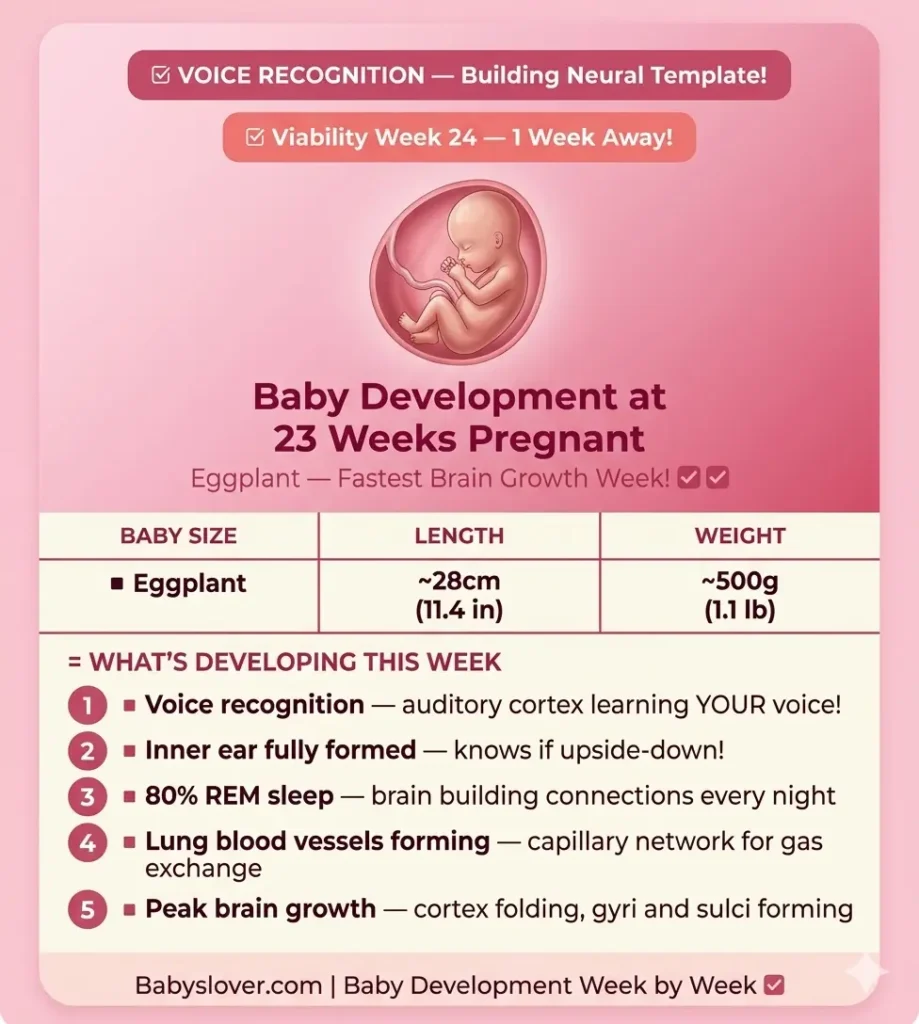
Week 23 is also when the inner ear reaches full structural development — meaning your baby now has a functional vestibular system capable of sensing orientation and balance, and can tell when floating upside-down versus right-side-up in the amniotic fluid. The lungs are forming the blood vessel network needed for gas exchange after birth. Eighty percent of the baby’s sleep is now REM sleep — the neurologically active state associated with brain development — meaning the brain is building and testing circuits around the clock even during the long sleep periods. And at 23 weeks pregnant, the eggplant-sized baby inside you weighs approximately 500 grams — just over a pound — and is growing at one of the fastest rates of the entire pregnancy. At Babyslover, here is the complete guide to Week 23: the voice recognition explained, the inner ear milestone, the viability conversation as it stands one week from the threshold, and everything you need to focus on right now.
Just finished last week? Our 22 weeks pregnant guide covered surfactant in depth, the viability survival rate table, and the flashlight trick.

| 📋 Quick Summary — Week 23 of Pregnancy | |
| Week | Week 23 of 40 — Second Trimester, Week 11 |
| Baby Size | 🍆 Eggplant / large grapefruit — ~29cm head-to-heel (11.4 inches) |
| Baby Weight | ~500 grams (just over 1 pound!) |
| KEY MILESTONES | 🎤 VOICE RECOGNITION — baby learning your voice specifically! • 👂 INNER EAR FULLY FORMED — functional balance/vestibular system! • 💤 80% REM SLEEP — brain building connections during every sleep • 🫁 LUNG BLOOD VESSELS forming — capillary network for gas exchange • 🧠 Fastest brain growth rate of the entire pregnancy this week • Skin beginning to thicken, fat deposits starting |
| Viability Note | ⏳ VIABILITY WEEK 24 is ONE WEEK AWAY. Surfactant production increasing each day. Every 24 hours from here adds to the odds. |
| Symptoms | Pregnancy brain (forgetfulness, brain fog), stress incontinence (leaking urine on laugh/sneeze), skin tags appearing, back pain worsening, heartburn intensifying, Braxton Hicks increasing, strong kicks noticeable daily |
| Act Now | 🎤 Talk, sing, read aloud to baby daily — voice recognition is being built RIGHT NOW. 🚨 Learn the preterm labor warning signs by name — one week from viability, knowing the difference matters. |
🌱 Baby Development at 23 Weeks Pregnant
At 23 weeks pregnant, your baby measures approximately 29cm head-to-heel — the size of a large eggplant or grapefruit — and weighs about 500 grams. The face, which has been building its structures since the first trimester, is now strikingly complete in detail: eyebrows are defined, lips are distinct, the nose is fully formed, and the eyes — still fused shut — are positioned and sized correctly for the face they’ll open in. Beneath the still-thin skin, fat deposits are beginning to lay down in earnest, and the week-over-week weight gain from here through the third trimester will be primarily fat and further organ maturation rather than structural development, which is largely complete.

| 🌱 Baby Development at 23 Weeks Pregnant | |
| Baby Size | 🍆 Eggplant — ~29cm head-to-heel (11.4 inches) |
| Weight | ~500 grams (just over 1 pound) — gaining ~100g each week now! |
| KEY MILESTONE | 🎤 VOICE RECOGNITION — the auditory cortex is building a neural template of your voice, specifically. Newborns recognize and turn toward their mother’s voice within hours of birth. This begins now. |
What Is Developing at Week 23
- 🎤 Voice recognition — your voice is being memorized: Sound has been reaching the womb since approximately Week 16-18. By Week 23, the auditory cortex — the brain region that processes sound — has developed to the point where it can begin distinguishing specific voice patterns from background noise. Your voice is the most consistently heard sound in the baby’s environment, and it arrives differently than external sounds: while sounds from outside travel through air, amniotic fluid, and uterine wall before reaching the baby’s ears, your voice also travels via bone conduction through your own body — making it richer, lower in pitch, and distinctly different from how it sounds to anyone listening from outside. The baby hears your voice thousands of times over the course of pregnancy, and by birth, that repetition has built a recognizable neural pattern. Research has consistently demonstrated that newborns preferentially turn toward their mother’s voice within hours of birth — they recognize it. That recognition is being constructed right now, this week, at Week 23.
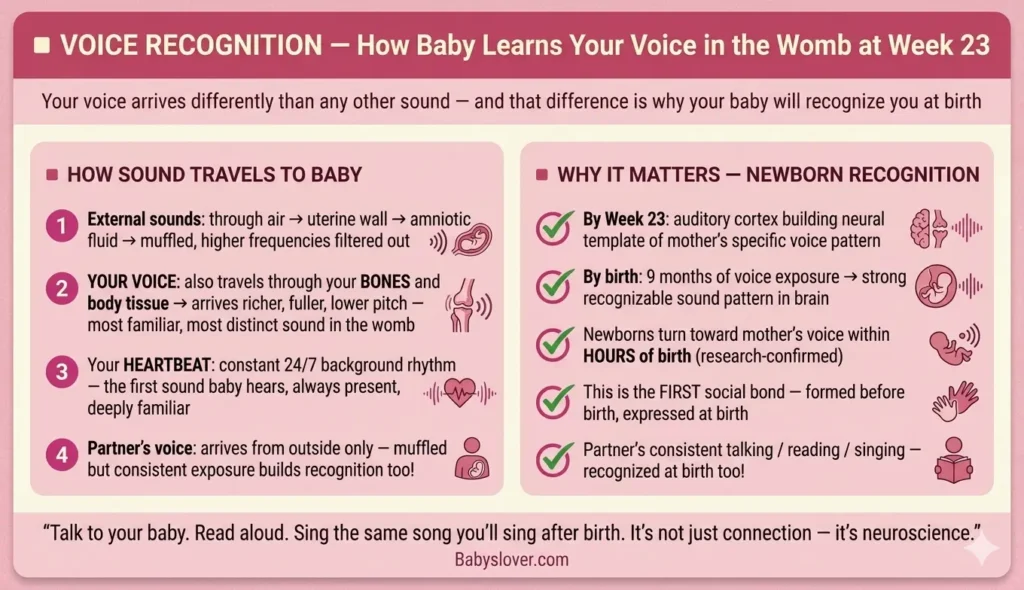
💡 Talk to your baby. Read aloud. Sing the same song repeatedly. It’s not just sweet — it’s neuroscience. The repeated exposure to your specific voice patterns builds the neural template that will make your baby recognize you from the first moments of life. Your partner’s voice travels from outside, so it arrives muffled and filtered — but consistent exposure through this period establishes that voice pattern too. The more consistently any voice is heard in the womb, the stronger the neural recognition at birth. 🎤
- 👂 Inner ear fully formed — the balance system is operational: The inner ear serves two distinct functions: hearing and balance. The cochlea (the hearing organ) has been developing for weeks. But at Week 23, the vestibular system — the balance organs — reaches full structural development. The vestibular apparatus consists of three semicircular canals and two otolith organs that detect both rotational movement and gravity. With this system complete, the baby can now sense orientation in the amniotic fluid — detecting whether it is upside-down, right-side-up, tilted, or spinning. The baby doesn’t cognitively understand these sensations yet — but the neural signals from the inner ear are being processed by the brain and are believed to play a role in the reflexes that cause newborns to right themselves and orient to gravity from birth.
- 💤 80% REM sleep — the brain-building state: At Week 23, approximately 80% of the baby’s sleep time is spent in REM sleep — a proportion that is dramatically higher than adult REM sleep (approximately 20-25%) and reflects the enormous neural developmental work underway. In REM sleep, the brain is highly active: neurons are firing, synaptic connections are being formed and tested, neural circuits are being consolidated. For a developing fetus, this level of REM activity is believed to be essential for building the brain architecture needed for the first weeks of life — the ability to respond to stimuli, to recognize familiar sounds and faces, to coordinate sucking and swallowing, and to begin the long process of learning. The 80% REM proportion at Week 23 gradually decreases through the third trimester as the brain matures — by the newborn stage it is approximately 50%, declining to adult levels through childhood.
- 🫁 Lung blood vessels forming — the gas exchange network: For the lungs to function after birth, two things must be present: surfactant (to keep air sacs open) and a capillary network surrounding each alveolus to extract oxygen from inhaled air and deliver it to the bloodstream. At Week 23, this capillary network is actively developing — the pulmonary vasculature (blood vessels of the lungs) is growing in parallel with the surfactant production that began last week. The gas exchange surface area of the lungs is increasing rapidly from this week onward. By Week 28-30, both the surfactant levels and the vascular network will have developed to the point where survival outside the womb — with intensive support — becomes increasingly probable.
- 🧠 Fastest brain growth rate of the pregnancy: Week 23 is one of the peak weeks for absolute brain growth rate — the cerebral cortex is growing and folding, with gyri (the ridges) and sulci (the grooves) beginning to appear on the brain’s surface. These folds are not cosmetic — they dramatically increase the surface area of the cortex, allowing more neural tissue to be packed into the skull. The cerebellum (coordination, balance) is growing particularly rapidly this week in parallel with the inner ear’s completion. The hippocampus — the brain’s memory center — is actively developing and is being primed by the auditory experiences the baby is having, including the voice recognition happening simultaneously.
- 🌡️ Skin beginning to thicken, fat deposits building: The thin, reddish, translucent skin of the early second trimester is beginning to change as subcutaneous fat starts depositing beneath the skin’s surface. The skin is still thin relative to a full-term newborn, but this is the beginning of the process that will, by Week 32-36, produce the rounder, softer, less wrinkled appearance of a near-term baby. The vernix caseosa — the white waxy coating that began forming at Week 17 — continues to thicken on the skin’s surface, protecting it from the constant amniotic fluid immersion.
💡 Fun fact: Your baby can now tell if it’s upside-down. The inner ear’s vestibular system is fully formed at Week 23, sending gravity and orientation signals to the brain. Those somersaults and flips you feel? The baby is not just moving randomly — it has a full sense of which direction is ‘down.’ This is the same balance system that will help a newborn orient itself and that will eventually allow a toddler to learn to walk. 👂
🚨 Preterm Labor Warning Signs — Know Them Before Week 24
With viability week 24 one week away and the third trimester approaching, Week 23 is exactly the right moment to learn the signs of preterm labor — not to cause anxiety, but because knowing the difference between normal pregnancy sensations and signs that warrant immediate contact can, in some cases, allow intervention that delays birth and gives the baby critical additional days or weeks of development. Preterm labor is labor that begins before Week 37. The earlier it is identified, the better the chance that tocolytic medications (medications that slow or stop contractions) can be used to delay delivery.
Signs That Require SAME-DAY OB Contact or Emergency Room
- Regular contractions coming every 10 minutes or more frequently: Four or more contractions in one hour before Week 37, especially if they do not stop with rest, position change, and hydration, require immediate evaluation. These are different from occasional Braxton Hicks — they are regular, increasingly intense, or not stopping
- Persistent dull lower back pain: New, constant, or rhythmically worsening back pain — particularly pain that comes in waves or follows a pattern — is different from the postural back pain of normal pregnancy and can indicate uterine contractions.
- Pelvic pressure: A feeling that the baby is pushing down, or pressure in the pelvis or vagina that is new or increasing — “the baby feels lower than usual” — can indicate cervical changes.
- Vaginal discharge changes: Discharge that becomes watery (possible amniotic fluid leakage), mucus-like, or bloody (possible bloody show) before 37 weeks requires same-day evaluation.
- Abdominal cramps: Cramps similar to menstrual cramps — with or without diarrhea — that are persistent, rhythmic, or worsening.
If you are uncertain whether what you are experiencing is preterm labor or normal pregnancy discomfort, the answer is always: call your OB. A provider would far rather evaluate a normal pregnancy symptom than have a woman delay contacting them out of not wanting to bother anyone. Preterm labor that is identified early has more management options than labor that has progressed significantly.
What’s Happening in Your Body at 23 Weeks Pregnant
🧠 Pregnancy Brain — Forgetfulness Is Real
Forgetting words mid-sentence. Walking into a room and not knowing why. Missing appointments that are written in the calendar. Pregnancy brain — the forgetfulness and cognitive fog that many women notice in the second trimester — is real, measurable, and has neurological explanations beyond just ‘hormones.’ During pregnancy, the brain actually undergoes structural changes: gray matter in specific regions involved in social cognition decreases in volume — a process believed to serve the function of fine-tuning neural circuits for the heightened social sensitivity required for parenting. Sleep disruption compounds the effect significantly. Research has shown that the degree of cognitive change correlates with the degree of attachment the mother feels toward the baby — suggesting it may be an adaptive reconfiguration rather than a deficit. It typically resolves within the first year after birth. What helps: written lists and calendars, simplifying decisions where possible, and treating memory lapses with humor rather than frustration.
💧 Stress Incontinence — Leaking When You Laugh
Leaking a small amount of urine when coughing, sneezing, laughing, or exercising — stress incontinence — affects a majority of pregnant women by the second trimester. The cause is mechanical and hormonal: the growing uterus places increasing pressure on the bladder, the pelvic floor muscles are affected by relaxin’s softening effects, and the bladder sphincter is under constant additional load. Management is primarily pelvic floor exercises (Kegel exercises) — three sets of 10-15 contractions daily, every day — which strengthen the muscles that control urinary sphincter function. Use panty liners for comfort. Stress incontinence is very common and temporary — it almost always improves significantly after delivery and pelvic floor recovery. Distinguish between stress incontinence and amniotic fluid leakage: amniotic fluid is continuous (it doesn’t stop), clear and odorless, and may be accompanied by a small gush. Stress incontinence is intermittent, associated with specific triggering activities, and stops. If you are uncertain which you are experiencing, contact your OB — amniotic fluid leakage requires immediate evaluation at any gestational age.
🏷️ Skin Tags — Tiny, Harmless, Temporary
Small, soft growths of skin appearing in areas where skin rubs against skin or clothing — underarms, neck, bra line, groin — are skin tags, a common pregnancy symptom driven by hormonal changes and increased friction. They are completely benign and cause no harm. They do not require treatment. Many resolve on their own after delivery as hormone levels normalize; others can be easily removed by a dermatologist after pregnancy if desired. They are not a sign of any underlying condition and are simply one of the many hormonal skin changes of pregnancy.
🔥 Heartburn Escalating — The Mechanical and Hormonal Double Cause
By Week 23, the uterus has risen high enough to begin physically pushing the stomach upward — compressing it and reducing its capacity — while simultaneously, progesterone continues relaxing the lower esophageal sphincter (the valve between the stomach and esophagus) that prevents acid reflux. The result is the classic pregnancy heartburn that worsens progressively through the third trimester. Management: smaller, more frequent meals; remaining upright for at least 30-45 minutes after eating; avoiding spicy, fatty, acidic, and carbonated foods; elevating the head of the bed; and antacids safe for pregnancy (calcium carbonate antacids such as Tums are widely used and also provide calcium — ask your OB for their recommendation). Proton pump inhibitors and H2 blockers are also available in pregnancy-safe formulations if dietary management is insufficient.
What to Eat at 23 Weeks Pregnant — DHA for the REM Brain
The brain growing at its fastest rate and spending 80% of sleep in REM state makes DHA omega-3, choline, and iron the nutritional headliners of Week 23.
| Nutrient | Why Critical at Week 23 | Best Sources |
| DHA Omega-3 | FASTEST BRAIN GROWTH WEEK — DHA is structural fat for neural tissue. Auditory cortex building voice recognition templates needs DHA. REM sleep neural consolidation requires adequate DHA | Cooked salmon 2x/week, sardines, DHA-fortified eggs, walnuts, chia seeds, DHA prenatal vitamin |
| Choline | Hippocampus (memory center) developing rapidly alongside voice recognition — choline is critical for neural tube integrity and memory system architecture. 450mg/day target | Whole eggs (best source — 2 eggs = ~300mg), beef, salmon, chicken, dairy |
| Iron | Bone marrow blood production continuing + fetal brain needs iron for myelination (nerve insulation) which is accelerating during the peak brain growth week | Lean beef, spinach + vitamin C, lentils, fortified cereals — pair with vitamin C always |
| Calcium + Vit D | Lung capillary network developing — calcium needed. Bone density continuing. Also inner ear’s bony labyrinth (vestibular system) is fully formed and structurally complete | Dairy, fortified plant milk, leafy greens, sardines, fortified OJ, sunshine + supplement |
| Protein | Rapid weight gain now primarily brain, muscle, and fat tissue — all require protein. 70-100g/day supports both neural development and the 500g/week growth rate now underway | Eggs, Greek yogurt, lean meats, legumes, cottage cheese, tofu, edamame |
| Fiber + Water | Heartburn escalating + stress incontinence + constipation all managed by hydration and fiber. Small frequent meals for heartburn require consistent fiber across multiple meals | 25-30g fiber + 8-10 glasses water. Oats, pears, prunes for constipation. Small frequent meals. |
DHA is the most important nutrient this week — and unfortunately the hardest to get from diet alone without fish. If you’re not eating cooked fatty fish twice a week, a DHA supplement of at least 200-300mg/day is strongly worth discussing with your OB. Most prenatal vitamins contain DHA in meaningful amounts, but the levels vary widely — our best prenatal vitamins guide covers which formulas include the most effective DHA concentrations for the second half of pregnancy.
For Your Partner — Week 23 Meaningful Actions
- Talk to the baby — your voice matters too: Your partner’s voice reaches the baby filtered through amniotic fluid and uterine wall — it arrives muffled and lower frequency than from inside. But consistent exposure from Week 23 onward builds a recognizable pattern. Read aloud, talk directly to the bump, sing — the baby is building a neural template of this voice too. Research on newborn voice preference consistently shows that babies recognize both parents’ voices with regular prenatal exposure. Ten minutes a day of talking, reading, or singing is meaningful neural input.
- Learn the preterm labor signs together: With viability week 24 one week away, this is the right week to review the preterm labor warning signs together so both of you know what to look for: regular contractions every 10 minutes or less, persistent lower back pain in waves, pelvic pressure, changes in discharge, abdominal cramping. If she experiences any of these, the answer is to call the OB — not to wait until morning, not to ‘see how it goes.’ Two people who know the signs are twice as likely to act appropriately.
- Stress incontinence — normalize it: If she laughs and leaks a small amount of urine, or needs to cross her legs before sneezing — this is stress incontinence, a majority-of-pregnant-women experience, not something unusual. How you respond to this as a partner matters: normalizing it without comment or humor at her expense makes it a non-issue. The pelvic floor exercises she’s doing daily will help, and the condition is temporary. The least helpful response is making it a moment of embarrassment.
- Hospital tour: Many hospitals offer prenatal tours of the labor and delivery unit. This is the right time to book one — the third trimester begins in four weeks, and walking through the labor and delivery floor before labor begins reduces anxiety significantly for both partners. Knowing where to park, where the entrance is, what the room looks like, and what to expect when you arrive makes the birth day itself substantially less overwhelming.
- Begin the hospital bag list: The hospital bag checklist for mom is detailed and involves items that need to be sourced — nursing bras, nipple cream, specific personal items — that take time to buy and prepare. Third trimester begins at Week 27. Reading the list now and beginning to gather items over the coming weeks means the bag is ready well before Week 36, which is the target.
When to Call Your Doctor at 23 Weeks Pregnant
- Regular contractions before Week 37: Every 10 minutes or more frequently, especially if not stopping with rest and hydration — same-day OB contact or emergency room.
- Persistent rhythmic lower back pain or pelvic pressure: New or worsening waves of back pain or a feeling that the baby is pushing down — same-day evaluation for preterm labor.
- Changes in vaginal discharge: Watery (possible amniotic fluid), bloody, or mucus-like discharge before Week 37 — same-day evaluation.
- Continuous fluid leaking from vagina: Any persistent trickle or gush of clear, odorless fluid — same-day emergency evaluation.
- Heavy vaginal bleeding: Soaking a pad or passing clots — same-day emergency contact.
- Sudden swelling of face, hands, or one leg: Face/hand swelling: possible preeclampsia — urgent. One-leg swelling: possible DVT — same-day.
- Fever above 100.4°F / 38°C: Prompt OB contact.
- Decreased or absent fetal movement: If movement that has been established goes suddenly quiet, lie on your left side for one hour and count movements. If fewer than 10 movements in one hour and your baby has been consistently active — contact your OB.
Your Week 23 Pregnancy Checklist
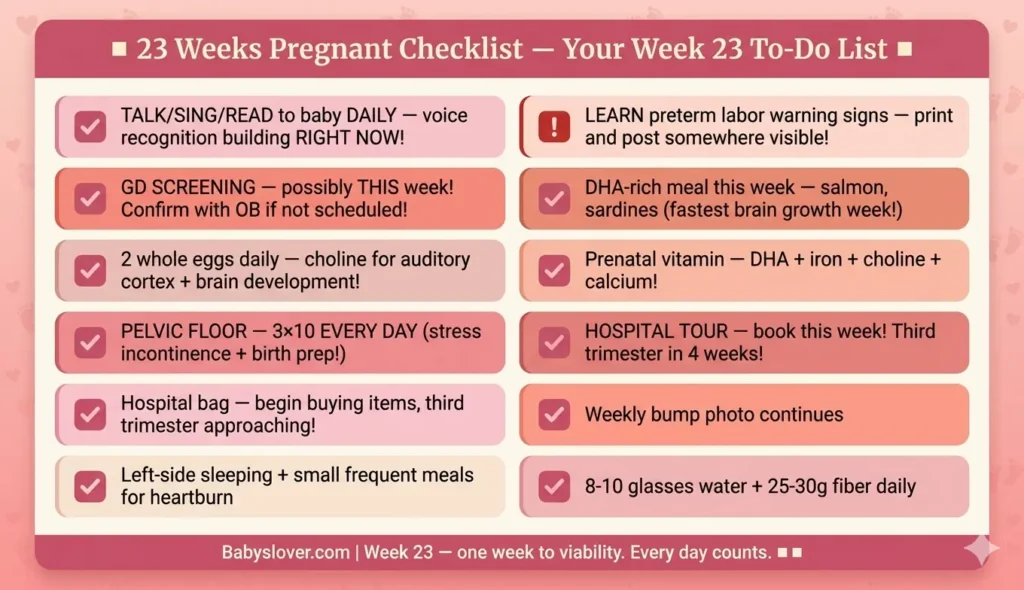
- ☑ 🎤 TALK, SING, READ to baby daily — voice recognition is being built right now!
- ☑ 🚨 Learn preterm labor warning signs by name — print and post somewhere visible
- ☑ 🩺 GD screening possibly THIS week — confirm with OB if not yet scheduled
- ☑ 💊 Prenatal vitamin daily — DHA + iron + choline + calcium!
- ☑ 🐟 DHA-rich meal this week — salmon, sardines, or DHA supplement
- ☑ 🥚 Two whole eggs daily — choline for the peak brain growth week!
- ☑ 🏋️ Pelvic floor exercises — 3×10 EVERY DAY (stress incontinence + birth prep!)
- ☑ 📋 Hospital tour — book this week! Third trimester in 4 weeks
- ☑ 🏥 Hospital bag — begin the list, start buying items
- ☑ 📸 Weekly bump photo continues
- ☑ 🌙 Left-side sleeping + pregnancy pillow + small meals for heartburn
- ☑ 💧 8-10 glasses water + 25-30g fiber daily
Frequently Asked Questions — 23 Weeks Pregnant
How big is my baby at 23 weeks pregnant?
At 23 weeks pregnant, your baby is approximately 29cm long from head to heel (about 11.4 inches) — the size of a large eggplant or grapefruit — and weighs about 500 grams (just over 1 pound). The baby is gaining approximately 100 grams per week at this stage and will continue at this pace or faster through the third trimester, eventually reaching approximately 3,200-3,600 grams (7-8 pounds) at term.
Can my baby hear me talking at 23 weeks?
Yes — your baby can hear and is specifically learning to recognize your voice at 23 weeks. The auditory cortex is building a neural template of your voice pattern through repeated exposure. Your voice is the most heard sound in the womb and reaches the baby via both air conduction (from outside) and bone conduction (through your body), making it recognizable in a unique way. Research consistently shows that newborns preferentially orient toward their mother’s voice within hours of birth — this recognition begins forming around Week 22-23. Talking, reading aloud, and singing directly are all meaningful at this stage.
What is the viability week 24 threshold?
Week 24 is the generally recognized threshold of viability — the gestational age at which survival outside the womb becomes possible, though difficult, with intensive NICU care. At exactly 24 weeks, survival rates are approximately 40-70%, and survivors face significant risks of complications. Viability does not mean the outcome is good — it means intensive intervention has a meaningful chance of success. Every week from 24 onward improves outcomes dramatically. Week 23, where you are now, is one week before that threshold — but every day between now and Week 40 adds to both survival probability and quality-of-life outcomes.
What does 80% REM sleep mean for my baby?
At 23 weeks, approximately 80% of your baby’s sleep time is spent in REM — rapid eye movement — sleep, the neurologically active sleep state in which the brain is highly active and neural circuits are being formed, tested, and consolidated. For a developing brain, this is believed to be essential for building the architecture needed for newborn function — sensory processing, motor coordination, social responsiveness, and early learning. The proportion gradually decreases as the brain matures — newborns are at approximately 50% REM, declining to adult levels (20-25%) through childhood.
What are preterm labor signs at 23 weeks?
Preterm labor signs before Week 37 that require same-day OB contact include: regular contractions every 10 minutes or more frequently (especially if not stopping with rest and hydration), persistent rhythmic lower back pain, new pelvic pressure or a feeling the baby is pushing down, changes in vaginal discharge (watery, bloody, or mucus-like), abdominal cramps with or without diarrhea, and fluid leaking from the vagina. If you are unsure whether what you’re experiencing is preterm labor or normal pregnancy discomfort, call your OB — providers would always rather evaluate than have you wait.
What is stress incontinence in pregnancy?
Stress incontinence — leaking a small amount of urine when coughing, sneezing, laughing, or exercising — is extremely common in the second and third trimester. It’s caused by the growing uterus compressing the bladder combined with relaxin’s effect on pelvic floor muscles. The most effective management is daily Kegel exercises (3 sets of 10-15 contractions). The important distinction: if fluid leaks continuously or you are uncertain whether it is urine or amniotic fluid, contact your OB — continuous clear odorless leaking requires evaluation.
Is pregnancy brain real?
Yes — pregnancy brain is real and neurologically measurable. Research using brain imaging has shown that gray matter in specific cortical regions decreases in volume during pregnancy — a process believed to represent adaptive neural remodeling for parenting rather than general cognitive decline. Sleep disruption, stress, and hormonal changes also contribute to the forgetfulness and focus difficulties many women notice. The changes are temporary and typically resolve within the first year after birth. Written lists, calendars, and reminder systems are the most practical management strategies.
💗 The Emotional Reality of Week 23 — One Week From a Threshold
One week from now is viability week 24.
That fact may land differently depending on how you came to this pregnancy, what your experience of the first and second trimesters has been, and what the word ‘viability’ means to you emotionally. For some women, it feels like a finish line. For others, it feels like the first time the precariousness of the situation has been named explicitly. Both responses make sense. Both are honest.
What is also true: every week from now adds to the odds in measurable, documented ways. The surfactant increasing daily in the lungs. The blood vessels forming in the alveoli. The brain folding and building. The voice recognition happening right now — the neural template being constructed this week that will make a newborn turn toward you in the first hours of life. That bonding is beginning in the womb. It is happening at Week 23.
Talk to your baby today. Read something aloud. Sing something you’ll sing again after birth.
At Babyslover, we think that’s worth doing this week specifically. 💗
👶 What Happens Next — 24 Weeks Pregnant Preview
24 weeks pregnant— viability week — arrives with its own remarkable developments:
- 🌽 Large corn / ear of corn — ~30cm, ~600 grams
- ✅ VIABILITY THRESHOLD REACHED — the medical milestone that Week 23 has been building toward
- Eyelids begin to open for the first time — eyes will be open by Week 26-28
- Taste buds fully formed — baby tasting amniotic fluid flavors with complete taste system
- Lung maturation accelerating — surfactant levels rising meaningfully
- GD screening — many women have their glucose challenge test this week
Keep following our complete pregnancy week by week guide — viability week is one week away, and next week’s guide covers exactly what the threshold means and what continues developing from there. 💗
Week 23: The Eggplant That Learned to Know You
Being 23 weeks pregnant means carrying an eggplant-sized person who is actively building the neural template of your voice — the pattern that will make them turn toward you within hours of birth, before they can see your face. Whose inner ear is fully formed and sensing every movement and orientation. Whose brain is spending 80% of sleep in REM, building connections in the dark. Whose lungs are threading blood vessels through developing alveoli, one day closer to breathing.
One week from now is viability week 24. But the voice recognition happening this week is, in its own way, already a form of arrival.
For everything ahead, our pregnancy tips for first time moms is with you from Week 23 to the end. 💗
1 thought on “23 Weeks Pregnant: Baby Size, Symptoms & Development”