

Welcome to 28 weeks pregnant — and third trimester. This weeks Your baby has crossed the first kilogram. That number — one full kilogram, 2.2 pounds — feels different from all the other weekly updates.
It marks a shift in what’s happening inside your belly. Fat is layering under the skin. The brain surface is wrinkling into its final architecture. The lungs are rehearsing breath after breath. And your baby can now dream.
Twelve weeks from now, this same baby will be in your arms. Here’s everything happening this 28 weeks pregnant — and third trimester.
Coming from last week? Our 29 weeks pregnant guide covered voice recognition and the inner ear milestone in depth.

Contents
- 1 Quick Summary: 28 Weeks Pregnant
- 2 What’s Happening in Your Body at 28 Weeks Pregnant
- 3 Baby Development at 28 Weeks Pregnant
- 4 Why Your Baby’s Brain Is Wrinkling Right Now
- 5 28 Weeks Pregnant Symptoms
- 6 Why Sleep on Your Left Side — The Real Reason
- 7 Fundal Height — What Your Midwife Is Measuring
- 8 The RhoGAM Shot at 28 Weeks — Fully Explained
- 9 How to Count Kicks — The Complete Guide
- 10 Nutrition at 28 Weeks Pregnant
- 11 Partner Tips for Week 28
- 12 Week 28 Checklist
- 13 Frequently Asked Questions — 28 Weeks Pregnant
- 13.1 What trimester is 28 weeks pregnant?
- 13.2 How many months is 28 weeks pregnant?
- 13.3 How much does a baby weigh at 28 weeks?
- 13.4 Can a baby survive at 28 weeks?
- 13.5 When do kick counts start?
- 13.6 What is the RhoGAM shot at 28 weeks?
- 13.7 Why do I feel so tired at 28 weeks pregnant?
- 13.8 Is it normal to have Braxton Hicks at 28 weeks?
- 14 Looking Ahead: 29 Weeks Pregnant
Quick Summary: 28 Weeks Pregnant
| Detail | Info |
| Baby size | Large eggplant — about 37–38 cm, ~1 kg (2.2 lbs) |
| Trimester | Third trimester begins |
| Months pregnant | 7 months pregnant |
| Weeks remaining | 12 weeks to go |
| Top milestone | First kilogram reached |
| This week’s action | Start kick counts + ask about RhoGAM |
What’s Happening in Your Body at 28 Weeks Pregnant
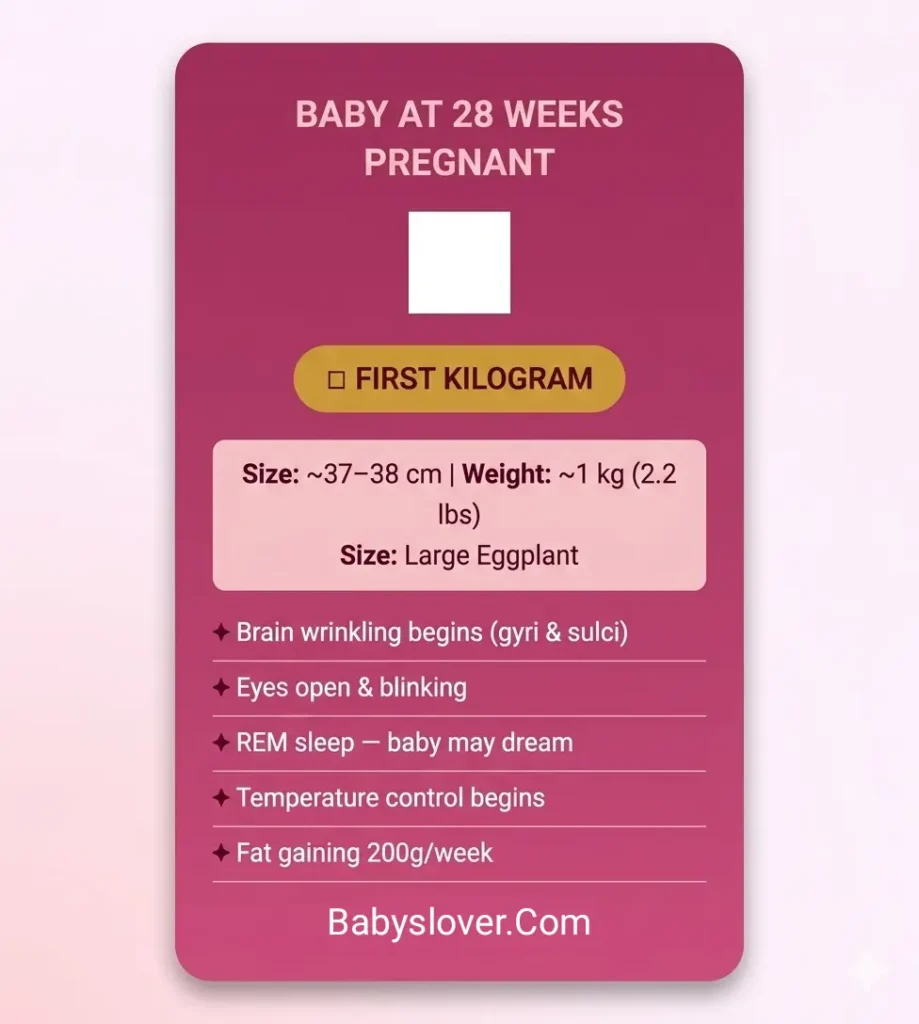
At 28 weeks pregnant, your uterus sits about 3.5 inches above your belly button. Your total weight gain is typically between 17 and 24 pounds — though this varies widely and both ends are completely normal.
Blood volume is still expanding. Your heart is working harder than it ever has. And your body is now preparing for two things simultaneously: keeping your growing baby nourished, and beginning the long preparation for labor.
Your appointments shift this week too. From here until Week 36, most providers move to biweekly visits — every two weeks instead of monthly.
What to expect at your Week 28 appointment:
- Blood pressure check (preeclampsia screening becomes more important now)
- Urine test for protein
- Fundal height measurement (tape measure — explained below)
- Baby’s heartbeat
- Gestational diabetes results discussion
- RhoGAM injection if you are Rh-negative
- Kick count instructions
Baby Development at 28 Weeks Pregnant

At 28 weeks pregnant, your baby measures approximately 37–38 cm from head to heel and weighs around 1 kilogram — roughly the weight of a bag of sugar.
| Detail | Measurement |
| Length | ~37–38 cm (about 14.8 inches) |
| Weight | ~1 kg (2.2 lbs) — FIRST KILOGRAM! |
| Size comparison | Large eggplant or head of lettuce |
| Heart rate | 110–160 bpm |
Key developments this week:
- Brain surface wrinkling: The brain begins forming gyri (ridges) and sulci (grooves) — folding to pack more neurons into the skull. More surface area = more connections = more capability.
- Eyes open and blinking: Your baby can open and close their eyes. Eyelashes are visible. A flashlight on your belly may cause baby to blink and turn away.
- REM sleep and dreaming: REM sleep is fully established. Researchers believe babies at this stage may experience something like dreams.
- Temperature regulation: Baby can now regulate their own body temperature — a huge milestone for life outside the womb.
- Fat accelerating: Baby is gaining roughly 200 grams per week from here forward — insulating for temperature control, storing metabolic energy, and supporting brain cell structure.
- Surfactant maturing: A baby born at 28 weeks today has roughly a 90% survival rate with NICU support.
- Boys: Testicles typically descend from the abdomen into the scrotum around Weeks 27–28.
Why Your Baby’s Brain Is Wrinkling Right Now
Before Week 28, your baby’s brain surface looks remarkably smooth. That begins to change this week.
The brain starts forming folds called gyri and sulci. This isn’t random — the brain is solving a packaging problem. It needs far more surface area than a smooth sphere can provide. By folding, it multiplies surface area dramatically without needing the skull to grow larger.
The cerebral cortex — responsible for thinking, memory, language, and personality — is laying down new neurons at a pace that won’t be matched again after birth.
This is why DHA matters so much in the third trimester. The American Academy of Pediatrics recommends 200 mg of DHA daily during pregnancy specifically for this phase of brain development.
28 Weeks Pregnant Symptoms
Shortness of Breath
Your uterus is pressing upward against your diaphragm. Your lungs have less room to expand. Rest when needed. If shortness of breath is sudden or severe, call your provider.
Braxton Hicks Contractions
By 28 weeks, Braxton Hicks are more noticeable — tightening across the front of your belly, irregular, painless, and brief. Real labor contractions wrap from back to front and intensify over time. If you’re getting more than 4 in an hour, or if they become painful, contact your provider.
Back Pain and Pelvic Pressure
Your center of gravity has shifted. Relaxin is loosening every joint in your body — including your pelvis and lower back. A pregnancy support belt can help. So can sleeping with a pillow between your knees.
Leg Cramps
Leg cramps at night are extremely common from Week 28 onward. Magnesium deficiency is a common contributor. Talk to your provider about magnesium glycinate.
Heartburn
Your growing uterus is pushing stomach acid upward. Smaller, more frequent meals help. Avoid lying down within 30 minutes of eating.
Leaking Colostrum
Some women notice a yellowish fluid leaking from their nipples around Week 28. This is colostrum — your baby’s first milk. Do NOT try to express or squeeze it out — stimulation can trigger contractions.
Sciatica
As your baby shifts position, they can press against the sciatic nerve — sending shooting pain from your lower back through your buttock and leg. Stretching, yoga, and prenatal massage help significantly.
Why Sleep on Your Left Side — The Real Reason
Running along the right side of your spine is the inferior vena cava (IVC) — the large vein that carries blood from your lower body back to your heart. When you lie flat on your back, your uterus compresses this vein, reducing blood flow back to your heart by up to 25%.
Less blood returning to your heart means less blood pumped out — including to your placenta and baby.
Sleeping on your left side moves your uterus off the IVC entirely. Blood flows freely. Your baby gets consistent circulation through the night.
| Sleep Position | Status | Why |
| Left side | Best | IVC completely free, optimal circulation |
| Right side | Acceptable | Partial IVC compression but manageable |
| Back | Avoid for extended sleep | Compresses IVC, reduces blood flow to baby |
| Stomach | Not possible at 28 weeks | Belly size prevents this |
Fundal Height — What Your Midwife Is Measuring
From Week 28 onward, your provider will measure your Symphysis Fundal Height (SFH) at every appointment — the distance from the top of your pubic bone to the top of your uterus, in centimeters.
Rule of thumb: fundal height in cm roughly equals weeks of pregnancy. At 28 weeks, SFH should be approximately 26–30 cm.
If SFH measures significantly smaller or larger, your provider may order a growth scan — not because something is necessarily wrong, but to get a clearer picture. Don’t panic if your measurement is off by a couple of centimeters.
The RhoGAM Shot at 28 Weeks — Fully Explained
If your blood type is Rh-negative (A-, B-, AB-, or O-), your provider will offer you a RhoGAM injection at your Week 28 appointment. Here’s what you actually need to understand.
| Question | Answer |
| Why does it matter? | If you’re Rh-negative and baby is Rh-positive, your immune system can develop antibodies that attack future pregnancies. |
| What does RhoGAM do? | It intercepts any Rh-positive blood cells that enter your bloodstream before your immune system can respond — permanently preventing antibody formation. |
| When given? | At 28 weeks, and again within 72 hours after delivery if baby is Rh-positive. |
| Is it safe? | Yes. Used since the 1960s with an exceptional safety record. Mild soreness at injection site is the only expected side effect. |
| What if unsure of blood type? | This week’s appointment is the perfect time to ask. |
How to Count Kicks — The Complete Guide
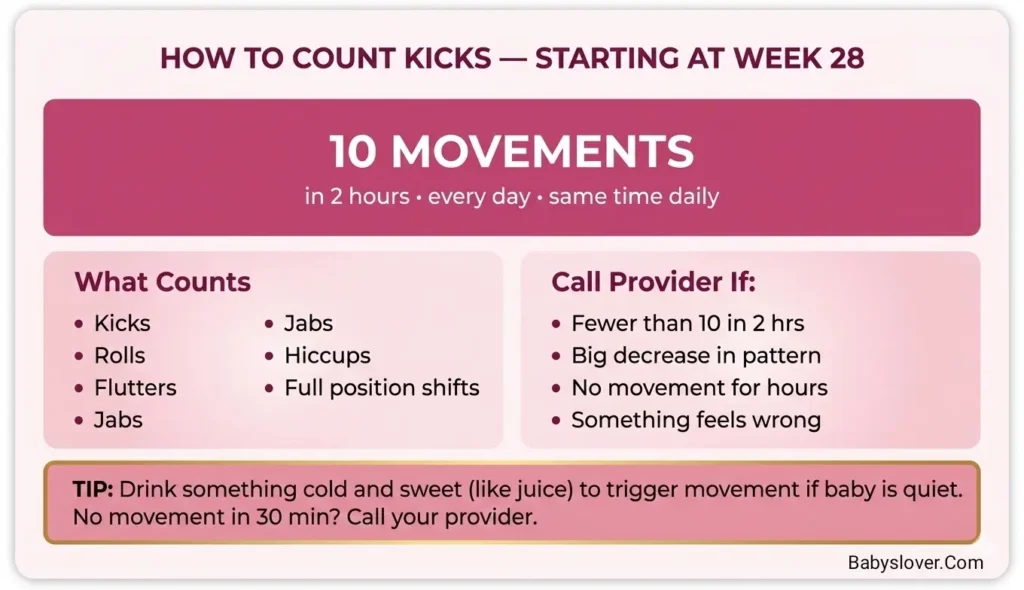
Your provider will introduce kick counts at your Week 28 appointment. Here’s how to do it correctly.
The goal: Feel 10 distinct movements within 2 hours.
What counts as a movement:
- Kicks, rolls, flutters, jabs, hiccups, full position shifts — all count
How to do it:
- Choose a consistent time daily — most babies are most active in the evening after dinner
- Lie on your left side or sit comfortably
- Note the time you start
- Count until you’ve felt 10 distinct movements
- Note how long it took
When to call your provider:
- Fewer than 10 movements in 2 hours
- A noticeable decrease from your baby’s usual pattern
- No movement for several hours when baby is usually active
TIP: Drinking something cold and sweet — like orange juice — often triggers movement. If that doesn’t produce movement within 30 minutes, call your provider.
Nutrition at 28 Weeks Pregnant
| Nutrient | Why It Matters at Week 28 | Best Sources |
| DHA (Omega-3) | Brain cortex folding and neuron development | Salmon, sardines, eggs, prenatal vitamins with DHA |
| Iron | Blood volume still expanding — deficiency causes fatigue | Red meat, lentils, spinach + vitamin C |
| Calcium | Baby’s bones hardening rapidly now | Dairy, fortified plant milks, leafy greens |
| Protein | Fat and muscle development accelerating | Chicken, eggs, Greek yogurt, legumes |
| Magnesium | Leg cramp prevention + muscle function | Almonds, pumpkin seeds, dark chocolate |
| Fiber | Constipation is very common in T3 | Oats, beans, fruits, vegetables, water |
Partner Tips for Week 28
- Take over nighttime tasks — sleep is genuinely difficult at this stage
- Learn the kick count routine — do it together in the evenings as a nightly bonding ritual
- Handle the heavy lifting — literally. Groceries, boxes, anything that strains her lower back
- Start the hospital bag conversation — look at the complete checklist together
- Research parental leave options — 12 weeks of lead time is enough to understand workplace policies
- Ask about cord blood banking — this is the last reasonable window to research and decide
Week 28 Checklist
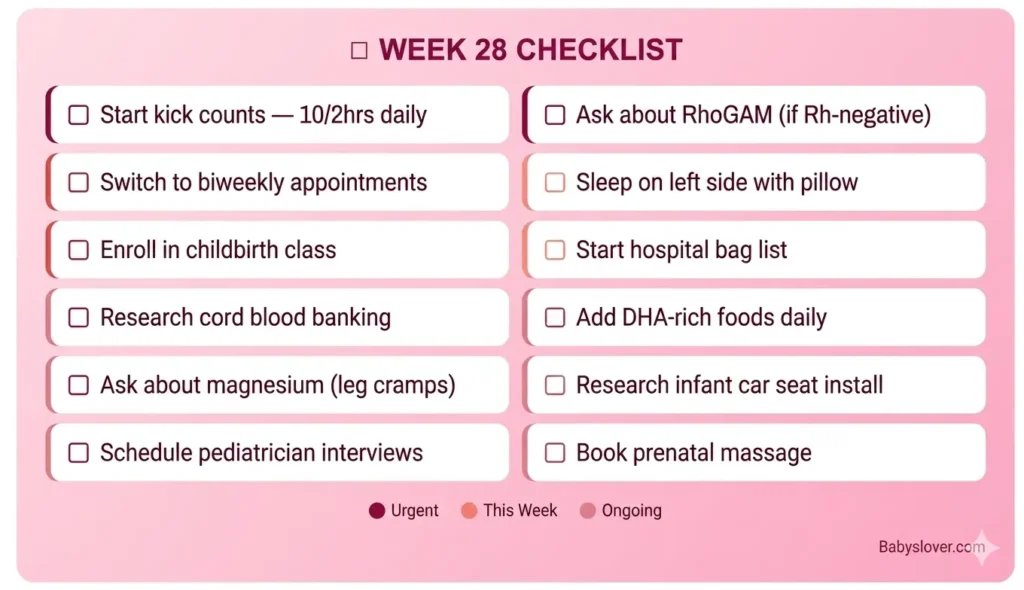
| Task | Priority |
| Start kick counts — 10 movements in 2 hours, daily | URGENT |
| Ask about RhoGAM if you are Rh-negative | URGENT |
| Switch to biweekly appointment schedule | This week |
| Start sleeping with pillow between knees — left side | Tonight |
| Enroll in or finish childbirth class | This week |
| Start your hospital bag list (pack by Week 36) | This week |
| Research cord blood banking if undecided | This week |
| Add DHA-rich foods to daily meals | Ongoing |
| Ask provider about magnesium for leg cramps | This week |
| Install or research infant car seat | This week |
| Schedule pediatrician interviews | This week |
| Book a prenatal massage | Soon |
Frequently Asked Questions — 28 Weeks Pregnant
What trimester is 28 weeks pregnant?
28 weeks pregnant is the start of the third and final trimester. You have approximately 12 weeks remaining. Third trimester runs from Week 28 through Week 40.
How many months is 28 weeks pregnant?
At 28 weeks pregnant, you are 7 months pregnant. Pregnancy is typically counted as 40 weeks — roughly 9.5 calendar months, which is why ‘9 months pregnant’ is technically a slight undercount.
How much does a baby weigh at 28 weeks?
At 28 weeks pregnant, your baby weighs approximately 1 kilogram (2.2 lbs) and measures about 37–38 cm from head to heel — roughly the size of a large eggplant.
Can a baby survive at 28 weeks?
Yes. A baby born at 28 weeks has approximately a 90% survival rate with NICU care. Lung development is advanced enough that most 28-weekers breathe with medical support. Outcomes improve significantly with each additional week.
When do kick counts start?
Most providers recommend beginning kick counts at 28 weeks pregnant. The goal is 10 distinct movements within 2 hours, counted daily. If you feel fewer than 10 movements in 2 hours, contact your provider.
What is the RhoGAM shot at 28 weeks?
RhoGAM is an injection given to Rh-negative mothers at 28 weeks (and again after delivery if the baby is Rh-positive). It prevents your immune system from forming antibodies against Rh-positive blood — protecting future pregnancies from hemolytic disease.
Why do I feel so tired at 28 weeks pregnant?
Third trimester fatigue is driven by several factors: blood volume has expanded by 40–50%, your heart is pumping harder, your body is building fat and brain tissue at an accelerating rate, and sleep quality has declined. Iron deficiency anemia — very common at this stage — also contributes significantly.
Is it normal to have Braxton Hicks at 28 weeks?
Yes. Braxton Hicks are very common from Week 28 onward — temporary tightening across the front of your belly, irregular, usually painless. If you have more than 4 in an hour, or if they become painful and regular, call your provider.
Looking Ahead: 29 Weeks Pregnant
At 29 weeks pregnant, your baby’s brain continues its rapid folding, fat deposits accelerate further, and bones are hardening as calcium demands increase significantly. Each week from here is a week closer to meeting your baby.
You’ve come a long way. The first kilogram is behind you. The third trimester is here. Keep going.
1 thought on “28 Weeks Pregnant: Baby Size, Symptoms & Development”