
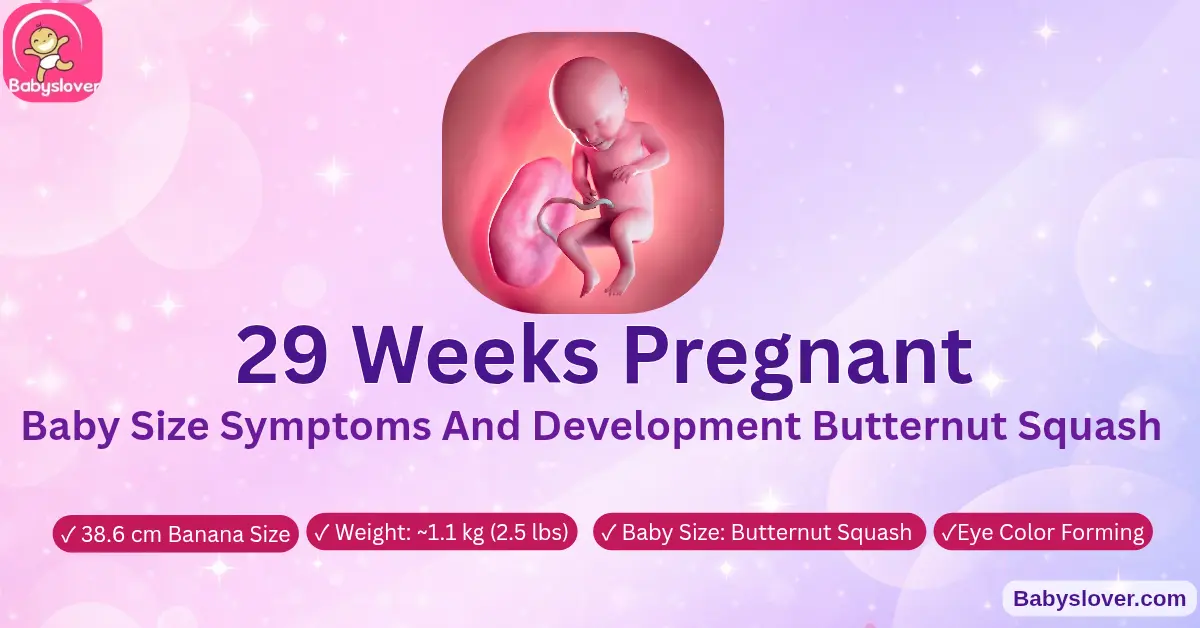
Your baby weighs about 1.1 kilograms right now. That number will more than triple before birth.
Between 29 Weeks Pregnant and your due date, your baby will gain roughly 2.3 more kilograms — going from just over a kilogram to somewhere near 3.4 kilograms, depending on genetics and nutrition. Most of that weight is still ahead of you. And so is a lot of the development that makes the final stretch of pregnancy feel so remarkable.
At 29 weeks pregnant, you’re 11 weeks from your due date. The bones inside your baby’s body are hardening. The eyes now have pigment. The bone marrow has quietly taken over the job of making every red blood cell in your baby’s body. And a soft coating of lanugo — the fine downy hair that covered your baby since Week 20 — is beginning to shed.
Here’s exactly what’s happening at 29 weeks pregnant. Coming from last week? Our 30 weeks pregnant guide covered voice recognition and the inner ear milestone in depth.
Contents
- 1 Quick Summary: 29 Weeks Pregnant
- 2 What’s Happening in Your Body at 29 Weeks Pregnant
- 3 Baby Development at 29 Weeks Pregnant
- 4 The Bone Marrow Milestone — Why It Matters More Than It Sounds
- 5 29 Weeks Pregnant Symptoms
- 6 Your Baby’s Eye Color — What’s Actually Happening
- 7 The Tdap Vaccine — Why Week 29 Is the Right Time
- 8 Writing Your Birth Plan — Start Now
- 9 Nutrition at 29 Weeks Pregnant
- 10 Partner Tips for Week 29
- 11 Your Week 29 Pregnancy Checklist
- 12 Frequently Asked Questions — 29 Weeks Pregnant
- 12.1 What trimester is 29 weeks pregnant?
- 12.2 How many months is 29 weeks pregnant?
- 12.3 How much does a baby weigh at 29 weeks pregnant?
- 12.4 Can a baby survive at 29 weeks?
- 12.5 What eye color will my baby have?
- 12.6 When should I get the Tdap vaccine in pregnancy?
- 12.7 Is it normal to have hemorrhoids at 29 weeks pregnant?
- 12.8 Why is my baby so active at 29 weeks pregnant?
- 13 Looking Ahead: 30 Weeks Pregnant
Quick Summary: 29 Weeks Pregnant
| Detail | Info |
| Baby size | Butternut squash — about 38.6 cm, ~1.1 kg (2.5 lbs) |
| Trimester | Third trimester — Week 2 of T3 |
| Months pregnant | 7 months pregnant |
| Weeks remaining | 11 weeks to go |
| Top milestone | Baby will TRIPLE in weight from here to birth |
| This week’s action | Book Tdap vaccine if not done + start birth plan |
What’s Happening in Your Body at 29 Weeks Pregnant
At 29 weeks pregnant, your uterus now sits roughly 4 inches above your belly button. The pressure on your diaphragm, stomach, bladder, and lower back is noticeable — and it will increase each week from here.
Blood volume is at its peak expansion — up to 50% more than before pregnancy. Your heart is pumping that extra volume continuously. Swelling in your feet and ankles by the end of the day is very common at this stage, and it’s typically normal. Sudden or severe swelling, especially combined with headache or visual changes, should be reported to your provider immediately as it can signal preeclampsia.
Frequent urination intensifies as your baby drops lower and presses more directly on the bladder. Stress incontinence — a small leakage when you cough, laugh, or sneeze — is also common and is caused by pelvic floor pressure, not weakness of character. Kegel exercises help.
What to expect at your Week 29–30 appointment:
- Blood pressure and urine protein check
- Fundal height measurement — should be approximately 27–31 cm
- Baby’s heartbeat
- Review of your gestational diabetes test results if pending
- Tdap vaccine discussion if not already given
- Kick count check-in
Baby Development at 29 Weeks Pregnant

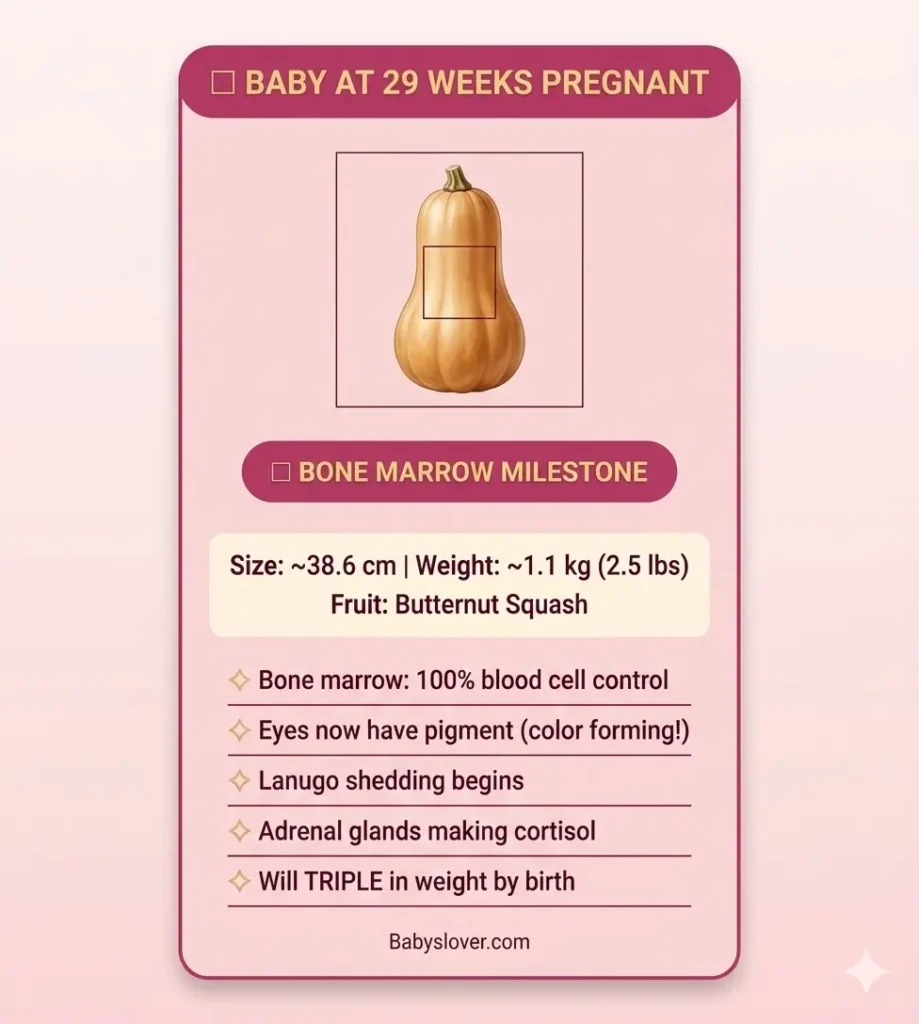
At 29 weeks pregnant, your baby measures approximately 38.6 cm from head to heel and weighs around 1.1 to 1.2 kg — roughly the size and weight of a butternut squash.
| Detail | Measurement |
| Length | ~38.6 cm (about 15.2 inches) |
| Weight | ~1.1–1.2 kg (approx. 2.5 lbs) |
| Size comparison | Butternut squash |
| Heart rate | 110–160 bpm |
| Weight by birth | Will roughly triple to ~3.4 kg |
Key developments this week:
- Bone marrow takes full control: The transition is complete. Your baby’s bone marrow is now solely responsible for producing all red blood cells. The liver and spleen — which handled this job from Weeks 6 and 10 respectively — have handed off entirely. This is one of the most important organ transitions of fetal development.
- Eyes have pigment: The irises now contain melanin. Eye color is beginning to take shape — though it won’t be truly locked in until several weeks or months after birth, when light exposure triggers additional melanin production.
- Skull flexible by design: Your baby’s skull is still made up of separate plates that can overlap during delivery. The gaps between them — called fontanelles — are soft spots you’ll feel on your newborn’s head. This flexibility is not a flaw. It is precision engineering for birth.
- Lanugo shedding begins: The soft, downy hair that has covered your baby’s skin since Week 20 begins to fall away this week. Vernix caseosa — the waxy protective coating — takes over as the primary skin protector going forward.
- Fat deposits tripling: From Week 29 onward, your baby gains approximately 200–250 grams per week — almost entirely fat and muscle. This fat creates the round, soft appearance of a newborn.
- Adrenal glands producing cortisol: Your baby’s adrenal glands are now producing cortisol — a hormone critical for lung maturation and the stress response at birth.
- Nerve myelination advancing: Myelin — the protective sheath around nerve fibers — continues forming. More myelin means faster nerve signals. Your baby’s reflexes are becoming quicker and more coordinated every week.
The Bone Marrow Milestone — Why It Matters More Than It Sounds
Around Week 29, a quiet but significant transition completes inside your baby’s body.
In the earliest weeks of fetal development, the liver was the primary blood-cell factory. By Week 10, the spleen joined in. Around Week 20, the bone marrow began its apprenticeship. And now, at Week 29, the handover is complete — the bone marrow is fully in charge of every red blood cell, white blood cell, and platelet your baby produces.
Why does this matter? Because bone marrow is where hematopoiesis — the production of blood cells — will happen for the rest of your baby’s life. The liver and spleen will never make red blood cells again after birth. Their temporary role in fetal development ends with this week’s transition.
It’s also why iron continues to be critical in your diet right now. Iron is the core ingredient in hemoglobin — the molecule red blood cells use to carry oxygen. Your baby’s bone marrow is pulling iron from your bloodstream to build a working circulatory system. If your iron is low, your baby takes priority — leaving you deficient and fatigued.
29 Weeks Pregnant Symptoms
Hemorrhoids
Hemorrhoids affect roughly 25–35% of pregnant women — and Week 29 onward is peak window. They occur when increased blood volume and uterine pressure engorge the veins around the rectum.
They can be internal (you feel pressure, discomfort, or bleeding) or external (you can feel them). Either way, they’re unpleasant but manageable.
What helps:
- High fiber diet — aim for 25–30g daily to prevent straining
- Drink at least 8–10 glasses of water daily
- Witch hazel pads (Tucks) — gentle, cooling, and genuinely effective
- Sitz baths — 10–15 minutes in warm water, 2–3 times daily
- Don’t sit on the toilet longer than necessary
- Avoid standing for long periods
- Ask your provider about topical creams safe in pregnancy — not all are approved
Hemorrhoids typically resolve within weeks of delivery. If you’re experiencing significant bleeding or extreme pain, mention it at your next appointment.
Frequent Urination and Stress Incontinence
As your baby descends lower in your pelvis over the coming weeks, bladder pressure intensifies. You may feel the urge to urinate immediately after you’ve just gone. This is real pressure on the bladder wall — not your imagination.
Stress incontinence — small leaks when you cough, sneeze, or laugh — is caused by pelvic floor muscles under strain. Daily Kegel exercises make a measurable difference. Contract the pelvic floor for 5 seconds, release for 5 seconds, repeat 10–15 times, three times a day.
Varicose Veins
Increased blood volume and slower circulation in the lower extremities can cause veins in the legs (and sometimes the vulva) to become enlarged and visible. They’re usually more uncomfortable than dangerous.
Compression stockings — worn from the moment you get up in the morning before your legs have time to swell — make a significant difference. Avoid standing for long periods. Elevate your legs when sitting.
Vulvar varicosities are rarely mentioned in pregnancy guides but affect many women. They cause aching pressure in the pelvic area. A vulvar support garment can help. They almost always resolve completely after delivery.
Heartburn and Indigestion
Your uterus is pushing your stomach upward and your stomach acid has less room to stay down. Smaller meals more frequently, avoiding lying down after eating, and sleeping with your upper body slightly elevated all help. Tums or Gaviscon are generally safe — confirm with your provider before using any antacid regularly.
Shortness of Breath
Your diaphragm has less room to move. This is normal. If shortness of breath is sudden, severe, or comes with chest pain or palpitations, contact your provider immediately — these symptoms warrant evaluation.
Pelvic Girdle Pain
Relaxin continues loosening the joints of your pelvis in preparation for delivery. For some women, this causes significant pelvic girdle pain — a deep ache in the front or back of the pelvis, sometimes radiating into the hips or inner thighs. A pelvic support belt and referral to a pelvic floor physiotherapist can help substantially.
Your Baby’s Eye Color — What’s Actually Happening
At 29 weeks pregnant, your baby’s eyes now contain melanin — the pigment that determines eye color. But what color they’ll ultimately be is still not fully decided.
Here’s the science behind it:
| Stage | Eye Color Status |
| Weeks 1–27 | Irises have almost no pigment — appear blue-gray in all babies regardless of genetics |
| Week 28–29 | Melanin begins depositing in the iris — color starts taking shape |
| Birth | Color is set but still subject to change — most newborns have blue-gray eyes initially |
| 6–12 months after birth | Light exposure triggers additional melanin — final color locks in |
| Up to age 3 | Some children’s eye color continues shifting during early childhood |
Dark brown eyes are determined by high melanin levels. Blue or green eyes occur when melanin levels are lower and light scatters differently through the iris. A baby’s genetics set the ceiling for how much melanin the iris can produce — but the actual production timeline plays out over months after birth.
The Tdap Vaccine — Why Week 29 Is the Right Time
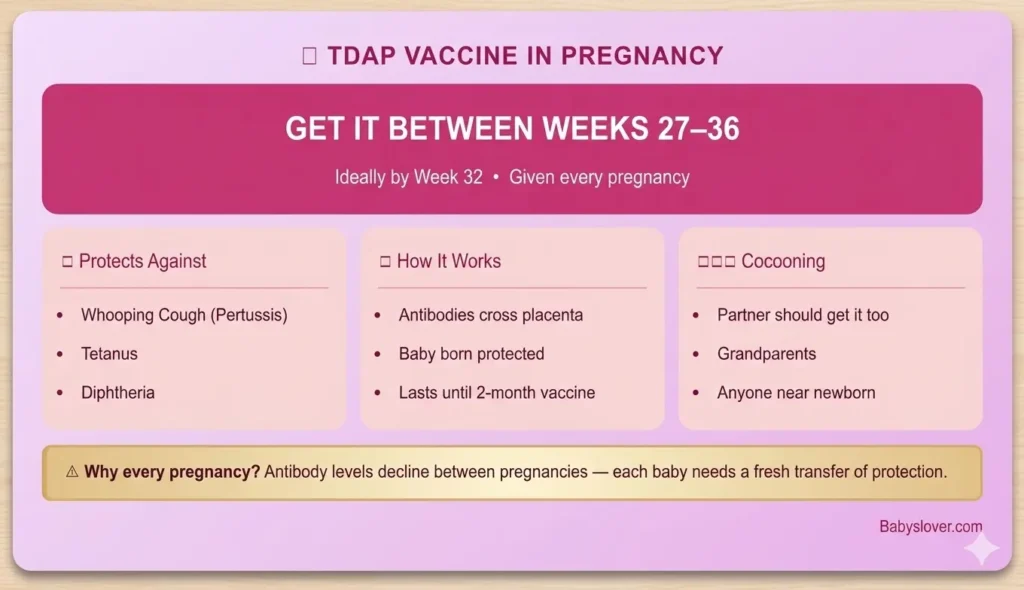
The CDC recommends the Tdap vaccine between Weeks 27 and 36 of every pregnancy — ideally earlier in this window rather than later. Week 29 is an ideal time if you haven’t had it yet.
Why Tdap in pregnancy?
Tdap protects against three diseases: Tetanus, Diphtheria, and Pertussis (whooping cough). Whooping cough is the main concern during pregnancy — and it is dangerous, sometimes fatal, for newborns who are too young to be vaccinated themselves.
When you receive the Tdap vaccine during pregnancy, your body produces antibodies that cross the placenta to your baby. Your newborn is born with those antibodies already in their system — providing protection from birth until they can receive their own vaccine at 2 months.
| Question | Answer |
| When to get it | Weeks 27–36, ideally by Week 32 |
| Why get it every pregnancy | Antibody levels decline — each pregnancy needs a fresh booster |
| Can your partner get it too? | Yes — this is called cocooning. Anyone who will be near the newborn should be vaccinated |
| Is it safe in pregnancy? | Yes — extensively studied, no serious safety concerns identified |
| Does it hurt? | Mild arm soreness for 1–2 days is common |
If you haven’t scheduled this yet, bring it up at your next appointment. It takes just a few weeks after vaccination for your body to produce and transfer the antibodies your baby needs.
Writing Your Birth Plan — Start Now
Week 29 is a good time to begin drafting your birth plan — not because it needs to be finished now, but because thinking through your preferences early gives you time to research, discuss with your partner, and talk to your provider.
A birth plan is not a contract. Births rarely follow a script, and your provider will always prioritize safety. The value of a birth plan is that it forces a conversation — with your partner and with your care team — about what matters to you.
What to include in your birth plan:
- Your support people — who you want in the room and in what circumstances
- Pain management preferences — epidural, nitrous oxide, IV medication, unmedicated, or open to discussion
- Fetal monitoring — continuous vs intermittent (if your provider allows)
- Movement during labor — freedom to walk, use the tub, birthing ball
- Pushing preferences — coached vs instinct-led
- Episiotomy preferences
- Immediate skin-to-skin contact after birth
- Delayed cord clamping (if desired — discuss with your provider)
- Cord blood banking decision (if relevant — see our guide on cord blood banking)
- Infant feeding — breastfeeding, formula, or combination
- NICU — if baby needs care, who can stay with them
Keep it to one page. Bullet points are better than paragraphs. Your providers will read it, but they won’t read an essay.
Nutrition at 29 Weeks Pregnant
| Nutrient | Why It Matters at Week 29 | Best Sources |
| Iron | Bone marrow pulling iron to make red blood cells — deficiency causes fatigue + affects baby’s oxygen supply | Red meat, lentils, spinach, fortified cereals + vitamin C for absorption |
| Calcium | Baby’s bones hardening rapidly — pulls from your bones if intake is insufficient | Dairy, fortified plant milks, sardines with bones, leafy greens |
| DHA (Omega-3) | Brain folding and neuron development continuing | Salmon, sardines, eggs, prenatal vitamins with DHA |
| Protein | Fat and muscle mass building at 200–250g/week | Chicken, Greek yogurt, eggs, legumes, cottage cheese |
| Fiber | Hemorrhoid and constipation prevention — critical this trimester | Oats, beans, prunes, fruits, vegetables, plenty of water |
| Vitamin C | Boosts iron absorption + immune support + collagen for skin stretching | Citrus, bell peppers, strawberries, kiwi |
An extra 450 calories per day is the standard recommendation from Week 28 onward. Focus on nutrient density — these calories should be working hard, not just filling space.
Partner Tips for Week 29
- Help write the birth plan — this should be a joint conversation, not a solo task
- Schedule the Tdap vaccine yourself if you haven’t — cocooning protects your newborn
- Learn the hemorrhoid situation — she needs fiber, water, and Tucks pads. Stock them without being asked.
- Take over anything that requires bending, crouching, or heavy lifting — her center of gravity is shifting daily
- Handle nighttime disruptions where possible — quality sleep is increasingly scarce
- Start researching paternity leave options seriously — 11 weeks is not as much time as it feels
- Review the hospital bag checklist together this week — give yourselves time to gather things gradually
Your Week 29 Pregnancy Checklist
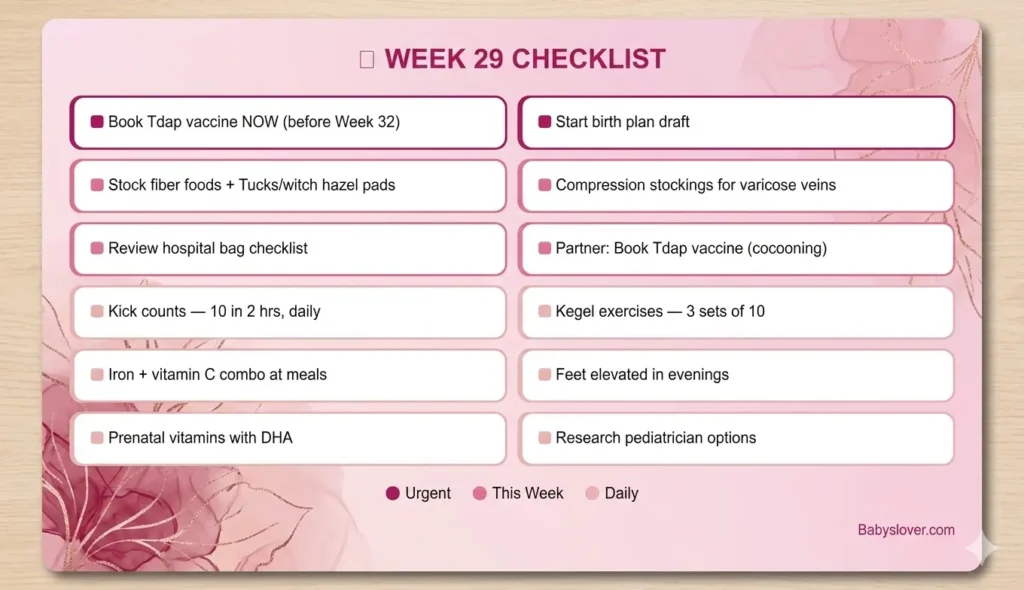
| Task | Priority |
| Book Tdap vaccine if not yet done (before Week 32) | URGENT |
| Start your birth plan draft | This week |
| Continue kick counts daily — 10 in 2 hours | Daily |
| Start stocking fiber-rich foods + Tucks pads | This week |
| Compression stockings for varicose veins if needed | This week |
| Review hospital bag checklist — identify what you still need | This week |
| Partner: Book your own Tdap vaccine | This week |
| Add iron + vitamin C combo to daily meals | Ongoing |
| Keep prenatal vitamins with DHA going daily | Ongoing |
| Kegel exercises — 3 sets of 10, daily | Daily |
| Elevate feet in the evenings to reduce swelling | Daily |
| Research pediatrician options if not done at Week 28 | Soon |
Follow our pregnancy week by week guide for every development from now to delivery. 💗
Frequently Asked Questions — 29 Weeks Pregnant
What trimester is 29 weeks pregnant?
29 weeks pregnant is the second week of the third trimester. Third trimester runs from Week 28 through Week 40. You have approximately 11 weeks remaining until your due date.
How many months is 29 weeks pregnant?
At 29 weeks pregnant, you are 7 months pregnant. Full-term pregnancy is 40 weeks — approximately 9.5 calendar months — so the common shorthand of ‘9 months’ is a slight undercount.
How much does a baby weigh at 29 weeks pregnant?
At 29 weeks pregnant, your baby weighs approximately 1.1 to 1.2 kg (about 2.5 lbs) and measures around 38.6 cm from head to heel — about the size of a butternut squash.
Can a baby survive at 29 weeks?
Yes. Survival rates for babies born at 29 weeks are approximately 90–95% with NICU care. Lungs are developed enough to breathe with medical support, though most will require respiratory assistance. Outcomes improve meaningfully with every additional week of gestation.
What eye color will my baby have?
At 29 weeks pregnant, melanin is beginning to deposit in your baby’s irises — so eye color is starting to take shape. However, final eye color isn’t determined until after birth, when light exposure triggers additional melanin production. Most newborns have blue-gray eyes initially regardless of their genetics. True eye color typically locks in between 6 and 12 months of age.
When should I get the Tdap vaccine in pregnancy?
The CDC recommends Tdap between Weeks 27 and 36 of pregnancy, ideally by Week 32. It’s given every pregnancy — not just your first — because antibody levels decline between pregnancies. The vaccine protects your newborn from whooping cough from birth until they can receive their own vaccine at 2 months.
Is it normal to have hemorrhoids at 29 weeks pregnant?
Yes — very common. Hemorrhoids affect roughly 25–35% of pregnant women and are most common in the third trimester. Increased blood volume and uterine pressure on rectal veins are the cause. High fiber intake, plenty of water, witch hazel pads, and sitz baths all help. They typically resolve within weeks of delivery.
Why is my baby so active at 29 weeks pregnant?
At 29 weeks pregnant, your baby is still active but the nature of movement is shifting — more rolls, turns, and strong kicks rather than the fluttery sensations of earlier weeks. Baby is also responding more strongly to external stimuli like sound, light, and movement. There is still enough room for vigorous movement, though this will gradually decrease over the coming weeks as space becomes tighter.
Looking Ahead: 30 Weeks Pregnant
At 30 weeks pregnant, your baby passes the 1.3 kg mark and their brain continues its rapid growth phase. Lanugo shedding accelerates, the bone marrow works at full capacity, and you’ll likely notice your baby settling into more consistent sleep-wake cycles that don’t always align with yours.
Eleven weeks. Keep counting kicks, keep nourishing that growing brain, and keep going.
For everything from here through delivery, our pregnancy tips for first time moms is with you every step. 💗
1 thought on “29 Weeks Pregnant: Baby Size, Symptoms & Development”