

31 Weeks Pregnant, your baby can hear you. Taste what you had for lunch. Feel the pressure when you press your hand against your skin. See light filtering through the uterine wall. And smell the amniotic fluid that carries traces of everything in your environment.
All five senses are operational at 31 weeks pregnant. Not developing. Not emerging. Operational.
Your baby is also beginning one of the most physically significant movements of the entire pregnancy — slowly rotating toward a head-down position. It doesn’t happen all at once. It happens over weeks, in response to gravity, space, and the instincts built into a body preparing itself for birth.
Nine weeks from your due date. A coconut-sized baby using all five senses, turning toward the world. Here’s everything happening at 31 weeks pregnant.

Contents
- 1 Quick Summary: 31 Weeks Pregnant
- 2 What’s Happening in Your Body at 31 Weeks Pregnant
- 3 Baby Development at 31 Weeks Pregnant
- 4 All Five Senses at 31 Weeks Pregnant — What Your Baby Actually Experiences
- 5 The Head-Down Position — What’s Happening and What If It Doesn’t
- 6 31 Weeks Pregnant Symptoms
- 7 The 3D/4D Ultrasound — Why Week 31 Is the Last Good Window
- 8 Passive Immunity — What Your Body Is Building Into Your Baby Right Now
- 9 Nutrition at 31 Weeks Pregnant
- 10 Partner Tips for Week 31
- 11 Week 31 Checklist
- 12 Frequently Asked Questions — 31 Weeks Pregnant
- 12.1 What trimester is 31 weeks pregnant?
- 12.2 How many months is 31 weeks pregnant?
- 12.3 How much does a baby weigh at 31 weeks pregnant?
- 12.4 Can a baby survive at 31 weeks?
- 12.5 Are all 5 senses developed at 31 weeks pregnant?
- 12.6 What is ICP and how do I know if I have it?
- 12.7 What position should my baby be in at 31 weeks?
- 12.8 Is it normal to not sleep well at 31 weeks pregnant?
- 12.9 When is the last chance for a 3D/4D ultrasound?
- 13 Looking Ahead: 32 Weeks Pregnant
Quick Summary: 31 Weeks Pregnant
| Detail | Info |
| Baby size | Coconut — about 41 cm, ~1.5 kg (3.3 lbs) |
| Trimester | Third trimester — Week 4 of T3 |
| Months pregnant | Almost 8 months pregnant |
| Weeks remaining | 9 weeks to go |
| Top milestone | All 5 senses fully operational + head-down rotation beginning |
| This week’s action | 3D/4D ultrasound last window + confirm antenatal class enrollment |
What’s Happening in Your Body at 31 Weeks Pregnant
At 31 weeks pregnant, your uterus now extends well above your belly button and is pressing upward against your stomach, liver, and diaphragm simultaneously. The physical symptoms that felt manageable a few weeks ago are now a constant presence.
You may no longer be able to see your feet when standing. Your center of gravity has shifted so significantly that simple tasks — getting up from a chair, rolling over in bed, climbing stairs — require real effort. This is not weakness. This is your body managing an extraordinary physical load while simultaneously building a complete human being.
Sleep is increasingly fragmented. The combination of physical discomfort, frequent urination, leg cramps, and anxiety about the approaching birth all contribute to broken nights. Some women find that a large body pillow — one they can tuck between their knees and under their belly — makes the difference between 3 hours of sleep and 6.
What to expect at your Week 31 or 32 appointment:
- Blood pressure and urine protein — preeclampsia surveillance
- Fundal height — should be approximately 29–33 cm at Week 31
- Baby’s heartbeat
- Baby’s position — your provider will feel your abdomen to determine whether baby is head-down, breech, or transverse
- Antenatal class confirmation
- Kick count check-in
- Discussion of birth preferences if not already done
Baby Development at 31 Weeks Pregnant

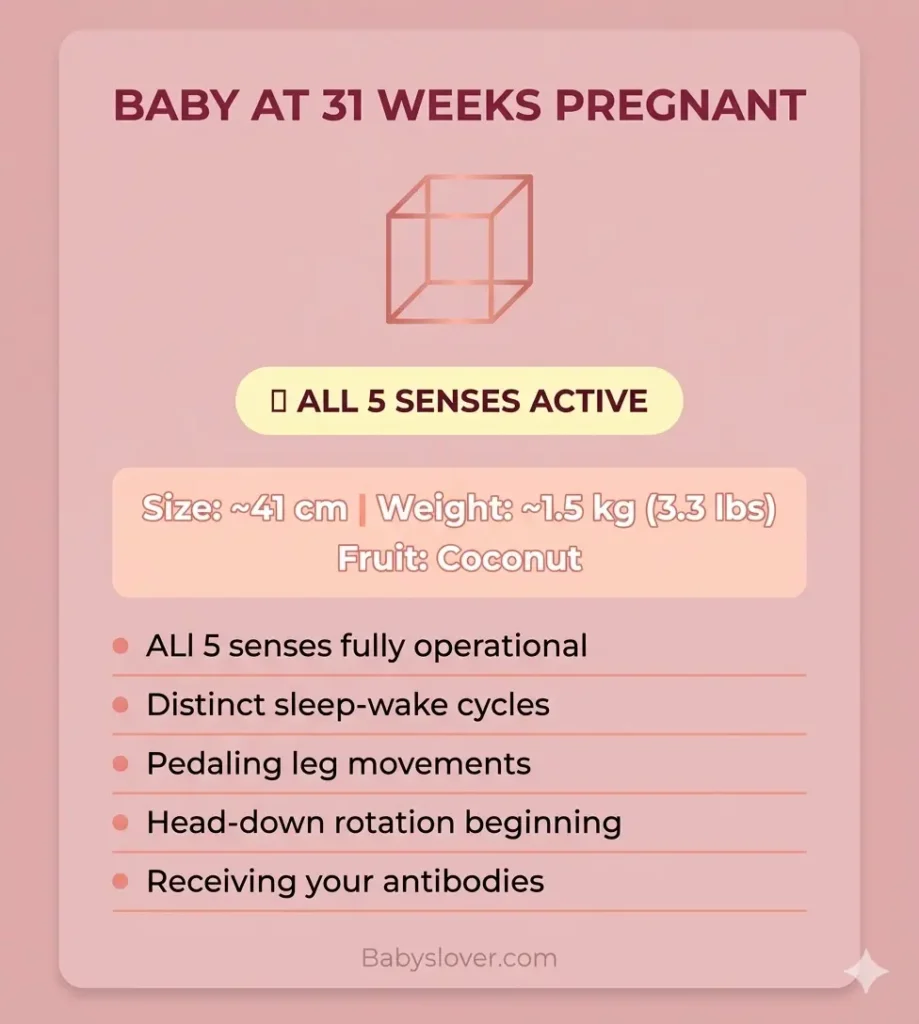
At 31 weeks pregnant, your baby measures approximately 41 cm from head to heel and weighs around 1.5 kg — roughly the size and weight of a coconut.
| Detail | Measurement |
| Length | ~41 cm (about 16.2 inches) |
| Weight | ~1.5 kg (approx. 3.3 lbs) |
| Size comparison | Coconut |
| Heart rate | 110–160 bpm |
| Movement type | Shifting from kicks to rolls — less space now |
Key developments this week:
- All five senses fully operational: Hearing, sight, taste, smell, and touch are all active. This is the week they’re all working simultaneously for the first time. The brain is now processing sensory information from multiple channels at once — a level of neurological integration that simply wasn’t possible in earlier weeks.
- Distinct sleep-wake cycles: Your baby now has clearly defined periods of sleep and wakefulness. These cycles are driven by brain activity, not just external stimulation. You may notice that kicks and movements follow a predictable pattern — often more active in the evenings when you’re resting, and quieter during the day when your movements lull baby to sleep.
- Pedaling leg movements: Your baby is making rhythmic, pedaling motions with their legs — not random movement, but coordinated cycling sequences driven by the motor cortex. This is the same neural pathway that will produce the newborn stepping reflex you’ll see in the first days of life.
- Head-down rotation beginning: Many babies begin turning head-down this week. Gravity plays a role — the heaviest part of the baby is the head, and the natural position over time tends downward. There is still time and room to change position, and most providers don’t act on position until Week 36.
- Fingernails approaching fingertips: Fingernails are growing toward the ends of the fingers. Some babies are born needing a trim within days of arrival.
- Immune system receiving antibodies: Your body is now actively transferring immunoglobulins — antibodies — across the placenta to your baby. This passive immunity will protect your newborn from infections in the weeks after birth, before their own immune system can mount independent responses.
- Brain processing complexity increasing: The neural connections formed over the past weeks are dense enough that your baby can now process complex sensory information and respond to it. Loud sounds prompt movement. Bright light through the uterine wall prompts turning away. Music prompts different responses than speech.
All Five Senses at 31 Weeks Pregnant — What Your Baby Actually Experiences
Most pregnancy guides say ‘all five senses are developed by Week 31.’ Almost none explain what your baby is actually experiencing through each one. Here’s the real picture.
| Sense | What’s Happening at Week 31 | What You Can Do |
| Hearing | Baby hears your voice, heartbeat, digestion, and external sounds. Low-frequency sounds penetrate the uterine wall best. Your voice is the most consistently heard sound in their world. | Talk, read, and sing directly to your belly — your baby is listening |
| Sight | Baby can detect light and shadow through closed lids. Bright light pressed to the belly may cause baby to turn away. Vision is still limited — the womb is dark. | The flashlight test: press a flashlight to your belly and watch for a response |
| Taste | Amniotic fluid carries flavor compounds from your diet. Baby swallows amniotic fluid and responds to sweetness with increased swallowing. Bitter flavors reduce swallowing. | Eat diverse, flavorful foods — research shows this shapes lifelong food preferences |
| Smell | Amniotic fluid carries olfactory compounds. Baby can distinguish smells already. At birth, newborns identify their mother’s breast milk by scent within hours. | This is passive — your baby is already learning your scent |
| Touch | Highly developed since Week 17. Baby feels the pressure of their own hands, the cord, the uterine wall, and responds to external touch on your belly. | Press gently on your belly — baby may press back |
The Head-Down Position — What’s Happening and What If It Doesn’t
Between Weeks 28 and 34, most babies gradually turn to a head-down (cephalic) position. At Week 31, many have made this turn — but it’s not yet a concern if they haven’t. Your provider won’t discuss intervention for position until Week 36.
| Position | What It Means | How Common at Week 31 |
| Cephalic (head-down) | Head toward cervix — ideal birth position | ~60–70% of babies by Week 31 |
| Breech (feet or bottom down) | Bottom or feet toward cervix | ~25–30% at Week 31 — most will turn |
| Transverse (sideways) | Baby lying horizontally across the uterus | ~5% at Week 31 — most will turn |
| Oblique (diagonal) | Head down but angled off-center | Small % — usually resolves |
If your baby is still breech at Week 31 — what happens next:
- Nothing urgent yet — most providers wait until Week 36 to discuss position intervention
- At Week 36, your provider may offer an External Cephalic Version (ECV) — a procedure to manually turn the baby from outside
- Gentle exercises (hands-and-knees position, forward-leaning inversions) are sometimes suggested — always discuss with your provider first
- Breech at term does not automatically mean cesarean — but it does affect your birth options
31 Weeks Pregnant Symptoms
Itching — and When It Becomes Serious
Some itching at this stage is entirely normal. Your skin is stretching, and stretching skin itches. Moisturizer and staying hydrated help with surface-level itching.
But there is a form of itching in the third trimester that requires immediate medical evaluation. It’s called Intrahepatic Cholestasis of Pregnancy (ICP) — sometimes called Obstetric Cholestasis — and it is a liver condition that typically begins around Weeks 30–31.
ICP symptoms that require prompt contact with your provider:
- Intense itching, especially on the palms of the hands and soles of the feet
- Itching that is worse at night — often severely so
- No visible rash (the skin looks normal but itches intensely)
- Itching that doesn’t respond to moisturizer or antihistamines
- Dark urine or pale stools (these indicate liver involvement)
- Jaundice (yellowing of skin or eyes — less common but serious)
ICP is associated with an increased risk of preterm birth and, in severe cases, stillbirth if untreated. It is diagnosed with a blood test measuring bile acid levels. Treatment is available — but only if it’s identified. Do not dismiss intense itching on the palms and soles as normal skin stretching. Contact your provider.
Sleep Difficulties — Peak Disruption Week
Week 31 is when sleep disruption typically reaches its worst point for most pregnant women. Every position that was once comfortable is now complicated. Lying on your back compresses the IVC. Lying on your right side is less optimal. Lying on your left side is best — but with a belly this size, maintaining any position for more than an hour is difficult.
What actually helps:
- Full-length pregnancy pillow between knees and under belly — the single most impactful sleep aid
- Elevating the head of the bed slightly if heartburn is disrupting sleep
- Keeping the room cool — your body temperature runs higher in T3
- Limiting fluids in the 2 hours before bed to reduce nighttime bathroom trips
- Short naps during the day — 20–30 minutes, not longer (longer naps disrupt nighttime sleep)
- Magnesium glycinate before bed — reduces leg cramps, promotes sleep quality
Heartburn Peaking
Heartburn tends to reach peak intensity around Weeks 30–32 as your uterus pushes the stomach higher and the lower esophageal sphincter remains relaxed from progesterone. Smaller, more frequent meals are the most effective dietary strategy. Avoid spicy, fatty, and acidic foods in the evenings. Sleep with the upper body slightly elevated.
Over-the-counter antacids — calcium carbonate (Tums) or alginate-based products (Gaviscon) — are generally considered safe in pregnancy. Always confirm with your provider before regular use.
Pelvic Pressure — Engagement Beginning
As your baby begins moving toward a head-down position, you may feel increased pressure low in the pelvis — a sensation sometimes described as carrying a bowling ball between your legs. This is normal. It means the heaviest part of your baby is settling lower.
Pelvic girdle pain — aching in the front or back of the pelvis — is distinct from this general pressure and affects roughly 20% of pregnant women in the third trimester. A pelvic support belt, physiotherapy, and sleeping with a pillow between your knees all help.
Rib Pain
At Week 31, your baby’s feet may be pressing directly against your lower ribs — especially if baby is still in a breech position. This can cause significant discomfort on one or both sides. Adjusting your posture, sitting up straight, and leaning away from the side that hurts can temporarily relieve pressure. As baby turns head-down, rib pain typically eases.
The 3D/4D Ultrasound — Why Week 31 Is the Last Good Window
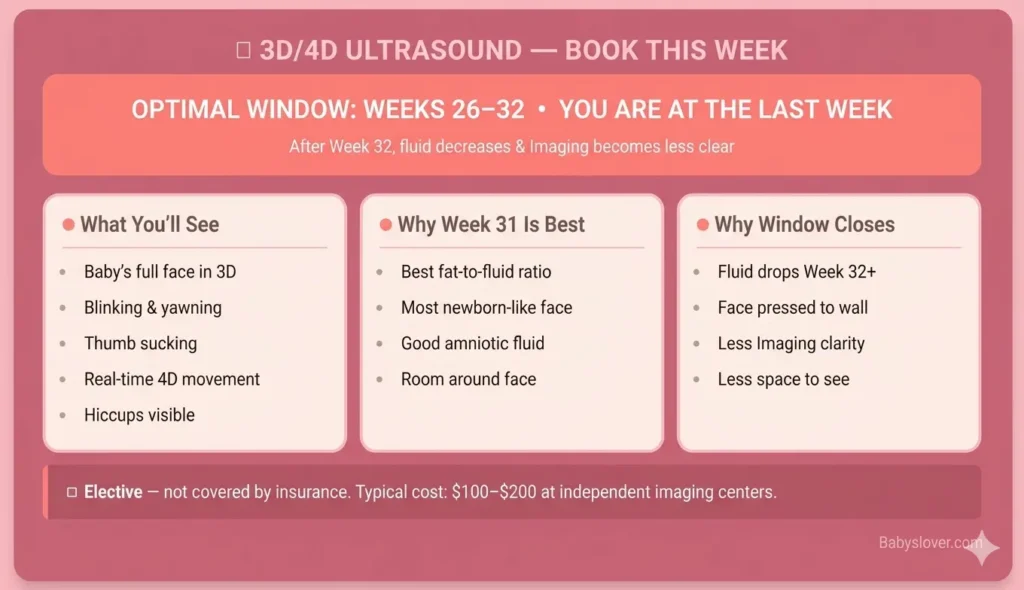
The optimal window for a 3D or 4D elective ultrasound is typically Weeks 26 to 32. At Week 31, you are at the very end of this window — and it’s the last point at which there is enough amniotic fluid and space around your baby’s face to capture a clear, detailed image.
Why the window closes after Week 32:
- Amniotic fluid decreases from Week 32 onward — less fluid means less acoustic clarity
- Baby’s face is increasingly pressed against the uterine wall or placenta as space reduces
- Fat fills in beautifully at Week 31 — your baby’s face now looks remarkably like their newborn face
What you’ll see at a 31-week 3D/4D ultrasound:
- Full facial features — cheeks, nose, lips, chin in three dimensions
- Baby blinking, yawning, thumb-sucking, smiling, or frowning
- Real-time movement in 3D — the ‘4D’ part (the fourth dimension is time)
- Possibly: pedaling leg movements, hand near face, hiccups visible as rhythmic jolts
This is an elective procedure — your insurance won’t cover it unless medically ordered. Costs typically range from $100–$200 at independent imaging centers. Your provider should be aware you’re having one, though it doesn’t replace your prenatal care ultrasounds.
If you want one, this week may genuinely be your last good chance.
Passive Immunity — What Your Body Is Building Into Your Baby Right Now
From Week 28 onward, your body transfers immunoglobulins — antibodies you’ve built over your lifetime — across the placenta to your baby. This process accelerates significantly in the final trimester.
What this means: when your baby is born, they will carry a copy of your immune memory. Every infection you’ve had, every vaccine you’ve received — the antibodies from all of it are being loaded into your baby’s bloodstream right now.
This passive immunity is why newborns can survive in a world full of pathogens before their own immune system matures. It lasts approximately 3–6 months after birth — declining as your transferred antibodies break down and your baby’s own immune system gradually takes over.
This is also the reason your Tdap vaccine during pregnancy is so effective. The antibodies you produce from that vaccine transfer to your baby — protecting them from whooping cough before they can be vaccinated themselves at 2 months.
Nutrition at 31 Weeks Pregnant
| Nutrient | Why It Matters at Week 31 | Best Sources |
| Iron | Baby pulling iron for blood cell production + your own blood volume at peak. Fatigue is the first sign of deficiency. | Red meat, lentils, spinach + vitamin C; ask provider about supplementing if iron levels are low |
| DHA (Omega-3) | Brain folding and neural connection density increasing each week | Salmon, sardines, eggs, prenatal vitamins with DHA |
| Calcium | Skeletal hardening continues — baby takes from your bones if dietary intake is insufficient | Dairy, fortified plant milks, sardines with bones, almonds |
| Vitamin C | Collagen synthesis for skin stretching + immune support + dramatically improves iron absorption | Citrus fruits, bell peppers, kiwi, strawberries |
| Fiber + Water | Constipation and hemorrhoid prevention — both worsen significantly in T3 | Oats, prunes, beans, vegetables, 8–10 glasses water daily |
| Choline | Brain development — 90% of pregnant women are deficient. Underconsumed nutrient. | Eggs (2 daily provides the most choline per serving), beef liver, chicken, soybeans |
Partner Tips for Week 31
- Take sleep seriously — if there’s anything you can do to extend her sleep, do it. Sleep deprivation compounds every other symptom.
- Learn ICP symptoms — itching on palms and soles of feet at night. If she mentions this, take it seriously and encourage her to call her provider.
- Book a 3D/4D ultrasound this week if you both want one — it’s the last good window
- Take on anything physical — getting up from furniture, carrying bags, bending to pick things up
- The hospital bag should be mostly packed by now — confirm it’s in progress together
- Research cord blood banking if you still haven’t decided — delivery day is not the time to be weighing this
- Practice the hospital route at the time of day you’d most likely be driving it
Week 31 Checklist
| Task | Priority |
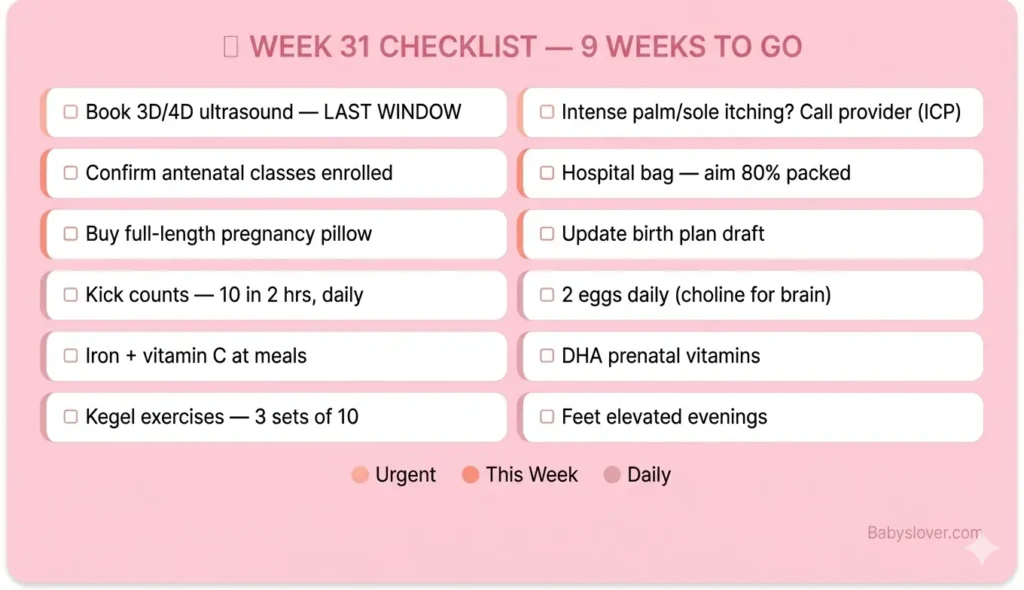
| Book 3D/4D ultrasound THIS WEEK if you want one — last good window | URGENT |
| Contact provider if you have intense palms/soles itching (ICP) | URGENT if symptoms present |
| Confirm antenatal classes enrolled and scheduled | This week |
| Continue kick counts — 10 movements in 2 hours, daily | Daily |
| Ask provider about baby’s position at next appointment | Next appointment |
| Hospital bag — aim to have 80% packed this week | This week |
| Buy or confirm pregnancy pillow for sleep | This week |
| Continue birth plan — aim to finalize by Week 34 | This week |
| Eat 2 eggs daily for choline — most overlooked pregnancy nutrient | Daily |
| Iron + vitamin C at meals | Daily |
| DHA prenatal vitamins | Daily |
| Kegel exercises — 3 sets of 10 | Daily |
| Feet elevated in evenings to reduce swelling | Daily |
| Magnesium glycinate before bed if leg cramps are disruptive | As needed |
Week 28 brings the first of many biweekly appointments. Follow our pregnancy week by week guide for every development from now to delivery.
Frequently Asked Questions — 31 Weeks Pregnant
What trimester is 31 weeks pregnant?
31 weeks pregnant is the fourth week of the third trimester. Third trimester runs from Week 28 through Week 40. You have approximately 9 weeks remaining until your due date.
How many months is 31 weeks pregnant?
At 31 weeks pregnant, you are approaching the end of your seventh month — roughly 7.75 months pregnant. Full-term pregnancy is 40 weeks, or approximately 9.5 calendar months.
How much does a baby weigh at 31 weeks pregnant?
At 31 weeks pregnant, your baby weighs approximately 1.5 kg (about 3.3 lbs) and measures around 41 cm from head to heel — roughly the size of a coconut. Baby is now gaining approximately 200–250 grams per week until birth.
Can a baby survive at 31 weeks?
Yes. Survival rates for babies born at 31 weeks with NICU care are approximately 95–98%. Lung development is well advanced, though most 31-weekers will require some respiratory support initially. Long-term outcomes are generally very good. Every additional week of gestation continues to improve outcomes.
Are all 5 senses developed at 31 weeks pregnant?
Yes — all five senses are fully operational at 31 weeks pregnant. Your baby can hear sounds (especially your voice), detect light, taste compounds in amniotic fluid, smell environmental odors carried in the fluid, and respond to touch both from within and outside the womb. The brain is now processing sensory information from multiple channels simultaneously.
What is ICP and how do I know if I have it?
Intrahepatic Cholestasis of Pregnancy (ICP) is a liver condition that typically begins around Weeks 30–31. The key symptom is intense itching, especially on the palms of the hands and soles of the feet — usually worse at night and not relieved by moisturizer. Unlike normal pregnancy skin itching, ICP itching has no visible rash. It requires immediate medical evaluation as it is associated with increased risk of preterm birth and, in severe untreated cases, stillbirth. It is diagnosed with a blood test and is treatable.
What position should my baby be in at 31 weeks?
At 31 weeks pregnant, approximately 60–70% of babies have turned head-down (cephalic position). If your baby is still breech or transverse, this is not yet a cause for concern — most babies turn before Week 36. Your provider will begin monitoring position more closely around Week 34–36 and may discuss options such as External Cephalic Version (ECV) if baby remains breech at term.
Is it normal to not sleep well at 31 weeks pregnant?
Yes — Week 31 is typically peak sleep disruption for most pregnant women. Physical discomfort, frequent urination, leg cramps, heartburn, and anxiety about birth all contribute to fragmented sleep. A full-length pregnancy pillow is the most consistently recommended practical aid. Short naps (20–30 minutes) can help compensate without disrupting nighttime sleep further.
When is the last chance for a 3D/4D ultrasound?
The optimal window for a 3D/4D elective ultrasound is Weeks 26–32. At 31 weeks pregnant, you are at the very end of this window — after Week 32, decreasing amniotic fluid and reduced space around the baby’s face make clear images more difficult to capture. If you want a 3D/4D ultrasound, this week is your last good opportunity.
Looking Ahead: 32 Weeks Pregnant
At 32 weeks pregnant, your baby passes 1.7 kg, the skin is no longer translucent, fingernails reach the fingertips, and the lungs are close to mature. The final countdown is shifting from weeks to a feeling of imminent reality.
Nine weeks. Five senses. A baby who can hear your voice, taste your food, and feel your hand. Keep going.