
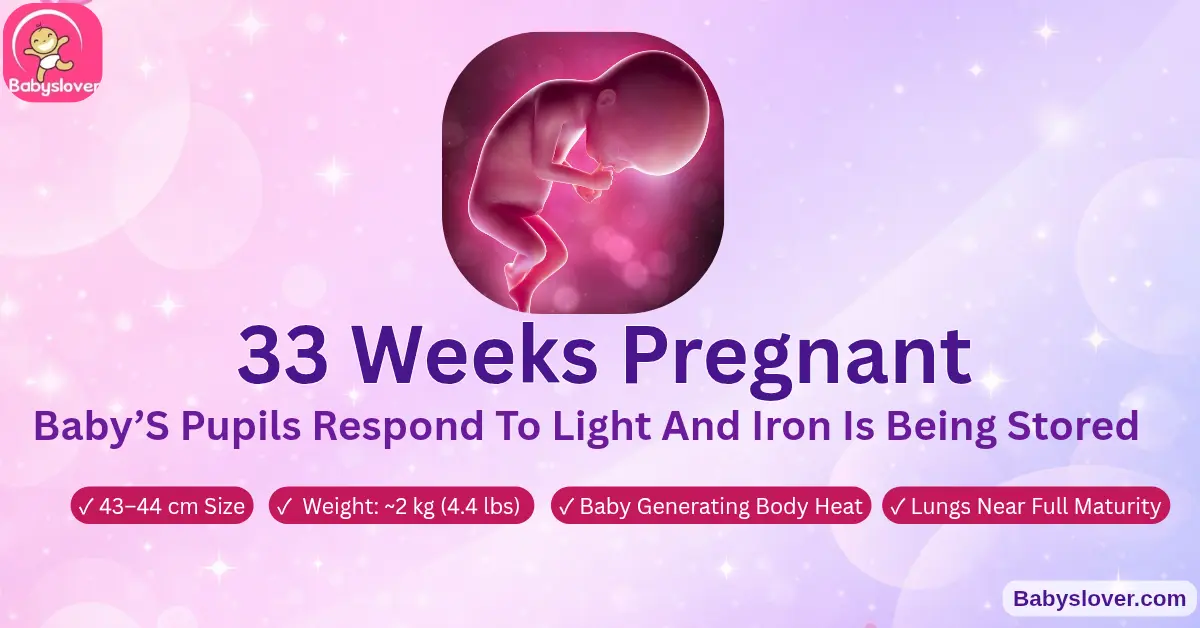
Something happened this week that most pregnancy guides mention in a single sentence, then move on from.
Your baby’s pupils now constrict when light hits them and dilate when it goes away. Not a sensitivity to brightness. Not a general awareness of light. The actual pupillary reflex – the same reflex a doctor checks with a penlight in every newborn examination – is active and functioning at 33 weeks pregnant.
Your baby’s liver is also doing something that will protect them for the first six months of their life outside the womb. It is building and storing an iron reserve – a supply of iron so substantial that exclusively breastfed babies can draw on it until they begin solid foods. That storage process is happening right now, in the final weeks before birth.
And if you have been feeling unusually warm lately – running hotter than usual even in cool rooms – part of that is your baby. Your baby is now generating body heat of their own. The warmth radiating from your belly is not just yours.
Seven weeks from your due date. Here is everything happening at 33 weeks pregnant.
Contents
- 1 Quick Summary: 33 Weeks Pregnant
- 2 What’s Happening in Your Body at 33 Weeks Pregnant
- 3 Baby Development at 33 Weeks Pregnant
- 4 The Pupillary Reflex at 33 Weeks – What It Means
- 5 Iron Storage – Why These Final Weeks Matter So Much
- 6 Why Your Areolas Are Getting Darker – The Science Behind It
- 7 33 Weeks Pregnant Symptoms
- 8 The Biophysical Profile – What It Is and Who Needs It
- 9 Nutrition at 33 Weeks Pregnant
- 10 Partner Tips for Week 33
- 11 Week 33 Checklist
- 12 Frequently Asked Questions – 33 Weeks Pregnant
- 12.1 What trimester is 33 weeks pregnant?
- 12.2 How many months is 33 weeks pregnant?
- 12.3 How much does a baby weigh at 33 weeks pregnant?
- 12.4 Can a baby survive at 33 weeks?
- 12.5 Why are my nipples getting darker at 33 weeks pregnant?
- 12.6 What is colostrum and when does it start leaking?
- 12.7 Why do I feel so hot at 33 weeks pregnant?
- 12.8 What is a biophysical profile in pregnancy?
- 12.9 How much protein do I need at 33 weeks pregnant?
- 13 Looking Ahead: 34 Weeks Pregnant
Quick Summary: 33 Weeks Pregnant
| Detail | Info |
| Baby size | Pineapple / butternut squash – ~43-44 cm, ~1.9-2 kg (4.2-4.4 lbs) |
| Trimester | Third trimester – Week 6 of T3 |
| Months pregnant | 8 months pregnant |
| Weeks remaining | 7 weeks to go |
| Top milestone | Pupils constrict/dilate + iron storage for 6 months + body heat generating |
| This week’s action | Know preterm labor signs + confirm pediatrician selected |
What’s Happening in Your Body at 33 Weeks Pregnant
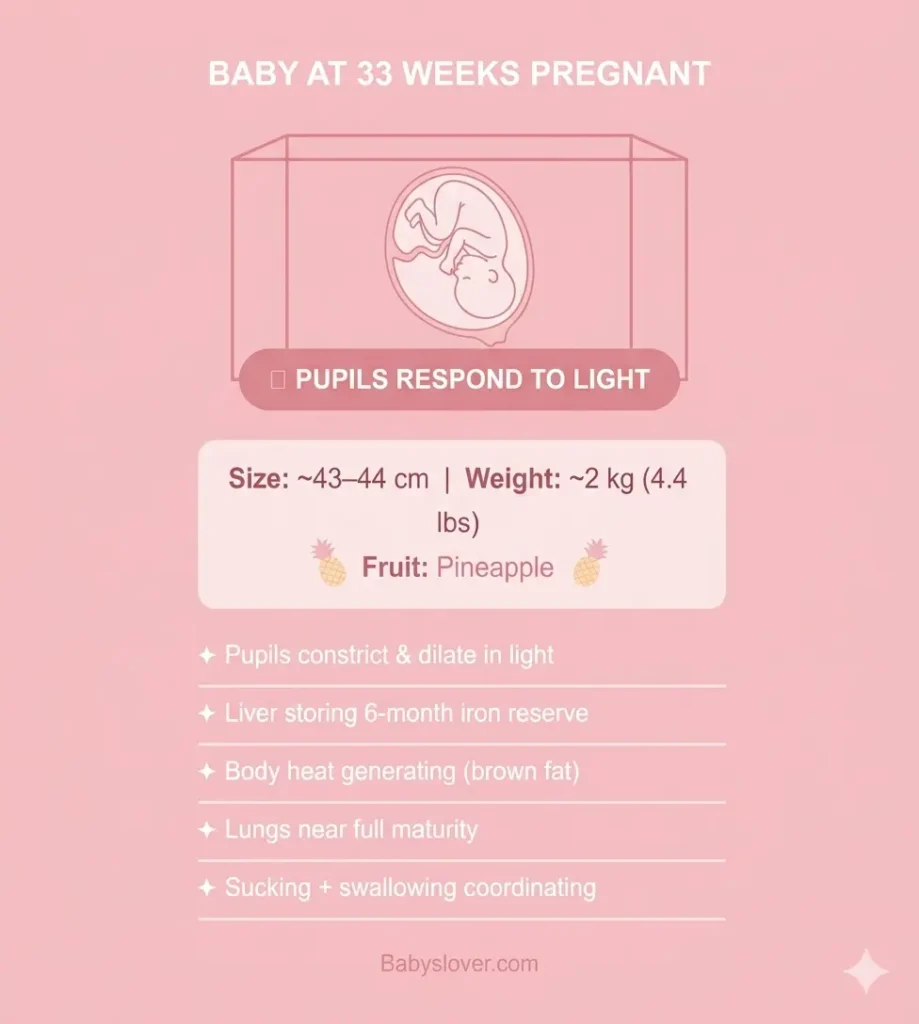
At 33 weeks pregnant, your uterus is now roughly 5 inches above your belly button – the same measurement as last week, but the pressure it exerts has increased as your baby has grown. The internal landscape of your body is almost entirely reorganized around the pregnancy at this point.
Amniotic fluid has been at its peak volume since around Week 32 and is now beginning a gradual decline that will continue until birth. This has a noticeable effect: as fluid decreases, there is less cushioning around your baby’s movements. Kicks and jabs that once felt padded now feel sharper and more direct. This is not a sign of distress – it is a sign of a baby growing into the available space.
Three out of four pregnant women report insomnia at this stage of pregnancy. The combined weight of physical discomfort, frequent urination, active fetal movement, heartburn, and anxiety about the birth ahead makes sustained sleep genuinely difficult for most women at Week 33. If you are sleeping in fragments, you are in the majority.
What to expect at your Week 33-34 appointment:
- Blood pressure and urine protein – preeclampsia surveillance
- Fundal height – should be approximately 31-35 cm at Week 33
- Baby’s heartbeat
- Baby’s position – head-down, breech, or transverse
- Review of any symptoms of preterm labor
- Kick count check-in
- Possible biophysical profile (BPP) if you are high-risk – more on this below
- Reminder that GBS test is coming at Weeks 35-37
Baby Development at 33 Weeks Pregnant
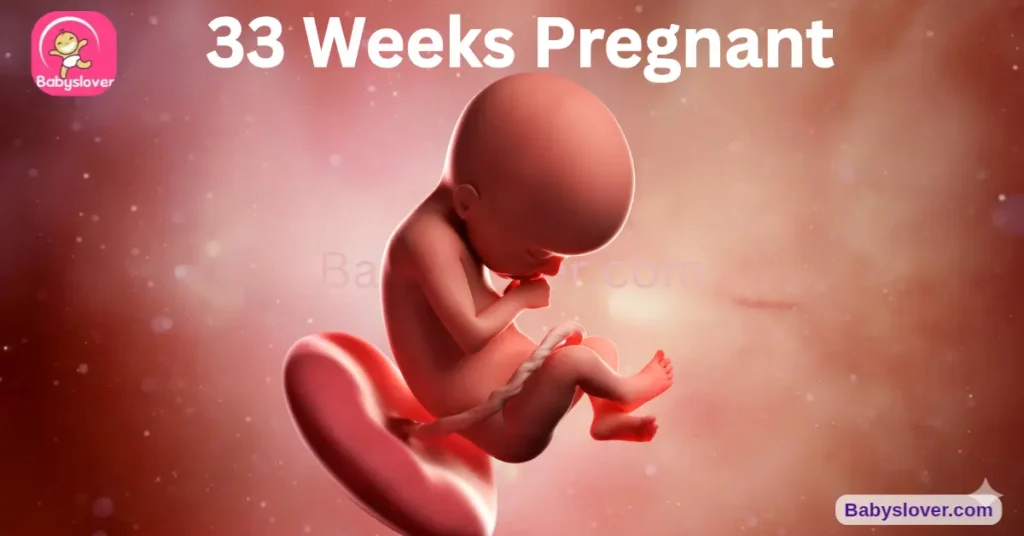
At 33 weeks pregnant, your baby measures approximately 43-44 cm from head to heel and weighs around 1.9 to 2 kg – roughly the size and weight of a pineapple or large butternut squash.
| Detail | Measurement |
| Length | ~43-44 cm (about 17 inches) |
| Weight | ~1.9-2 kg (approx. 4.2-4.4 lbs) |
| Size comparison | Pineapple / large butternut squash |
| Heart rate | 110-160 bpm |
| Weekly weight gain | ~200-250 grams per week from here |
Key developments this week:
- Pupils constrict and dilate: The pupillary light reflex is now active. When a bright light is directed at the uterus, your baby’s pupils constrict. When the light is removed, they dilate. This is the same reflex tested in every newborn exam – and it is fully operational seven weeks before birth.
- Iron stored in the liver: Your baby’s liver is now actively building an iron reserve that will sustain them for the first four to six months of life. Breast milk is relatively low in iron – intentionally so, because the iron is highly bioavailable – but it relies on this prenatal iron reserve being built up in the final weeks of pregnancy. Preterm babies, who miss some of this storage period, often need iron supplementation.
- Body heat generation begins: Your baby is now generating their own body heat through brown adipose tissue – the metabolically active fat that burns energy to produce warmth. This is the same type of fat that keeps newborns warm in the first hours and days of life. You may notice you feel warmer than usual – some of that heat is coming from your baby.
- Lungs approaching full maturity: The lungs are close. Surfactant production is near completion. Practice breathing movements are occurring regularly. A baby born at 33 weeks today would very likely breathe with minimal support.
- Skull bones firming but still flexible: The six plates of the skull are beginning to firm up while maintaining the flexibility needed for birth. Full ossification will not complete until early adulthood – but the process is visibly advancing week by week.
- Eyes open during waking periods: Your baby is now opening their eyes when awake and closing them when sleeping – the same pattern they will follow as a newborn. REM sleep, with rapid eye movements visible under the lids, continues during sleep cycles.
- Sucking and swallowing coordinating: The sucking and swallowing reflexes are almost fully coordinated this week. By birth, they will work together in the synchronized pattern needed for feeding – whether from breast or bottle.
The Pupillary Reflex at 33 Weeks – What It Means
The pupillary light reflex – the automatic constriction of the pupil in response to bright light – is one of the most fundamental neurological functions in the human body. It is controlled by the brainstem and does not require conscious processing. When it is absent in a newborn, it triggers immediate evaluation.
At 33 weeks pregnant, this reflex is active and working. The pathway that makes it function – light entering the eye, signal traveling via the optic nerve to the brainstem, response traveling via the oculomotor nerve back to the iris sphincter muscle – is complete and operational.
This is what it means in practical terms: if you press a flashlight against your belly and turn it on, your baby’s pupils constrict. Turn it off, and they dilate. You are interacting with a neurological reflex that will be tested in the first minutes of your baby’s life outside the womb.
The flashlight test at this stage also tends to prompt movement – your baby may turn away from the light, kick toward it, or simply become more active. All of these responses reflect a nervous system that is processing sensory input and generating motor responses in real time.
Iron Storage – Why These Final Weeks Matter So Much
Most pregnancy guides mention iron in the context of maternal diet and preventing anemia. Far fewer explain what your baby is doing with iron right now – and it is one of the most important processes happening in the final trimester.
Between Weeks 30 and 40, your baby’s liver accumulates an iron reserve. This reserve – stored as ferritin and hemosiderin in liver cells – is designed to last approximately four to six months after birth. It is the bridge between prenatal iron supply (from your bloodstream via the placenta) and the point at which your baby will begin eating iron-rich solid foods.
Breast milk contains relatively little iron. This is not a flaw – the iron in breast milk is absorbed at a rate of 50-70%, which is exceptionally high. But the quantity is still low, and exclusively breastfed babies depend heavily on their prenatal iron stores to maintain healthy hemoglobin levels in the first months of life.
| Situation | Iron Store Impact | Recommendation |
| Full-term birth | Iron stores fully built – typically sufficient for 4-6 months | Begin iron-rich solid foods around 6 months |
| Premature birth (before Week 37) | Iron stores partially built – stores may last only 2-3 months | Pediatrician may recommend iron drops from 2-4 weeks of age |
| Maternal iron deficiency in T3 | Baby still takes priority – but stores may be reduced | Iron supplementation for mom reduces this risk – ask your provider |
| Delayed cord clamping | Extra iron delivered via cord blood after birth | Ask your provider about this option – adds meaningful iron to newborn supply |
This is one of the strongest reasons why adequate iron intake in the third trimester matters beyond just keeping you from feeling exhausted. Your baby’s first months of independent life are being prepared right now.
Why Your Areolas Are Getting Darker – The Science Behind It
Darkening of the areolas – the pigmented area around the nipples – is extremely common from the first trimester onward. By Week 33, the darkening is often pronounced and may extend outward.
The cause is hormonal: rising estrogen and progesterone stimulate melanocytes in the skin to produce more melanin. But the reason this happens specifically in the areola region goes beyond random hormone distribution.
Research in evolutionary biology suggests that areola darkening serves a specific purpose for newborns. Newborns are born with vision calibrated to approximately 20/400 – they can only see clearly at close range. They cannot read visual contrast well beyond high-contrast patterns.
A darkened areola against lighter breast skin creates exactly the kind of high-contrast visual target that a near-sighted newborn can detect. Research has shown that newborns will orient toward and crawl toward darker circular contrasts placed on skin – even without prior feeding experience.
Your body is placing a navigation marker on itself for your newborn. The darkening is not a side effect. It is a feature.
The darkening is permanent for some women, though many find it fades significantly after breastfeeding ends. The Montgomery glands – the small bumps around the areola – also become more prominent in late pregnancy. These glands produce an oily secretion that lubricates the nipple and, according to research, carries a scent that newborns are attracted to.
33 Weeks Pregnant Symptoms
Insomnia – Why It Peaks Now
Approximately 75% of pregnant women report insomnia at some point in the third trimester, with Week 33 being within the peak window. Understanding why it happens is actually useful – it changes how you approach it.
There is no single cause. It is a convergence:
- Physical discomfort: No position is comfortable for more than an hour with a belly this size
- Frequent urination: Your bladder capacity is minimal and baby’s head may be pressing on it
- Baby’s movement: Active periods, especially in the evening and early morning, prevent deep sleep
- Heartburn: Lying down triggers acid reflux in many women by Week 33
- Leg cramps: Magnesium deficiency peaks in T3
- Anxiety: Labor is getting close. Your mind works through it at night.
- Hormonal sleep disruption: Progesterone fragments sleep architecture
What actually helps at this stage:
- Stop fighting it – accept that you will sleep in stretches, not blocks
- Full-length pregnancy pillow – the single most effective physical aid
- Keep the room cool – your body runs warmer now
- Magnesium glycinate before bed – reduces cramps and improves sleep quality
- Limit fluids after 7pm – reduces bathroom trips without compromising daily intake
- If you wake and can’t sleep within 20 minutes – get up, do something quiet in dim light, return when sleepy
- Audiobooks at low volume – distract anxious thoughts without stimulating the brain
Feeling Hot All the Time
Feeling unusually warm is nearly universal at 33 weeks pregnant – and it has two distinct causes working simultaneously.
First: your metabolic rate has increased significantly. Your body is running the equivalent of a continuous endurance effort – building tissue, pumping extra blood volume, maintaining the placenta, and regulating two bodies’ worth of temperature. All of this generates heat.
Second: your baby is now generating their own body heat. Brown adipose tissue – the metabolically active fat that forms specifically for newborn thermoregulation – is functional at Week 33. Your baby is warm. And your baby’s warmth transfers to you through the uterine wall.
Practical tips: dress in layers, keep a fan nearby, stay hydrated (dehydration compounds heat intolerance), and let go of the impulse to match the room temperature other people find comfortable. Your internal thermostat is running high right now for good reason.
Headaches
Headaches are common at 33 weeks pregnant and have several contributing causes: hormonal fluctuations, dehydration (easily the most common cause), poor sleep, muscle tension from postural changes, and blood pressure changes.
Most pregnancy headaches respond well to hydration, rest in a dark room, a cool compress on the forehead, and Tylenol (acetaminophen) – which is generally considered the safest OTC pain reliever during pregnancy. Ibuprofen and aspirin should be avoided in the third trimester unless specifically directed by your provider.
A headache that is sudden, severe, and unlike any headache you have had before – especially if combined with visual changes, swelling, or pain under the ribs – should be evaluated immediately. This symptom profile can indicate preeclampsia.
Colostrum Leaking
Colostrum – the thick, yellow-gold first milk – may have been present since around Week 20 but tends to become more noticeable and may begin leaking by Week 33. This is a good sign. It means your body is preparing to feed your baby from the very first moments of life.
Colostrum is extraordinary nutrition. It is protein-dense, antibody-rich, low in volume but high in everything a newborn needs in the first 24-72 hours before mature milk arrives. Newborns’ stomachs are the size of a marble at birth – the small quantities of colostrum are exactly right for that stomach size.
Breast pads in your bra manage any leakage. Do not attempt to express colostrum in preparation for birth – nipple stimulation can trigger contractions, and there is no benefit to accumulating colostrum in advance.
Preterm Labor Warning Signs at 33 Weeks
A baby born at 33 weeks is likely to survive and thrive with NICU support – but every additional week in the womb meaningfully improves outcomes. Knowing the signs of preterm labor is important at this stage.
| Warning Sign | What It Feels Like | What to Do |
| Regular contractions | Tightening every 10 minutes or more, getting stronger | Call your provider immediately – do not wait |
| Pelvic pressure | Persistent pressure low in the pelvis, like baby is pushing down | Call your provider if it’s new or worsening |
| Lower back pain | Persistent dull ache in the lower back, especially if new or rhythmic | Call if combined with other symptoms |
| Vaginal fluid | Watery fluid that doesn’t stop – possible membrane rupture | Go to hospital immediately |
| Vaginal bleeding | Any fresh red blood beyond a small brown tinge | Go to hospital immediately |
| Discharge change | Increase in watery or mucousy discharge, possibly with blood tinge | Call your provider |
If you are unsure whether what you are experiencing is preterm labor, call your provider. There is no wrong time to call. Providers would far rather reassure you over the phone at 2am than have you wait at home uncertain.
The Biophysical Profile – What It Is and Who Needs It
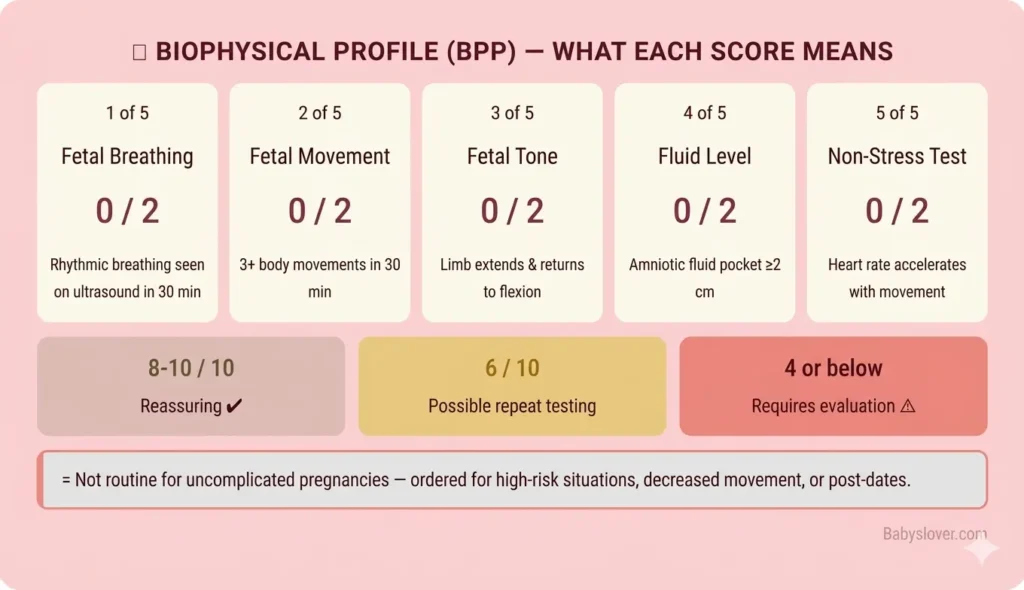
A Biophysical Profile (BPP) is an ultrasound-based assessment that evaluates five specific aspects of fetal wellbeing. It is used for high-risk pregnancies and can be ordered from around Week 32 onward.
Most first-time mothers at Week 33 will not have a BPP unless they have a specific risk factor. But knowing what it is means you won’t be surprised or alarmed if your provider orders one.
| Component | What’s Being Assessed | How It’s Done | Score |
| Fetal breathing | Rhythmic practice breathing movements | Observed on ultrasound for 30 min | 0 or 2 |
| Fetal movement | At least 3 body movements in 30 min | Observed on ultrasound | 0 or 2 |
| Fetal tone | At least 1 limb extension + return to flexion | Observed on ultrasound | 0 or 2 |
| Amniotic fluid | Adequate fluid volume – pocket at least 2 cm | Measured on ultrasound | 0 or 2 |
| Non-stress test (NST) | Heart rate accelerates with movement | Fetal heart monitor, 20-40 min | 0 or 2 |
Maximum score is 10. A score of 8 or 10 with normal fluid is generally reassuring. A score of 6 may prompt repeat testing or additional evaluation. Scores of 4 or below may indicate the baby needs more immediate attention.
Who typically gets a BPP:
- High-risk pregnancies – gestational diabetes, preeclampsia, growth restriction
- Twin or multiple pregnancies
- Decreased fetal movement reported by the mother
- Post-dates pregnancy (past 40 weeks)
- Previous pregnancy loss
- Any situation where the provider wants closer monitoring of fetal wellbeing
Nutrition at 33 Weeks Pregnant
Protein needs peak in the third trimester – and Week 33 is squarely in this window.
| Nutrient | Why It Matters at Week 33 | Daily Target & Best Sources |
| Protein | Baby gaining 200-250g/week of muscle and fat. You need 71g/day – 25g MORE than pre-pregnancy. Some experts add 10g more in T3. | Chicken, eggs, Greek yogurt (18g per cup), lentils, cottage cheese, fish |
| Iron | Baby’s liver storing 6-month iron reserve. Your blood volume at peak demands iron too. | Red meat, lentils, spinach + vitamin C; ask provider about supplementing |
| DHA (Omega-3) | Brain development ongoing. Pupil reflexes, nerve myelination all require DHA. | Salmon, sardines, eggs, prenatal vitamins with DHA |
| Calcium | Bone hardening continues – baby still pulls from your bones if intake is low | Dairy, fortified milks, sardines with bones, almonds, leafy greens |
| Choline | Brain development – 90% of women deficient. As important as folic acid. | 2 eggs daily provides the highest choline per serving of any common food |
| Fiber + Water | Constipation intensifies – hemorrhoids worsen without prevention | Prunes, oats, beans, vegetables + 8-10 glasses water daily |
Appetite continues to be compressed by your crowded stomach. Small, protein-dense meals every 2-3 hours are more effective than three large ones at this stage. A high-protein snack before bed – Greek yogurt or cottage cheese – can also improve sleep quality by stabilizing blood sugar overnight.
Partner Tips for Week 33
- Know the preterm labor signs yourself – you may be the one who notices something she dismisses or minimizes
- Take the temperature seriously – literally. If she says she is hot, she is hot. Open windows, run the fan, stop arguing about the thermostat.
- Hospital bag should be fully packed now – confirm it together this week
- Do the flashlight test together – press a flashlight to her belly and watch for baby’s response. It is a genuinely moving experience.
- Help her eat enough protein – cooking a high-protein dinner takes one task off her plate at the time she is most fatigued
- The pediatrician should be confirmed by now – if not, make this your task this week
- If she is not sleeping, do not suggest solutions she has already tried. Just be present and take over tasks that let her rest when she can.
Week 33 Checklist
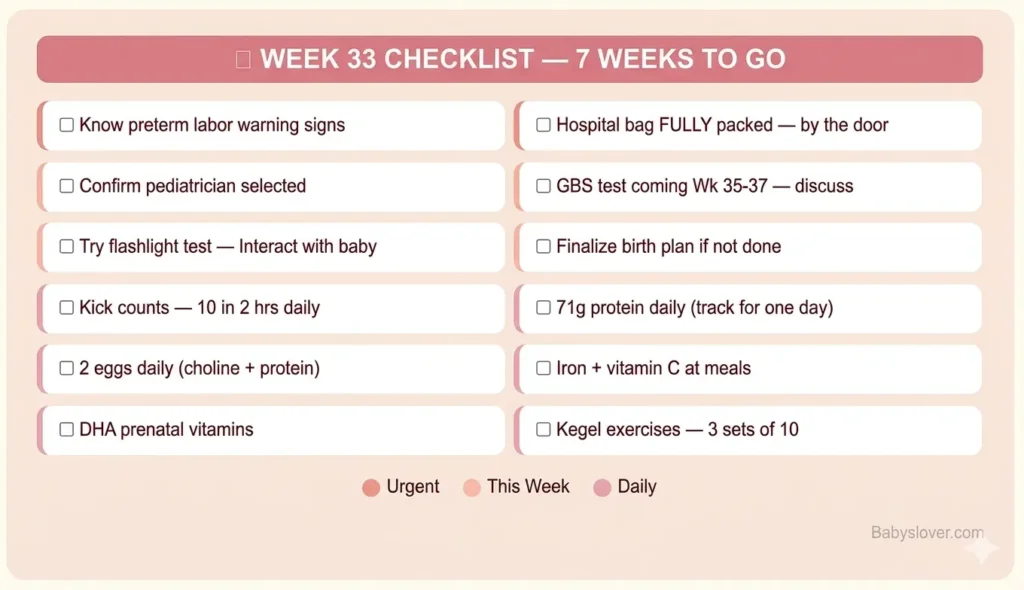
| Task | Priority |
| Know preterm labor warning signs – share with partner | URGENT – know these now |
| Hospital bag fully packed and by the door | URGENT – do this week |
| Continue kick counts daily – 10 in 2 hours | Daily |
| Confirm pediatrician is selected | This week |
| Know GBS test is coming at Week 35-37 | Awareness – discuss with provider |
| Try the flashlight test – interact with your baby | Fun this week |
| High-protein snack before bed for better sleep | Daily |
| Magnesium glycinate before bed if leg cramps are a problem | As needed |
| Protein goal: 71g daily – track it for a day to calibrate | This week |
| Iron + vitamin C at meals daily | Daily |
| 2 eggs daily for choline and protein | Daily |
| DHA prenatal vitamins | Daily |
| Kegel exercises – 3 sets of 10 | Daily |
| Feet elevated in evenings | Daily |
| Birth plan – finalize this week if not done at Week 32 | This week |
Frequently Asked Questions – 33 Weeks Pregnant
What trimester is 33 weeks pregnant?
33 weeks pregnant is the sixth week of the third trimester. Third trimester runs from Week 28 through Week 40. You have approximately 7 weeks remaining until your due date.
How many months is 33 weeks pregnant?
At 33 weeks pregnant, you are 8 months pregnant. Full-term pregnancy is 40 weeks – approximately 9.5 calendar months – so the common ‘9 months’ phrase undercounts the full journey slightly.
How much does a baby weigh at 33 weeks pregnant?
At 33 weeks pregnant, your baby weighs approximately 1.9 to 2 kg (about 4.2 to 4.4 lbs) and measures around 43-44 cm from head to heel – roughly the size of a pineapple or large butternut squash. Baby is gaining approximately 200-250 grams per week from here until birth.
Can a baby survive at 33 weeks?
Yes. Survival rates for babies born at 33 weeks with NICU care are approximately 95-98%. Lungs are well-developed and most 33-weekers breathe with minimal support. Long-term outcomes are generally very good, with major complications becoming increasingly rare the closer to term a baby is born.
Why are my nipples getting darker at 33 weeks pregnant?
Areola darkening during pregnancy is caused by hormonal stimulation of melanin-producing cells in the skin. Research in evolutionary biology suggests this darkening serves a navigational purpose – it creates a high-contrast visual target that helps near-sighted newborns (who can only see clearly at 8-12 inches) find the breast for feeding. The Montgomery glands around the areola also enlarge and produce a scent that newborns are attracted to. For many women, the darkening fades significantly after breastfeeding ends.
What is colostrum and when does it start leaking?
Colostrum is the first milk your body produces – thick, yellow-gold, and extremely nutrient-dense. It can begin leaking as early as Week 16, but becomes more noticeable for many women around Week 33. It is protein-rich and antibody-dense, designed for a newborn’s marble-sized stomach in the first 24-72 hours before mature milk arrives. Breast pads help with leakage. Do not try to express it in preparation for birth – nipple stimulation can trigger contractions.
Why do I feel so hot at 33 weeks pregnant?
Two factors are working together at 33 weeks pregnant. First, your metabolic rate has increased significantly to support pregnancy – this generates substantial internal heat. Second, your baby is now actively generating their own body heat through brown adipose tissue. Your baby’s warmth transfers through the uterine wall to you. Staying hydrated, dressing in breathable layers, and using a fan are the most practical responses.
What is a biophysical profile in pregnancy?
A biophysical profile (BPP) is an ultrasound assessment that evaluates five aspects of fetal wellbeing: breathing movements, body movement, muscle tone, amniotic fluid level, and heart rate response during movement. Each component scores 0 or 2, for a maximum of 10. It is used for high-risk pregnancies and after 40 weeks, and can be ordered from around Week 32 onward. It is not a routine test for uncomplicated pregnancies.
How much protein do I need at 33 weeks pregnant?
At 33 weeks pregnant, the recommended protein intake is approximately 71 grams per day – 25 grams more than the pre-pregnancy recommendation. Some experts suggest an additional 10 grams in the third trimester specifically. Good sources include chicken breast (~31g per 100g), Greek yogurt (~18g per cup), eggs (~6g each), lentils (~18g per cup cooked), and cottage cheese (~14g per half cup).
Looking Ahead: 34 Weeks Pregnant
At 34 weeks pregnant, your baby’s lungs reach near-full maturity, fingernails extend past the fingertips, the central nervous system is completely developed, and the fat deposits that will make your newborn round and soft are in their final accumulation phase. The Group B Strep test is approaching in the next 1-3 weeks.
Seven weeks. Pupils that respond to light. A liver building your baby’s iron supply. Keep going.
Follow our pregnancy week by week guide for every development from now to delivery