
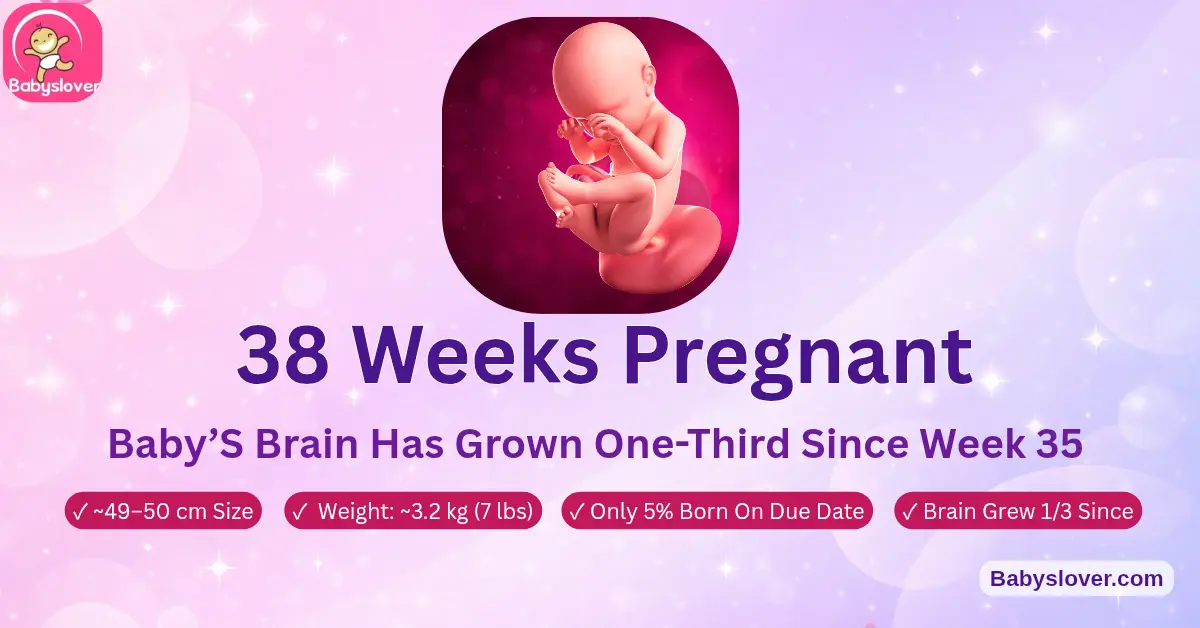
Between Week 35 and Week 39, your baby’s brain will have grown by one-third.
Not one-third of total brain size. One-third added in just four weeks. The neural connections forming in this final sprint – the synapses linking neurons that have been waiting for their partners since early in the second trimester – are what separate a 35-week brain from a 39-week brain. What has been assembled since Week 35 is not new architecture. It is density. Speed. The wiring that makes everything work faster and better.
At 38 weeks pregnant, your baby’s head and abdomen are now the same circumference. The proportional asymmetry of early pregnancy – the enormous head relative to the body – has resolved. Your baby looks, proportionally, like a newborn. Because that is exactly what your baby is becoming.
Only 5% of babies are born on their due date. You may be two weeks away from that date, or you may already be in labor by the time this number matters. The biology of birth does not run on a calendar. But it is running, quietly and steadily, toward something that is now very close.
Two weeks from your due date. Here is everything happening at 38 weeks pregnant.

Contents
- 1 Quick Summary: 38 Weeks Pregnant
- 2 What’s Happening in Your Body at 38 Weeks Pregnant
- 3 Baby Development at 38 Weeks Pregnant
- 4 The Final Brain Sprint – What Grew Between Week 35 and Now
- 5 38 Weeks Pregnant Symptoms
- 6 What to Do If Your Water Breaks at 38 Weeks
- 7 Freezer Meals – The Most Practical Thing You Can Do This Week
- 8 The Waiting – How to Manage the Final Two Weeks
- 9 Nutrition at 38 Weeks Pregnant
- 10 Partner Tips for Week 38
- 11 38 Weeks Pregnant Checklist
- 12 Frequently Asked Questions – 38 Weeks Pregnant
- 12.1 What trimester is 38 weeks pregnant?
- 12.2 How many months is 38 weeks pregnant?
- 12.3 How much does a baby weigh at 38 weeks pregnant?
- 12.4 Is 38 weeks full term?
- 12.5 What happens when your water breaks at 38 weeks?
- 12.6 Why is diarrhea a sign of labor?
- 12.7 When will I go into labor if I’m 38 weeks pregnant?
- 12.8 Why can’t I sleep at 38 weeks pregnant?
- 13 Looking Ahead: 39 Weeks Pregnant
Quick Summary: 38 Weeks Pregnant
| Detail | Info |
| Baby size | Rhubarb / winter melon – ~49-50 cm, ~3.0-3.4 kg (6.6-7.5 lbs) |
| Trimester | Third trimester – Week 11 of T3 |
| Term status | Early term (full term begins Week 39) |
| Weeks remaining | ~2 weeks to due date |
| Top milestone | Brain grew 1/3 since Week 35 + head and abdomen same circumference |
| This week’s action | Freezer meals + know water-breaking protocol + manage sleep actively |
What’s Happening in Your Body at 38 Weeks Pregnant
At 38 weeks pregnant, the body you are living in is doing something remarkable. It is carrying a near-term baby, maintaining full blood volume at 50% above normal, managing the weight of a uterus that has expanded 500-1,000 times, and simultaneously beginning to dismantle the hormonal architecture of pregnancy in preparation for what comes next.
Your weight gain may have slowed or even plateaued at this point. This is normal and expected – the body redirects resources toward final preparation rather than expansion. Some women actually lose 1-2 pounds in the final days before labor as the body sheds fluid in preparation.
The physical discomforts of this week are not new – they are intensified versions of what has been building since Week 28. Pelvic pressure, bladder urgency, fatigue, difficulty sleeping, heartburn, swelling. Every one of them is the result of a nearly full-term baby occupying your body. All of them resolve after birth with surprising speed.
What to expect at your Week 38 appointment:
- Blood pressure, urine protein, fundal height – standard final-weeks monitoring
- Baby’s heartbeat
- Baby’s position – confirmed head-down for the vast majority
- Optional cervical exam – effacement and dilation update
- Discussion of induction timeline if approaching due date or if indicated
- Non-stress test if ordered – monitoring baby’s heart rate response to movement
- Final birth plan review
Baby Development at 38 Weeks Pregnant

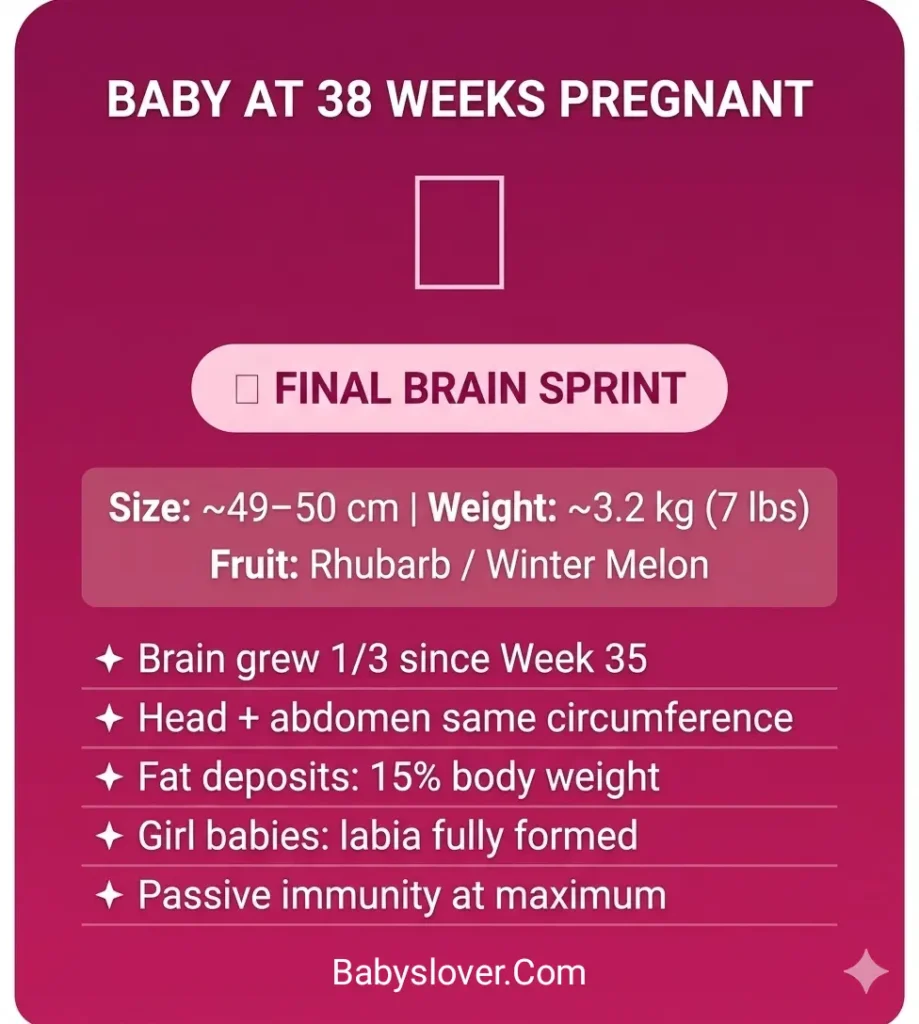
At 38 weeks pregnant, your baby measures approximately 49-50 cm from head to heel and weighs around 3.0 to 3.4 kg – roughly the size and weight of a bunch of rhubarb or large winter melon. Birth weight varies enormously at this stage and both smaller and larger babies are entirely normal.
| Detail | Measurement |
| Length | ~49-50 cm (about 19.4 inches) |
| Weight | ~3.0-3.4 kg (approx. 6.6-7.5 lbs) |
| Size comparison | Rhubarb / winter melon |
| Heart rate | 110-160 bpm |
| Brain status | Grew 1/3 in size since Week 35 – final connectivity sprint |
Key developments this week:
- Brain: one-third larger than at Week 35: Between Week 35 and birth, the brain undergoes one of the most dramatic growth spurts of the entire pregnancy. This final phase is almost entirely synaptic – the formation of connections between neurons that have been in place since earlier weeks. A brain with denser connections processes faster, learns more efficiently, and coordinates reflexes more precisely. This is why the difference between a 35-week and a 39-week brain shows up in measurable outcomes.
- Head and abdomen same circumference: By Week 38, the head circumference and abdominal circumference have equalized. Early in fetal development, the head was disproportionately large – reflecting the priority of brain development. Now the body has caught up. This proportional balance is one of the measurements your provider takes during growth scans – it confirms symmetrical development.
- Girl babies: labia fully developed: In female babies, the labia majora and labia minora are now completely formed and have reached their birth proportions. This milestone, combined with the testicle descent in males completed at Week 34-35, means external genitalia are fully developed in both sexes by Week 38.
- Fat at cheeks and limbs fully deposited: The fat deposits that have been building since Week 30 are now complete. The round, soft, chubby appearance associated with newborns is fully in place. This fat – approximately 15% of body weight – is the primary insulation your baby will rely on to regulate temperature in the hours after birth.
- Liver nearly fully developed: The liver’s enzyme systems – including those responsible for bilirubin processing, which affects jaundice risk after birth – are approaching full maturity. Babies born at 38 weeks still have slightly higher jaundice rates than those born at 39-40 weeks, which is one reason the early term vs. full term distinction matters clinically.
- Antibody transfer at maximum: The passive immunity transferred from your bloodstream through the placenta is at its peak level. Your baby carries the most comprehensive version of your immune memory they will ever receive. This protection begins declining after birth as your transferred antibodies break down – but by then, colostrum and breast milk continue delivering immune support through a different pathway.
- Intestines: meconium complete, digestion queued: Meconium is fully accumulated and waiting for the trigger of birth. The entire digestive system – stomach acid, pancreatic enzymes, bile production, intestinal peristalsis – is assembled and queued for its first activation at the first feeding.
The Final Brain Sprint – What Grew Between Week 35 and Now
The brain your baby has at Week 38 is measurably different from the brain at Week 35 – and the difference is not in structure but in connectivity.
From Week 35 to birth, the brain adds approximately one-third of its volume. Almost none of that volume is new neurons – the neuron population was largely established in the second trimester. What is being added now is synapses – the contact points between neurons where information passes – and myelin – the fatty insulating sheath that dramatically increases the speed at which nerve signals travel.
A brain with denser synaptic connections processes more information simultaneously and responds faster. A brain with more myelin conducts signals faster and with less interference. Both of these processes are continuing at Week 38 and will continue through birth and well into early childhood.
| Brain Metric | Week 35 | Week 38 | Week 39-40 (Full Term) |
| Brain weight | ~370g | ~400g | ~400-430g |
| Cortical surface area | Rapidly folding | Near-final folding | Fully developed gyri/sulci |
| Myelination level | Active but incomplete | Advancing significantly | Near-complete in key pathways |
| Synaptic density | Rapidly increasing | Substantially denser | Optimal for birth |
| Bilirubin processing | Moderate capacity | Good capacity | Full capacity (less jaundice risk) |
This table is why providers do not recommend elective delivery before 39 weeks in uncomplicated pregnancies. The difference between Week 38 and Week 40 is not visible and not dramatic – but it is real and measurable in outcomes.
38 Weeks Pregnant Symptoms
Sleep Deprivation – The Clinical Consequences
Research suggests that over 98% of women in the third trimester cannot sleep through the night. This is not merely uncomfortable – it has specific clinical implications for labor and delivery.
Studies have found that severe sleep deprivation in the final weeks of pregnancy is associated with:
- Longer labor duration – particularly in the active phase
- Increased perception of pain during contractions
- Higher rates of assisted delivery (vacuum or forceps)
- Higher rates of cesarean section, particularly in first-time mothers
This does not mean you should panic about lost sleep. It means sleep at 38 weeks pregnant is a genuine clinical priority – not a luxury.
Practical strategies beyond ‘use a pregnancy pillow’:
- Sleep in whatever position works – if your back provides temporary comfort and you are not staying on it for hours, the brief periods are acceptable
- Audiobooks or calm podcasts at very low volume can quiet an anxious mind into sleep without stimulating it into wakefulness
- Napping during the day is not weakness – it is strategic recovery
- A consistent pre-sleep routine (same time, same quiet activity, same cool dark room) helps signal sleep to a body that is dysregulated
- Magnesium glycinate before bed reduces leg cramps and improves sleep quality – ask your provider
- If insomnia is severe and persistent, mention it specifically to your provider – there are safe options for this stage
Diarrhea – A Sign Labor Is Near
Loose stools or diarrhea at 38 weeks pregnant is often dismissed as a digestive symptom. It can be – but it can also be something more specific.
As the body prepares for labor, prostaglandins – the same compounds involved in cervical ripening and uterine contractions – also stimulate the bowels. The result is diarrhea or loose stools that can precede labor by hours to a day or two. This is the body’s way of clearing the digestive tract before the physical demands of labor.
If diarrhea is accompanied by regular contractions, a change in discharge, or the feeling that ‘something is different’ – take it seriously as a possible early labor sign. If it is an isolated symptom without other changes, it may simply be pregnancy-related digestive sensitivity. Stay hydrated. Note the timing. Monitor for other signs.
Swelling Increasing
Edema in the feet, ankles, and hands tends to peak in the final two weeks of pregnancy. Blood volume is at maximum. Fluid retention is at its highest. Gravity is relentless.
Elevating feet when sitting, staying hydrated, wearing compression stockings in the morning before swelling begins, and avoiding prolonged standing all help. Swelling that is severe, sudden, asymmetrical (one limb far more swollen than the other), or combined with headache or visual changes requires immediate contact with your provider.
Intense Pelvic Pressure
Your baby’s head is pressing directly on your pelvic floor and bladder. The sensation at 38 weeks pregnant is often described as pressure, heaviness, or the feeling that the baby might fall out – none of which is possible, but all of which is a reasonable description of what a 3+ kg head pressed against a pelvic floor feels like.
Short walks help shift position and relieve some pressure. Sitting in a warm bath reduces the gravitational component temporarily. A pregnancy support belt helps with extended periods of standing. This symptom resolves with delivery – typically within hours.
Increased Mucus and Possible Bloody Show
Increased vaginal discharge continues. Many women at 38 weeks notice a significant increase in thick mucus – this is the cervix continuing to change as it effaces and dilates.
Bloody show – pink or red-tinged mucus, sometimes mixed with mucus plug material – is a sign that the cervix is actively changing and labor is approaching. It can precede labor by hours or days. Note the timing and color. If bleeding is heavy (soaking a pad), contact your provider immediately.
What to Do If Your Water Breaks at 38 Weeks
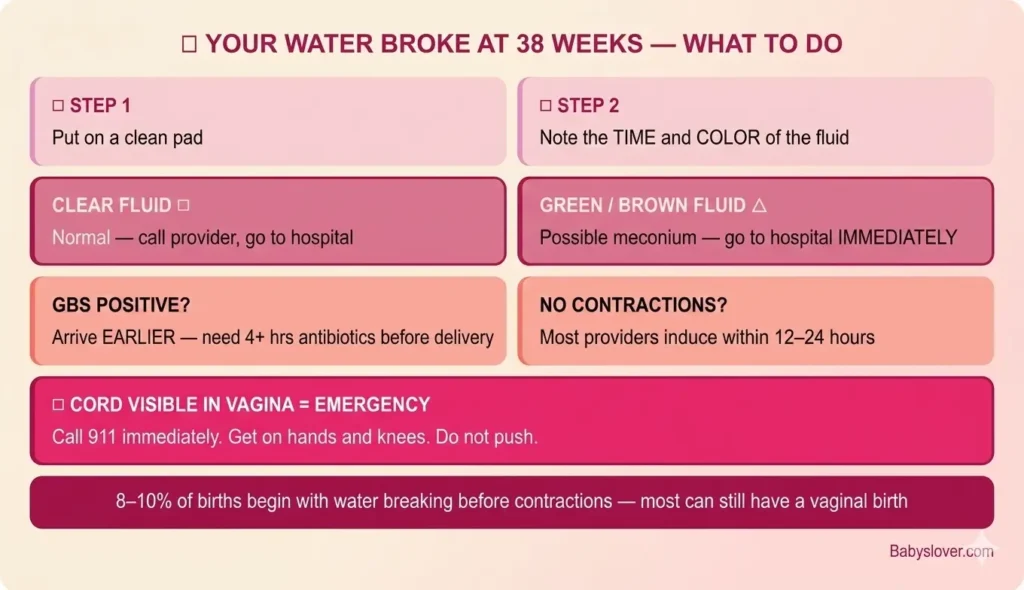
The rupture of membranes (your water breaking) can happen before contractions begin – this is called premature rupture of membranes at term (PROM), and it happens in approximately 8-10% of pregnancies.
A University of Michigan study found that the majority of women who experience PROM at term can still have a vaginal birth. However, once membranes rupture, the barrier between the uterus and the outside world is gone – infection risk increases with time. Most providers recommend coming in for evaluation when this happens.
| Situation | What Happens | What to Do |
| Gush of clear/pale fluid | Membranes may have ruptured – amniotic fluid has no odor or a mild sweet smell | Put on a pad, note the time, call your provider or go to hospital – do not wait |
| Slow trickle that doesn’t stop | Could be amniotic fluid leaking – different from discharge which stops | Lie down for 30 min – if pad is wet when you stand, contact your provider |
| GBS positive + water breaks | Need antibiotic coverage – early arrival gives time for 4+ hours of antibiotics before delivery | Call provider immediately – arrive at hospital sooner rather than later |
| Water breaks, no contractions | PROM – common in 8-10% of pregnancies. Provider will discuss management options. | Go to hospital. Most providers induce within 12-24 hours if contractions don’t start. |
| Green or brown-tinged fluid | Possible meconium-stained fluid – requires immediate evaluation at delivery | Go to hospital immediately regardless of contractions |
| Water breaks with cord visible | Cord prolapse – rare but emergency | Call 911, get on hands and knees immediately, go to emergency |
One clarification that matters: your water does not have to break before labor begins. Most women go into labor with membranes intact. Water breaking first is one pattern – contractions first is another. Both are normal.
Freezer Meals – The Most Practical Thing You Can Do This Week
Of all the advice given at 38 weeks pregnant, this one makes one of the most tangible differences to the postpartum period – and it can only be done before the baby arrives.
The first two to four weeks after birth are characterized by exhaustion, around-the-clock feeding, and physical recovery. Cooking a meal requires two free hands, 20-30 minutes of uninterrupted time, and cognitive function. All of these are in extremely short supply with a newborn.
Batch cooking and freezing meals now – when you have the kitchen, the time, and the relative cognitive capacity – is practical preparation that will genuinely help your recovery.
What freezes well and is useful postpartum:
- Soups and stews – easy to eat one-handed, warming, easy to add nutrients
- Casseroles and baked pasta dishes – reheat in oven, no monitoring needed
- Breakfast muffins and egg bites – one-handed, nutrient-dense, protein-rich
- Rice dishes, grain bowls – easy reheating, flexible
- Smoothie packs – frozen fruit + greens + protein portions, just add liquid
What to prioritize for nutrition:
- Iron-rich foods – postpartum iron levels affect energy and breast milk production. Red meat dishes, lentil soups, spinach-based recipes.
- Protein-dense meals – muscle recovery and milk production both require protein
- Healthy fats – brain health (yours and baby’s through milk) and hormone regulation
- High-fiber options – constipation is extremely common in the first postpartum week, especially after cesarean
If cooking feels impossible at this stage, ask a partner, family member, or friend to help. Accepting help with freezer meals is one of the most useful things your support network can do for you right now.
The Waiting – How to Manage the Final Two Weeks
For many women, Week 38 is not the week labor begins. It is the week of waiting for labor to begin.
Only about 5% of babies arrive on their due date. Most births happen somewhere in the Window between 38 and 41 weeks. The due date is a statistical midpoint, not a deadline. A baby born at 38 weeks and one born at 41 weeks are both within the range of normal timing.
The waiting at 38 weeks is one of the stranger emotional experiences of pregnancy. You are physically done being pregnant – or very close to it. You are ready. But the baby is on its own schedule.
What helps during the waiting:
- Walking – it is genuinely useful for labor preparation (helps baby descend, releases oxytocin, maintains fitness) and it moves time
- Organizing baby’s space – nesting is real and productive, and the satisfaction of having things ready reduces anxiety
- Low-stakes entertainment – films, books, podcasts. Not birth story forums. Reading dramatic birth stories at 38 weeks typically increases anxiety without providing useful information.
- Time with your partner – these are the final days of your pre-baby life. Simple, present, quiet time.
- Perineal massage – if started at Week 34, continue 1-2 times per week
- Rest without guilt – sleep, nap, lie down. Every hour of rest now is an hour in the bank.
Nutrition at 38 Weeks Pregnant
| Nutrient | Why It Matters at Week 38 | Best Sources |
| Iron | Postpartum hemorrhage risk and postpartum fatigue both worsen with iron deficiency. Build your stores now. | Red meat, lentils, fortified cereals + always pair with vitamin C |
| Protein | Recovery from birth – whether vaginal or cesarean – requires protein. Milk production requires protein. | Chicken, eggs, Greek yogurt, lentils, cottage cheese |
| Healthy fats | Breast milk is 50% fat – the fat composition of your diet directly influences milk quality in the first weeks | Avocado, olive oil, nuts, fatty fish, full-fat dairy |
| DHA (Omega-3) | Baby’s brain connectivity sprint is still active. Your DHA goes into milk if you breastfeed. | Salmon, sardines, eggs, prenatal vitamins with DHA |
| Fiber + Water | Constipation is almost universal in the first postpartum week. Build gut health now. | Prunes, oats, beans, vegetables + 8-10 glasses water daily |
| Calcium | Breastfeeding pulls calcium from your bones if dietary intake is insufficient | Dairy, fortified plant milks, sardines with bones, almonds |
Appetite may fluctuate significantly at 38 weeks – some women feel unusually hungry, others have almost no appetite as the body redirects energy. Follow your hunger signals, prioritize nutrient density when you do eat, and do not force large meals on a compressed stomach.
Partner Tips for Week 38
- Help make freezer meals this week – this is a genuinely useful task that will pay dividends for four to six weeks after birth
- The waiting is harder than it looks. It combines physical exhaustion with the specific anxiety of not knowing when something enormous is about to happen. Patience and presence matter more than problem-solving.
- Know the water-breaking protocol – and specifically know that GBS positive status means earlier hospital arrival is critical
- If she wakes at 3am with what might be contractions, be awake with her. Time them. Be present. 3am is not the time to suggest she was probably imagining them.
- Review the birth plan together one final time – not to change it, but so you both remember it going in
- Sleep while you can – your last chance for extended sleep is right now. The first 2-4 weeks with a newborn will redefine your relationship with rest.
- Know your hospital’s overnight entrance. Know where to park. Know what entrance to use if membranes have ruptured vs active labor. Know it cold.
38 Weeks Pregnant Checklist
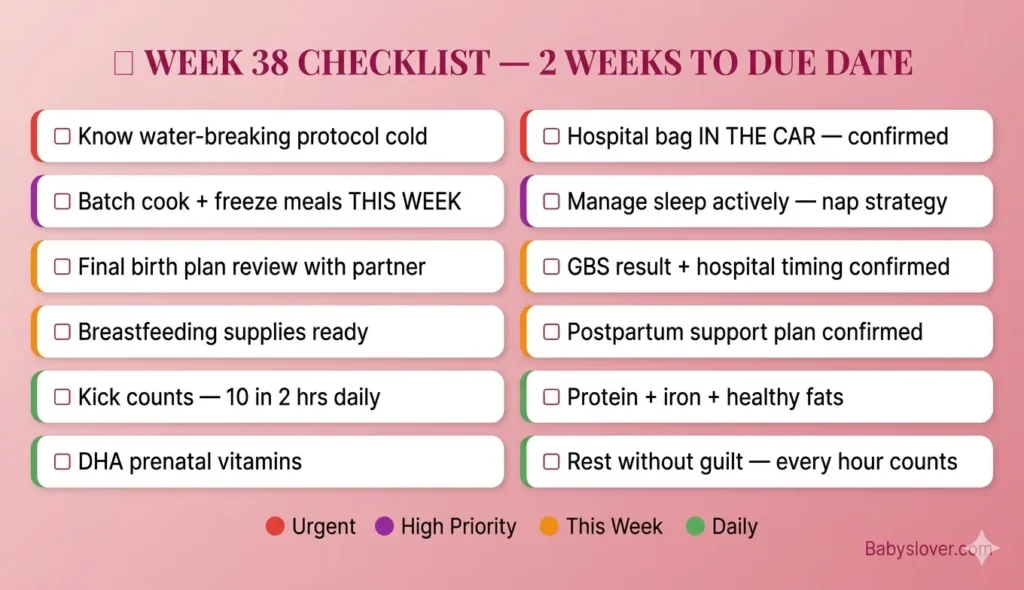
| Task | Priority |
| Know water-breaking protocol – especially if GBS positive | URGENT – know this now |
| Hospital bag in car – confirmed this week | URGENT |
| Know labor signs + 5-1-1 rule + go-immediately criteria | URGENT |
| Batch cook and freeze meals – this week if possible | HIGH PRIORITY this week |
| Continue kick counts – 10 movements in 2 hours, daily | Daily |
| Manage sleep actively – magnesium, cool room, nap strategy | Daily priority |
| Final birth plan review with partner | This week |
| Confirm GBS result and what positive means for hospital timing | This week |
| Perineal massage 1-2x this week if started at Week 34 | This week |
| Newborn care review – cord care, first bath, safe sleep position | This week |
| Breastfeeding supplies ready – nursing bra, lanolin, nursing pillow | Confirm this week |
| Postpartum support plan – who visits when, who helps how | This week |
| Protein + iron + healthy fats at every meal | Daily |
| DHA prenatal vitamins | Daily |
| Rest without guilt – every hour is an hour in the bank | Daily |
Follow our pregnancy week by week guide for every development from now to delivery.
Frequently Asked Questions – 38 Weeks Pregnant
What trimester is 38 weeks pregnant?
38 weeks pregnant is the eleventh week of the third trimester. Third trimester runs from Week 28 through Week 40. You have approximately 2 weeks remaining until your due date.
How many months is 38 weeks pregnant?
At 38 weeks pregnant, you are 9 to 10 months pregnant depending on how you count. Pregnancy is 40 weeks total – approximately 9.5 calendar months. Most women reach their due date feeling like they have been pregnant for more than 9 months, which is accurate.
How much does a baby weigh at 38 weeks pregnant?
At 38 weeks pregnant, your baby weighs approximately 3.0 to 3.4 kg (about 6.6 to 7.5 lbs) and measures around 49-50 cm from head to heel – roughly the size of a bunch of rhubarb or large winter melon. Birth weight varies significantly and both smaller and larger babies are entirely normal at this stage.
Is 38 weeks full term?
38 weeks is early term, not full term. According to ACOG classification, full term begins at 39 weeks 0 days. Early term is Weeks 37-38. While a baby born at 38 weeks has excellent outcomes, the final week of brain connectivity development, liver maturation, and fat deposition that occurs between Week 38 and Week 39 has real clinical value. This is why providers do not recommend elective delivery before 39 weeks in uncomplicated pregnancies.
What happens when your water breaks at 38 weeks?
When your water breaks at 38 weeks, put on a pad, note the time, note the color (clear is normal, green or brown requires urgent evaluation), and contact your provider or go to the hospital. If you are GBS positive, arriving sooner is important for antibiotic coverage. A University of Michigan study found that most women who experience premature rupture of membranes at term can still have vaginal births. Most providers recommend induction within 12-24 hours if contractions do not begin on their own.
Why is diarrhea a sign of labor?
Diarrhea or loose stools can precede labor by hours to a day or two because prostaglandins – the hormones involved in cervical ripening and uterine contractions – also stimulate bowel activity. The body essentially clears the digestive tract in preparation for the physical demands of labor. If loose stools are accompanied by regular contractions, discharge changes, or other labor signs, take it as a possible early labor signal and contact your provider.
When will I go into labor if I’m 38 weeks pregnant?
There is no way to predict this with accuracy. Only 5% of babies are born on their due date. Most births happen between 38 and 41 weeks of pregnancy. Cervical exam findings – dilation and effacement – do not reliably predict labor timing. Some women who are 3 cm dilated at Week 38 deliver two weeks later. Others who are closed at Week 38 go into labor the next morning. The biology of labor initiation varies enormously between individuals and between pregnancies. The most honest answer is: within the next one to four weeks.
Why can’t I sleep at 38 weeks pregnant?
Over 98% of women in the third trimester cannot sleep through the night. The causes are multiple and simultaneous: physical discomfort from the belly size, frequent urination, baby movement, leg cramps, heartburn, anxiety about birth, and hormonal changes affecting sleep architecture. Sleep deprivation at this stage is associated with longer labor and more assisted deliveries, making sleep an active clinical priority. Magnesium glycinate before bed, a cool dark room, a full-length pregnancy pillow, and strategic napping during the day are the most evidence-supported approaches.
Looking Ahead: 39 Weeks Pregnant
At 39 weeks pregnant, your baby reaches full term. The final phase of brain connectivity completes. Liver maturation is finished. The fat deposits are done. And the labor that has been quietly building for weeks may be days or hours away. If it is your first time, or your fourth, the anticipation and the unknowing of this final week carries a feeling that belongs entirely to pregnancy. Two weeks. A brain one-third larger than six weeks ago. A body ready. Keep going.