
The moment you’ve been waiting for is finally here. If you’ve just seen two pink lines — or a little digital word that says ‘Pregnant’ — take a breath. This is real. You are 4 weeks pregnant, and your entire life just changed in the best possible way.
At Babyslover, we want to walk you through 4 weeks pregnant in complete detail — what’s happening with your tiny baby right now, what symptoms to expect (and which ones are normal), what your hCG levels mean, and the most important steps to take in these first exciting days. If you’re just catching up, read 3 weeks pregnant first to understand what led to this moment.
| 📋 Quick Summary — Week 4 of Pregnancy | |
| Week | Week 4 of 40 |
| Trimester | First Trimester |
| Baby Size | 🌱 Poppy seed — 0.04 inches (1mm) |
| Baby Stage | Blastocyst → Embryo (3 germ layers forming) |
| Key Milestone | 🎉 POSITIVE PREGNANCY TEST — hCG detectable! |
| hCG Range | 5–708 mIU/mL (varies widely — normal) |
| Symptoms | Missed period, mild cramping, breast tenderness, bloating, fatigue, light spotting — OR no symptoms |
| First Step | 📞 Call your OB-GYN to schedule first prenatal appointment |
Contents
- 1 Congratulations — You Are Officially Pregnant! 🎉
- 2 What’s Happening in Your Body at 4 Weeks Pregnant
- 3 🌱 Baby Development at 4 Weeks Pregnant
- 4 4 Weeks Pregnant Symptoms — What’s Normal, What’s Not
- 5 hCG Levels at 4 Weeks Pregnant — What Do They Mean?
- 6 Your Positive Pregnancy Test at 4 Weeks
- 7 What to Do First — After a Positive Test at 4 Weeks
- 8 What to Eat at 4 Weeks Pregnant
- 9 For Your Partner — Week 4 Is Your Week Too
- 10 When to Call Your Doctor at 4 Weeks Pregnant
- 11 Your Week 4 Pregnancy Checklist — Do This Now
- 12 Frequently Asked Questions — 4 Weeks Pregnant
- 13 💗 The Emotional Side of Week 4 — It’s Okay to Feel Everything
- 14 👶 What Happens Next — 5 Weeks Pregnant Preview
- 15 Week 4: The Beginning of Everything
Congratulations — You Are Officially Pregnant! 🎉
4 weeks pregnant is the milestone most women have been waiting for — this is when implantation is complete, your period is missed (or about to be), and a home pregnancy test can finally confirm what’s happening inside your body.
Here’s a quick reality check on the timeline: you’re 4 weeks pregnant by the LMP (last menstrual period) calendar, which means your embryo is actually only about 2 weeks old since conception. The math feels confusing, but your OB counts pregnancy from Day 1 of your last period — so Week 4 is when real, confirmed, detectable pregnancy begins for most women.
Week 4 is also when many women get the shock of their lives — a test taken almost by habit turning suddenly, unmistakably positive. Whether you’ve been trying for months or this came as a surprise, the feeling of seeing those two lines for the first time is something you’ll never forget.
What’s Happening in Your Body at 4 Weeks Pregnant
Your body is undergoing a remarkable transformation this week — most of it invisible, but critically important for the healthy pregnancy ahead.
Implantation Is Complete
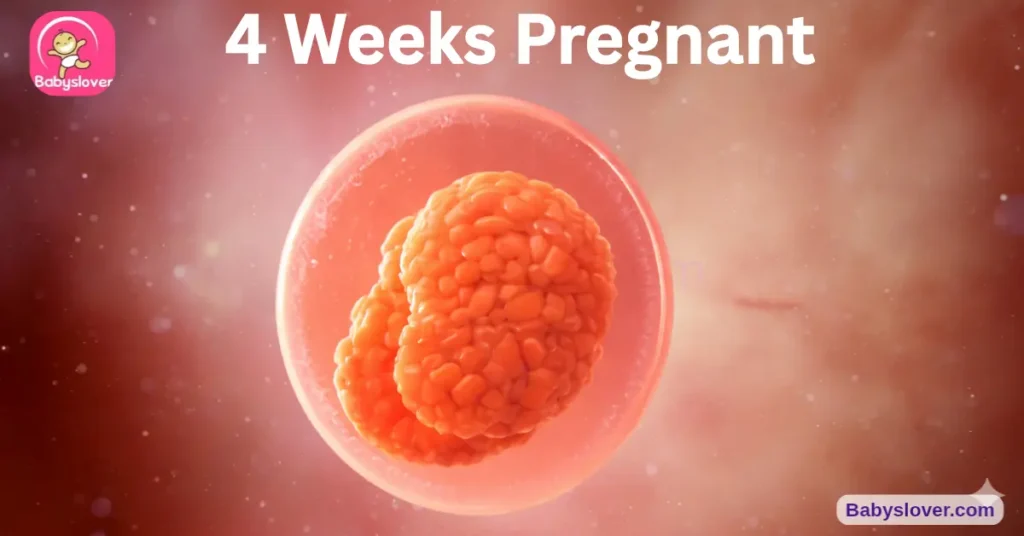
The blastocyst that traveled down your fallopian tube in Week 3 has now fully burrowed into your uterine lining. Implantation is complete. This is the official beginning of pregnancy — your body and your embryo are now connected, and the placenta is beginning to form.
hCG Is Rising Rapidly
The moment implantation is complete, your placenta cells begin producing hCG — human chorionic gonadotropin. This is the hormone that pregnancy tests detect. hCG signals your ovaries to stop releasing eggs, keeps your uterine lining thick, and triggers the production of estrogen and progesterone. At 4 weeks, hCG levels are rising rapidly — roughly doubling every 48-72 hours. This explosive rise is what causes your pregnancy symptoms to begin.
Your Period Is Late or Missing
For most women, the missed period is the very first sign that something is different. If your cycle is usually regular, a period that doesn’t arrive is a strong signal to test. Some women experience very light implantation spotting around this time — easily mistaken for a light period — but it typically lasts only 1-2 days and is much lighter than a normal flow.
Your Uterus Is Starting to Change
Your uterus, which is normally the size of a small pear, is beginning to grow very slightly to accommodate the expanding embryo and placenta. You won’t see a bump yet — not for many weeks — but internally, the transformation has begun. The uterine lining continues to thicken to nourish the growing embryo.
Progesterone Is Surging
Progesterone — your main pregnancy-maintenance hormone — is rising sharply this week. It’s responsible for keeping the uterine lining stable, relaxing uterine muscles to prevent early contractions, and preparing your body for the long journey ahead. It’s also the hormone behind many of Week 4’s most uncomfortable symptoms: bloating, fatigue, and breast tenderness.
🌱 Baby Development at 4 Weeks Pregnant
Your baby at 4 weeks pregnant is incredibly tiny — but the activity happening inside those few cells is extraordinary.
| 🌱 Baby Development at 4 Weeks Pregnant | |
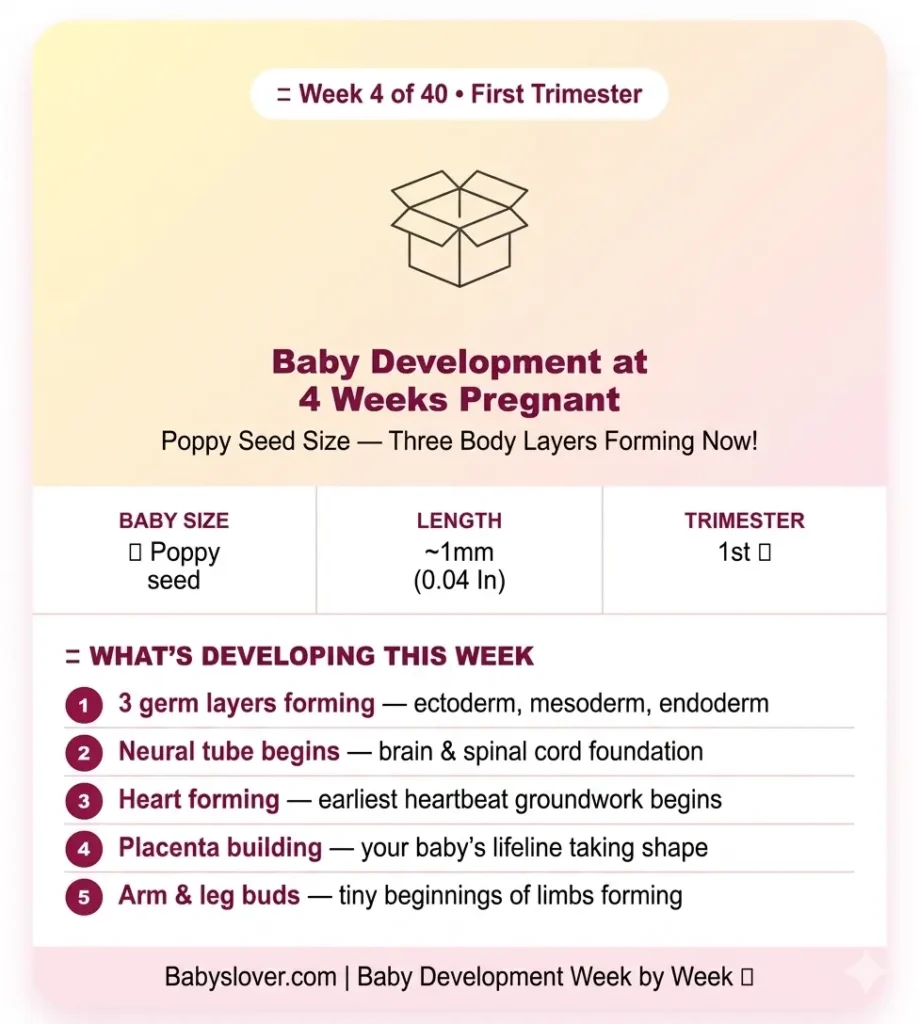
| Baby Size | 🌱 Poppy seed — 0.04 inches (1mm / about 0.078 inches by end of week) |
| Fruit Comparison | 🌱 Poppy seed |
| Weight | Less than 0.04 grams — microscopic |
| Stage | Embryo — three germ layers forming |
| Week / Trimester | Week 4 of 40 • First Trimester |
| Key Development | Three body layers forming — every organ system starts here |
What Is Developing at Week 4 — The Three Germ Layers
According to the American Pregnancy Association, the most critical development at 4 weeks is the formation of three distinct cell layers inside the embryo — called germ layers. These three layers are the foundation for every single organ and tissue in your baby’s body:
- Ectoderm (outer layer): Will become your baby’s brain, nervous system, skin, hair, nails, eyes, and enamel for their teeth. The neural tube — the precursor to the brain and spine — begins forming from this layer.
- Mesoderm (middle layer): Will become the heart, circulatory system, skeleton, muscles, kidneys, and connective tissues. The very earliest groundwork for your baby’s heartbeat begins in this layer this week.
- Endoderm (inner layer): Will develop into the lungs, liver, pancreas, thyroid, and the entire gastrointestinal tract. Your baby’s entire digestive system traces back to this week.
- Placenta forming: The outer cells of the blastocyst are actively building the placenta — the organ that will deliver oxygen, nutrients, and antibodies from you to your baby for the next 36 weeks. The umbilical cord is also beginning its earliest development.
- Arm and leg buds beginning: Tiny buds that will eventually become your baby’s arms and legs are starting to form — though they’re not yet distinguishable at this stage.
- Amniotic sac forming: The amniotic sac — the fluid-filled protective ‘bubble’ your baby lives in — is developing around the embryo. The yolk sac, which provides early nutrition to the embryo before the placenta takes over, is also forming.
- Earliest blood movement: Rudimentary blood is beginning to move through the main vessels — though a true heartbeat is still 2-3 weeks away from being detectable.
💡 Fun fact: Your baby is the size of a poppy seed right now — about 1mm long. But inside that tiny speck, every major body system is laying its very first foundation. The brain, heart, lungs, skin, and skeleton all start from this week.
4 Weeks Pregnant Symptoms — What’s Normal, What’s Not
Week 4 symptoms range from quite noticeable to completely absent — and both are completely normal. Here’s what you might experience:
📅 Missed Period — The #1 Sign
For most women, a missed period is the first and clearest signal that something is different. If your cycle is regular and your period doesn’t arrive, it’s time to test. Some women experience light implantation spotting around this time — but it’s much lighter, shorter, and different in color (pink or brown) from a regular period.
🤢 Nausea — The Early Wave
While full morning sickness typically peaks around Weeks 6-8, some women begin feeling queasy as early as Week 4 as hCG levels surge. According to Mayo Clinic, nausea affects up to 80% of pregnant women in the first trimester. If it starts this week, small frequent meals and staying hydrated can help manage it.
🍈 Breast Tenderness and Fullness
Your breasts may feel sore, heavy, swollen, or more sensitive than usual. The areolas (the darker skin around your nipples) may also begin to darken and the nipples may become more sensitive. This is caused by rapidly rising estrogen and progesterone — the same hormones that trigger PMS breast symptoms, but more intense.
😴 Fatigue — Next-Level Tired
Many women describe the exhaustion of early pregnancy as unlike anything they’ve felt before — a deep, bone-heavy tiredness that sleep doesn’t fully fix. This is caused by progesterone, which has a sedating effect on the body. Your blood volume is also beginning to increase, and your body is directing enormous energy toward building the placenta and embryo. Rest whenever you can — this is not laziness, it’s biology.
🫧 Bloating and Cramping
Progesterone slows your digestive system, causing bloating and that ‘full’ feeling even when you haven’t eaten much. Mild cramping is also common this week and often signals healthy implantation — your uterus expanding and the embryo settling in. If cramping is severe or one-sided with heavy bleeding, call your doctor immediately.
🚽 Frequent Urination
Your kidneys are already working harder to filter your increasing blood volume. hCG also increases blood flow to your pelvic region, putting gentle pressure on your bladder. Frequent trips to the bathroom can begin as early as Week 4 — yes, already!
😢 Mood Swings
The sudden, dramatic surge in estrogen and progesterone can significantly affect your mood. You might feel tearful, irritable, anxious, overjoyed, or all of the above in the space of an hour. This is completely normal — your brain chemistry is adjusting to a completely new hormonal reality.
💭 No Symptoms — Also Perfectly Normal
4 weeks pregnant with no symptoms is extremely common. Many women feel nothing at all during Week 4 — especially if this is their first pregnancy or their hormone levels rise gradually. Lack of symptoms at 4 weeks does not indicate miscarriage or an unhealthy pregnancy. Symptoms typically increase as hCG rises over the coming weeks.
💡 Important: Every pregnancy is different. Some women feel everything at once; others feel nothing for weeks. Your symptoms — or lack of them — are not a reliable measure of how healthy your pregnancy is. Trust your test, not your symptoms.
hCG Levels at 4 Weeks Pregnant — What Do They Mean?
Understanding hCG levels at 4 weeks pregnant is one of the most common early pregnancy questions — and one of the most misunderstood.
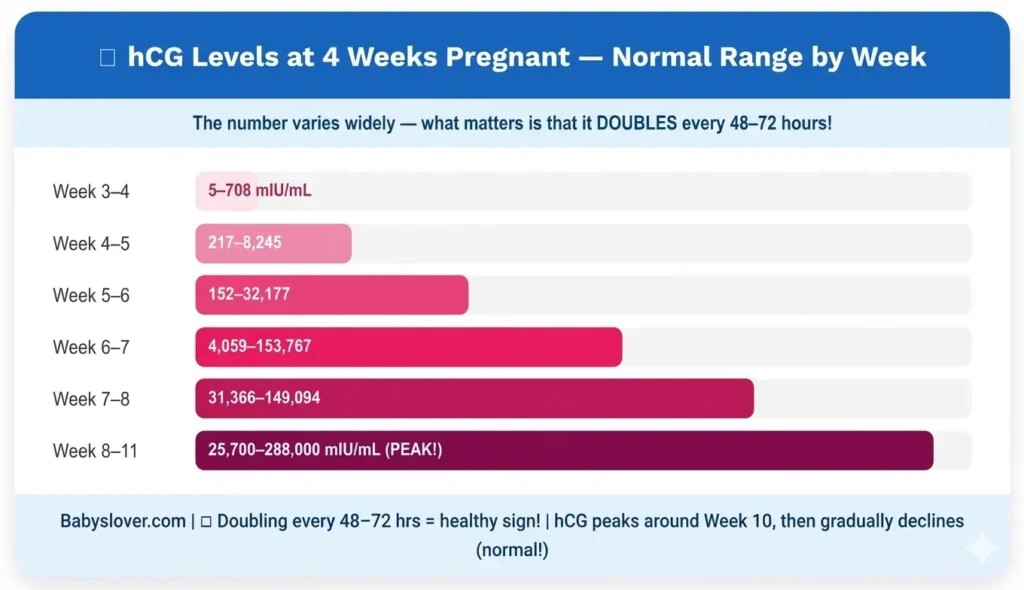
| Pregnancy Week | Normal hCG Range | What It Means |
| Week 3-4 | 5 – 708 mIU/mL | Implantation complete, hCG rising rapidly |
| Week 4-5 | 217 – 8,245 mIU/mL | hCG surging — symptoms increasing |
| Week 5-6 | 152 – 32,177 mIU/mL | Gestational sac visible on ultrasound |
| Week 6-7 | 4,059 – 153,767 mIU/mL | Heartbeat detectable on ultrasound |
| Week 8-11 | 25,700 – 288,000 mIU/mL | hCG near its peak |
| Week 10+ (peak) | Levels plateau then gradually decline | Normal — placenta takes over hormone production |
The most important thing to understand about hCG: the number itself matters far less than the trend. A healthy pregnancy is indicated by hCG levels that double approximately every 48-72 hours in early pregnancy — not by hitting a specific number. A woman with hCG of 50 and another with hCG of 500 can both have perfectly healthy pregnancies at 4 weeks, as long as both are doubling correctly.
According to the American Pregnancy Association, an hCG level above 25 mIU/mL is considered positive for pregnancy. Levels between 6-24 mIU/mL are in the gray area and should be retested in 48-72 hours to confirm a rise.
💡 Should I worry if my hCG seems low? Only your doctor can interpret your specific levels. A single hCG number means very little without context. What matters is the doubling pattern over 48-72 hours. Don’t compare your number to others online — the range at 4 weeks is enormous and all normal.
Your Positive Pregnancy Test at 4 Weeks
Week 4 is when most home pregnancy tests turn positive — this is the week your period is missed and hCG levels are usually high enough to detect in urine.
When Is the Best Time to Test?
Test with your first morning urine — it’s the most concentrated, giving the most accurate result. If you tested early (before your missed period) and got a negative, don’t give up. Test again on the day of your expected period or a few days after for the most reliable result.
What If I Got a Faint Line?
A faint line is a positive. Even the lightest line means hCG was detected. Don’t try to determine how pregnant you are by the darkness of the line — line darkness varies by test brand, time of day, hydration, and hCG concentration. A faint positive today will typically be a dark positive in a few days as hCG rises.
What If My Test Is Still Negative?
If your period is late but the test is negative, it’s possible your hCG hasn’t reached detectable levels yet — especially if you ovulated later than usual. Wait 3-4 days and test again with first morning urine. If your period continues to be absent and tests remain negative, consult your OB — they can do a blood test that detects hCG at much lower levels.
What to Do First — After a Positive Test at 4 Weeks
Now that you have a positive test, here are the most important first steps for 4 weeks pregnant:
📞 1. Call Your OB-GYN
Your first call should be to your OB-GYN or midwife’s office. Let them know you have a positive test. Most practices will schedule your first prenatal appointment for around 8-10 weeks — when there’s more to see on an ultrasound (including a heartbeat). Some will see you earlier if you have a history of complications or fertility treatment.
💊 2. Start Prenatal Vitamins Today — If You Haven’t Already
If you weren’t already taking a prenatal vitamin, start today. The neural tube — which becomes your baby’s brain and spinal cord — closes in the next 2-3 weeks. Folic acid (at least 400mcg daily, ideally 600-800mcg when pregnant) is essential for preventing neural tube defects during this critical window. Our guide to the best prenatal vitamins can help you choose the right one. Per the CDC, folic acid taken before and during early pregnancy significantly reduces neural tube defect risk.
🚫 3. Stop Alcohol Immediately
There is no known safe amount of alcohol during pregnancy — especially in the first trimester when your baby’s brain, heart, and organ systems are forming. Stop completely, today. If you drank before you knew you were pregnant, speak to your doctor — most early, unintentional exposure is unlikely to cause harm, but your OB can reassure you.
📅 4. Calculate Your Due Date
Your estimated due date (EDD) is calculated as 40 weeks from the first day of your last period. If your last period started on January 1st, your due date is approximately October 8th. Your OB will confirm this with an early ultrasound, which is the most accurate dating method.
🤫 5. When to Tell People
Most OBs recommend waiting until after 12 weeks (the end of the first trimester) to share the news widely — this is when miscarriage risk drops significantly. Of course, telling your partner, one trusted friend, or close family is entirely your choice. You may also want to consider starting to research topics like cord blood banking — important decisions you’ll need to make before your baby arrives.
What to Eat at 4 Weeks Pregnant
Nutrition at 4 weeks pregnant is critical — your baby’s neural tube, heart, and major organ layers are all forming right now. Here’s what to prioritize:
| Nutrient | Why Critical at Week 4 | Best Sources |
| Folic Acid | Neural tube closure — prevents spina bifida | Leafy greens, lentils, avocado, fortified cereals, prenatal vitamin |
| Iron | Blood volume expanding — baby needs iron from start | Lean meat, spinach, lentils, beans, fortified oatmeal |
| Calcium | Bone and teeth formation beginning | Dairy, fortified plant milk, tofu, sardines, kale |
| Omega-3 (DHA) | Brain and neural development — starts now | Salmon (cooked), sardines, walnuts, DHA supplement |
| Vitamin D | Supports bone development and immune function | Fortified milk, eggs, fatty fish, sunlight, supplement |
| Protein | Cell building and embryo growth | Eggs, chicken, Greek yogurt, lentils, quinoa, nuts |
What to completely avoid at 4 weeks pregnant: alcohol (zero), raw/undercooked meat and fish, high-mercury fish (swordfish, shark, king mackerel, tilefish), unpasteurized cheeses and juices, deli meats (unless heated until steaming), raw sprouts, and excess caffeine (keep under 200mg/day — roughly one 12oz coffee).
For Your Partner — Week 4 Is Your Week Too
If your partner has just shared the news with you — or you found out together — here’s how to show up right now:
- Celebrate, then listen: Your partner may be feeling joy, fear, shock, and excitement all at once. Let the moment land. Ask how she’s feeling. Hold space for both emotions — the happiness and the worry.
- Take the prenatal vitamin shopping seriously: Help research and pick up a high-quality prenatal vitamin today if she doesn’t have one. This is one of the single most impactful things you can do right now.
- Clear the kitchen of alcohol: Making this easy for her by removing temptation — especially if she’s in social situations — is a practical and loving gesture.
- Learn together: Spend time this week reading about early pregnancy, what to expect at the first prenatal appointment, and what decisions are coming (like cord blood banking and prenatal testing). Informed partners are far more supportive partners.
- Let her rest: The fatigue of early pregnancy is real and physical. Offering to cook, handle extra chores, or simply let her sleep without guilt is enormously helpful in these first weeks.
- Manage your own emotions too: It’s completely normal for partners to feel scared, overwhelmed, or unsure — even while being outwardly supportive. Find one trusted person or resource to process your own feelings so you can continue showing up for her.
When to Call Your Doctor at 4 Weeks Pregnant
Most women at 4 weeks pregnant are in safe, normal early pregnancy. But call your doctor or go to urgent care if you experience:
- Heavy bleeding: Light pink or brown spotting is often implantation bleeding and is normal. Bright red, heavy bleeding (soaking a pad) is not normal — call immediately.
- Severe one-sided cramping with dizziness or shoulder pain: These are warning signs of ectopic pregnancy, where the embryo has implanted outside the uterus. This is a medical emergency. Go to the ER.
- Fever over 100.4°F (38°C): Infection in early pregnancy needs prompt evaluation.
- Extreme nausea with inability to keep any fluids down: Severe hyperemesis gravidarum can cause dangerous dehydration and needs medical attention.
- Positive test followed within days by heavy bleeding: This may be a chemical pregnancy (very early miscarriage). Your OB can confirm and support you through it.
Your Week 4 Pregnancy Checklist — Do This Now
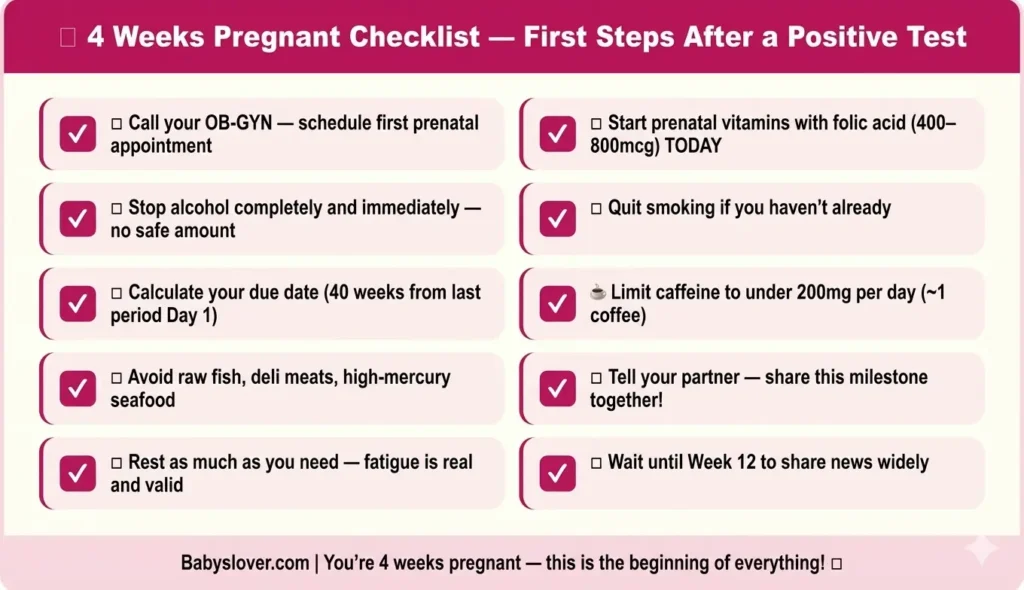
- ☑ Call OB-GYN to schedule your first prenatal appointment (aim for 8-10 weeks)
- ☑ Start prenatal vitamins with folic acid (400-800mcg) — TODAY
- ☑ Stop alcohol completely and immediately
- ☑ Stop smoking if you haven’t already
- ☑ Calculate your due date — count 40 weeks from Day 1 of your last period
- ☑ Limit caffeine to under 200mg per day
- ☑ Avoid raw fish, deli meats, high-mercury fish, unpasteurized foods
- ☑ Let your partner know — share this exciting milestone together
- ☑ Rest as much as you need — fatigue is real and valid
- ☑ Avoid hot tubs, saunas, and extreme heat
- ☑ Keep taking folic acid every single day — critical this week
- ☑ Hold off on telling most people until Week 12 — miscarriage risk drops significantly after the first trimester
Frequently Asked Questions — 4 Weeks Pregnant
What does 4 weeks pregnant feel like?
For many women, 4 weeks pregnant feels like a more intense version of PMS — breast tenderness, bloating, cramping, fatigue, and mood swings. Some also feel nausea beginning. But many women feel absolutely nothing unusual at 4 weeks, and that’s equally normal. The intensity of symptoms doesn’t predict pregnancy health.
Is a faint positive at 4 weeks normal?
Yes — a faint line is a positive result. At 4 weeks, especially in the early days, hCG levels may just be crossing the test’s detection threshold. The line will darken over the next few days as hCG rises. Test again in 2-3 days with first morning urine to confirm.
Can I have a miscarriage at 4 weeks?
Miscarriage is most common in the first trimester — statistically around 10-20% of confirmed pregnancies. At 4 weeks, this risk is real but decreases significantly with each passing week and with each rise in hCG. By Week 6-7 when a heartbeat is confirmed, the risk drops considerably. Most early losses are due to chromosomal issues — not anything the mother did or didn’t do.
How big is my baby at 4 weeks pregnant?
Your baby at 4 weeks pregnant is about 0.04 inches long (approximately 1mm) — roughly the size of a poppy seed. It’s invisible to the naked eye and far too small to see on an ultrasound yet. But inside that tiny embryo, the three germ layers that will form every organ in your baby’s body are already taking shape.
When should I schedule my first prenatal appointment?
Call your OB-GYN this week to let them know you’re pregnant. Most practices will schedule your first full prenatal appointment for 8-10 weeks — when there’s more to examine, and a heartbeat can usually be detected on ultrasound. If you have a high-risk history, fertility treatment, or complications, they may see you sooner.
Is it safe to exercise at 4 weeks pregnant?
Yes — moderate exercise is safe and beneficial throughout a normal, low-risk pregnancy. Walking, swimming, yoga, and light cardio are all encouraged. Avoid high-impact contact sports, activities with fall risk, and anything that makes you overheat. Always listen to your body, stay well hydrated, and get clearance from your OB if you have any concerns.
I’m 4 weeks pregnant with twins — are my symptoms worse?
Women pregnant with twins often have higher hCG levels (because there are two placentas producing the hormone), which can mean more intense symptoms — more nausea, more fatigue, more breast tenderness. Twins are typically confirmed via ultrasound around Week 6-8. A very high hCG for your stage can sometimes be an indicator, but it’s not diagnostic.
Is light bleeding at 4 weeks pregnant normal?
Light pink or brown spotting can be normal at 4 weeks — it may be late implantation bleeding as the embryo finishes embedding in your uterine lining. Bright red, heavy bleeding is not normal and warrants an immediate call to your OB. Any bleeding with severe pain, especially one-sided, needs emergency evaluation.
💗 The Emotional Side of Week 4 — It’s Okay to Feel Everything
Finding out you’re pregnant is one of the most profound moments of your life — whether it was long-awaited or completely unexpected.
It’s okay to feel overjoyed and terrified at the same time. It’s okay to cry from happiness and then immediately worry about miscarriage. It’s okay to not feel ready, even if you tried for this. It’s okay to feel numb before the reality sets in.
Whatever you’re feeling right now — it’s valid. Pregnancy changes everything: your body, your plans, your sense of self, your relationship. Give yourself grace and space to feel all of it.
At Babyslover, we believe that a supported, informed mom is a healthier, happier mom. You’ve got this — and we’re with you every step of the way. 💗
👶 What Happens Next — 5 Weeks Pregnant Preview
Week 5 is when things get more real. Here’s a preview of 5 weeks pregnant:
- Your embryo grows rapidly — from poppy seed to sesame seed size
- The heart begins to form and may start beating — around 80-100 beats per minute
- The neural tube continues closing — brain and spinal cord development accelerating
- hCG levels surge dramatically — morning sickness typically peaks around now
- Nausea, food aversions, and fatigue often intensify in Week 5
- Your uterus is growing — though no visible bump yet
Continue following our complete pregnancy week by week guide — from Week 1 all the way to Week 40, we’ve got every milestone covered!
Week 4: The Beginning of Everything
Being 4 weeks pregnant is the official start of one of the most extraordinary journeys of your life. The positive test is just the beginning. Inside you, a tiny poppy seed-sized embryo is quietly, furiously building every system it will ever need.
Take your vitamins. Rest. Eat well. Call your OB. And give yourself permission to be excited — this is real, it’s happening, and it’s wonderful.
Have questions about Week 4, positive tests, or early pregnancy symptoms? Leave a comment — we read every one. And if this is your first pregnancy, our pregnancy tips for first time moms guide is the perfect next read. 💗
2 thoughts on “4 Weeks Pregnant: Symptoms, Positive Test & Baby Development”