

Something extraordinary is happening inside you right now. At 5 weeks pregnant, your baby is no bigger than a sesame seed. But this tiny embryo has reached a milestone that will take your breath away: your baby’s heart is beginning to beat for the very first time.
Welcome to Week 5 — one of the most remarkable weeks of your entire pregnancy. At Babyslover, we’ll walk you through every detail of 5 weeks pregnant: what’s happening with your baby’s development, what symptoms to expect (yes, morning sickness usually arrives this week), and exactly what you should be doing right now. If you’re just catching up, read our 4 weeks pregnant guide first for the full picture from your positive test.

| 📋 Quick Summary — Week 5 of Pregnancy | |
| Week | Week 5 of 40 |
| Trimester | First Trimester |
| Baby Size | 🌿 Sesame seed — 2–3mm (about 0.10 inches) |
| Baby Stage | Embryo — neural tube closing, heart starting to beat |
| Key Milestone | ❤️ FIRST HEARTBEAT — primitive heart tube begins beating! |
| hCG Range | 217–8,245 mIU/mL (rising rapidly) |
| Symptoms | Morning sickness, extreme fatigue, breast tenderness, food aversions, frequent urination, bloating, mood swings |
| First Step | 📞 Confirm prenatal appointment booked (Week 8–10) + continue prenatal vitamins daily |
Contents
- 1 What’s Happening in Your Body at 5 Weeks Pregnant
- 2 🌱 Baby Development at 5 Weeks Pregnant
- 3 5 Weeks Pregnant Symptoms — The Full Picture
- 4 5 Weeks Pregnant Ultrasound — What Can You See?
- 5 What to Eat at 5 Weeks Pregnant — Even With Morning Sickness
- 6 For Your Partner — Week 5 Is Hard. Show Up.
- 7 When to Call Your Doctor at 5 Weeks Pregnant
- 8 Your Week 5 Pregnancy Checklist
- 9 Frequently Asked Questions — 5 Weeks Pregnant
- 10 💗 The Emotional Side of Week 5
- 11 👶 What Happens Next — 6 Weeks Pregnant Preview
What’s Happening in Your Body at 5 Weeks Pregnant
Your body at 5 weeks pregnant is working around the clock — and most of what’s happening is invisible from the outside. But inside, the pace of change is breathtaking.
hCG Is Surging — And So Are Your Symptoms
Your hCG has now risen sharply from the 5–708 mIU/mL range of Week 4 to anywhere from 217–8,245 mIU/mL this week — and it continues to double approximately every 48–72 hours. This dramatic surge drives nearly every symptom you’re feeling: the nausea, the fatigue, food aversions, and that overwhelming sense of smell.
Your Uterus Is Beginning to Expand
Your uterus is growing to accommodate the embryo, placenta, and amniotic fluid. You won’t see a visible bump yet, but you may feel a subtle heaviness or fullness in your lower abdomen — similar to the pre-period feeling, but more persistent. Mild cramping is common and normal as this expansion continues.
Placenta and Umbilical Cord Are Building
The placenta — the organ that will nourish your baby with oxygen and nutrients for the next 35 weeks — is growing rapidly. The umbilical cord is also beginning its development, forming the lifeline between you and your baby. These structures aren’t fully functional yet, but the infrastructure is building fast.
Your Sense of Smell May Be Superhuman
One of the strangest early pregnancy changes: a dramatically heightened sense of smell. Foods you loved, perfumes you’ve worn for years, or everyday household smells can trigger instant nausea. This is caused by rising estrogen and is completely normal — though deeply inconvenient. Switching to unscented products and avoiding smell triggers can help significantly.
Your Breasts Are Changing
Rising estrogen and progesterone are causing breast tissue to grow in preparation for eventual breastfeeding. Many women notice noticeably heavier, fuller, and more tender breasts this week. The areolas may darken and nipples become more sensitive. A comfortable, supportive bra (you may need to size up) makes a significant difference.
🌱 Baby Development at 5 Weeks Pregnant
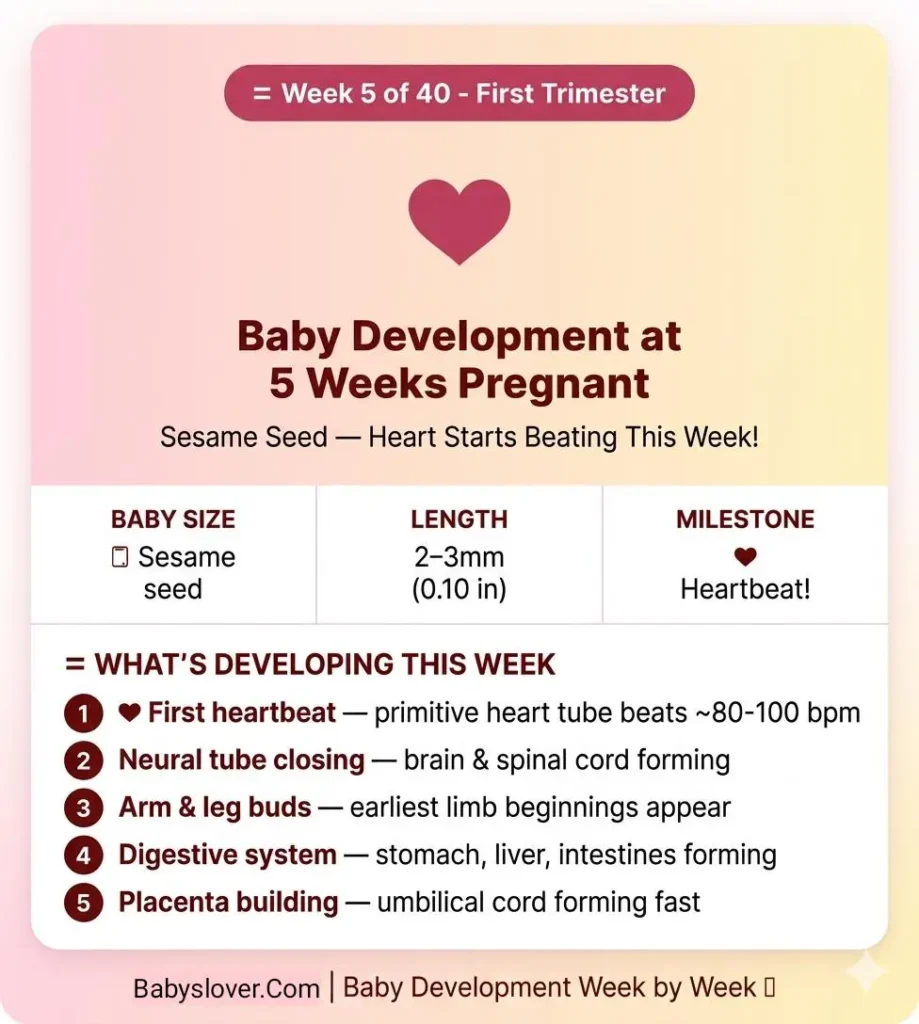
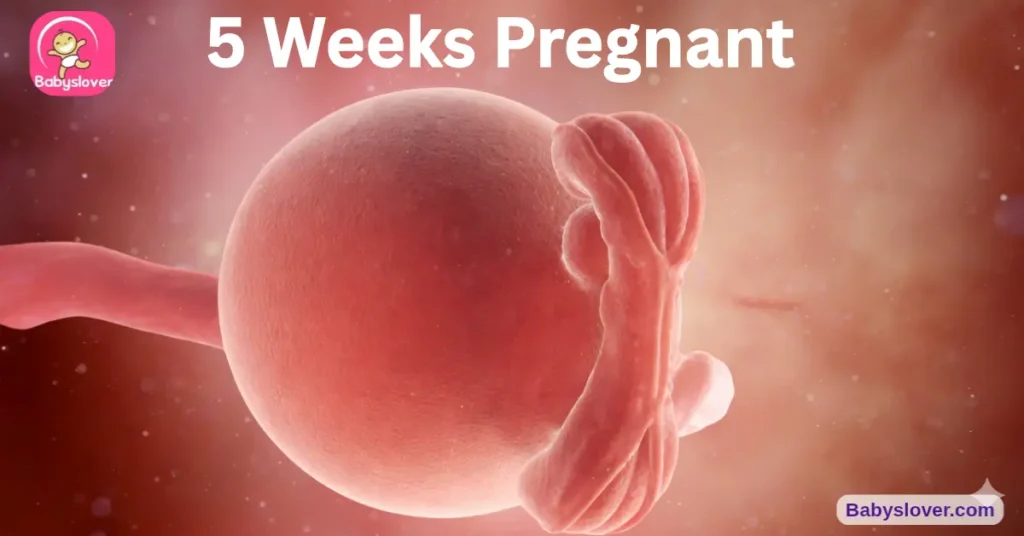
At 5 weeks pregnant, your baby — now officially called an embryo — is about 2–3mm long, roughly the size of a sesame seed. That might sound impossibly small, but the developments happening inside that tiny speck are extraordinary.
| 🌱 Baby Development at 5 Weeks Pregnant | |
| Baby Size | 🌿 Sesame seed — approximately 2–3mm (0.10 inches) |
| Fruit Comparison | 🌿 Sesame seed |
| Weight | Less than 0.1 grams — microscopic |
| Stage | Embryo — rapid organ formation underway |
| Week / Trimester | Week 5 of 40 • First Trimester |
| Key Development | ❤️ FIRST HEARTBEAT — primitive heart tube begins to beat! |
What Is Developing at Week 5
This is perhaps the most emotionally powerful week of early pregnancy — because this is the week your baby’s heart begins to beat.
- ❤️ First heartbeat begins: The primitive heart tube — a simple C-shaped structure that will become your baby’s four-chambered heart — begins to contract and circulate blood for the first time. Beating around 80–100 times per minute, this isn’t yet a fully formed heart, but it is your baby’s first cardiac activity. Typically begins this week, though detectable on ultrasound from Week 6–7.
- Neural tube closing: The neural tube — which will become your baby’s brain and spinal cord — is actively closing this week. This is exactly why folic acid is so critical right now: it directly supports this process and reduces the risk of neural tube defects. Per the CDC, taking 400–800mcg folic acid daily significantly lowers this risk.
- Three germ layers differentiating: The ectoderm, mesoderm, and endoderm layers established in Week 4 are now actively forming specific tissues and organs. The mesoderm is building the heart. The ectoderm is racing to form the neural tube. The endoderm is beginning the liver and lungs.
- Arm and leg buds emerging: Tiny limb buds — the earliest beginnings of your baby’s arms and legs — are appearing. They don’t look like limbs yet, but the cellular groundwork for every future finger and toe starts this week.
- Digestive system foundations: The earliest structures of the digestive system — stomach, intestines, and liver — are beginning to form from the endoderm layer. Your baby’s liver, which will be one of its largest organs, starts here.
- Head is disproportionately large: The embryo’s head is noticeably larger than the rest of the body because the brain and face are developing at rapid pace. This top-heavy appearance is normal and characteristic of all human embryos at this stage.
- Placenta and yolk sac active: The placenta continues building, and the yolk sac is still actively nourishing the embryo while the placenta finishes developing its full capability.
💡 Fun fact: Your baby’s heart is beating around 80–100 times per minute this week — nearly twice as fast as yours. By Week 10, it will be racing at 170+ beats per minute!
5 Weeks Pregnant Symptoms — The Full Picture
Week 5 is when many women transition from ‘I think I might be pregnant’ to ‘I am DEFINITELY pregnant’ — because the symptoms often become impossible to ignore. Here’s everything you might experience at 5 weeks pregnant:
🤢 Morning Sickness — The Week It Usually Hits
Morning sickness is the most well-known pregnancy symptom, and Week 5 is when it typically begins. According to Mayo Clinic, it affects up to 80% of pregnant women — and despite the name, it can strike at any time of the day or night. For some it’s mild queasiness; for others it’s debilitating nausea with vomiting. What causes it? Primarily the dramatic surge in hCG combined with rising estrogen. The good news: morning sickness typically improves significantly after Week 12–14.
If you can’t keep any food or fluids down, call your OB — severe nausea (called hyperemesis gravidarum) requires medical treatment to prevent dangerous dehydration.
😴 Extreme Fatigue
The exhaustion of early pregnancy is real and often shocking to first-time moms. Your body is building an entirely new organ (the placenta), expanding blood volume, and sustaining a growing embryo — all while maintaining your normal bodily functions. Progesterone also has a sedative effect. Rest whenever you can. This is not laziness — it is your body doing something extraordinary.
🍈 Breast Tenderness and Changes
Sore, heavy breasts are one of the most consistent Week 5 symptoms. The tenderness can be so pronounced that sleeping on your stomach becomes uncomfortable. Areolas often darken, and the small bumps around the nipples (Montgomery glands) may become more prominent — oil glands preparing for future breastfeeding. A supportive bra worn day and night significantly reduces discomfort.
🫧 Bloating and Cramping
Progesterone slows your digestive system, creating bloating and gas. Mild uterine cramping continues as the uterus grows. This is typically similar to mild period cramps and is normal. Cramping that is severe, one-sided, or paired with heavy bleeding needs immediate medical evaluation.
👃 Heightened Sense of Smell
Your partner’s cologne now makes you gag. The neighbor’s cooking is unbearable. Your own shampoo smells wrong. This hyperosmia (heightened smell sensitivity) is caused by rising estrogen and is one of the strangest early pregnancy symptoms. It typically improves in the second trimester. Until then: unscented products, open windows, and avoiding known smell triggers.
🍕 Food Aversions and Cravings
Strong food aversions often develop at Week 5 — previously loved foods becoming repulsive. Meat, eggs, and strong-smelling foods are common triggers. Cravings may also appear simultaneously. Both are normal responses to hormonal changes. Eat what you can stomach — adequate calories and your prenatal vitamin are the priorities right now, not nutritional perfection.
🚽 Frequent Urination
Your kidneys are filtering more blood, hCG is increasing pelvic blood flow, and your uterus is beginning to press on your bladder. Frequent bathroom trips — including at night — can begin as early as Week 5 and only increase as pregnancy progresses.
😢 Mood Swings and Anxiety
Estrogen and progesterone surging directly affect brain chemistry. Joy, fear, irritability, tearfulness — sometimes all in one afternoon. The emotional weight of early pregnancy (excitement, worry about miscarriage, life changes) compounds this. Your feelings are valid. Give yourself grace.
💭 No Symptoms at 5 Weeks — Is That Normal?
Yes, absolutely. 5 weeks pregnant with no symptoms is common and does not indicate something is wrong. Every woman and every pregnancy is different. Many women with symptom-free first trimesters have perfectly healthy pregnancies. Trust your prenatal care, not your symptom list.
💡 Lack of morning sickness does NOT mean something is wrong. Many women experience little or no nausea throughout early pregnancy and go on to have perfectly healthy babies. Don’t compare your symptoms to others.
5 Weeks Pregnant Ultrasound — What Can You See?
What a 5-Week Ultrasound Shows
If you have a transvaginal ultrasound at exactly 5 weeks, your doctor may be able to see a gestational sac (a small dark circle in the uterus) and possibly a yolk sac. The embryo may be visible as a tiny bright speck. This early, it’s mainly about confirming the pregnancy is in the uterus and not ectopic.
Can You Hear the Heartbeat at 5 Weeks?
Possibly — but not reliably. The heart has just started beating this week. Even with transvaginal ultrasound, a heartbeat may not be clearly detectable at exactly 5 weeks. Most providers confirm the heartbeat between Weeks 6–8. If an early scan doesn’t show a heartbeat yet, that is not necessarily cause for alarm — your baby may simply be a few days younger than calculated.
When Is the First Prenatal Appointment?
According to ACOG, most providers schedule the first full prenatal visit between 8–10 weeks — when a heartbeat is clearly detectable, blood tests can be done, and gestational age can be accurately confirmed. If you haven’t called your OB-GYN yet, do it this week. Practices fill up quickly — don’t wait.
What to Eat at 5 Weeks Pregnant — Even With Morning Sickness
Eating well at 5 weeks pregnant is challenging when morning sickness is hitting. Here’s a practical, symptom-friendly nutrition approach:
| Nutrient | Why Critical at Week 5 | Best Sources |
| Folic Acid | Neural tube is CLOSING this week — critical window | Leafy greens, lentils, avocado, fortified cereals, prenatal vitamin |
| Vitamin B6 | Directly reduces morning sickness severity | Chicken, fish, bananas, potatoes, fortified cereals |
| Iron | Blood volume rapidly expanding | Lean meat, spinach, beans, tofu, fortified oatmeal |
| Protein | Embryo cell building — heart and neural tube forming | Eggs, chicken, Greek yogurt, lentils, nuts |
| Ginger | Natural nausea relief — evidence-backed | Ginger tea, ginger chews, natural ginger ale, ginger supplements |
| Water | Prevent dehydration from vomiting | 8-10 glasses/day — sip slowly; add lemon or mint if needed |
Morning Sickness Eating Strategy
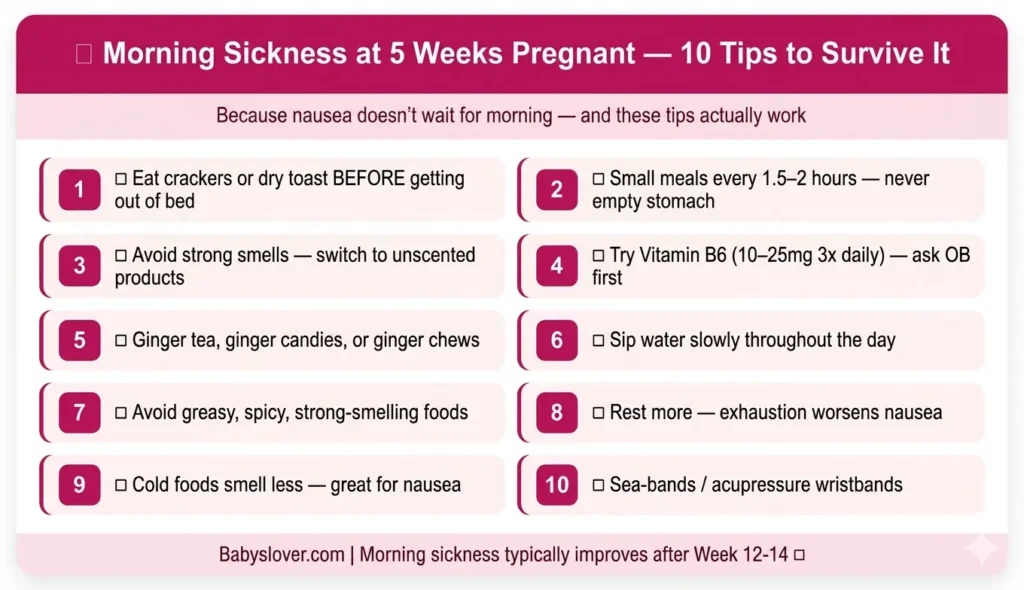
- Eat crackers or dry toast BEFORE getting out of bed in the morning
- Small meals every 1.5–2 hours — empty stomach dramatically worsens nausea
- Cold foods often smell less and trigger less nausea than hot foods
- Avoid greasy, spicy, or strong-smelling foods during nausea peaks
- Vitamin B6 (10-25mg three times daily) is clinically shown to reduce nausea — ask your OB
- Ginger in any form is one of the most evidence-backed natural remedies for morning sickness
Our best prenatal vitamins guide covers options that include B6 and are gentler on a nauseous stomach — worth checking before your next bottle.
For Your Partner — Week 5 Is Hard. Show Up.
If your partner is feeling wretched this week — exhausted, nauseous, emotional, uncomfortable — here’s how to genuinely help:
- Take over the kitchen: Cooking smells trigger nausea. Volunteer to cook (window open, extractor on) or bring in food. Bland, simple options — plain pasta, toast, broth, crackers, bananas — are usually best tolerated.
- Be patient with food changes: She may suddenly hate previously loved foods, eat the same three things for weeks, or have strange cravings. Her sense of smell and taste are dramatically altered. Support without judgment.
- Protect her sleep: Early pregnancy fatigue is real and physical. Take on extra tasks, encourage early bedtimes, and don’t downplay the exhaustion.
- Ditch the strong cologne: Even beloved scents can become nausea triggers. Switch to unscented or lightly scented products until the first trimester passes.
- Learn about the first prenatal visit: Attend with her when possible. Know what questions to ask: due date confirmation, genetic screening options, blood test results, activity restrictions. Informed partners are far more effective partners.
- Acknowledge the hard parts: ‘It’ll pass’ is true but not helpful when she’s vomiting. ‘I see how hard this is and I’m here’ goes much further.
When to Call Your Doctor at 5 Weeks Pregnant
Most Week 5 symptoms are normal — call your OB or go to urgent care if you experience:
- Severe one-sided pain with dizziness or shoulder pain: Warning signs of ectopic pregnancy — a medical emergency. Go to the ER immediately.
- Heavy bright red bleeding: Light pink/brown spotting can be normal. Heavy bleeding is not — call your OB immediately.
- Severe vomiting — unable to keep any liquids down: Hyperemesis gravidarum requires IV fluids and antiemetic medication. Don’t try to push through it.
- Fever above 100.4°F (38°C): Infection during early pregnancy needs prompt evaluation.
- Sudden complete disappearance of strong symptoms: A sudden dramatic symptom loss (not just mild fading) can occasionally indicate a missed miscarriage. Contact your OB if concerned — though many cases of symptom fading are normal variation.
Your Week 5 Pregnancy Checklist
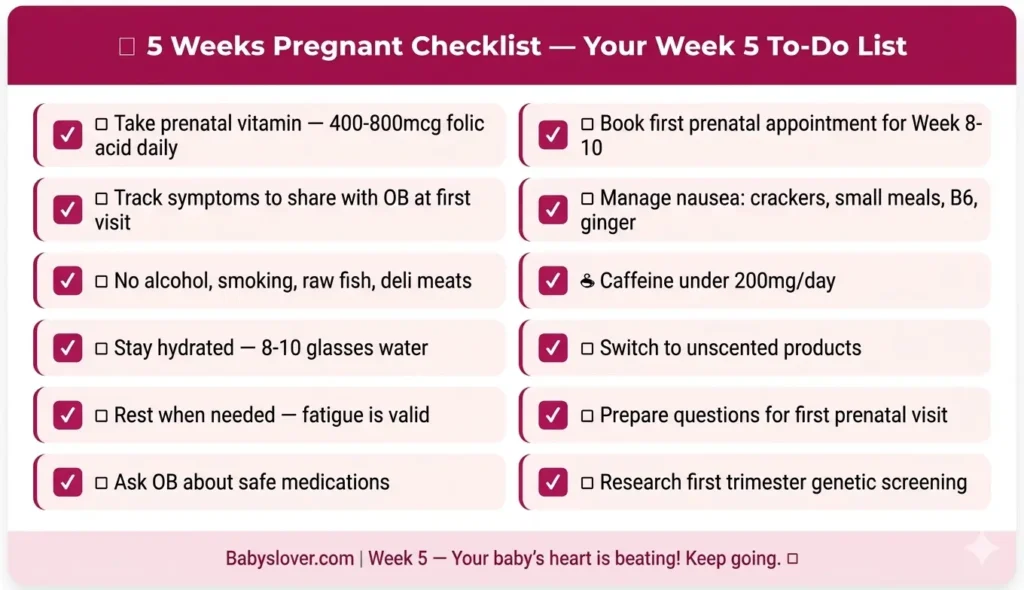
- ☑ Take prenatal vitamin daily — confirm it has 400-800mcg folic acid
- ☑ Book first prenatal appointment for Week 8-10 if not already done
- ☑ Start tracking symptoms — share with your OB at first visit
- ☑ Manage morning sickness: crackers before rising, small meals, B6, ginger
- ☑ Continue strict avoidance of alcohol, smoking, raw fish, unpasteurized foods
- ☑ Keep caffeine under 200mg per day
- ☑ Stay hydrated — 8-10 glasses water daily, sip slowly
- ☑ Switch to unscented products to reduce nausea triggers
- ☑ Rest when needed — fatigue is real and valid
- ☑ Prepare questions for your first prenatal visit
- ☑ Ask your OB about safe options for nausea, headaches, and common discomforts
- ☑ Research first trimester genetic screening options available to you
Frequently Asked Questions — 5 Weeks Pregnant
Is there a heartbeat at 5 weeks pregnant?
Your baby’s primitive heart tube begins beating this week, but it is typically not detectable on ultrasound until Week 6–7. If an early scan at 5 weeks doesn’t show a heartbeat, this is not necessarily cause for alarm — the embryo may be a few days younger than calculated. Your OB will advise the right timing for your scan.
Why is morning sickness so bad at 5 weeks?
Morning sickness is driven by rapidly rising hCG levels, which surge dramatically at Week 5. The nausea often intensifies as hCG peaks around Week 10, then improves after the first trimester. Eating small frequent meals, vitamin B6, and ginger are all evidence-backed strategies.
What does 5 weeks pregnant feel like?
For most women, 5 weeks pregnant feels like intense PMS combined with new symptoms: nausea, food aversions, overwhelming fatigue, and heightened smell. Some women feel surprisingly fine. Both are normal.
Can I have a miscarriage at 5 weeks?
Miscarriage risk is real in the first trimester — around 10-20% of confirmed pregnancies. At 5 weeks, this risk begins to decrease with each passing week. Once a heartbeat is confirmed (typically at 6-8 weeks), the risk drops considerably. Most early miscarriages are caused by chromosomal abnormalities — not anything the mother did or didn’t do.
How big is my baby at 5 weeks pregnant?
Your baby at 5 weeks pregnant is approximately 2–3mm long — about the size of a sesame seed. It weighs less than a fraction of a gram. Despite this tiny size, the heart has begun beating and every major organ system is laying its foundations.
Is it normal to have no morning sickness at 5 weeks?
Yes — completely normal. Many women have little or no morning sickness throughout the first trimester and go on to have perfectly healthy pregnancies. Symptom severity does not predict pregnancy health or outcome. Don’t compare your pregnancy experience to others.
Is light cramping at 5 weeks pregnant normal?
Yes — mild cramping similar to period cramps is common as the uterus expands. Severe cramping, one-sided pain, or cramping with heavy red bleeding is not normal and requires immediate medical evaluation.
Can I take anything for morning sickness at 5 weeks?
Always consult your OB first. Evidence-backed options your doctor may suggest: Vitamin B6 (pyridoxine) 10-25mg three times daily, ginger supplements or ginger tea, and for more severe nausea, prescription antiemetics. Never self-medicate without your provider’s guidance.
💗 The Emotional Side of Week 5
Week 5 is a week of profound contradictions.
You are thrilled and terrified. Excited and exhausted. Full of love for someone the size of a sesame seed — and full of fear that it might not last.
Both things are allowed to be true at the same time.
Anxiety about miscarriage in the early weeks is one of the most common emotional experiences of early pregnancy — and one of the least discussed. Many women spend the first trimester holding their breath, afraid to get too attached before 12 weeks. If that’s you: your feelings are completely normal.
At Babyslover, we believe in talking honestly about the emotional reality of pregnancy — not just the beautiful parts. You’re not doing pregnancy wrong if you’re anxious. You’re just human. Give yourself permission to love this baby right now, while holding space for the uncertainty. 💗
👶 What Happens Next — 6 Weeks Pregnant Preview
Week 6 is when pregnancy becomes more visible — on an ultrasound! Here’s what to expect next from 6 weeks pregnant:
Keep following our complete pregnancy week by week guide — from Week 1 all the way to Week 40, every milestone covered!
1 thought on “5 Weeks Pregnant: Symptoms, Heartbeat & Baby Development”