
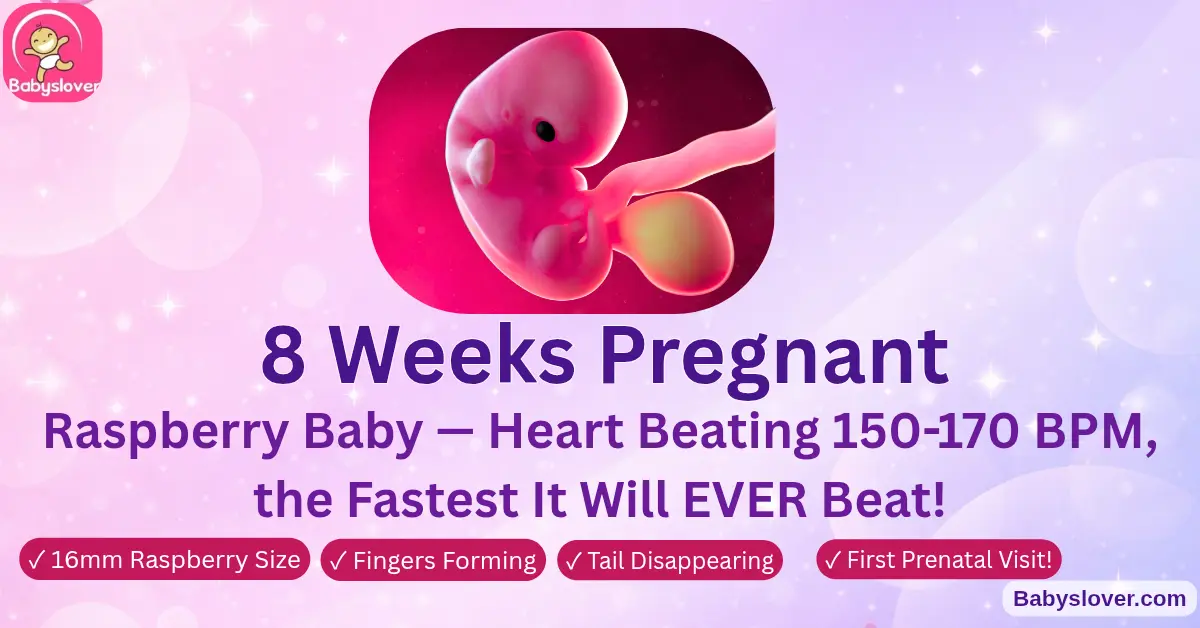
Your baby’s heart is beating faster right now than it will at any other point in its entire life. At 8 weeks pregnant, your raspberry-sized baby’s heart is racing at 150–170 beats per minute — nearly three times faster than a resting adult heart. It will never beat this fast again. And that’s just one of the remarkable things happening this week.
Week 8 is also likely the week of your first prenatal visit — the appointment where pregnancy stops being a positive test and becomes a confirmed, dated, heartbeat-verified reality.
At Babyslover, we’ll walk you through everything at 8 weeks pregnant: your baby’s astonishing development, what symptoms to expect, what happens at your first OB appointment, and what to do this week.
Just finishing last week? Our 7 weeks pregnant guide has the blueberry-to-raspberry growth story.
| 📋 Quick Summary — Week 8 of Pregnancy | |
| Week | Week 8 of 40 |
| Trimester | First Trimester (20% complete!) |
| Baby Size | 🍓 Raspberry / kidney bean — 16mm (0.63 inches) |
| Baby Weight | ~0.04 oz / just over 1 gram |
| KEY MILESTONE | 💗 HEART RATE 150-170 BPM — fastest it will EVER beat! Fingers & toes forming, tail fading |
| hCG Range | 31,000–149,000 mIU/mL — near its peak! |
| Symptoms | Morning sickness intensifying or near peak, extreme fatigue, breast changes, bloating, heartburn, frequent urination, acne, mood swings |
| First Step | 📋 Attend (or book!) your first prenatal appointment THIS week — most OBs see first patients at 8-10 weeks |
Contents
- 1 What’s Happening in Your Body at 8 Weeks Pregnant
- 2 🌱 Baby Development at 8 Weeks Pregnant
- 3 8 Weeks Pregnant Symptoms — What’s Normal
- 4 Your First Prenatal Visit — It’s Happening This Week
- 5 What to Eat at 8 Weeks Pregnant
- 6 Can I Dye My Hair at 8 Weeks Pregnant?
- 7 For Your Partner — The First Prenatal Visit
- 8 When to Call Your Doctor at 8 Weeks Pregnant
- 9 Your Week 8 Pregnancy Checklist
- 10 Frequently Asked Questions — 8 Weeks Pregnant
- 11 💗 The Emotional Reality of Week 8 — The First Heartbeat
- 12 👶 What Happens Next — 9 Weeks Pregnant Preview
- 13 Week 8: The Raspberry That Changes Everything
What’s Happening in Your Body at 8 Weeks Pregnant
At 8 weeks pregnant, you’re completing your second month of pregnancy — and internally, your body is working harder than it ever has to sustain and nourish your rapidly growing baby.
Blood Volume Has Increased 20-25%
Your blood volume has already increased by 20-25% from its pre-pregnancy level — and it will continue rising until it peaks at roughly 50% more than normal by the third trimester. Your heart is literally pumping more blood per minute. Your kidneys are filtering more. Your veins are more visible. This is why you feel both more energized at certain moments and utterly depleted at others — your cardiovascular system is running at a higher load, 24 hours a day.
The Placenta Is Almost Functional
Your placenta is growing rapidly this week and will reach full functionality around Week 12. Until then, your body is still carrying the full hormonal load of early pregnancy — which is a major reason that first-trimester symptoms are so intense. Once the placenta fully takes over progesterone production at Week 12, many women notice a significant easing of nausea, fatigue, and mood swings. Week 8 means you are now just 4 weeks from that turning point.
Ligaments Are Loosening — Enter Round Ligament Pain
The hormone relaxin is actively loosening your ligaments and joints to prepare your body for the physical demands of a growing pregnancy and eventual birth. This is wonderful for your pelvis — but it can cause sharp, catching pains in your lower abdomen or groin when you move suddenly, sneeze, laugh, or cough. This is called round ligament pain and is completely normal. Moving more slowly when changing positions helps significantly.
Skin Oil Production Is Spiking
Your skin is producing more oil than before pregnancy, driven by the hormone surge. The result: pregnancy acne (often along the chin and jawline), or the opposite — the famed ‘pregnancy glow’ of luminous, flushed skin. You may get both at different times. Do not use retinoids or retinol for acne — these are unsafe during pregnancy. Ask your OB about pregnancy-safe topical treatments if acne is bothering you.
Your Waistbands Are Getting Tighter
Your uterus is now the size of a large orange, and while you may not look pregnant yet, your normal clothes are likely feeling snug — especially around the waist. This is a combination of uterine growth and progesterone-driven bloating. Many women move into looser waistbands or their first maternity clothes around Week 8-10. There’s no milestone for when you ‘should’ show — every body is different.
🌱 Baby Development at 8 Weeks Pregnant
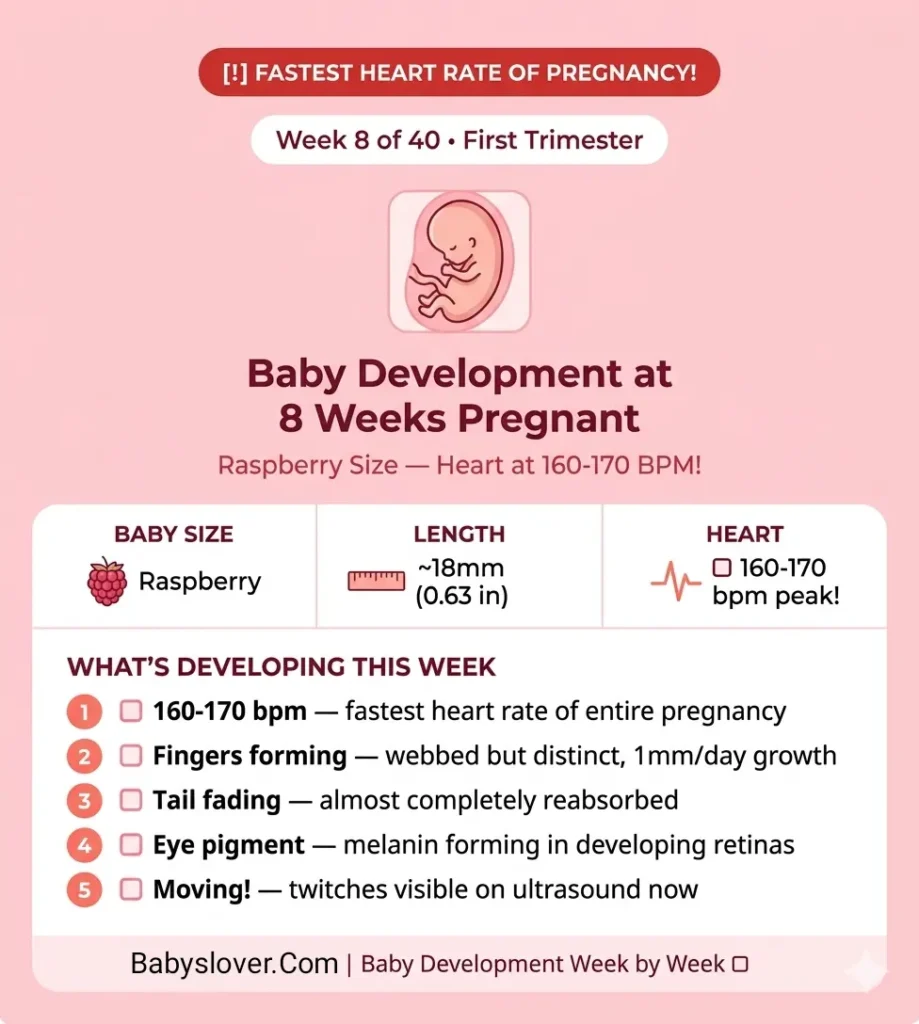
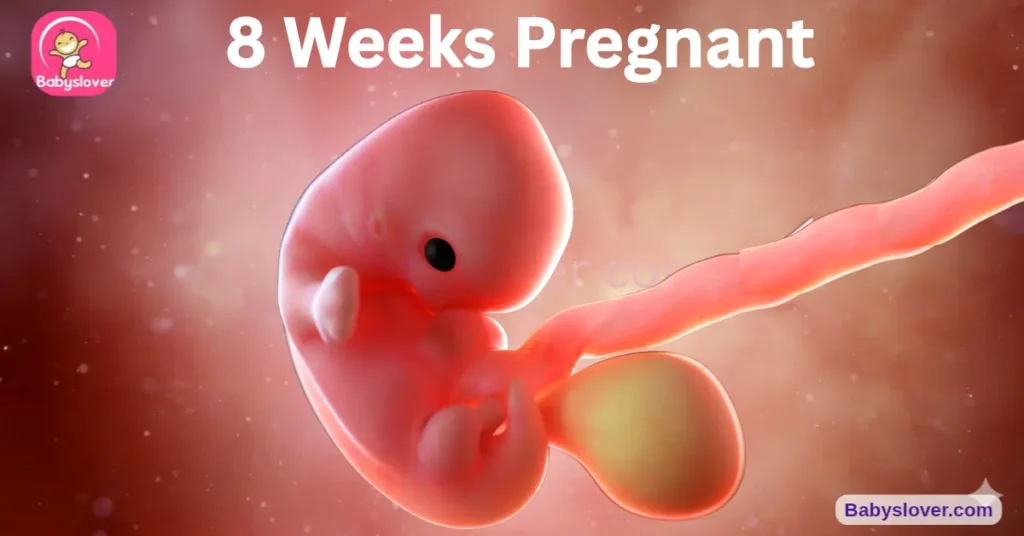
At 8 weeks pregnant, your baby — still technically an embryo for just one more week — measures approximately 16mm long, the size of a raspberry or kidney bean. Your baby is growing approximately 1mm every single day this week. What was a blueberry seven days ago is now recognizably more human in shape on an ultrasound screen — with a head, a body, and tiny limb buds that have become distinct arms and legs.
| 🌱 Baby Development at 8 Weeks Pregnant | |
| Baby Size | 🍓 Raspberry / kidney bean — 16mm (0.63 inches) |
| Fruit Comparison | 🍓 Raspberry or kidney bean |
| Weight | ~1 gram (0.04 oz) — just becoming measurable |
| Stage | Embryo — final week! Becomes fetus at Week 9 |
| Week / Trimester | Week 8 of 40 • First Trimester |
| KEY STAT | 💗 Heart rate 150-170 bpm — FASTEST of the entire pregnancy! |
What Is Developing at Week 8
- 💗 Heart rate peaks at 150-170 bpm — the fastest it will ever be: Your baby’s heart rate reaches its highest point around Weeks 8-10, beating 150-170 times per minute — nearly three times faster than a healthy resting adult heart. This peak rate is necessary because the embryonic heart must pump blood through tiny, rapidly developing vessels at high pressure to deliver oxygen to every forming tissue simultaneously. After Week 10, the heart rate will gradually slow — to around 120-160 bpm by the third trimester. If you hear this heartbeat for the first time at your 8-week ultrasound, the rapid, horse-galloping rhythm is completely normal and healthy.
- 🖐️ Fingers and toes forming — still webbed: Last week’s paddle hands have progressed into distinct fingers and toes — you can see them on an 8-week ultrasound as five separate rays at the end of each limb. However, they are still connected by webbing — thin tissue between each digit. This webbing will break down over the next 1-2 weeks, separating the fingers and toes fully. The fingers on the hands are slightly more developed than the toes at this stage, as hand development leads foot development throughout the embryonic period.
- 🪱 Tail is disappearing: The small tail-like structure that was present at the base of the spine during the embryonic phase is now almost completely reabsorbed into the body. By Week 9, it will be fully gone. Your baby has spent the last several weeks looking somewhat like a tadpole — this week, that phase is ending and a distinctly human silhouette is emerging on ultrasound.
- 👁️ Eye pigment developing: The retinas at the back of your baby’s developing eyes are now beginning to develop pigment — the melanin that will eventually determine your baby’s eye color. The eyelids are present and fully covering the eyes (they won’t open until Week 26-28). The nose, upper lip, and ears are all becoming more defined and recognizable on ultrasound this week.
- 🦷 Tooth buds forming in the gums: Twenty primary tooth buds are developing in the gum tissue this week — the precursors to your baby’s first set of teeth, which won’t emerge until around 6 months after birth. These structures are already responding to the calcium and nutrients in your diet. This is why your prenatal vitamin’s calcium content matters right now.
- 🫁 Intestines forming in the umbilical cord: One of the most extraordinary facts about Week 8 development: your baby’s intestines are growing inside the umbilical cord, not inside the abdomen. The abdominal cavity is currently too small to contain them, so the intestines loop out into the cord. They’ll migrate back into the abdominal cavity around Weeks 10-12 as the body grows large enough to accommodate them. This is completely normal and is visible on early ultrasounds.
- 🤸 Spontaneous movement — visible on ultrasound: Your baby is making tiny spontaneous movements this week — twitches, arm flexes, and leg kicks are all possible and visible on a high-quality 8-week ultrasound. These aren’t intentional movements controlled by the brain yet — they are reflex actions generated by the developing nervous system. You won’t feel them for many weeks (usually Week 16-22 for first-time moms), but you may be able to watch them live on the ultrasound screen at your first prenatal appointment.
- 🧬 Reproductive organs beginning development: Your baby’s sex was genetically determined at fertilization — but the physical development of the reproductive organs is only just beginning. This week, the gonads (ovaries or testes) are beginning to develop, though external genitalia won’t be distinguishable on ultrasound for several more weeks.
💡 Fun fact: Your baby’s heart will beat approximately 54 million times before birth. At Week 8, with its peak rate of 170 bpm, it’s beating so fast that the sound on ultrasound has been described as a ‘galloping horse’ — a sound many parents say they never forget. 💗
8 Weeks Pregnant Symptoms — What’s Normal
Week 8 is notorious for being one of the most intensely symptomatic weeks of the first trimester. Here’s what’s completely normal at 8 weeks pregnant:
🤢 Morning Sickness — Often at Its Absolute Worst
For many women, Weeks 8-10 are the peak of morning sickness — the hCG-driven nausea that affects up to 80% of pregnant women. Morning sickness at 8 weeks can be relentless: all-day nausea, smell-triggered vomiting, inability to eat normally. Evidence-backed approaches: Vitamin B6 (ask your OB about safe dosing), ginger in any form (tea, candies, capsules), small frequent meals, and keeping crackers by the bed to eat before getting up.
If you cannot keep any liquid down for 24+ hours, are losing weight, or feel faint, contact your OB — hyperemesis gravidarum is a serious condition that requires IV fluids and possibly antiemetic medication. It is not something to manage silently.
😴 Extreme Fatigue — Still Physiological
Week 8 fatigue remains profound. The placenta isn’t fully functional yet, your body is producing enormous hormonal loads, blood volume is still expanding, and your heart and kidneys are working harder than ever. This is not a willpower problem. Short naps when possible, early bedtimes, and delegating tasks you normally do are all valid and intelligent responses to first-trimester fatigue.
🍈 Breast Changes — Bigger and More Tender
Many women go up one full cup size by Week 8. The veins on the breasts are more visible due to increased blood flow. The areolas may have darkened and grown. Montgomery tubercles — small bumps around the nipple — are becoming more prominent, preparing for potential breastfeeding. A well-fitting, soft, non-underwire bra worn day and night can dramatically reduce breast discomfort.
🔥 Heartburn — A New Arrival This Week
Progesterone relaxes the lower esophageal sphincter — the valve between the stomach and esophagus — allowing stomach acid to back up. Heartburn arrives for many women around Week 7-9 and can persist throughout the pregnancy. Eating smaller meals, avoiding spicy and greasy foods, not lying down within 2-3 hours of eating, and staying upright after meals all help. Ask your OB about safe antacids — Tums (calcium carbonate) is generally considered safe.
🚽 Frequent Urination — Your New Reality
Your uterus is now the size of a large orange and increasingly pressing on your bladder from above. Combined with kidneys filtering 20-25% more blood than before pregnancy, frequent urination is essentially non-negotiable at Week 8. Urgency — the sudden, immediate need to go — is also common. This slightly eases in the second trimester as the uterus rises out of the pelvis, but returns strongly in the third.
🤕 Headaches — New and Hormonal
Headaches are common in the first trimester and are caused by surging estrogen and progesterone, increased blood volume, dehydration (especially if morning sickness is reducing fluid intake), and often caffeine reduction if you’ve cut back. Acetaminophen (Tylenol) is the only OTC pain reliever considered safe during pregnancy. Avoid ibuprofen, aspirin, and naproxen entirely — these NSAIDs can cause complications in pregnancy.
💭 8 Weeks Pregnant With No Symptoms
No symptoms at 8 weeks is common and does not indicate a problem. A significant proportion of women experience minimal first-trimester symptoms and go on to have healthy, full-term pregnancies. If you’ve had symptoms that suddenly and completely disappeared alongside cramping or bleeding, that’s worth a call to your OB — but fading symptoms alone are not necessarily concerning.
💡 Morning sickness severity does not predict pregnancy health. Women who feel the worst don’t have ‘better’ pregnancies, and women who feel fine are not ‘worse off.’ Symptom intensity is hormonally driven and varies enormously between individuals and between pregnancies in the same person.
Your First Prenatal Visit — It’s Happening This Week
For most women with a singleton low-risk pregnancy, the first prenatal appointment happens between Weeks 8–10. If you’re reading this and haven’t yet booked yours, call your OB today — practices fill up quickly. This is the most comprehensive prenatal appointment you’ll have, and it’s worth being fully prepared.
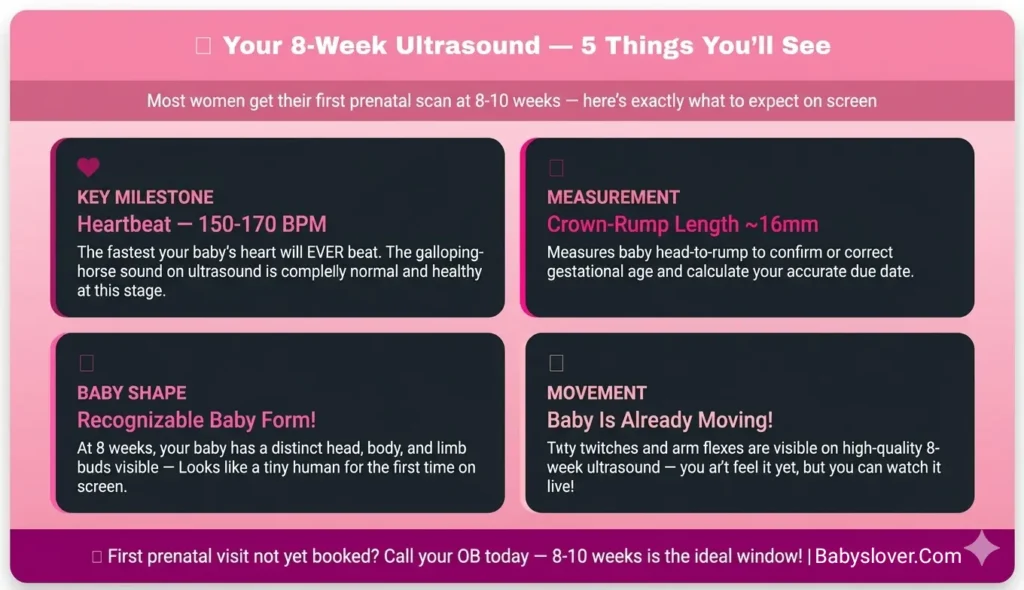
What Will Happen at Your 8-Week Appointment
- Ultrasound — to confirm intrauterine pregnancy, measure baby (Crown-Rump Length), hear/see heartbeat, verify due date, and check for twins
- Blood tests — blood type, Rh factor, complete blood count, STI screening (HIV, syphilis, hepatitis B, chlamydia), rubella and chickenpox immunity, thyroid function
- Urine test — UTI, protein levels (preeclampsia marker), glucose
- Pap smear — cervical screening if due (safe during pregnancy)
- Blood pressure, weight, and BMI — establishes your pregnancy baseline
- Medical and family history review
- Genetic screening discussion — NIPT (available Week 10+), NT scan (11-14 weeks), CVS — you decide what testing you want
- Due date confirmation — your OB may adjust your due date based on ultrasound measurements
Questions to Bring to Your 8-Week Appointment
- Is my current weight/gain on track for my pregnancy?
- Which medications I currently take are safe to continue?
- What genetic screening do you recommend for my age and history?
- Is it safe to exercise — what types and intensity?
- Can I dye my hair during pregnancy?
- What OTC medications are safe for headaches, colds, allergies?
- What are the red flags I should call you for between appointments?
- When is my next appointment, and what will it include?
Print this list and bring it with you. Our pregnancy tips for first time moms guide also has a full first-prenatal-visit preparation section worth reading the night before your appointment.
What to Eat at 8 Weeks Pregnant
| Nutrient | Why Critical at Week 8 | Best Sources |
| Folic Acid | Brain producing neurons rapidly — neural development ongoing through Q1 | Prenatal vitamin (400-800mcg), leafy greens, lentils, avocado |
| Calcium | Tooth buds forming — baby draws calcium from you for dental structure | Dairy, fortified plant milk, sardines, kale, broccoli |
| Vitamin B6 | Most evidence-backed natural anti-nausea approach | Chicken, fish, bananas, chickpeas, potatoes (10-25mg 3x/day, ask OB) |
| Iron | Blood volume 20-25% higher — iron demand rising every week | Lean meat, spinach, beans, tofu, fortified cereals + vitamin C for absorption |
| DHA | Brain growing rapidly — DHA is primary structural fat for neural tissue | Cooked salmon, sardines, walnuts, DHA in prenatal vitamin |
| Water | Prevents headaches, aids kidneys, combats nausea — critical at Week 8 | 8-10 glasses/day; ice cold often better tolerated with nausea |
Per the CDC, folic acid taken consistently through the first trimester significantly reduces neural tube defect risk. If nausea makes swallowing prenatal capsules hard, try taking them at night with food, switching to a gummy prenatal, or asking your OB about a chewable option. Our best prenatal vitamins guide covers the gentlest formats for nausea-prone moms.
Can I Dye My Hair at 8 Weeks Pregnant?
This is one of the most-searched questions among first-trimester moms — and the answer is more reassuring than many expect.
Most research suggests that hair dye used in well-ventilated spaces from Week 12 onward poses minimal risk to the baby. The first trimester is when the most critical organ development is occurring, so most OBs recommend waiting until Week 13 or later as an extra precaution. If you need to color your hair before then, options with less scalp contact — highlights, balayage, and similar techniques — are considered lower risk than root-to-tip all-over color.
- Always use hair color in a well-ventilated room
- Wear gloves when applying
- Avoid leaving dye on longer than necessary
- Consider waiting until Week 12+ for root-touching all-over color
- Highlights and balayage have less scalp contact — considered lower risk
- Always tell your stylist you are pregnant
💡 The safest approach: ask your OB at your first prenatal appointment. They know your specific health history and can give you the most personalized guidance. Most will say highlights are fine and all-over color after Week 12 is likely safe.
For Your Partner — The First Prenatal Visit
Week 8 often marks the first time a partner hears the baby’s heartbeat — and that changes everything.
- Attend the first prenatal appointment if at all possible: This is not a routine check — it’s a comprehensive exam with an ultrasound where the heartbeat will be confirmed and the baby will be measured. Hearing 150-170 bpm live on that screen is transformative. Many partners describe this as the moment the pregnancy truly became real to them.
- Bring your own questions: Read the ‘Questions to Ask’ section and add your own. The first prenatal appointment is designed for both partners, and OBs appreciate engaged partners who are invested in the pregnancy. Your questions matter and your presence makes the appointment richer.
- Be aware the appointment can be long: The first prenatal visit is typically 60-90 minutes long — longer than all subsequent visits. Block out the time. Come prepared to wait. The thoroughness of this appointment is a good thing.
- Manage the home environment for morning sickness: Week 8 nausea is often at its worst. Take over any cooking, trash duty, or strong-smelling household tasks without being asked. Keep the kitchen stocked with crackers, ginger products, and bland foods. Your partner’s ability to keep nutrients down matters for both her and the baby.
- Start reading about fetal development: Knowing that your baby’s heart is beating 150-170 times per minute right now, that its fingers are forming with tiny webbing, that it can move — these facts create emotional connection. You don’t need to feel the symptoms to feel connected. You just need to know what’s happening.
- Check your workplace leave policies: Week 8 is a good time to quietly begin understanding what parental leave you’re entitled to, how much notice your workplace requires, and what financial planning is needed. This is preparation that serves both of you — and it’s easier to do calmly now than in a rush later.
When to Call Your Doctor at 8 Weeks Pregnant
Seek immediate care for:
- Severe one-sided abdominal pain with shoulder pain, dizziness, or faintness: Ectopic pregnancy emergency — go to the ER immediately, do not wait.
- Heavy red bleeding (soaking a pad or passing clots): Light pink or brown spotting can be normal. Heavy active bleeding requires urgent evaluation.
- Vomiting — cannot keep any liquid down for 24+ hours: Hyperemesis gravidarum needs medical treatment. IV fluids and antiemetics may be required.
- Fever above 100.4°F / 38°C: Infection in the first trimester needs prompt evaluation.
- Severe, persistent headache unresponsive to Tylenol, especially with visual changes: While mild headaches are common, a severe headache with visual disturbance should always be reported.
- Painful urination: UTIs are very common in pregnancy and must be treated — untreated UTIs can lead to kidney infection and preterm labor.
Your Week 8 Pregnancy Checklist
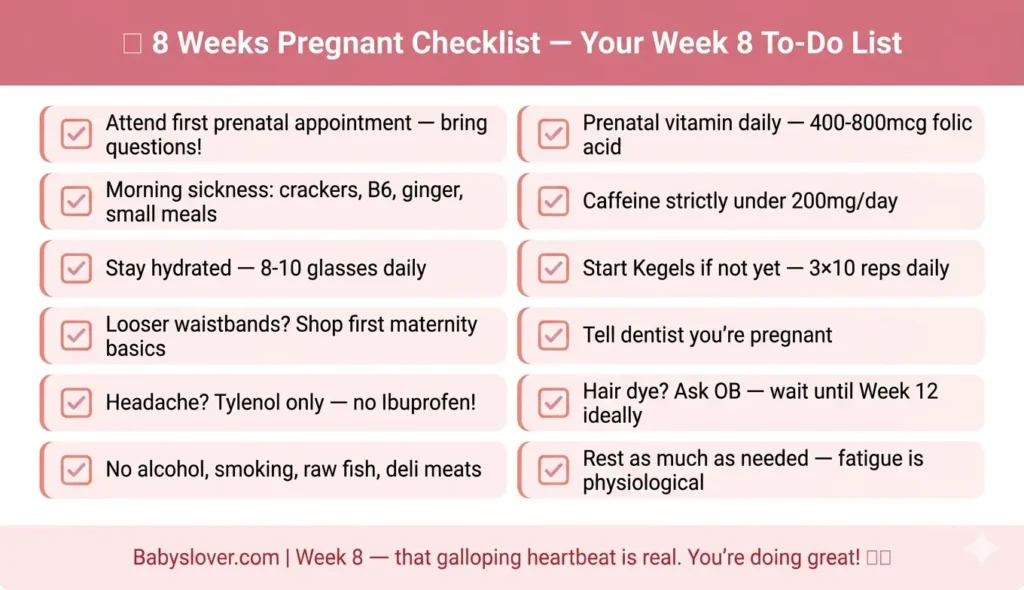
- ☑ Attend your first prenatal appointment — bring your printed question list!
- ☑ Take prenatal vitamin daily — folic acid 400-800mcg
- ☑ Morning sickness: crackers before rising, small meals, B6 (ask OB), ginger
- ☑ Caffeine strictly under 200mg per day
- ☑ Stay hydrated — 8-10 glasses of fluid daily
- ☑ Start Kegel exercises if you haven’t yet — 3 sets of 10 per day
- ☑ Shopping for looser waistbands or first maternity basics?
- ☑ Tell your dentist you’re pregnant — gum changes are real
- ☑ Tylenol only for headaches — avoid ibuprofen and aspirin entirely
- ☑ Ask OB about safe hair dye timing if relevant
- ☑ No alcohol, smoking, raw fish, deli meats, high-mercury seafood
- ☑ Rest as much as you need — first-trimester fatigue is physiological
Frequently Asked Questions — 8 Weeks Pregnant
What does 8 weeks pregnant feel like?
For most women, 8 weeks pregnant feels like peak first-trimester difficulty — nausea is often at its worst, fatigue is profound, and new symptoms like heartburn and headaches may be arriving. It also often marks the first prenatal appointment — a moment that brings both relief and emotional intensity. Many women describe hearing the heartbeat for the first time at their 8-week scan as profoundly overwhelming. In a good way.
How big is my baby at 8 weeks pregnant?
Your baby at 8 weeks pregnant is approximately 16mm long — the size of a raspberry or kidney bean — and weighs just over 1 gram. Growing approximately 1mm per day, your baby is moving from blueberry (Week 7) to raspberry (Week 8) in a single week.
Is bleeding normal at 8 weeks pregnant?
Light pink or brown spotting can occur at 8 weeks from a variety of normal causes — residual implantation site healing, cervical sensitivity, or post-intercourse spotting from increased cervical blood flow. Heavy red bleeding, passing clots, or spotting accompanied by severe cramping is not normal and requires immediate medical evaluation.
Can you hear the heartbeat at 8 weeks pregnant?
Yes — your baby’s heartbeat is clearly detectable on transvaginal ultrasound at 8 weeks, beating at 150-170 bpm. A Doppler (the handheld device that transmits sound through your abdomen) typically cannot detect the heartbeat reliably until around 10-12 weeks, as the baby is still deep in the pelvis. Your first prenatal ultrasound is the way most parents hear it at this stage.
Is it normal to not be showing at 8 weeks?
Yes — completely normal. Most first-time mothers don’t have a visible bump until Weeks 12-16. The uterus is still contained within the pelvis at 8 weeks and not visible from the outside. Any ‘puffiness’ or fullness you notice is typically from bloating, not the uterus itself. Women who have been pregnant before and women carrying twins tend to show earlier.
Why is my heart racing at 8 weeks pregnant?
A noticeably faster heart rate (palpitations) is common and normal in the first trimester. Your heart is pumping 20-25% more blood per minute than before pregnancy. Occasional awareness of your heartbeat is normal. If you have sustained rapid heartbeat at rest, dizziness, or chest pain, contact your OB.
Is it safe to exercise at 8 weeks pregnant?
Yes — for most low-risk pregnancies, moderate exercise is beneficial throughout the first trimester. Walking, swimming, prenatal yoga, and light cardio are all safe and encouraged. Avoid contact sports, activities with fall risk, high-impact exercise, hot yoga, and anything causing overheating or significant exertion. Always get your OB’s confirmation at your first prenatal visit.
When will morning sickness end?
For most women, morning sickness peaks between Weeks 8-10 and begins improving by Week 12-14 as hCG levels peak and then decline. By Week 16, the majority of women have significant relief. About 10% of women experience nausea that extends into the second trimester, and a small percentage throughout the pregnancy. If you’re suffering at Week 8, relief is coming — likely within 4-6 weeks.
💗 The Emotional Reality of Week 8 — The First Heartbeat
There’s a before and an after.
Before you hear the heartbeat at your 8-week scan, pregnancy can feel somewhat abstract — a positive test, weeks of symptoms, a change happening internally but invisible. After you hear those 150-170 beats per minute — galloping, alive, insistently real — it becomes something else entirely.
Many parents describe this moment as the first time the pregnancy felt fully, undeniably true. Some cry without expecting to. Some feel a wave of love and terror simultaneously. Some feel relief so intense they struggle to put it into words.
Whatever you feel in that room — it’s the right feeling. You don’t have to perform a certain emotion. You’re allowed to be overwhelmed, cautious, overjoyed, terrified, or some indescribable combination of all of it.
That heartbeat is your baby. It’s real. It’s happening. 💗
👶 What Happens Next — 9 Weeks Pregnant Preview
Week 9 brings the biggest developmental milestone of the first trimester — here’s what to look forward to with 9 weeks pregnant:
- Baby officially becomes a FETUS — the embryonic phase is complete!
- Grows from raspberry to grape — 22mm (0.9 inches)
- Tail completely disappears — fully reabsorbed this week
- Baby can make a tiny FIST — all 5 major joints are functional
- Thumb sucking may begin
- Eyelids fully fused shut — retinas developing behind them
- Tooth buds forming in gum tissue
Keep following our complete pregnancy week by week guide — from Week 1 all the way to Week 40!
Week 8: The Raspberry That Changes Everything
Being 8 weeks pregnant means carrying a raspberry-sized miracle whose heart is beating at the fastest rate it will ever sustain. Whose fingers are forming — still webbed, still tiny — but distinctly, recognizably fingers. Whose spontaneous movements are already visible to the right ultrasound machine, even though you can’t feel them yet.
The first prenatal appointment is here. The heartbeat is about to become real. Week 12 — and everything that comes with it — is approaching.
Keep going. Keep resting. Keep taking the vitamins. And know that every hard day of Week 8 is a day your baby’s heart is beating 150-170 times to stay alive for you. 💗 For everything else you need this trimester, read our pregnancy tips for first time moms — written for exactly this moment.
1 thought on “8 Weeks Pregnant: Symptoms, Baby Size & First Prenatal Visit”