
If you’ve spent another night pacing the hallway, patting your baby’s back for the hundredth time, or Googling “why won’t my baby sleep” at 2 AM — the Ferber Method might be exactly what your family needs right now.
The Ferber Method is one of the most researched and widely recommended sleep training techniques for babies and toddlers. Developed by pediatric sleep expert Dr. Richard Ferber, this approach teaches your baby to fall asleep independently using a gradual, check-in based system — not just letting them cry alone in the dark.
At Babyslover, we’ve put together the most complete Ferber Method guide you’ll find anywhere — covering every age from 4 months to 3 years, a full Ferber Method chart for both naps AND nighttime sleep, step-by-step instructions, and honest answers to the questions every exhausted parent is actually asking.

What Is the Ferber Method?
The Ferber Method — sometimes called Ferberizing or graduated extinction — is a sleep training technique that teaches babies and toddlers to fall asleep on their own.
Here’s how it works in simple terms: You put your baby down in their crib while they’re still awake. If they cry, you wait for a set amount of time before going in to briefly reassure them. Then you leave again — and the next time you wait a little longer. Each night, the wait times get progressively longer.
The key word here is progressive. You’re not ignoring your baby. You’re checking in regularly — just less and less often — so they learn that you’re still there, they’re safe, and they can figure out how to fall asleep on their own.
Dr. Richard Ferber first published this method in his book Solve Your Child’s Sleep Problems in 1985. Since then, it’s been studied extensively, and pediatricians at the American Academy of Pediatrics consistently recognize graduated extinction as a safe and effective approach to sleep training.
Is the Ferber Method the Same as Cry It Out?
This is probably the most common question parents ask — and the answer is no, they’re not the same.
The Cry It Out method (also called extinction) means you put your baby down and don’t go back in until morning, no matter how long they cry. There are zero check-ins.
The Ferber Method is different. You go in at regular, timed intervals to reassure your baby. You just don’t pick them up or feed them back to sleep. It’s more structured, and for many families, it feels more manageable because you’re still responding — just on a delay.
Think of it this way: The Cry It Out method is jumping into cold water all at once. The Ferber Method is walking in slowly, step by step.
What Age Can You Start the Ferber Method?
Most pediatricians recommend starting the Ferber Method at 4 to 6 months old. Here’s why that age range matters:
By 4 months, most babies have developed enough neurologically to start learning self-soothing. Their circadian rhythm is beginning to form, and many can go longer stretches without needing to eat at night.
By 6 months, the majority of healthy babies no longer need nighttime feedings for nutrition — making sleep training more straightforward.
Before 4 months, we don’t recommend the Ferber Method. Newborns and very young babies have genuine needs at night — hunger, warmth, connection — that shouldn’t be sleep trained away.
| Age | Ready for Ferber? |
|---|---|
| 0–3 months | ❌ No — too young |
| 4–5 months | ⚠️ Maybe — check with your pediatrician |
| 6–12 months | ✅ Yes — sweet spot |
| 12 months+ | ✅ Yes — may take a little longer |
| 2–3 years | ✅ Yes — with slight adjustments |
How the Ferber Method Works: Step-by-Step
Before you start, do these three things:
1. Build a consistent bedtime routine.
A 20–30 minute routine — bath, pajamas, story, cuddle, song — teaches your baby’s brain that sleep is coming. Start this routine at least a week before you begin sleep training.
2. Set up a safe, comfortable sleep space.
Dark room (blackout curtains make a big difference), comfortable temperature around 68–72°F, and a white noise machine if helpful. Make sure the crib meets current safety standards with nothing extra inside.
3. Pick your start date.
Choose a stretch of 2 weeks where your family will be home consistently — no travel, no major schedule changes. Consistency is what makes this work.
On the first night:
- Go through your full bedtime routine as usual.
- Place your baby in the crib awake but drowsy. This is the most important step. If your baby is already asleep when you put them down, they haven’t learned to fall asleep on their own.
- Say goodnight calmly and leave the room.
- If they cry, wait the scheduled time (see chart below) before going in.
- During your check-in, keep it brief — 1 to 2 minutes maximum. Pat their chest, speak softly (“You’re safe, it’s time to sleep, I love you”), and leave before they fall asleep.
- If they continue crying, wait the longer interval before going in again.
- Repeat until your baby falls asleep.
That’s Night 1. It won’t be easy. But you’ve got this.
Ferber Method Chart for Sleep Training — Official Nighttime Intervals
This is the standard Ferber Method timing chart. Use this as your guide for the first 7 nights.
| Night | 1st Check-In | 2nd Check-In | 3rd Check-In | After That |
|---|---|---|---|---|
| 1 | 3 min | 5 min | 10 min | 10 min |
| 2 | 5 min | 10 min | 12 min | 12 min |
| 3 | 10 min | 12 min | 15 min | 15 min |
| 4 | 12 min | 15 min | 17 min | 17 min |
| 5 | 15 min | 17 min | 20 min | 20 min |
| 6 | 17 min | 20 min | 25 min | 25 min |
| 7 | 20 min | 25 min | 30 min | 30 min |
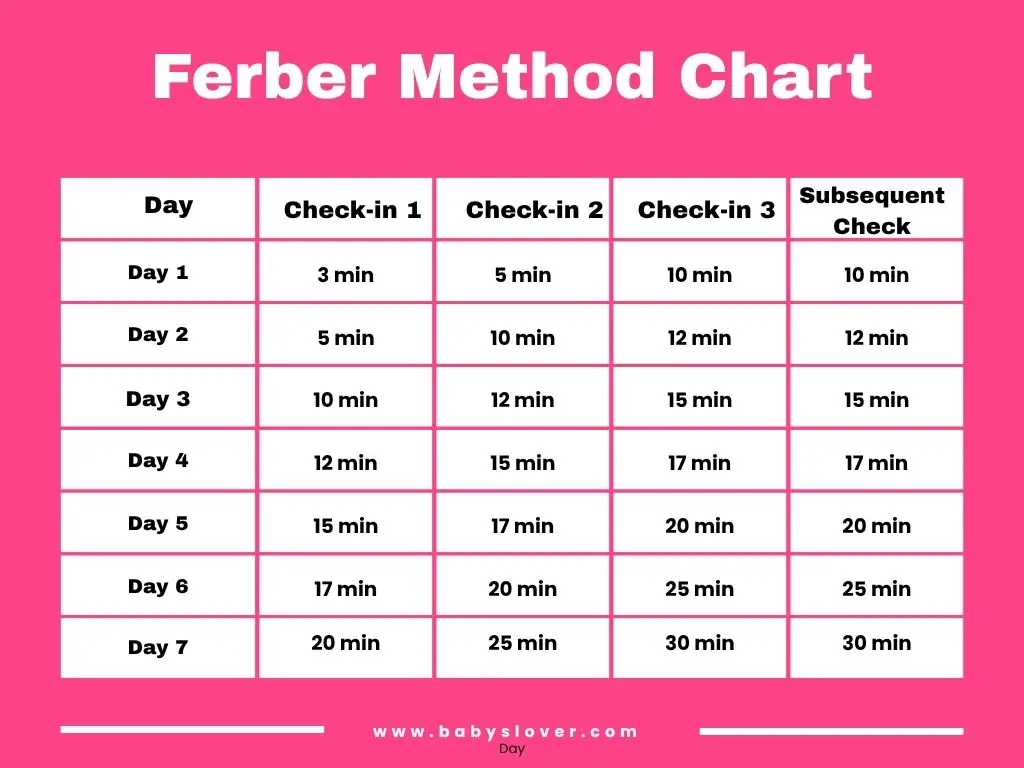
How to use this Ferber Method chart:
- Start at Night 1 even if your baby is older — you’re building the method from scratch
- If your baby falls asleep before a check-in, don’t go in
- If your baby wakes again after falling asleep, restart the intervals from the beginning for that waking
- Consistency matters more than exact minutes — slight adjustments are fine
Ferber Method for 4 Month Old
Four months is on the early side, and we want to be honest with you about that. Your baby’s circadian rhythm is just starting to develop, and many 4-month-olds still genuinely need a feeding or two at night for nutrition.
That said, some 4-month-olds are ready — especially if they’re healthy, gaining weight well, and your pediatrician has given the green light.
What’s different at 4 months:
- Start with shorter wait times (1–3 minutes) rather than jumping to the standard chart
- Night feedings are still normal — only sleep train for non-hunger wakings
- Progress may be slower — expect 1 to 2 weeks before you see real change
- If your baby is in the middle of the 4-month sleep regression, wait it out first
Before You Start:
- Confirm with your pediatrician that your baby is ready (typically 4+ months, good health, feeding well)
- Ensure your baby isn’t going through a developmental regression or major milestone
- Have realistic expectations—progress may be slower at this age
The 4-Month Approach:
Start with a consistent bedtime routine. This might be a bath, cuddles, and a story. Keep it the same every night.
Place your baby in their crib drowsy but awake. Let them know it’s sleep time with a calm voice.
If crying starts, use these wait times:
- Night 1-3: Wait 1 minute, check in (2 minutes max), leave
- Night 4-7: Wait 3 minutes, check in, leave
- Week 2: Wait 5 minutes, check in, leave
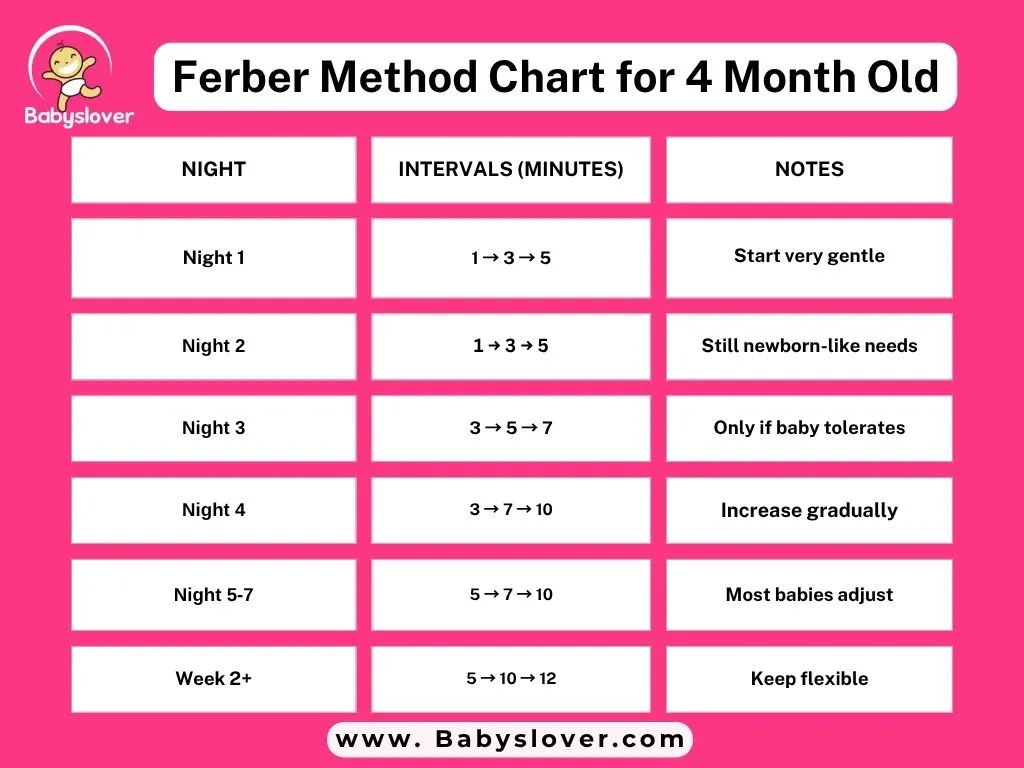
The most important thing at this age: a solid bedtime routine. If you do nothing else, establish a consistent 20-minute routine for a few weeks before attempting sleep training. Many families find this alone makes a significant difference.
Ferber Method for 5 Month Old
Five months is a transitional age — past the newborn fog but not quite at the 6-month sweet spot. Most 5-month-olds can handle the Ferber Method with some modifications.
At this age, your baby may still need one nighttime feeding. That’s completely okay. Use the Ferber Method for non-hunger wakings, and respond normally to genuine hunger cues.
Use the same modified chart as 4 months for the first few nights, then gradually move toward the standard chart. What parents often notice at 5 months: improvement tends to come a little faster than at 4 months, usually within 5–7 nights.
Ferber Method for 6 Month Old
Six months is the gold standard starting age for Ferber sleep training — and for good reason.
By now, most babies can self-soothe more effectively, don’t need nighttime feedings for nutrition (though always check with your pediatrician), and have a more predictable sleep rhythm. Use the standard Ferber chart above.
Before You Start:
- Your baby should be sleeping in their own space (crib, bassinet, or nearby)
- Establish a solid bedtime routine (15-30 minutes)
- Make sure daytime naps are consistent
What to expect night by night at 6 months:
- Night 1: Expect 30–60 minutes of crying before sleep. This is the hardest night.
- Night 2–3: Often worse before it gets better. This is called an extinction burst — it’s completely normal and actually means the method is working.
- Night 4–5: You’ll start to see real improvement. Crying times get shorter.
- Night 7+: Most babies are falling asleep within 10–15 minutes.
The 6-Month Approach:
Create a calming bedtime routine. Think bath time, pajamas, a story, and cuddles. Aim for the same time each night.
Place your baby in the crib awake. Say goodnight and leave the room.
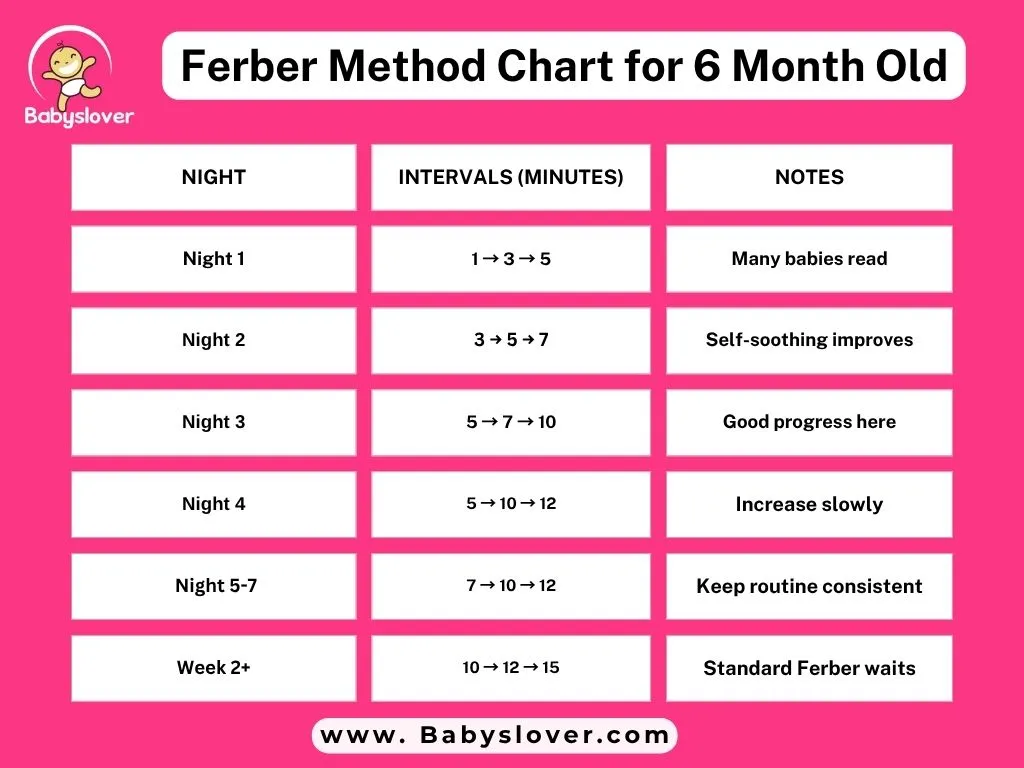
If your baby cries, use these wait times:
- Night 1-2: Wait 1 minute before checking
- Night 3-4: Wait 3 minutes before checking
- Night 5-7: Wait 5 minutes before checking
- Week 2+: Wait 10 minutes before checking
During check-ins, keep them under 2 minutes. A calm voice, gentle touch, and reassurance are enough. Don’t pick up your baby or turn on lights.
Progress through the waiting times only if you see improvement. If night 3 is still very difficult, repeat the same times for another night or two.
Ferber Method for 1 Year Old
At 1 year old, your baby is becoming more aware, mobile, and emotionally complex. They’re also likely taking one or two naps and might have established sleep habits (good or challenging ones).
Before You Start:
- Your baby should be eating solid foods and not dependent on night feeds
- Confirm with your pediatrician there are no health concerns
- Have a consistent nap and bedtime schedule
The 1-Year Approach:
Routines are everything at this age. A 20-30 minute bedtime routine sets the stage for success.
Put your baby down awake but drowsy. This is important—they need to practice falling asleep on their own.
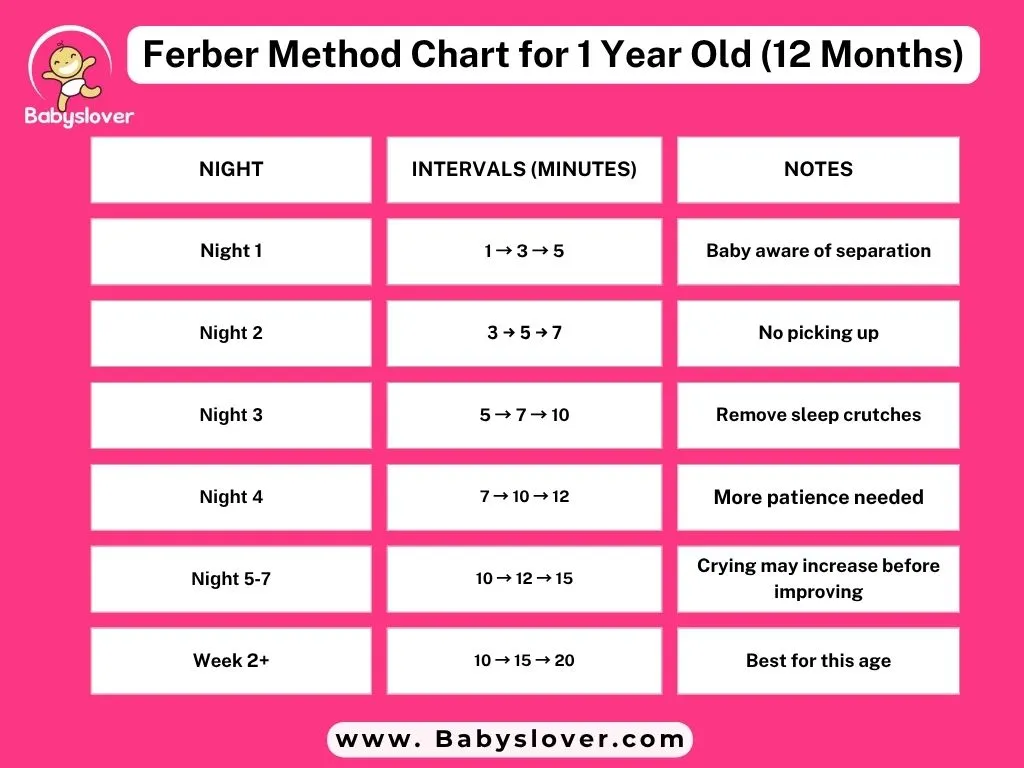
If crying begins, use these wait times:
- Night 1-2: Wait 1 minute before checking
- Night 3-5: Wait 3 minutes before checking
- Night 6-7: Wait 5 minutes before checking
- Week 2+: Wait 5-10 minutes before checking
Check-ins should be quick and calm. Keep the room dim. Your baby might cry harder when they see you—that’s developmentally normal. Brief reassurance, then leave.
For nighttime awakenings: Respond to genuine needs (fever, injury), but use the same waiting method for crying due to sleep association.
What to expect: One-year-olds often improve within 5-7 nights. Some take longer. Staying consistent through tough nights makes the difference.
Ferber Method for 18 Month Old
Eighteen months brings the full force of toddler independence — and it can make sleep training feel like a negotiation you keep losing. Your 18-month-old might stand in the crib crying, scream with impressive persistence, or suddenly develop strong separation anxiety.
Bedtime routine is everything at this age. Make it consistent, predictable, and 20–30 minutes long. Include simple choices where you can — “Do you want the dinosaur book or the bunny book?” — this gives your toddler a small sense of control and reduces resistance significantly.
Before You Start:
- Ensure your toddler is in a bed they can’t escape from easily (or a crib with high rails)
- Your toddler should have an established routine
- Consider if there are any big changes (new sibling, moving, starting daycare)
The 18-Month Approach:
Bedtime routine becomes even more important. Include predictable elements like books, songs, and cuddles. Keep it to 20-30 minutes.
Set clear expectations in simple words: “It’s sleep time now. I’m leaving. I’ll be back in the morning.”
Place your toddler in bed and leave calmly.
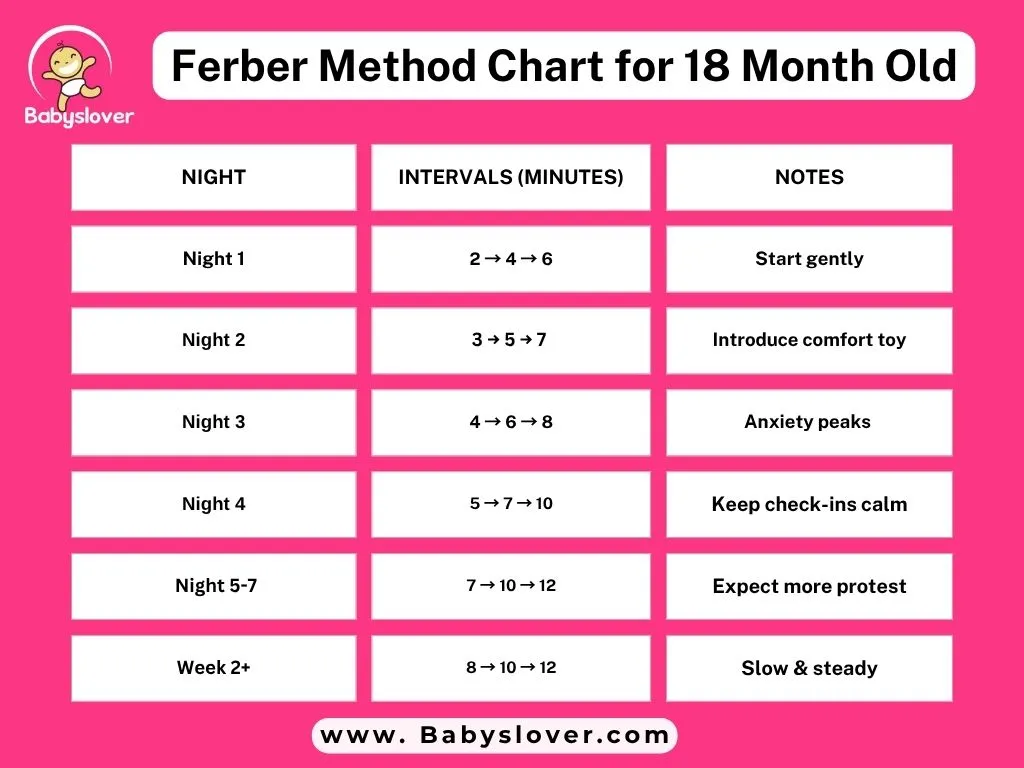
If crying or calling for you starts, use these wait times:
- Night 1-2: Wait 2 minutes before checking
- Night 3-4: Wait 4 minutes before checking
- Night 5-7: Wait 6 minutes before checking
- Week 2+: Wait 8-10 minutes before checking
When you check in, stay calm. A brief interaction, reassurance, and back out. Your toddler may ask for water, snuggles, or bathroom trips. Address genuine needs quickly, then leave.
What to expect: This age can be tougher. You might see 2-3 weeks of adjustment. Your consistency matters more than your toddler’s immediate cooperation.
Ferber Method for 2 Year Old
Two-year-olds are testing boundaries, expressing preferences, and sometimes struggling with big emotions around sleep. They might have fears (the dark, being alone) or resistance to bedtime routines.
Before You Start:
- Your toddler has an established routine
- You’re prepared for increased resistance and testing
- You have a secure, safe sleep space (toddler bed or crib, depending on your setup)
The 2-Year Approach:
Create a predictable routine: dinner, bath, pajamas, stories, cuddles. Keep it consistent.
Give clear, simple warnings before sleep time: “In 10 minutes, it’s bedtime.” This helps your toddler transition.
Place your toddler in bed and leave calmly, even if they protest.
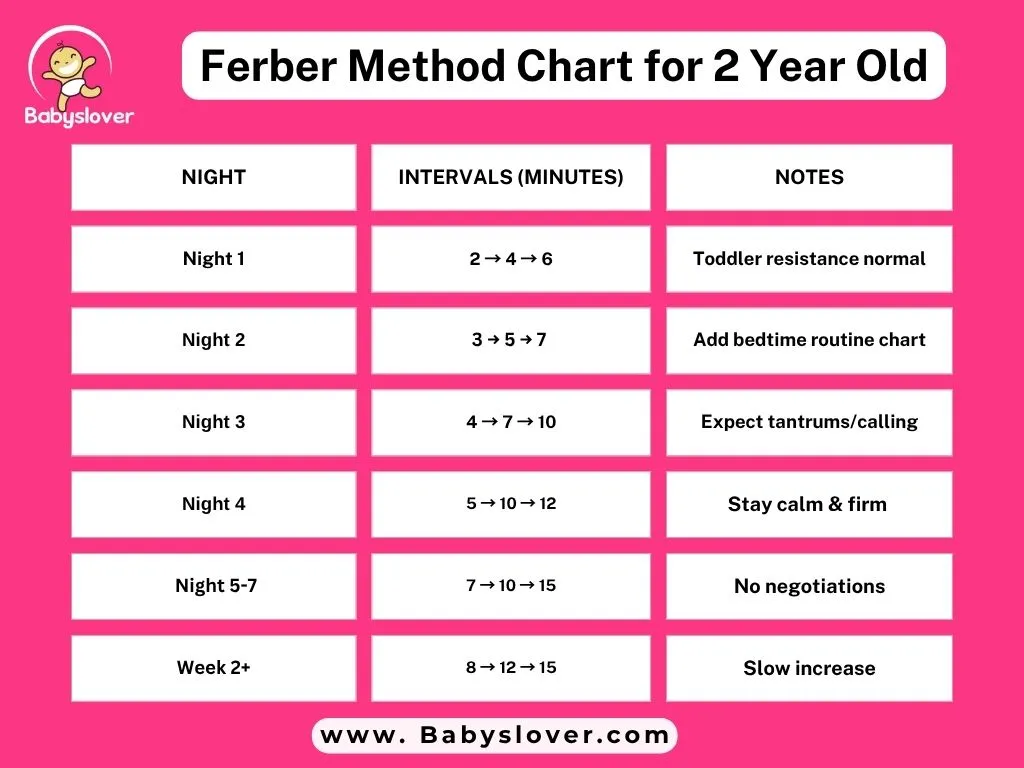
Use these wait times:
- Night 1-2: Wait 2 minutes before checking
- Night 3-5: Wait 4 minutes before checking
- Night 6-7: Wait 6 minutes before checking
- Week 2+: Wait 8 minutes before checking
During check-ins, acknowledge their feelings briefly: “I know you’re upset. You’re safe. It’s sleep time.” Keep interactions short.
Your 2-year-old might cry hard, get out of bed, or call repeatedly. Stay calm and consistent. Each time they get up, calmly return them to bed.
What to expect: Two-year-olds often need 2-4 weeks of consistency. Regression is common with travel, illness, or changes. That’s okay—restart your method calmly.
Ferber Method for 3 Year Old
Three-year-olds are incredibly verbal, imaginative, and skilled at negotiating. Sleep training at this age often means addressing why they’re resisting sleep (fears, excitement, needing control) as much as teaching the method itself.
Before You Start:
- You’ve talked with your child about the plan (age-appropriate)
- Your child is in a toddler bed or big kid bed
- Daytime routine is consistent
The 3-Year Approach:
Talk with your child about sleep training beforehand. Use simple language: “We’re going to practice falling asleep in your bed. I’ll be nearby if you need me.” This gives them understanding and control.
Bedtime routine should be calming and predictable: dinner by 6 PM, wind-down activities, stories, cuddles, then bed.
Place your child in bed and say goodnight calmly.
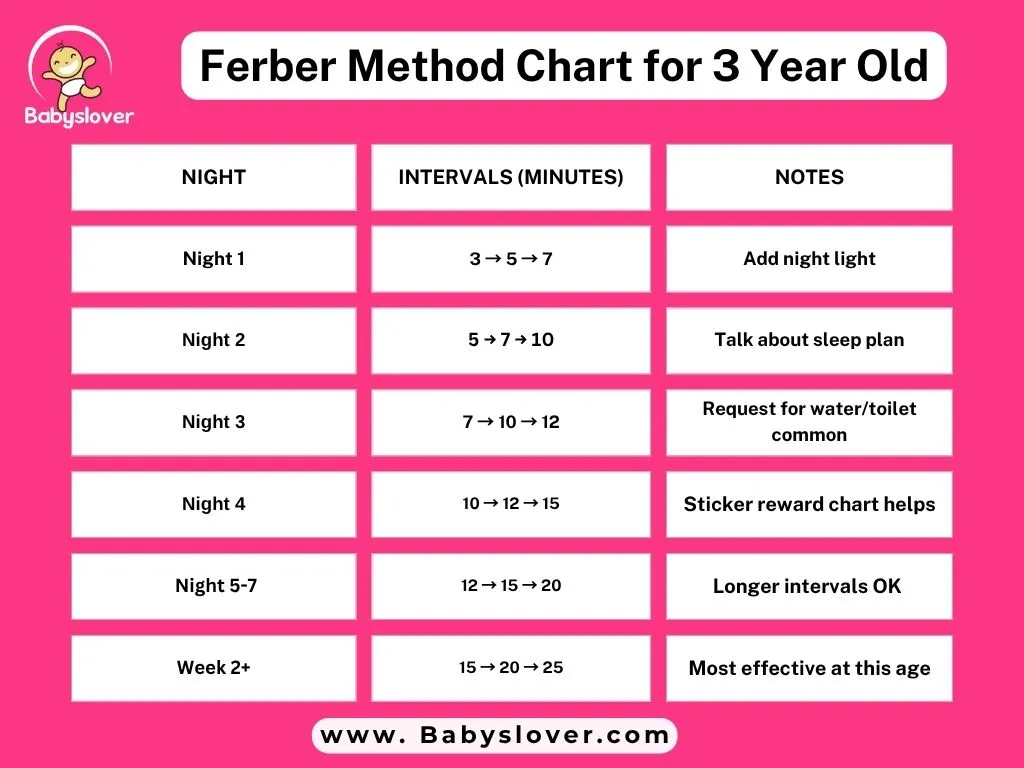
Use these wait times:
- Night 1-3: Wait 3 minutes before checking
- Night 4-6: Wait 5 minutes before checking
- Week 2+: Wait 10 minutes before checking
When checking in, keep it brief. You might say: “You’re doing great. It’s sleep time. I’m just checking on you. Rest now.” Brief physical reassurance, then leave.
Your 3-year-old might request water, bathroom trips, or cuddles. Address one genuine need per request, then it’s back to sleep.
What to expect: Three-year-olds often improve in 1-2 weeks with consistency. They might test boundaries more than younger kids, but they also understand explanations better. Stay calm and compassionate.
Sample Ferber Check-In Chart (For All Ages)
Here’s a visual guide to help you track your Ferber method progress:
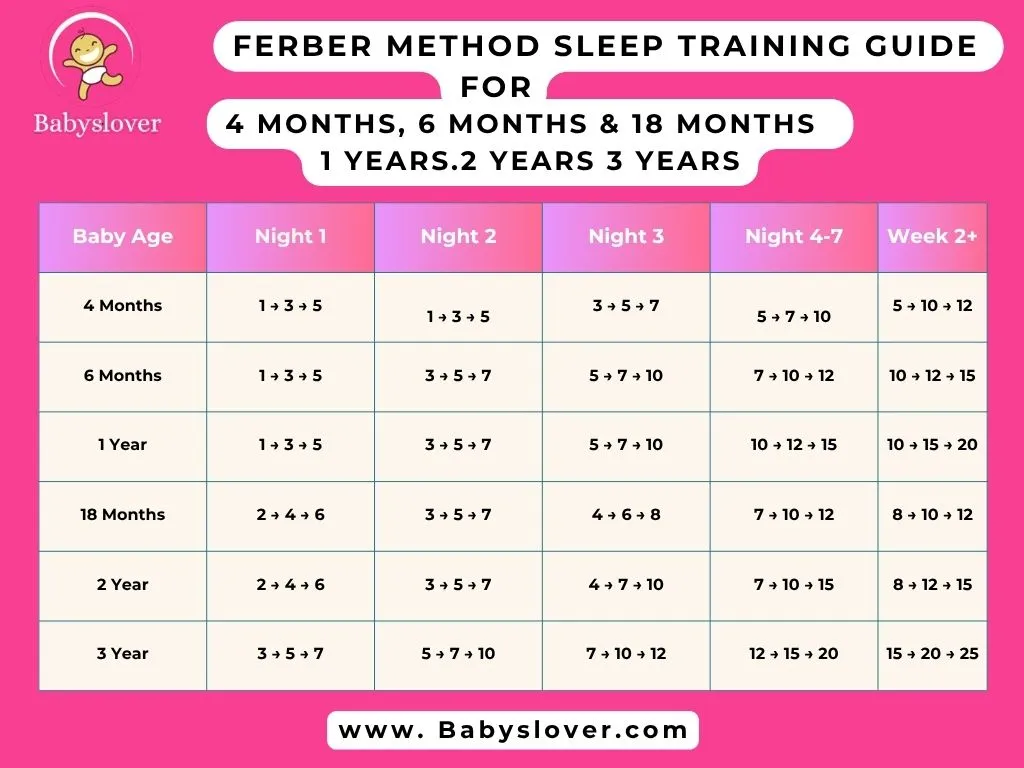
| Night | Age 4-6 Mo | Age 12 Mo | Age 18 Mo | Age 2-3 Yr |
|---|---|---|---|---|
| 1 | 1 min | 1 min | 2 min | 2-3 min |
| 2 | 1 min | 1 min | 2 min | 2-3 min |
| 3 | 3 min | 3 min | 4 min | 3-5 min |
| 4 | 3 min | 3 min | 4 min | 3-5 min |
| 5 | 5 min | 3 min | 6 min | 5-6 min |
| 6 | 5 min | 5 min | 6 min | 5-6 min |
| 7 | 5 min | 5 min | 8 min | 6-8 min |
| Week 2+ | 10 min | 5-10 min | 8-10 min | 8-10 min |
How to use this chart:
- Start at Night 1 with your baby’s age group
- Wait the recommended minutes before checking in
- Move to the next night, adjusting wait times as shown
- If your baby has a very difficult night, you can repeat the previous day’s wait times
- By week 2, most families move to longer intervals
Remember: This is a guide, not a strict rule. Every baby is different. Trust your instincts and adjust as needed.
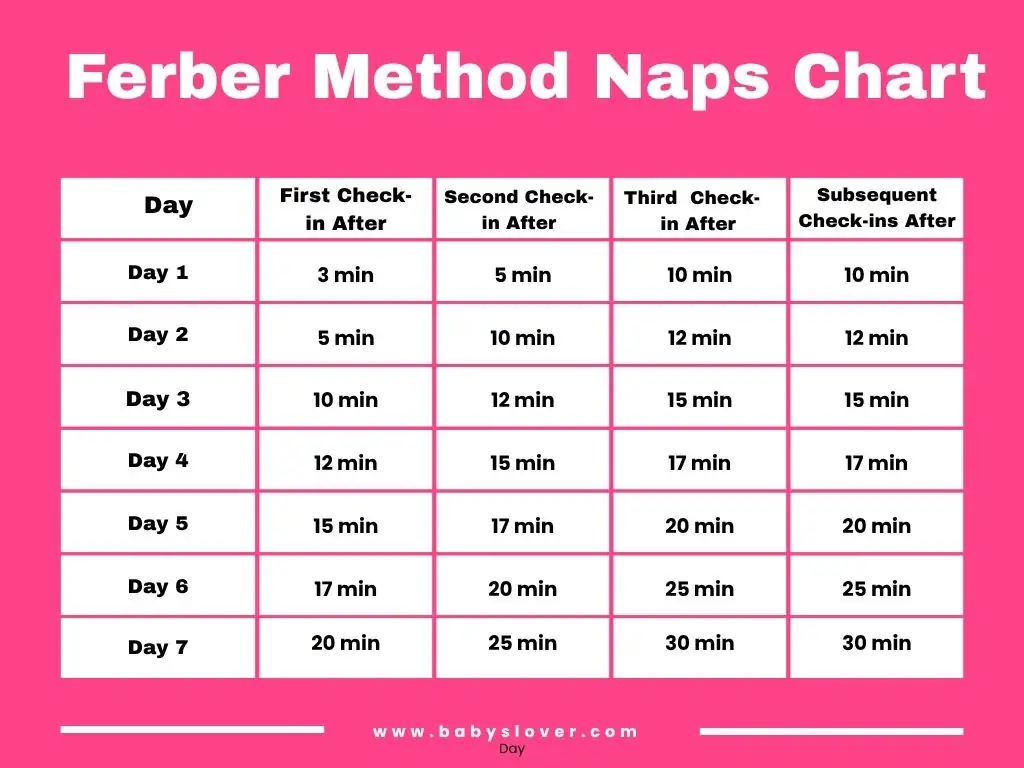
Ferber Method for Naps: Complete Guide + Chart
Many parents start with nighttime sleep training and wonder: should I use the Ferber Method for naps too?
Yes — and here’s why it matters.
Naps and nighttime sleep are connected. A baby who learns to fall asleep independently at night but still needs to be rocked for naps is getting mixed signals. For the best and fastest results, use a consistent approach for both.
What’s different about nap training with the Ferber Method:
- Naps have less sleep pressure than nighttime, so they can take a few extra days to train
- If your baby hasn’t fallen asleep after 45–60 minutes, end the nap attempt and try again at the next scheduled nap time — don’t let it drag on all day
- Nap training typically takes 7–14 days — a few days longer than nighttime training
- Short naps (under 30 minutes) are common at first — keep going, babies often start connecting sleep cycles within 1–2 weeks
How to use the Ferber Method for naps — step by step:
- Create a short pre-nap routine (5–10 minutes): dim the lights, a short story or song, cuddle, then into the crib awake
- Leave the room
- If crying starts, use the nap intervals below
- Keep check-ins brief — 1 to 2 minutes, calm voice, gentle pat on chest, then leave
- If no sleep after 60 minutes, get your baby up and try again at the next scheduled nap
Ferber Method Naps Chart:
| Night | Age 4-6 Mo | Age 12 Mo | Age 18 Mo | Age 2-3 Yr |
|---|---|---|---|---|
| 1 | 1 min | 1 min | 2 min | 2-3 min |
| 2 | 1 min | 1 min | 2 min | 2-3 min |
| 3 | 3 min | 3 min | 4 min | 3-5 min |
| 4 | 3 min | 3 min | 4 min | 3-5 min |
| 5 | 5 min | 3 min | 6 min | 5-6 min |
| 6 | 5 min | 5 min | 6 min | 5-6 min |
| 7 | 5 min | 5 min | 8 min | 6-8 min |
| Week 2+ | 10 min | 5-10 min | 8-10 min | 8-10 min |
Common nap training challenges:
Baby skips nap entirely: Offer an early bedtime that day to prevent overtiredness. Don’t compensate with extra nap time — it disrupts the schedule.
One nap works but another doesn’t: Completely normal. Keep applying the same method at every single nap. Consistency across all naps is what teaches the skill.
A consistent sleep environment makes a real difference for nap training. Blackout curtains are a game-changer during the day — natural afternoon light can significantly delay sleep onset. A quality white noise machine like the LectroFan Classic or Hatch Rest helps mask household sounds that are much louder during daytime sleep than at night.
Tips for Success with the Ferber Method
Do this:
- Start when you’re emotionally ready — not just when you’re desperate. If you’re going to give up on Night 2, wait until you can truly commit.
- Get your partner on the same page before you start. Inconsistency between caregivers is the number one reason the Ferber Method doesn’t work.
- Keep a simple nightly log — write down how long it took your baby to fall asleep. On Night 4 when it feels hopeless, you’ll look back at Night 1 and see real progress.
- Use a white noise machine. It helps your baby settle — and honestly, it helps you not hear every single sound through the monitor.
- Set a timer on your phone for check-in intervals so you’re not staring at the clock.
Don’t do this:
- Don’t pick your baby up during check-ins. Your presence reassures them — but picking up teaches them that crying leads to being held.
- Don’t extend check-ins beyond 2 minutes. A longer visit makes it harder for your baby to settle back down.
- Don’t start the Ferber Method during a sleep regression, illness, teething flare-up, or major life change like a new sibling or moving.
- Don’t switch methods mid-week. Give the Ferber Method at least 7 full nights before deciding if it’s working.
When to Pause or Stop the Ferber Method
Pause immediately if your baby:
- Gets sick — fever, ear infection, cold, or reflux flare-up
- Is in genuine pain from teething
- Goes through a significant life change like a new sibling, a move, or starting daycare
- Is in the middle of a major developmental leap or sleep regression
One pause won’t undo your progress. Once things settle, pick up where you left off.
Contact your pediatrician if:
- You’ve been consistent for 2 full weeks with no improvement at all
- Your baby shows signs of illness you can’t identify
- Something just doesn’t feel right — always trust your gut
Alternatives to the Ferber Method
The Ferber Method is not right for every family, and that’s completely okay. Here are other evidence-based approaches worth exploring:
- Chair Method (Camping Out): You sit in a chair next to the crib while your baby falls asleep, moving the chair closer to the door each night. Gentler than Ferber but takes longer.
- Pick Up/Put Down: You pick your baby up when they cry, calm them, then put them back down awake and repeat. Very responsive but labor-intensive.
- Cry It Out (Extinction): You put your baby down and don’t go back in until morning. Faster results but emotionally harder for most parents.
- Bedtime Fading: You gradually move bedtime later until your baby is falling asleep more easily, then slowly move it earlier. Very gentle but takes several weeks.
There is no single “right” method. The best sleep training approach is the one you can actually stick to consistently.
Frequently Asked Questions
Does the Ferber Method really work?
For most families, yes. Research consistently shows that graduated extinction methods like the Ferber Method are effective for improving infant and toddler sleep. Most babies show significant improvement within 5–7 nights. Some take up to 2 weeks. Consistency is the single most important factor.
Is the Ferber Method safe?
Yes. Multiple long-term studies have found no negative effects on children’s emotional development, attachment, or behavior from using the Ferber Method with healthy babies over 4–6 months. The American Academy of Pediatrics recognizes it as a safe and effective sleep training approach.
What if my baby cries for hours?
On Night 1, crying for 30–60 minutes is common. If your baby has been crying for more than 2 hours without any decrease, it’s okay to pick them up, comfort them fully, and try again tomorrow. This is a marathon, not a sprint.
What are the Ferber Method time intervals?
The standard Ferber Method time intervals start at 3 minutes on Night 1 and gradually increase to 20–30 minutes by Night 7. For 4-month-olds, start shorter — 1 to 3 minutes. For toddlers 18 months and older, start at 2–3 minutes. See the full Ferber Method chart above for exact intervals by night.
Can I use the Ferber Method for naps and nighttime at the same time?
Yes, and most sleep consultants recommend it. Training for naps and nighttime simultaneously reinforces the skill faster because your baby is practicing independent sleep multiple times per day. Use the nap chart for daytime sleep and the nighttime chart for bedtime and night wakings.
What if the Ferber Method worked before and now it’s not?
Sleep regressions happen at 4 months, 8–10 months, 12 months, 18 months, and 2 years. After a regression, you may need a short re-training period — usually 3–5 nights rather than the full 7. Get back to basics with your routine and the chart.
Can I do Ferber if I’m breastfeeding?
Yes. If your baby still needs nighttime feedings, feed them when they’re genuinely hungry, then use the Ferber Method for all other wakings. Over time, night feedings typically reduce naturally as your baby learns to sleep longer stretches.
What is Ferberizing?
Ferberizing is another name for using the Ferber Method for sleep training. The term comes from Dr. Richard Ferber’s name and simply means following his progressive waiting approach — putting your baby down awake and checking in at gradually increasing intervals until they learn to fall asleep independently.
What’s the best white noise machine for Ferber sleep training?
The LectroFan Classic, Hatch Rest, and Yogasleep Dohm are consistently top-rated by parents and pediatric sleep consultants. A white noise machine masks sudden household sounds that can wake your baby during and after sleep training — making the whole process smoother.
Final Thoughts
Sleep training is one of the most personal decisions you’ll make as a parent. There is no perfect method — only the method that works for your family.
If the Ferber Method feels right for you, this guide has everything you need to start with confidence. Remember: the first few nights are the hardest. Night 1 is brutal. Night 3 is when most parents want to quit. Night 5 is when most babies start to turn a corner.
Consistency is everything. You know your baby. You’ve got this.
If you have questions or want to share how it’s going, drop a comment below — we read every single one. And if you’re still deciding which sleep training method is right for your family,
2 thoughts on “Ferber Method Sleep Training: Complete Age-by-Age Guide + Nap Chart (2026)”