

Is your baby’s sleep (or lack of it) leaving you exhausted? At Babyslover, we understand how overwhelming sleepless nights can be. When you’re looking into the CIO method (cry it out method) you probably have a lot of questions—and concerns.
Is it safe? Will it work for your baby? How old should they be? We’re here to help you understand this controversial but widely-used cry it out method with honest, evidence-based information so you can make the best choice for your family.
Sleep training is one of the biggest parenting decisions you’ll make, and it’s completely normal to feel uncertain about it. In this guide, we’ll walk you through everything you need to know about the cry it out method, including when to start, how to do it safely, and what to expect along the way.
What Is the Cry It Out Method?
The cry it out method, often called CIO or “extinction,” is a sleep training approach where you put your baby to bed awake and allow them to fall asleep on their own—even if they cry. Unlike responsive methods where you check on your baby frequently, true cry it out means minimal parental intervention until the baby falls asleep.
The idea behind this method is that babies learn to self-soothe and fall asleep independently, rather than relying on parental help like rocking, feeding, or bouncing to drift off. Proponents believe this teaches babies to sleep through the night and establish healthy sleep habits.
We know this sounds harsh, and your instinct to comfort your crying baby is completely valid. Many parents feel conflicted about this approach, and that’s okay. Our goal is to give you the facts so you can decide what feels right for your baby.
When Can You Let a Baby Cry It Out? (Recommended Age)
This is one of the most important questions parents ask, and the answer matters. Most pediatricians and sleep experts recommend waiting until your baby is at least 4-6 months old before attempting the cry it out method.
Here’s why age matters:
Before 4 months: Newborns cannot self-soothe yet, and their sleep is primarily driven by hunger, discomfort, and their developing circadian rhythm. Crying in this stage is communication, and your baby genuinely needs you.
4-6 months: Around this age, many babies develop the neurological capacity to self-soothe and sleep for longer stretches without feeding. This is when cry it out typically becomes more appropriate.
After 6 months: By this age, most babies are capable of sleeping through the night without feeding (though some still need it). This is often considered an ideal time to start more formal sleep training.
That said, every baby is different. Your pediatrician can help you determine if your specific baby is developmentally ready. We always recommend consulting with your doctor before starting any sleep training method.
How to Do the Cry It Out Method (Step-by-Step Guide)
If you’ve decided cry it out is right for your family, here’s how to do it:
Step 1: Prepare your environment
Make sure your baby’s room is safe, dark, and at a comfortable temperature. Remove any soft objects, pillows, or blankets. Your baby should be in a safe sleep space—crib, bassinet, or play yard—on their back.
Step 2: Establish a consistent bedtime routine
Before starting cry it out, establish a calming routine: bath, story, song, cuddles. Keep this exactly the same every night. This signals to your baby that sleep is coming.
Step 3: Put your baby down awake
After your routine, place your baby in the crib while they’re still awake but drowsy. Say goodnight in a calm, loving voice. Then leave the room.
Step 4: Don’t return
This is the hard part. Don’t go back in, even if your baby cries. Returning reinforces the crying and makes the method less effective. If your baby needs a feed, you may have scheduled check-in times depending on the version you’re using.
Step 5: Be consistent
Do this every single night and every nap time you’re training. Inconsistency teaches your baby that crying sometimes works, making it take longer overall.
Step 6: Give it time
Most experts recommend committing to the method for at least 3-7 nights before deciding if it’s working. Changes often happen gradually.
Cry It Out Method by Age
The approach to cry it out changes based on your baby’s age and developmental stage. Let’s look at what this looks like at different ages.
Cry It Out Method for 4-Month-Old
At four months old, your baby is entering a stage where sleep training becomes more feasible. However, at this age, you need to be thoughtful and gentle.
What to expect: Your 4-month-old will likely cry more intensely than an older baby. Their sleep needs are still significant (14-17 hours per day), and they may still need 1-2 night feeds depending on their weight and feeding history.
How to approach it: Many sleep experts recommend a gentler version of cry it out for this age, sometimes called “camp out” or “graduated extinction.” This might mean sitting next to the crib initially, then gradually moving further away over several nights, rather than full extinction immediately.
Duration: Expect crying sessions to last 30 minutes to an hour initially. This is normal and doesn’t mean the method isn’t working.
Important note: Make sure your baby is gaining weight appropriately and your pediatrician has cleared them for reduced night feeds before starting cry it out at this age.
Cry It Out Method for 6-Month-Old
By six months, most babies are developmentally ready for cry it out, and many parents find it more effective at this age.
What to expect: Your 6-month-old has a more developed circadian rhythm and may cry less intensely than a 4-month-old. Many can go through the night without feeds (though some still need one), and their sleep patterns are becoming more predictable.
How to approach it: Full cry it out extinction is typically more effective at this age. Put your baby to bed awake, say goodnight, and don’t return until morning (or until a scheduled feed time if needed).
Duration: Crying often decreases faster at this age. Many parents see improvement within 3-7 nights.
Nap training: At 6 months, you can also begin applying cry it out to naps, though nighttime often improves first.
Tips for Using the Cry It Out Method Effectively
We know this is challenging. Here are strategies to make it work better:
Start when you’re ready: Don’t begin cry it out if you’re not mentally prepared. Your hesitation will make it harder to stay consistent. Wait until you feel confident about the decision.
Pick the right time: Avoid starting during travel, illness, teething, or major life changes. Your baby needs stability during this transition.
Ensure your baby is healthy: Never start cry it out if your baby is sick, teething severely, or going through a developmental leap. Wait for calmer times.
Time it right: Start around 7-8 p.m., when your baby is naturally tired. Avoid starting in the middle of the night.
Support your partner: If you have a partner, make sure you’re both on board. One parent doubting the process makes consistency nearly impossible.
Manage your own emotions: Listen to music, go for a walk, or sit outside during the crying. You don’t have to listen to it happen. Your mental wellbeing matters too.
Track the progress: Keep a simple log of how long your baby cries each night. Seeing improvement (even small) helps you stay motivated.
Know it gets easier: Night one or two is the hardest. Each night typically gets better if you stay consistent.
Does Cry It Out Actually Work?
This is the million-dollar question. At Babyslover, we believe in being honest: yes, cry it out typically works, but with important caveats.
What research shows: Multiple studies have found that cry it out methods are effective at reducing night wakings and helping babies learn to self-soothe. Many babies do learn to fall asleep independently using this method.
What “works” means: Success usually means your baby cries less, falls asleep faster, and sleeps for longer stretches. Most parents see noticeable improvement within 1-2 weeks.
It doesn’t work for everyone: Some babies respond quickly; others take longer. Temperament, age, and consistency all play a role. A baby with a strong-willed temperament may take longer than a more easygoing baby.
Long-term results: Some studies suggest cry it out leads to lasting sleep improvements, while other research is less conclusive. What we do know is that when babies learn to self-soothe, they typically continue doing so.
The bottom line? Cry it out works for many families, but it’s not a guarantee for every baby.
How Long Does a Baby Cry During Cry It Out?
One of the biggest worries parents have is whether their baby will cry endlessly. Let’s be realistic about what to expect.
First night: Expect 30 minutes to 2 hours of crying. Yes, it can be intense. This is the hardest night.
Second and third nights: Usually 15-45 minutes. Crying often decreases noticeably.
Week one: By night 5-7, many babies cry for 10-20 minutes or fall asleep more quickly.
Week two and beyond: Some babies are sleeping through within a week or two. Others take longer. A few babies cry for extended periods on certain nights even as overall progress improves.
Important: If your baby cries for more than 2 hours on the first night without stopping, or if they’re vomiting from crying, stop and consult your pediatrician. Some babies may not be ready.
Is the Cry It Out Method Safe or Harmful?
We get this question constantly, and it deserves a thoughtful answer. The safety of cry it out is actually debated among experts, and that’s important to acknowledge.
What research suggests: Most current research indicates that cry it out does not cause lasting psychological harm when used appropriately. Studies show it doesn’t increase cortisol (stress hormone) levels long-term, and it doesn’t damage attachment when done at the right age.
The concern: Some older research and some child development experts worry that ignoring a baby’s cry could affect attachment or emotional development. This concern is particularly voiced for babies under 4 months.
What we know for sure: Letting a baby cry for a few nights is not the same as neglect. Neglect is chronic lack of care and responsiveness. Cry it out is a temporary sleep training method used by parents who care deeply about their children.
Safety guidelines: To use cry it out safely, your baby should be:
- At least 4-6 months old
- Healthy and growing well
- In a safe sleep environment
- Developmentally ready for self-soothing
- Fed and in a clean diaper before bedtime
Trust your instincts: If cry it out doesn’t feel right for your family, there are other methods. Gentler approaches like the Ferber method (checking on your baby at intervals) or “camping out” exist too.
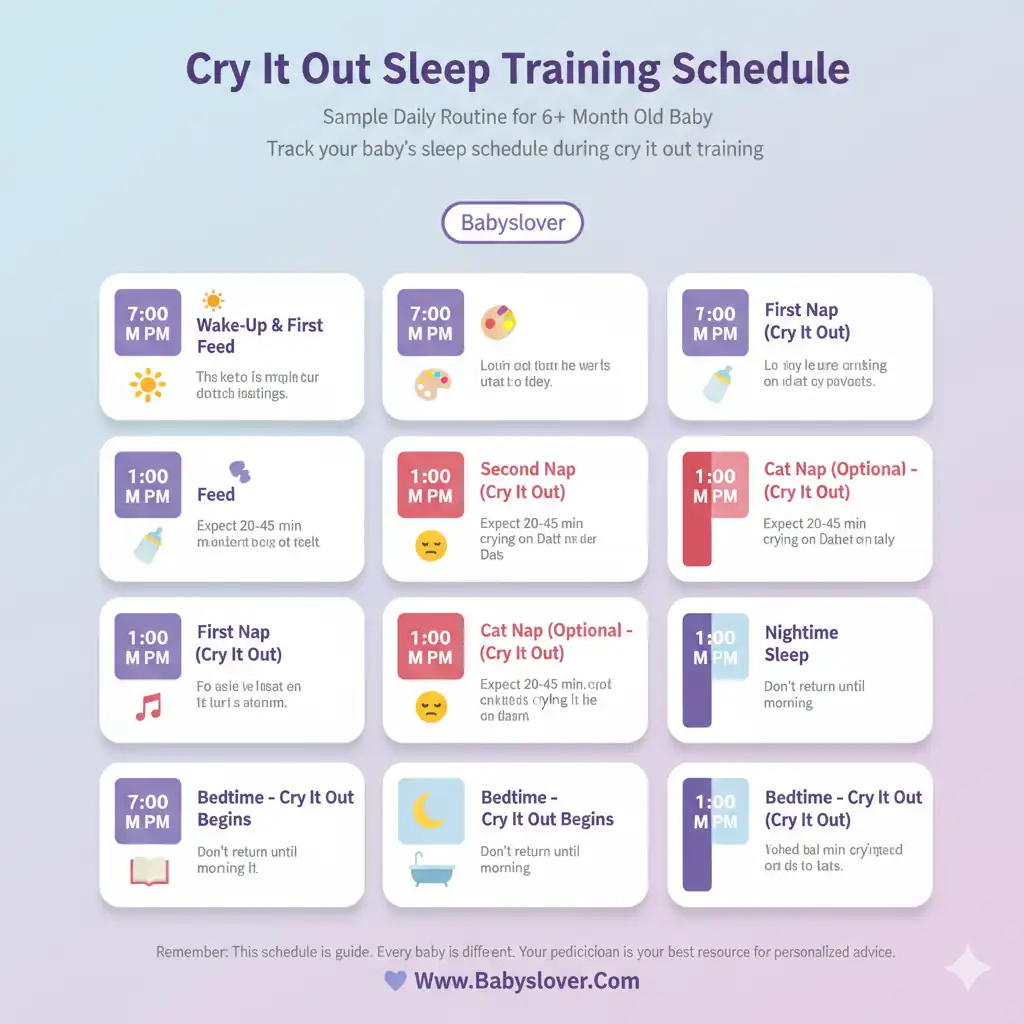
Cry It Out Sleep Training Schedule (Example Routine)
Here’s what a typical day might look like when you’re using cry it out:
7:00 a.m. – Wake-up, feed, play
9:00 a.m. – First nap attempt (cry it out)
11:00 a.m. – Wake, feed, play
1:00 p.m. – Second nap attempt (cry it out)
3:00 p.m. – Wake, feed, play, outdoor time
5:00 p.m. – Dinner, wind-down begins
6:00 p.m. – Bath time
6:30 p.m. – Story, song, cuddles (bedtime routine)
7:00 p.m. – Bedtime (placed awake in crib, cry it out begins)
Overnight – No responses to crying; only respond for scheduled feeds if applicable
6:00 a.m. – Wake-up for the day
This schedule assumes your baby is around 6+ months. Adjust wake times and nap schedules based on your baby’s actual sleep needs.
Cry It Out Method Pros and Cons
Let’s be honest about both sides:
Pros of Cry It Out:
Your baby learns to self-soothe independently. This skill benefits them throughout life. You get better sleep, which improves your mental health and patience as a parent. Results often come quickly—many families see improvement within 1-2 weeks. It’s relatively simple: no complicated routines or products needed. Once it works, many families enjoy years of good sleep. Your baby learns that nighttime is for sleeping, which sets healthy lifelong habits.
Cons of Cry It Out:
It’s emotionally hard to listen to your baby cry. Multiple nights of crying can be incredibly stressful. It doesn’t work for every baby; some take much longer or don’t respond. It can feel harsh to parents who prefer responsive parenting. You might second-guess yourself during the process. It may not work if your baby is sick, teething, or going through developmental leaps. Some parents experience guilt afterward, even if it was successful.
The truth? Cry it out works well for many families, but it’s not the right choice for everyone. Your feelings about this method matter as much as the research.
Can You Use the Cry It Out Method for Naps?
Yes, but with some important differences from nighttime.
Why naps are harder: Babies sleep more lightly during naps, and external stimuli (noise, light, activity) can wake them more easily. Naps also don’t benefit from the same circadian rhythm sleep pressure that nighttime has.
When to start: Most experts recommend establishing good nighttime sleep first, then tackling naps after nighttime is solid (usually 1-2 weeks into nighttime cry it out).
What to expect: Naps often take longer to improve than nights. Be patient. Some babies take 2-3 weeks or longer before naps improve with cry it out.
Realistic results: Naps might not become perfect even after nighttime is solid. Some babies are just lighter nappers, and that’s normal. The goal is consistency and reasonable lengths, not perfect 2-hour naps.
Keep nap times consistent: Nap timing matters. Try to nap at the same times daily, as this helps with sleep pressure and circadian rhythm.
How Long Does It Take for Cry It Out to Work? (Timeline)
Here’s a realistic timeline of what many families experience:
Night 1: Significant crying (30 minutes to 2 hours). Your baby likely falls asleep from exhaustion. You feel emotionally drained.
Night 2-3: Crying usually decreases. Some babies cry 20-45 minutes. You see a glimmer of hope.
Night 4-7: By this point, many babies cry for just 10-20 minutes or fall asleep within 5-10 minutes. This is when you know it’s working.
Week 2: For many babies, this is where real success appears. They’re going to bed more easily and sleeping longer stretches.
Week 3-4: By now, most babies who respond well to cry it out are falling asleep independently and sleeping through the night.
The outliers: Some babies respond in 3-4 nights. Others take 2-3 weeks. A small percentage take much longer or don’t respond well at all.
Important: Give it at least one full week of consistency before deciding it’s not working. You need enough data to know.
Common Cry It Out Method Mistakes to Avoid
Learning from others’ experiences helps. Here are the biggest mistakes we see:
Mistake 1: Inconsistency
The kiss of death for cry it out. If you return on night four because you can’t handle it, you teach your baby that persistence works. Stay consistent for at least 7 nights.
Mistake 2: Starting too early
Beginning before 4 months or before your baby is developmentally ready makes it much harder. Wait until your baby is ready.
Mistake 3: Not having a solid routine
Babies fall asleep faster and sleep better with consistent bedtimes and routines. Establish this before starting cry it out.
Mistake 4: Putting a baby down overstimulated or overtired
Your baby should be drowsy but awake—not wound up. Overtired babies cry harder and longer.
Mistake 5: Doing it during stressful times
Starting cry it out during teething, illness, travel, or major life changes sets you up to fail. Pick a calm period.
Mistake 6: Not being emotionally ready
If you don’t truly feel okay with cry it out, your doubt will crack your consistency. Make sure this is your choice, not something you feel pressured into.
Mistake 7: Expecting perfection
Some nights will be harder than others. Progress isn’t always linear. One harder night doesn’t mean it’s failing.
Mistake 8: Ignoring your baby’s actual needs
If your baby is hungry, wet, or sick, respond. Cry it out isn’t about ignoring genuine needs—it’s about not responding to sleep-onset crying.

Conclusion
The cry it out method is one of the most effective sleep training approaches available, but it’s not right for every family. At Babyslover, we believe you know your baby and your family best. Whether cry it out feels like the right choice depends on your comfort level, your baby’s temperament, and your family’s values around sleep.
If you do choose cry it out, remember: you’re not being cruel. You’re teaching an important life skill. Many children thrive after learning to self-soothe. And if you decide cry it out isn’t for you, there are other methods that work too.
Whatever you choose, know that seeking good sleep for your baby—and yourself—is worth the effort. You’re doing an amazing job as a parent, and reaching out for information shows how much you care.
Cry It Out Method FAQ
How many nights does cry it out usually take to see results?
Most families see noticeable improvement within 3-7 nights. The first night or two is typically the hardest, with crying decreasing noticeably by night 3 or 4. However, some babies take 2-3 weeks, and others respond in just a few nights. Consistency matters more than speed—stick with it for at least a week before evaluating.
Is cry it out okay for breastfed babies?
Yes, cry it out can work for breastfed babies. The key is ensuring your baby is getting enough calories during the day. Make sure breastfeeding is well-established and your baby is gaining weight appropriately before starting cry it out. Some breastfed babies still need one or two night feeds at 4-6 months, so check with your pediatrician about whether full extinction or scheduled feeding is appropriate.
Can I do cry it out if my baby is teething or sick?
No. We strongly recommend waiting. Teething and illness cause genuine discomfort and distress, and cry it out won’t work well during these times. Your baby’s crying indicates real pain, not just sleep resistance. Wait until your baby feels better and teething has passed before attempting cry it out.
This is one of the biggest challenges with cry it out in shared spaces. Yes, it’s possible, but difficult. Your baby’s crying will disturb others, and you might hesitate to stay consistent because of that. If possible, temporarily move your baby to another room for a week during cry it out, or use white noise and earplugs for other family members. Talk honestly with anyone sharing your space about your plan.
What if baby cries for too long—when should I intervene?
If your baby cries continuously for more than 2 hours without stopping, or if they’re vomiting from crying, stop and consult your pediatrician. This isn’t normal. Some babies cry hard for an hour and then sleep; that’s different from never stopping. Trust your judgment, but also be honest with yourself about what’s normal crying versus something concerning.
Can cry it out affect night feedings?
No. If your baby is eating well during the day and your pediatrician has cleared them for fewer night feeds, cry it out doesn’t prevent them from eating if truly hungry. Some babies will still cry to feed if they need it. However, many parents use cry it out specifically to eliminate unnecessary night wakings that aren’t hunger-related.
Is cry it out different from the Ferber method?
Yes, they’re different. Cry it out (extinction) means you don’t return at all until morning. The Ferber method involves checking on your baby at increasing intervals—say 3 minutes, then 5 minutes, then 10 minutes. Ferber is gentler but takes longer. The Ferber method might be a good middle ground if full cry it out feels too harsh for you.
Should I try cry it out during travel or vacation?
Absolutely not. Travel disrupts sleep routines and adds stress. Your baby is already dealing with new environments and schedule changes. Start cry it out when you’re home and life is calm. Once sleep is solid at home, your baby will usually handle travel better.
How do I know if cry it out is not working for my baby?
If after 2-3 weeks of consistent crying, there’s no improvement whatsoever—your baby is crying just as long and intensely—something isn’t right. Possible reasons: your baby isn’t developmentally ready, your baby is sick or uncomfortable, there’s too much inconsistency, or your baby is just very strong-willed and needs a gentler approach. Talk to your pediatrician and consider trying a different method.
What if I feel guilty after cry it out works?
This is surprisingly common, and we want to normalize it. You might feel guilty that you “let” your baby cry, even though it worked and your baby is now sleeping better. Remember: guilt doesn’t mean you did something wrong. You used an evidence-based method to help your whole family sleep better. That’s a loving choice, even if it felt hard.
At Babyslover, we believe you’re doing an amazing job. Sleep training is hard, and you deserve support no matter which method you choose. Trust yourself, trust your baby, and remember—there’s no one “right way” to parent.
2 thoughts on “Cry It Out Method for Baby Sleep Training: Everything You Need to Know”