
You just found out you’re pregnant — or you’re trying to conceive — and suddenly you’re staring at an entire wall of prenatal vitamins with no idea where to start.
Every brand says it’s the best. Every label is full of words you can’t pronounce. And you just want to know: what are the best prenatal vitamins I should actually be taking?
At Babyslover, we’ve done the research for you. Whether you’re trying to conceive, in your first trimester, or breastfeeding postpartum — this guide covers what to look for, which brands are worth it, and what to avoid. No fluff, no confusion.

Why the Best Prenatal Vitamins Matter More Than You Think
Even with a healthy diet, pregnancy puts nutritional demands on your body that food alone can’t always meet.
Your blood volume increases by up to 50% during pregnancy. Your baby needs nutrients around the clock. And in the first few weeks — often before a positive test — critical brain and spine development is already happening.
The best prenatal vitamins fill those gaps. They’re not a replacement for eating well. They’re a safety net that makes sure nothing important falls through — for you or your baby.
Who Should Take Prenatal Vitamins?
Prenatal vitamins aren’t just for pregnant women. Here’s who needs them and when:
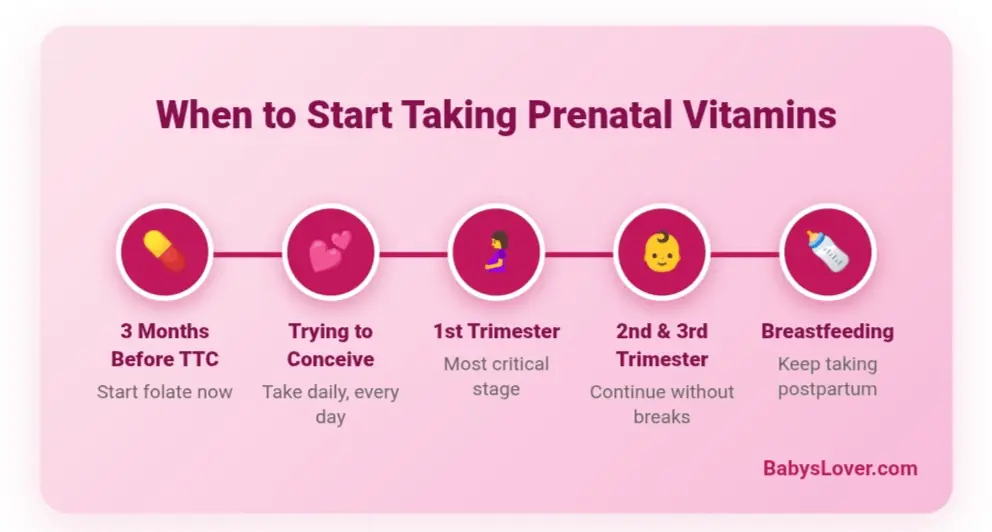
- Trying to conceive (TTC): Start at least 3 months before trying. Folate is critical in the first 28 days of pregnancy — before most women even know they’re pregnant.
- Pregnant moms: Essential from the moment you find out, through all three trimesters.
- Breastfeeding moms: Nursing keeps your nutrient demands high. The best prenatal vitamins while breastfeeding help replenish what milk production takes from your body.
What to Look for in the Best Prenatal Vitamins
Not all prenatal vitamins are created equal. These are the nutrients that actually matter — and what competitors often get wrong.
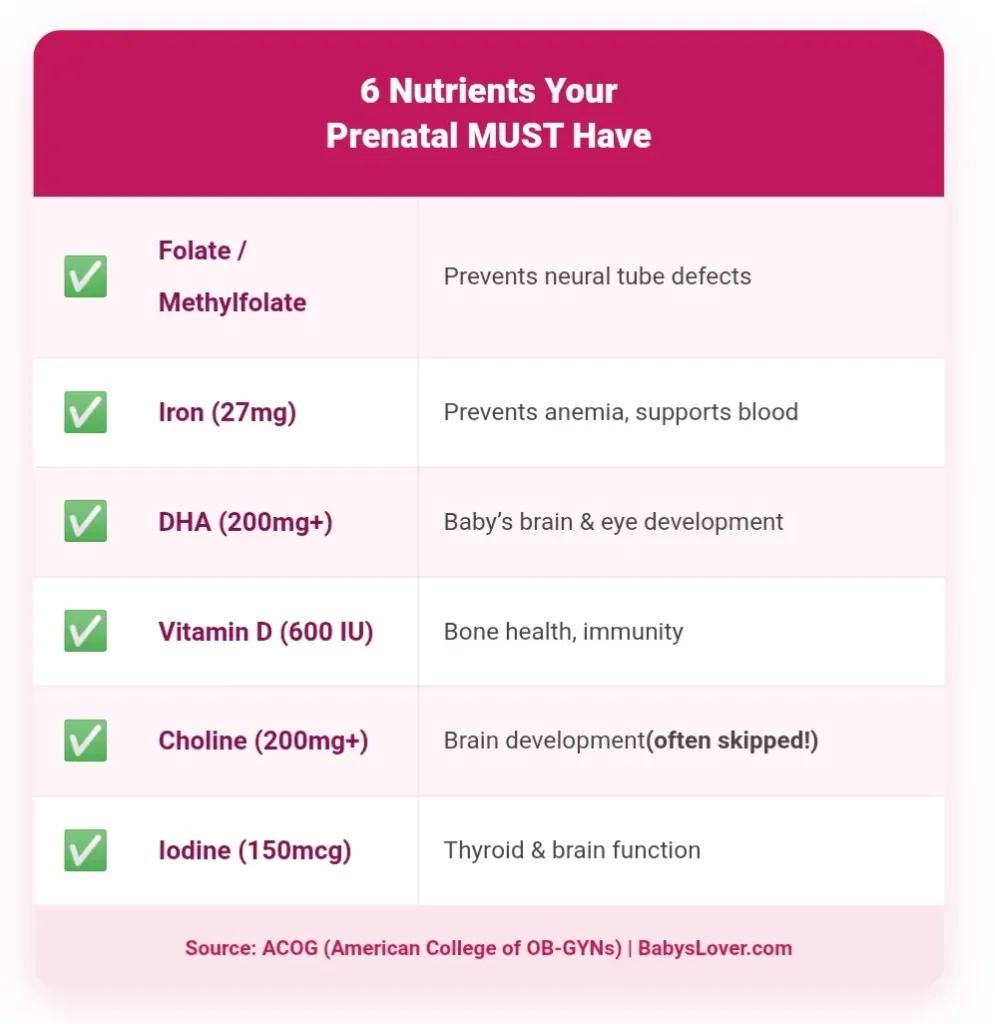
Folate or Methylfolate — Not Just Folic Acid
Folate is the single most important nutrient in any prenatal vitamin. It prevents neural tube defects in the earliest weeks of pregnancy — often before you even know you’re pregnant.
Most prenatal vitamins use synthetic folic acid. That works for many women. But around 25% of women have the MTHFR gene variant, which makes it hard to convert folic acid efficiently.
Methylfolate (5-MTHF) is the already-active form — your body absorbs it immediately, no conversion needed. If you don’t know your MTHFR status, choosing a prenatal with methylfolate is the smarter move regardless.
What to look for: At least 400–600 mcg of folate or methylfolate per serving.
Iron
Iron supports your baby’s development and helps prevent anemia as your blood volume expands during pregnancy. Most pregnant women become iron deficient, especially in the second and third trimesters.
The form matters. Ferrous sulfate is common but causes constipation. Ferrous bisglycinate is gentler on digestion and absorbs better.
What to look for: 27 mg of iron per day, ideally as bisglycinate.
DHA
DHA is an omega-3 fatty acid that builds your baby’s brain and eyes — especially important in the third trimester. Many prenatal vitamins skip it entirely or include too little.
If yours doesn’t include DHA, add a separate omega-3 supplement. Algae-based DHA is the best option for vegan moms.
What to look for: At least 200 mg of DHA per day.
Vitamin D
Most American women are low in Vitamin D — and pregnancy increases the need. Vitamin D supports bone development and helps your body absorb calcium.
What to look for: 600–1000 IU of Vitamin D3 per day.
Choline
Choline is crucial for baby’s brain development — and it’s consistently skipped by most prenatal brands. Getting enough from food alone is tough. You’d need three eggs a day to hit the recommended amount.
What to look for: At least 200–300 mg of choline per day. Check the label specifically — many “premium” prenatals skip this entirely.
Iodine
Iodine supports thyroid function and your baby’s brain development. It’s one of the most commonly missed nutrients in prenatal vitamins.
What to look for: 150–220 mcg of iodine per day.
Third-Party Testing
Supplements aren’t regulated the same way medications are. Third-party testing means an independent lab verified what’s on the label is actually in the bottle — and that it’s free from heavy metals and contaminants.
Look for NSF, USP, or Informed Sport certification. This matters more than any marketing claim on the packaging.
6 Best Prenatal Vitamins of 2026: OB-GYN Recommended Picks
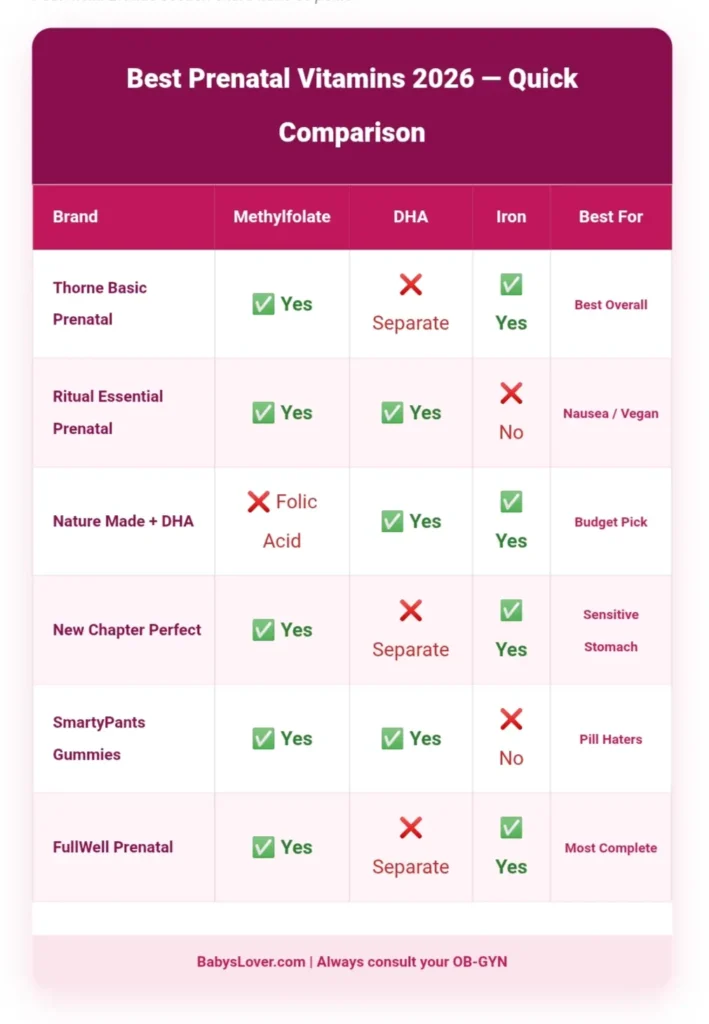
Here are the 6 best prenatal vitamins worth taking in 2026, selected based on nutrient quality, ingredient forms, tolerability, and third-party testing.
Best Overall: Thorne Basic Prenatal
Thorne Basic Prenatal is consistently recommended by OB-GYNs and dietitians — and it earns that reputation. It uses methylfolate instead of synthetic folic acid, covers choline (which most brands skip), and uses highly bioavailable forms throughout.
The iron is well-tolerated. The formula is third-party certified. And it’s manufactured to pharmaceutical-grade standards.
The main downside: three capsules a day, and no DHA included. You’ll need a separate omega-3. But for nutrient quality, it’s at the top.
Best for: Women who want a clinician-trusted prenatal vitamin with no shortcuts on ingredients.
Best Prenatal Vitamin with DHA: Ritual Essential Prenatal
Ritual’s prenatal vitamin is one of the most well-known best prenatal vitamins on the market. It uses methylfolate, includes vegan algae-based DHA, and comes in a delayed-release capsule designed to reduce nausea.
It’s non-GMO, vegan, third-party tested, and unusually transparent about ingredient sourcing. Perfect if you want DHA included and prefer a cleaner formula.
Downside: lower choline, no calcium or magnesium. But as an all-in-one option with DHA, it’s one of the best prenatal vitamins for first trimester tolerability.
Best for: Women who want DHA included, vegan formulas, or sensitive stomachs.
Best Budget Prenatal Vitamin: Nature Made Prenatal + DHA
If cost matters — and it often does — Nature Made Prenatal Multi + DHA covers the basics in one softgel at a price that’s hard to beat. USP certified, widely available, includes folic acid, DHA, iron, and Vitamin D.
It uses folic acid rather than methylfolate, so women with MTHFR variants may absorb it less efficiently. But for most women, it’s a reliable and genuinely affordable prenatal vitamin that gets the job done.
Best for: Women on a budget who want a dependable, widely available prenatal vitamin.
Best Prenatal Vitamin for Nausea: New Chapter Perfect Prenatal
First trimester nausea is brutal. New Chapter Perfect Prenatal is fermented from whole food ingredients, which makes it significantly gentler on an unhappy stomach. You can even take it on an empty stomach.
It uses methylfolate throughout and is easy to tolerate even during the worst nausea weeks. No DHA included, so add a separate omega-3.
Best for: First trimester, morning sickness, or anyone with a very sensitive stomach.
Best Prenatal Gummy: SmartyPants Prenatal Formula
Not everyone can swallow pills, especially with nausea. SmartyPants Prenatal Gummies include folate, algae-based DHA, iodine, Vitamin D, and B12 in a format women actually enjoy taking.
The trade-off: no iron, since gummies can’t include it effectively due to taste and stability. If you need iron — and most pregnant women do — you’ll need to supplement it separately.
Best for: Women who struggle with pills, or as a temporary option during severe morning sickness.
Most Complete: FullWell Prenatal Multivitamin
FullWell is the most nutrient-complete option on this list. Methylfolate, meaningful choline, gentle iron, comprehensive B vitamins, iodine — all at doses that actually matter.
It’s pricier, and it comes as eight capsules a day split into two doses. That’s a lot. But if you want the most comprehensive best prenatal vitamin available, FullWell leaves nothing out.
Best for: Women who want to cover every nutritional base and don’t mind the higher price.
Best Prenatal Vitamins by Life Stage
Best Prenatal Vitamins for Trying to Conceive
If you’re trying to conceive, start the best prenatal vitamins at least 3 months before you begin trying. Folate needs to be in your system before ovulation and fertilization happen.
At this stage, focus on: methylfolate, iron, Vitamin D, and iodine. Thorne Basic Prenatal and FullWell are both excellent prenatal vitamins for trying to conceive.
Best Prenatal Vitamins for First Trimester
First trimester is when neural tube development happens — and when nausea is at its worst. During these weeks, the best prenatal vitamins for first trimester are the ones you can actually keep down.
If capsules are making you sick, switch to New Chapter Perfect Prenatal or SmartyPants Gummies temporarily. Any prenatal vitamin is better than none — especially in weeks 4 through 10.
Best Prenatal Vitamins During Second and Third Trimester
By the second trimester, nausea usually eases. This is a good time to switch back to a more comprehensive formula if you’d moved to gummies earlier.
In the third trimester, DHA becomes especially important as your baby’s brain growth accelerates. Make sure your prenatal vitamin includes at least 200 mg of DHA — or add a separate omega-3 supplement.
Best Prenatal Vitamins While Breastfeeding
Most OB-GYNs recommend continuing the best prenatal vitamins while breastfeeding. Nursing keeps your nutritional demands high — especially for Vitamin D, iron, iodine, and DHA, which all pass through breast milk to your baby.
Continuing a quality prenatal vitamin while breastfeeding also supports your own postpartum recovery, energy levels, and helps replenish stores depleted during pregnancy.
When to Start Taking Prenatal Vitamins
Earlier than most women expect. The baby’s neural tube — which becomes the brain and spinal cord — develops in the first 28 days of pregnancy. That’s often before a positive pregnancy test.
Most OB-GYNs recommend starting the best prenatal vitamins at least 3 months before trying to conceive. That gives folate time to build up in your system before it’s needed most.
Already pregnant and haven’t started yet? Start today. It’s never too late.
Prenatal Vitamins vs Regular Multivitamins
Regular multivitamins aren’t formulated for pregnancy. They typically have lower folate and iron, skip DHA entirely, and sometimes include nutrients at doses that aren’t safe during pregnancy — like high-dose Vitamin A in retinol form.
Once you’re pregnant or trying to conceive, switch to a dedicated prenatal vitamin. The best prenatal vitamins are specifically dosed for your body’s needs at this stage of life.
What to Avoid in Prenatal Vitamins
- High-dose Vitamin A (retinol form): Too much preformed Vitamin A can cause birth defects. Look for Vitamin A as beta-carotene instead.
- Calcium and iron together in the same pill: They compete for absorption. If both are in your prenatal, you’re likely absorbing less of each.
- No third-party certification: Without independent testing, you can’t verify the label is accurate.
- Artificial colors and unnecessary fillers: Not dangerous in small amounts, but pointless when cleaner options exist at the same price.
How to Take Prenatal Vitamins Without Getting Nauseous
Iron is usually the culprit behind prenatal vitamin nausea. Here’s what helps:
- Always take your prenatal with food — never on an empty stomach
- Try taking it at night before bed instead of in the morning
- Avoid taking iron-containing prenatals with dairy, tea, or eggs — these block iron absorption
- If capsules trigger nausea in the first trimester, switch to gummies temporarily
- If nothing works, talk to your OB about prescription prenatal options or splitting your dose
Frequently Asked Questions About the Best Prenatal Vitamins
What are the best prenatal vitamins recommended by OB-GYNs?
Thorne Basic Prenatal and Ritual Essential Prenatal are among the most consistently recommended by OB-GYNs and registered dietitians. Both use methylfolate, high-quality ingredient forms, and are third-party tested. Always ask your own OB at your first prenatal visit — they may have a specific recommendation based on your health history.
What are the best prenatal vitamins for the first trimester?
In the first trimester, tolerability matters as much as ingredients. New Chapter Perfect Prenatal and SmartyPants Prenatal Gummies are gentler options for queasy stomachs. If you can manage capsules, Thorne Basic Prenatal or Ritual Essential Prenatal are the strongest nutritional choices from day one.
Should I take prenatal vitamins before pregnancy?
Yes — ideally 3 months before you start trying. Folate is critical in the first 28 days of pregnancy, often before a positive test. Starting early ensures your levels are where they need to be from conception onward.
What is the difference between folic acid and methylfolate in prenatal vitamins?
Folic acid is the synthetic form that needs to be converted by your body before use. Methylfolate (5-MTHF) is already in its active form and absorbs more efficiently. Women with the MTHFR gene variant — around 25% of people — can’t convert folic acid well. For them, methylfolate is essential. For everyone else, methylfolate is still the better choice.
Are prenatal gummies as good as prenatal capsules?
Usually not quite. Gummies can’t include iron effectively, so most skip it entirely. They’re a good temporary option during severe morning sickness, but most women should switch back to capsules or softgels when possible.
Should I keep taking prenatal vitamins while breastfeeding?
Yes. Most OB-GYNs recommend continuing the best prenatal vitamins while breastfeeding. Nursing increases nutritional demands — especially for Vitamin D, DHA, iodine, and iron — all of which also support your baby through breast milk.
Can prenatal vitamins cause weight gain?
No. Prenatal vitamins do not cause weight gain. Any weight gain during pregnancy is from the pregnancy itself — not from your prenatal vitamin. This is a common myth with no evidence behind it.
Do prenatal vitamins help you get pregnant?
Prenatal vitamins don’t directly boost fertility, but they support reproductive health. Folate, Vitamin D, and omega-3s all play roles in hormone function and egg quality. Many fertility specialists recommend starting the best prenatal vitamins for trying to conceive 3 months before you begin trying.
Final Words
The best prenatal vitamin is the one that matches your specific needs — your stage of pregnancy, your diet, your stomach, and your budget.
If you’re not sure where to start, Thorne Basic Prenatal covers the most ground for most women. Add a separate DHA supplement and you have a solid foundation.
And always loop in your OB-GYN or midwife. They know your individual health picture and can guide you to the right formula for your specific situation.
You’re already doing the right thing by thinking carefully about this. That matters more than picking the “perfect” brand.
Have a question about prenatal vitamins we didn’t cover? Drop it in the comments — we read every single one.
And when you’re ready for what comes next — we have everything you need on pregnancy health tips, pregnancy announcement captions, and your week-by-week pregnancy journey.
18 thoughts on “6 Best Prenatal Vitamins in 2026 – OB-GYN Picks for Pregnancy, TTC & Breastfeeding”