

You’re in your third trimester, and suddenly there’s a pamphlet in your OB’s waiting room about cord blood banking. Then another one. And an ad. And a billboard.
Is this something you actually need to do? Or is it a $2,000 decision you’ll regret either way?
At Babyslover, we went through all the research, the medical guidelines, and the honest numbers to answer one question: is cord blood banking worth it?
This guide covers everything — what cord blood banking actually is, the real pros and cons, what private vs public banking means, the costs, and what doctors genuinely recommend. So you can make the best decision for your family without being swayed by marketing. If you’re still in early pregnancy, our pregnancy tips for first time moms guide is a great starting point too.

What Is Cord Blood Banking? (Simple Explanation)
After your baby is born and the umbilical cord is cut, there is blood left inside the cord. That blood is rich in stem cells — immature cells that can grow into many different types of blood cells.
Cord blood banking is the process of collecting that blood and storing the stem cells for potential future medical use. The collection is completely painless — for both you and your baby. It takes less than 10 minutes and happens after the cord is cut, so it never interferes with delivery or skin-to-skin time.
Stem cells from cord blood have been used to treat over 80 diseases — including leukemia, lymphoma, sickle cell anemia, and certain immune disorders. The first cord blood stem cell transplant was performed in 1988, and since then, more than 35,000 transplants have been done worldwide.
So the question isn’t whether cord blood stem cells have value — they clearly do. The real question when asking is cord blood banking worth it is: what’s the actual chance your family will ever use them, and does that justify the cost?
Private vs Public Cord Blood Banking — The Key Difference
Before answering is cord blood banking worth it, you need to understand there are two completely different options:
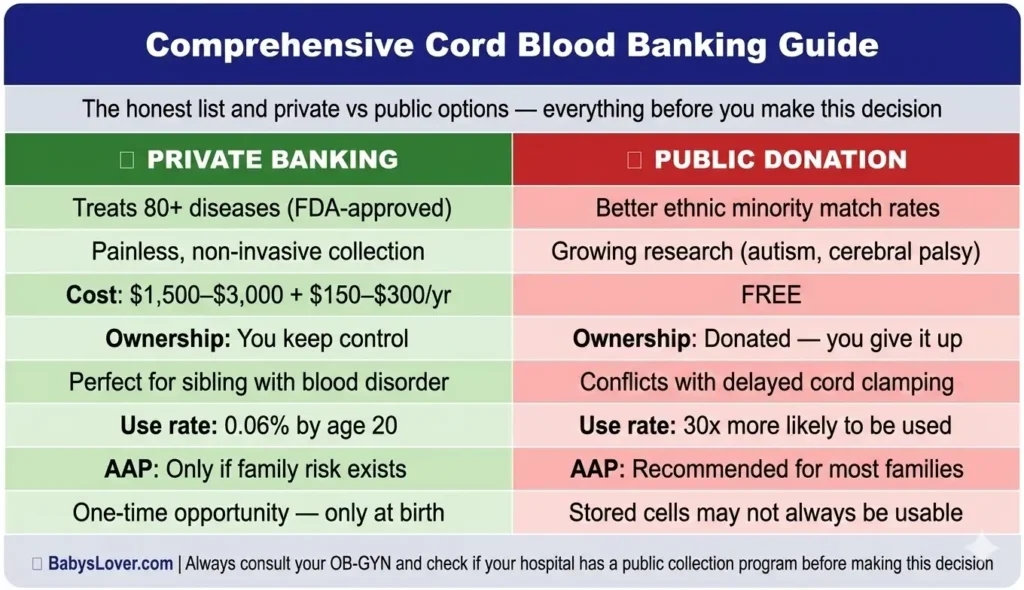
| 🔒 Private Banking | 🌍 Public Donation | |
| Cost | $1,500–$3,000 upfront + $150–$300/year storage | FREE |
| Who can use it | Your family only | Anyone who needs a match |
| Ownership | You own the stem cells | Donated — you give up ownership |
| Availability | Always reserved for you | May not be available for your family |
| Likelihood of use | 0.06% chance by age 20 | 30x more likely to be used |
| AAP recommends? | Only for families with known risk | Yes — for most families |
Private Cord Blood Banking
With private banking, you pay a company to store your baby’s cord blood exclusively for your family’s use. The upfront cost is typically $1,500 to $3,000 for collection and processing, plus an annual storage fee of $150 to $300 per year. Over 20 years, that’s $4,500–$9,000 total.
The main appeal: if your child or a sibling ever needs a stem cell transplant, the cord blood is there and ready. No searching for a donor match — it’s already banked.
The main reality: the chance that your child will need their own cord blood by age 20 is about 0.06%, or 3 in 5,000. And there’s a catch — if your child develops leukemia or another genetic blood disorder, their own cord blood often cannot be used because it carries the same genetic mutation that caused the disease.
Public Cord Blood Banking
With public donation, you donate your baby’s cord blood to a national registry — completely free. It can then be accessed by any patient in the world who needs a stem cell transplant and is a match.
Public cord blood is 30 times more likely to be used than privately stored cord blood. If you ever need a transplant yourself or your child needs one in the future, you would search the national registry — and your donated cord blood helps others do the same.
One important note: not all hospitals have public cord blood collection programs. According to ACOG guidelines, you should check with your hospital before Week 34 to find out if they participate.
Cord Blood Banking Pros and Cons — The Honest List
When parents ask is cord blood banking worth it, here’s what actually goes on both sides of the scale:
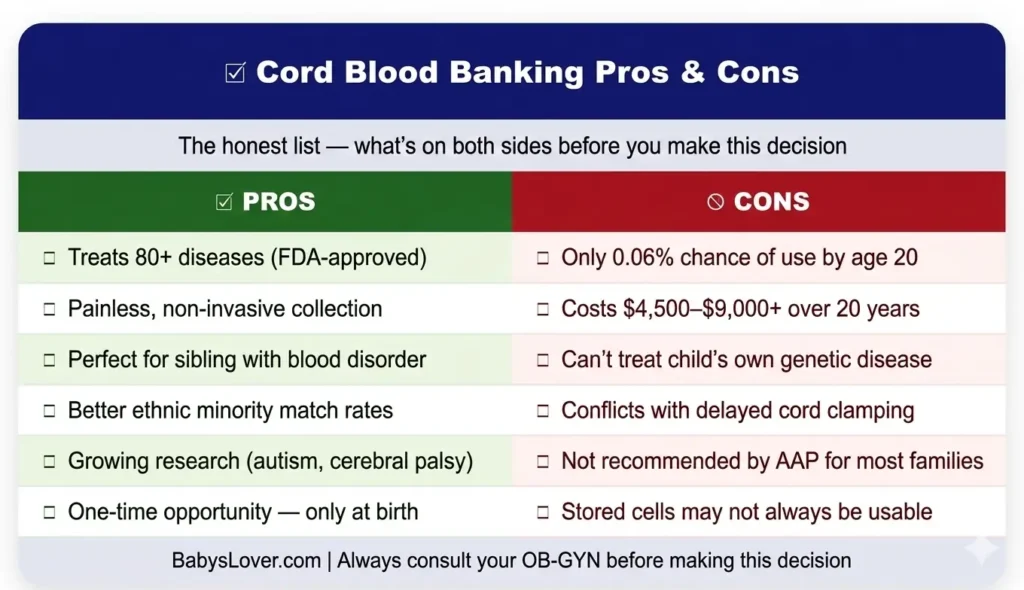
✅ Pros of Cord Blood Banking
- Treats 80+ diseases: Cord blood stem cells are FDA-approved to treat leukemia, lymphoma, sickle cell anemia, thalassemia, Fanconi anemia, and many other blood and immune disorders.
- Painless and non-invasive: Collection happens after the cord is cut. Zero risk or discomfort to mom or baby. The whole process takes under 10 minutes.
- Better sibling match potential: A sibling has a 25% chance of being a perfect match. If you have a child already living with a treatable blood disorder, storing a new baby’s cord blood can be genuinely life-saving.
- Growing medical research: Researchers at Duke and other institutions are actively studying cord blood’s potential for treating autism, brain injuries, cerebral palsy, and Type 1 diabetes. The science is evolving fast.
- Less invasive than bone marrow: Unlike bone marrow transplants, cord blood stem cells require a less exact match and cause fewer complications like graft-versus-host disease.
- One-time collection window: Once the cord blood is gone, it’s gone. You only get this one opportunity at birth.
❌ Cons of Cord Blood Banking (Private)
- Very low chance of use: The odds your child will need their own cord blood by age 20 is about 0.06%. Statistically, most privately banked cord blood is never used.
- High cost: Private banking costs $1,500–$3,000 upfront plus $150–$300/year in storage fees. Over 20 years, you could spend $7,000–$9,000 total.
- Can’t treat the child’s own genetic disease: If your child develops leukemia or a genetic blood disorder, their own cord blood carries the same genetic mutations and typically cannot be used for their treatment.
- May not be usable after storage: There have been reported cases of contamination or degradation at some private cord blood banks. Not all stored samples are guaranteed to be usable years later.
- AAP does not recommend private banking for most families: The American Academy of Pediatrics considers private storage as ‘biological insurance’ and states it’s not recommended unless there is a family history of a treatable condition.
- Conflict with delayed cord clamping: The AAP and ACOG now recommend delayed cord clamping (waiting 30–60 seconds before cutting the cord) for its health benefits to your newborn. Cord blood collection requires immediate clamping, so you may have to choose between the two.
Who Should Consider Private Cord Blood Banking?
This is where the answer to is cord blood banking worth it becomes clearer. Private banking makes the most sense for families in these situations:
- You have an older child with leukemia, sickle cell disease, or another blood disorder: A new sibling’s cord blood could be a life-saving match. This is the strongest medical reason to privately bank.
- You have a known family history of inheritable blood disorders: Conditions like thalassemia, Fanconi anemia, or immune deficiencies that run in your family increase the medical justification significantly.
- You belong to an ethnic minority: Finding bone marrow matches is much harder for Black, Hispanic, Asian, and mixed-race patients. Private banking gives your family a guaranteed match from your own genetic background.
- You have the financial means and peace of mind matters to you: If the cost is manageable and the ‘just in case’ factor genuinely gives you comfort — that’s a valid reason too. Just go in with clear expectations.
For most healthy families with no known risk factors — the AAP, ACOG, and most OBs recommend donating to a public bank instead. Your donation is free, helps others, and cord blood stored in public banks is 30 times more likely to be used.
Cord Blood Banking Cost — Full Breakdown for 2026
One of the most searched questions about is cord blood banking worth it is the real cost. Here’s what you’re actually looking at for private banking:
| Cost Item | Low End | High End |
| Collection + Processing (one-time) | $1,200 | $2,500 |
| Annual Storage Fee | $100/year | $300/year |
| Total after 10 years | ~$2,200 | ~$5,500 |
| Total after 20 years | ~$3,200 | ~$8,500 |
| Add cord tissue banking | +$500-800 | +$1,500+ |
| Public donation | FREE | FREE |
Some private banks offer payment plans and promotional discounts — especially if you sign up during pregnancy. But always read the fine print on renewal terms, transfer fees, and what happens if the company goes out of business.
For reference — deciding on cord blood banking is one of the bigger financial decisions you’ll make in your third trimester, alongside finalizing your hospital bag checklist and your birth plan.
Cord Blood Banking vs Delayed Cord Clamping — Can You Do Both?
This is one of the most important practical questions when thinking about cord blood banking.
Delayed cord clamping — waiting 30 to 60 seconds (or longer) before cutting the umbilical cord — allows more blood to flow from the placenta to your baby. The AAP and ACOG now recommend it for all healthy newborns because it increases iron stores, improves blood volume, and has been linked to better neurodevelopmental outcomes.
The problem: the longer you wait to clamp the cord, the less blood remains for collection. Most cord blood banks require immediate or very early clamping to collect a sufficient sample.
In practice, this means you typically have to choose one or the other. For most healthy families, delayed cord clamping offers more immediate and certain benefits to your newborn than the small statistical chance of needing the banked cord blood.
Talk to your OB about what they recommend given your specific pregnancy and health history. Add this discussion to your checklist when you visit our pregnancy week-by-week guide to plan your third trimester.
What Diseases Can Cord Blood Treat?
Cord blood stem cells are FDA-approved to treat over 80 conditions. Here are the main categories — this is relevant when asking is cord blood banking worth it for your family’s health history:
| Category | Examples |
| Blood Cancers | Leukemia (ALL, AML, CML), Lymphoma, Myelodysplastic syndrome |
| Blood Disorders | Sickle cell anemia, Thalassemia, Fanconi anemia, Aplastic anemia |
| Immune Disorders | Severe combined immunodeficiency (SCID), Wiskott-Aldrich syndrome |
| Metabolic Disorders | Hurler syndrome, Adrenoleukodystrophy, Gaucher disease |
| Under Research | Autism, cerebral palsy, Type 1 diabetes, Parkinson’s, brain injuries |
Important note: ‘under research’ means clinical trials are ongoing. These are not approved treatments yet — and using cord blood for these conditions is still experimental. Legitimate cord blood banks will be transparent about this.
What Do Doctors Actually Say About Cord Blood Banking?
When parents ask is cord blood banking worth it, medical organizations are fairly clear in their guidance:
- American Academy of Pediatrics (AAP): Does not recommend private cord blood banking for most families. Considers it ‘biological insurance’ and warns that marketing can be emotionally manipulative. However, strongly supports donating to public banks.
- ACOG (American College of Obstetricians and Gynecologists): Encourages public donation. Does not recommend private banking unless there is a family history of a specific disorder that could be treated with stem cells.
- NIH and FDA: Recognize the medical value of cord blood stem cells. Public cord blood banks are FDA-regulated. Support ongoing research into expanded uses.
Bottom line from the medical community: private banking is not a waste of money if your family has specific medical risk factors. For most healthy families, public donation is the better choice.
Frequently Asked Questions — Is Cord Blood Banking Worth It?
Is cord blood banking worth it for a healthy family with no medical history?
For most healthy families, private cord blood banking is not considered worth the cost by the AAP and ACOG. The statistical chance your child will use their own banked cord blood by age 20 is about 0.06%. Public donation is recommended instead — it’s free, helps others, and cord blood in public banks is 30 times more likely to be used.
Is cord blood banking worth it if I have an older child with leukemia or sickle cell?
Yes — this is the strongest medical reason to privately bank cord blood. A sibling has a 25% chance of being a compatible match, and having the cord blood immediately available can be critical. Talk to your OB and your child’s specialist about whether private banking is right for your situation.
What is the real cost of cord blood banking?
Private cord blood banking typically costs $1,200 to $2,500 for collection and processing, plus $100 to $300 per year in storage fees. Over 20 years, most families spend $3,000 to $8,000+. Public donation is completely free.
Can my child use their own cord blood if they get leukemia?
Usually not. If your child develops leukemia or another genetic blood disorder, their own cord blood carries the same genetic mutations and cannot be used to treat them. Cord blood is more useful for treating a sibling or another family member with a compatible blood type.
What is the difference between cord blood banking and cord tissue banking?
Cord blood banking collects the blood from the umbilical cord after birth. Cord tissue banking collects and stores the actual tissue of the cord — which contains a different type of stem cell (mesenchymal stem cells) with different potential applications. Some private banks offer both. Cord tissue banking adds cost and is still largely experimental in its applications.
Does cord blood banking affect delayed cord clamping?
Yes — the two are difficult to combine. Cord blood collection requires early clamping to collect enough blood. Delayed cord clamping, which is now recommended by the AAP, requires waiting 30-60+ seconds. You typically have to choose one or the other. Discuss this with your OB before delivery.
Which cord blood banks are the best and most trustworthy?
Look for FDA-registered banks that are also AABB accredited (the gold standard for cord blood banks). Top private banks in the US include ViaCord, Cord Blood Registry (CBR), and Americord. Always research independently and read the full contract — especially annual storage fees, transfer fees, and what happens to your cord blood if the company closes.
Is cord blood banking a scam?
No — cord blood stem cells have genuine, proven medical value. The concern from medical organizations is not that cord blood banking is fraudulent, but that private banking is marketed aggressively to parents in a way that overstates the likelihood of use. The medical value is real. Whether private banking is worth the cost for your specific family is the actual question to ask.
So — Is Cord Blood Banking Worth It?
Here’s the honest answer to is cord blood banking worth it:
- Private cord blood banking IS worth it if: You have a family history of treatable blood disorders, an older child with leukemia or sickle cell, belong to an ethnic minority with lower bone marrow match rates, or simply have the budget and want that peace of mind.
- Private cord blood banking is probably NOT worth it if: Your family has no known blood disorder history, budget is a concern, and you’re primarily responding to marketing pressure. The 0.06% usage statistic is real.
- Public donation IS worth considering for everyone: It’s free. It saves lives. It helps build the diversity of the national registry. And cord blood donated publicly is 30 times more likely to be used than privately stored cord blood.
Whatever you decide — make it your decision, based on your family’s actual health history, budget, and values. Not based on a billboard.
Talk to your OB at your next appointment. And while you’re planning for the end of pregnancy, make sure your hospital bag checklist is ready by Week 36, and take a look at our best prenatal vitamins guide too — those are decisions with a much higher chance of daily impact!
Have a question we didn’t answer? Drop it in the comments below. Every family’s situation is different, and we’re here to help you think it through.
3 thoughts on “Is Cord Blood Banking Worth It? Honest Pros, Cons & Cost (2026)”