
Something extraordinary may have just happened inside your body — and you probably don’t even know it yet.
Week 3 is one of the most quietly miraculous weeks of your entire pregnancy. The sperm and egg have united. Your baby’s DNA is set. And right now, a tiny cluster of rapidly dividing cells is making its way toward your uterus to begin the most important journey of its life.
At Babyslover, we’re walking you through 3 weeks pregnant in full detail — what’s happening with your embryo, the signs of implantation, what symptoms are real vs. imagined at this stage, when to take a pregnancy test, and how to take care of yourself during this magical and uncertain window. If you’re just catching up, start with 2 weeks pregnant first.
| 📋 Quick Summary — Week 3 of Pregnancy | |
| Week | Week 3 of 40 |
| Trimester | First Trimester |
| Baby Size | Smaller than a grain of salt (0.0019 inches / 0.048mm) |
| Baby Stage | Zygote → Morula → Blastocyst |
| Key Event | ✨ Fertilization complete → Implantation beginning |
| Symptoms | Implantation spotting (25% of women), mild cramping, breast tenderness, bloating, fatigue — OR no symptoms at all |
| Can I test now? | ⏳ Not yet — wait until missed period (Week 4) for accurate result |
Are You Actually Pregnant at 3 Weeks?
Yes — if fertilization occurred during Week 2, you are officially pregnant at 3 weeks. But here’s the thing: almost no one knows it yet.
At 3 weeks pregnant, conception has just happened — or is in the final stages of occurring. Your embryo is a microscopic cluster of cells making its way toward your uterus. Your body hasn’t produced enough hCG (the pregnancy hormone) for a home test to detect it. Your period hasn’t been missed yet. And most symptoms, if any appear at all, feel exactly like PMS.
This is why Week 3 is often called the ‘secret’ week of pregnancy — everything is happening, but almost nothing is visible or detectable from the outside.
💡 How pregnancy is counted: Pregnancy is measured from the first day of your last period. So Week 3 by the LMP calendar is only about 1 week after ovulation and fertilization. Your actual embryo is only about 7 days old — even though you’re called ‘3 weeks pregnant’.
What’s Happening in Your Body at 3 Weeks Pregnant
Your body at 3 weeks pregnant is undergoing a quiet revolution — mostly invisible, but absolutely extraordinary.
The Zygote Is Dividing Rapidly
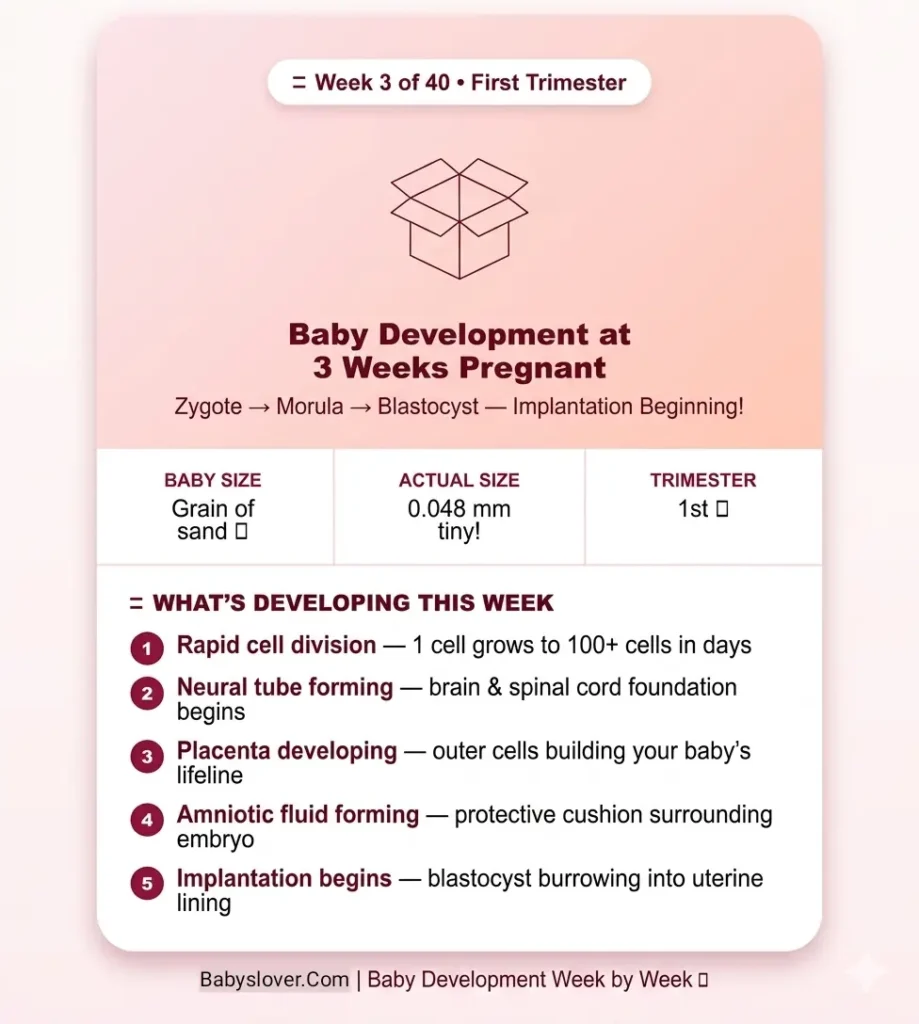
After fertilization, the single-celled zygote immediately begins dividing. One cell becomes two, two become four, four become eight — and so on. By 3 to 4 days after fertilization, your embryo is called a morula — a solid ball of 16 or so cells, roughly the size of a grain of sand. It’s traveling down the fallopian tube toward your uterus the entire time.
The Morula Becomes a Blastocyst
As the morula continues dividing, it develops a fluid-filled cavity and transforms into a blastocyst — a hollow ball of around 100 cells. This structure has two distinct parts: the inner cell mass (which will become your baby) and the outer cell layer called the trophoblast (which will become the placenta).
Implantation Begins
Around Days 6-10 after fertilization — which falls between Days 20-24 of your cycle — the blastocyst arrives in your uterus and begins implantation. It burrows into the thick, nutrient-rich uterine lining that has been building since Week 1. This process takes a few days to complete and marks the official beginning of your pregnancy.
hCG Production Starts
Once the blastocyst begins implanting, the trophoblast cells start producing hCG — human chorionic gonadotropin, the pregnancy hormone. hCG signals your ovaries to stop releasing eggs and tells your body to keep producing progesterone to maintain the uterine lining. hCG is the hormone detected by pregnancy tests — but at 3 weeks, levels are usually still too low to trigger a positive result.
Progesterone Is Rising
Your progesterone levels are climbing this week, driven by the corpus luteum (the follicle that released your egg in Week 2). Progesterone relaxes the uterine muscles to prevent early contractions and thickens the uterine lining to support the implanting embryo. It’s also the hormone responsible for many early pregnancy symptoms — breast tenderness, bloating, and fatigue.
🌱 Baby Development at 3 Weeks Pregnant
Your baby at 3 weeks pregnant is almost impossibly small — but what’s happening inside those few cells is one of the most complex biological processes in nature.
| 🌱 Baby Development at 3 Weeks Pregnant | |
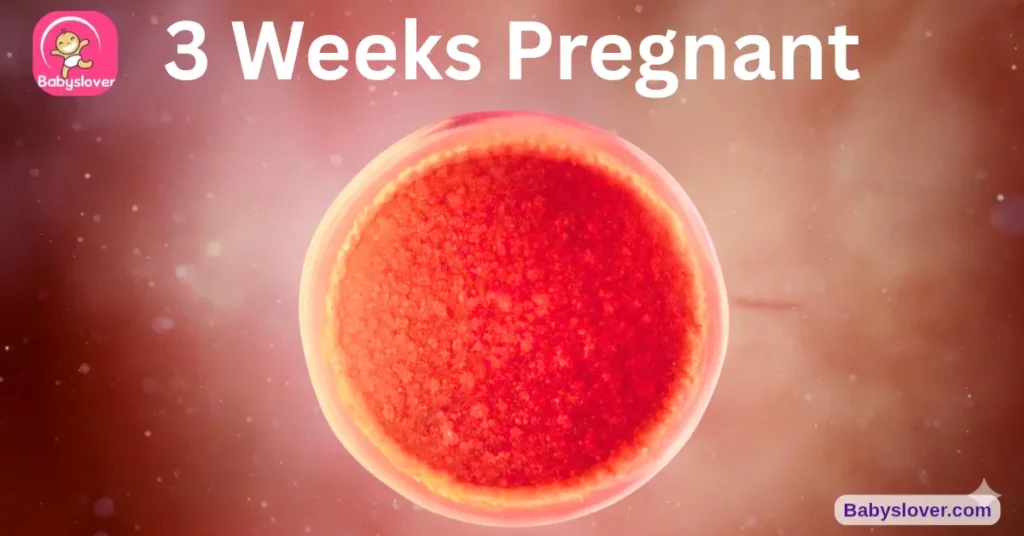
| Baby Size | 0.0019 inches (0.048 mm) — smaller than a grain of salt |
| Fruit Comparison | ✨ Grain of sand / poppy seed (just fertilized) |
| Weight | Essentially zero — microscopic |
| Stage Name | Zygote → Morula → Blastocyst |
| Week / Trimester | Week 3 of 40 • First Trimester |
| Key Milestone | Implantation — beginning of official pregnancy |
What Is Actually Developing at Week 3?
According to the American Pregnancy Association, Week 3 is when the foundational development of your baby’s most critical systems begins:
- Rapid cell division: Your embryo grows from 1 cell to 100+ cells within just 3-4 days. Each division is programmed with incredible precision — every cell knows exactly what it will eventually become.
- Neural tube formation beginning: The neural tube — which becomes your baby’s brain and spinal cord — begins its initial development this week. This is exactly why folic acid is so critical: it protects the neural tube during these very first days of development, often before you even know you’re pregnant.
- Placenta development starting: The outer layer of the blastocyst (trophoblast cells) begins forming the placenta — the remarkable organ that will deliver nutrients and oxygen to your baby for the next 37 weeks.
- Amniotic fluid forming: Amniotic fluid begins collecting around the embryo. This protective fluid will cushion your baby throughout the entire pregnancy, allowing movement and protecting against bumps and pressure.
- Three germ layers forming: The embryo begins differentiating into three primary cell layers — the ectoderm (skin, brain, nervous system), mesoderm (muscles, bones, heart, kidneys), and endoderm (digestive system, lungs, liver). Every single part of your baby’s body traces back to one of these three layers.
- Heart and circulatory system: The very earliest groundwork for the heart and circulatory system begins this week — though a heartbeat won’t be detectable until around Week 6.
💡 Your baby is smaller than the period at the end of this sentence. But inside those few cells, the entire blueprint of a human being is already written — your baby’s eye color, hair color, blood type, height potential, and even personality traits are encoded in their DNA, set at the moment of fertilization.
3 Weeks Pregnant Symptoms — What’s Real and What’s PMS
Here’s the honest truth about 3 weeks pregnant symptoms: most women feel absolutely nothing unusual this week — and that’s completely normal.
Any symptoms you feel at 3 weeks are caused by rising progesterone and early hCG — not by your baby’s size or movement. They’re also nearly identical to typical PMS symptoms, which is why this week can be so confusing. According to Mayo Clinic, the earliest pregnancy symptoms can begin within a week of conception for some women, while others don’t notice anything until after a missed period.
🩸 Implantation Bleeding or Spotting
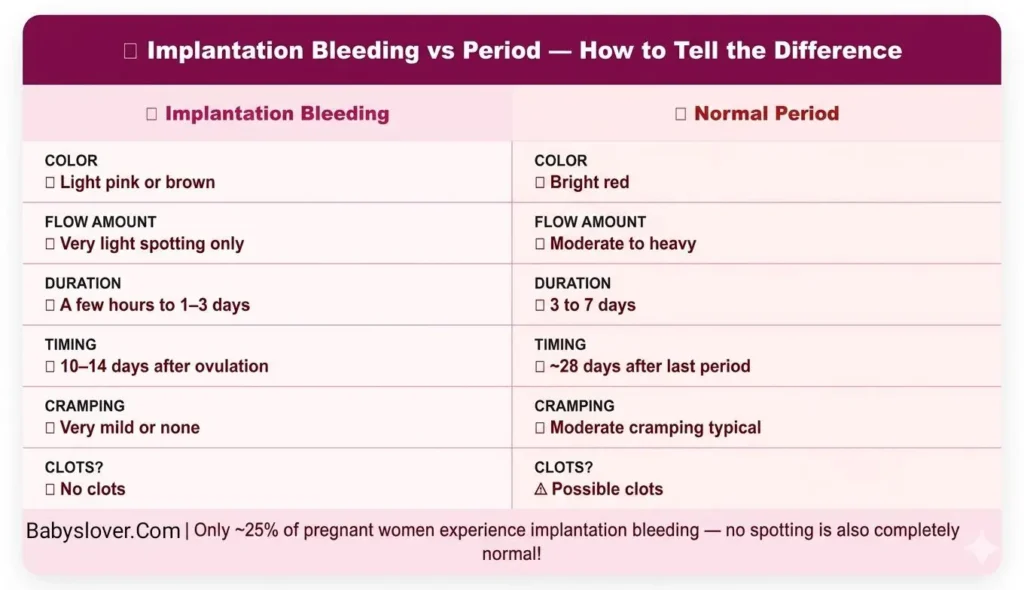
About 25% of pregnant women notice a small amount of light spotting when the embryo implants into the uterine lining. This is called implantation bleeding, and it’s one of the earliest possible signs of pregnancy.
It usually appears as light pink or brownish discharge — not bright red — and lasts only a few hours to 2-3 days. It’s typically much lighter than a period and has no clots. Many women mistake it for the start of their period and don’t realize they’re pregnant.
If you notice spotting and it stays very light with no heavy flow, no large clots, and no severe pain — it may well be implantation bleeding. Make a note of the date and how it looks.
🤏 Mild Cramping
Mild cramping during Week 3 is common and usually signals implantation — the blastocyst burrowing into your uterine lining. These cramps typically feel like lighter, softer versions of period cramps — a gentle pulling or aching in your lower abdomen. They’re usually short-lived.
If cramping is severe, concentrated strongly on one side, or accompanied by heavy bleeding, contact your doctor — these can be signs of an ectopic pregnancy, which needs immediate evaluation.
🍈 Breast Tenderness
Rising progesterone can cause your breasts to feel sore, heavy, swollen, or more sensitive than usual. This feels similar to pre-period breast tenderness — but during pregnancy, it can be slightly more intense. Some women also notice their nipples becoming more sensitive or slightly darker in color.
😴 Fatigue
Your body is doing extraordinary work this week — even if you can’t see it. The surge in progesterone, combined with your body beginning to shift resources toward a potential pregnancy, can leave you feeling more tired than usual. If you’re feeling unusually exhausted around Days 20-24 of your cycle, take note.
🫧 Bloating
Progesterone slows down your digestive system slightly, which can cause that full, bloated feeling. This is very similar to PMS bloating and is completely normal at 3 weeks pregnant.
👃 Heightened Sense of Smell
Some women notice an unusually strong reaction to smells during the very early weeks of pregnancy — strong perfumes, cooking smells, or cleaning products can suddenly feel overwhelming. This is driven by rising estrogen and is one of the earlier, subtler pregnancy signs.
💭 No Symptoms — Also Completely Normal
The majority of women at 3 weeks pregnant feel absolutely nothing different. No spotting. No cramping. No breast tenderness. This is completely normal and doesn’t indicate anything is wrong. Many women who go on to have perfectly healthy pregnancies don’t feel a single thing until after their missed period.
Can I Take a Pregnancy Test at 3 Weeks Pregnant?
We know the urge is real — but the honest answer is: not yet, for most women.
Home pregnancy tests detect hCG in your urine. At 3 weeks pregnant, implantation is just beginning or hasn’t fully completed yet. hCG levels are extremely low — often too low for even the most sensitive tests to detect.
Here’s how hCG works: after implantation, levels start very low and roughly double every 48 hours. By the time you’ve missed your period (around Week 4), hCG levels are usually high enough for a reliable home test result.
| When to Test | Likely Result | Why |
| 3 weeks pregnant | ❌ Negative (usually) | hCG too low — implantation just starting |
| 3 weeks 5-6 days | ⚠️ Possibly faint positive | If early implanter, some hCG present |
| After missed period (Week 4+) | ✅ Most accurate | hCG high enough for reliable detection |
| Blood test (doctor) | ✅ Earlier detection | Can detect hCG 7-12 days after conception |
If you do test at 3 weeks and get a negative — don’t despair. A negative at this stage doesn’t mean you’re not pregnant. Test again in 3-4 days, then again after your missed period. hCG doubles every 48 hours, so a test that shows nothing today could be strongly positive within a week.
💡 Tip: Test with first morning urine when hCG is most concentrated. Use a sensitive brand (Clearblue Early or First Response Early Result detect as low as 6.5 mIU/mL). But the most reliable time is still after a missed period.
What to Eat at 3 Weeks Pregnant — Implantation Support
Nutrition at 3 weeks pregnant directly supports implantation and the very earliest stages of your baby’s neural tube development. Here’s what to focus on:
| Nutrient | Why It Matters at Week 3 | Best Food Sources |
| Folic Acid | Neural tube closes this week — critical for preventing spina bifida | Spinach, lentils, avocado, asparagus, fortified cereal |
| Antioxidants | Protect embryo from oxidative stress during cell division | Blueberries, strawberries, kale, broccoli, nuts |
| Zinc | Supports rapid cell division and DNA synthesis | Beef, chickpeas, pumpkin seeds, cashews, eggs |
| Omega-3 Fatty Acids | Brain and nervous system development starting | Salmon, sardines, walnuts, flaxseeds, chia seeds |
| Vitamin B6 | Supports implantation and may reduce early nausea | Bananas, potatoes, chicken, sunflower seeds |
| Hydration | Supports blood volume expansion and embryo development | Water (8-10 glasses/day), herbal teas, coconut water |
Make sure you’re taking your prenatal vitamin every day — this is non-negotiable at Week 3. If you haven’t started yet, check our guide to the best prenatal vitamins to find one with adequate folic acid (at least 400mcg) and iron. According to the CDC, folic acid must be in your system before and during early pregnancy to prevent neural tube defects.
What to avoid at 3 weeks pregnant: alcohol (completely — no amount is safe), smoking, raw/undercooked meat and fish, unpasteurized cheeses, high-mercury fish (swordfish, king mackerel, shark), deli meats, and excess caffeine (keep under 200mg/day).
What to Do at 3 Weeks Pregnant — The Two-Week Wait
The period between ovulation and your expected period — the two-week wait (TWW) — is one of the hardest parts of trying to conceive. You’re waiting, wondering, and analyzing every little sensation. Here’s how to manage it:
Continue All Preconception Habits
Keep taking prenatal vitamins, eating well, staying hydrated, getting sleep, and avoiding alcohol and smoking. If fertilization occurred, your embryo is in an incredibly vulnerable stage right now. Everything you put into your body can potentially affect it — even before you know you’re pregnant.
Avoid Hot Baths, Saunas, and Extreme Heat
High temperatures can interfere with implantation and early embryo development. Stick to warm (not hot) showers, avoid hot tubs and saunas, and skip extremely heated yoga classes during the two-week wait.
Don’t Over-Test
Testing every day from Week 3 can become emotionally exhausting and lead to confusion from evaporation lines or false negatives. Give it until at least 3-4 days before your expected period, or ideally the day of your missed period, for the most accurate result. Constant testing rarely changes the outcome — it just affects your anxiety levels.
Take Care of Your Mental Health
The two-week wait is genuinely difficult, especially if you’ve been trying for several months. It’s completely okay to feel anxious, hopeful, scared, and excited all at once. Try to stay gently occupied — a walk, a hobby, light exercise, time with people you love. Being kind to yourself this week matters.
Note Any Unusual Symptoms
Pay quiet attention to your body — especially any spotting, cramping, or breast changes. Keep a note on your phone. This information can be helpful when you speak to your OB about early pregnancy.
For Your Partner — What Dad Can Do at 3 Weeks Pregnant
Week 3 is just as emotionally significant for your partner. Here’s how they can support the journey right now:
- Be present and patient: The two-week wait is stressful. Your partner may be watching for every symptom or anxiously avoiding thinking about it entirely. Just being warm, attentive, and non-pressuring makes a real difference.
- Continue the healthy habits from Week 2: Keep limiting alcohol, avoiding smoking, eating well, and managing stress. Sperm health continues to matter — especially if another conception attempt is needed this cycle.
- Don’t push about testing: Suggesting constant pregnancy tests can add pressure. Let your partner decide when she feels ready to test — and support whatever result comes.
- Keep things light: Plan something enjoyable together during the two-week wait — a movie night, a day out, cooking a meal together. Distraction and connection are both helpful.
- Learn about early pregnancy together: Reading about what might be happening inside your partner’s body right now — the blastocyst, implantation, the beginning of a new life — is something many couples find deeply meaningful. You’re both in this.
When to Call Your Doctor at 3 Weeks Pregnant
Most of what happens at 3 weeks pregnant doesn’t require medical attention. But contact your OB or go to urgent care if you experience:
- Heavy bleeding: Light pink or brown spotting is normal (implantation). Bright red, heavy bleeding — especially with clots — at this stage warrants immediate medical attention.
- Severe one-sided pain: Sharp, intense pain on one side of your lower abdomen — especially combined with spotting, dizziness, or shoulder tip pain — can indicate an ectopic pregnancy. This is a medical emergency. Seek care immediately.
- High fever: A fever over 100.4°F (38°C) during early pregnancy should always be evaluated — infections during early pregnancy can potentially affect implantation.
- Severe nausea and vomiting: Morning sickness at 3 weeks is uncommon. If you’re already experiencing severe vomiting that’s preventing you from keeping fluids down, call your doctor.
- Strong positive pregnancy test followed by heavy bleeding: This can indicate a chemical pregnancy (a very early miscarriage). Your doctor can check hCG levels and provide support and guidance.
Your Week 3 Pregnancy Checklist
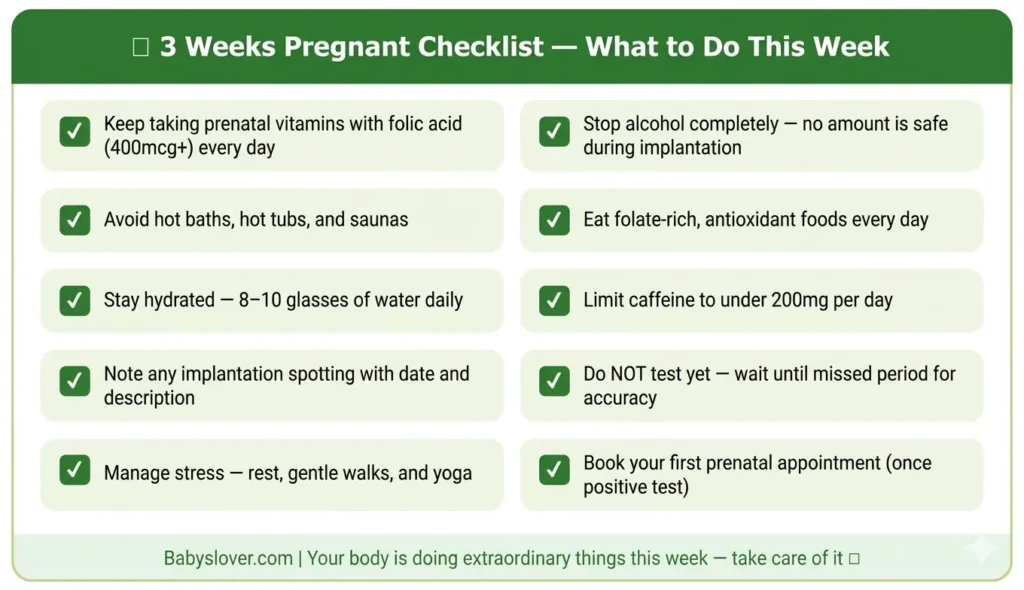
Here’s your complete 3 weeks pregnant to-do list:
- ☑ Keep taking prenatal vitamins with folic acid (400mcg minimum) every day
- ☑ Stop alcohol completely — no amount is safe during the implantation window
- ☑ Avoid hot baths, hot tubs, and saunas
- ☑ Eat folate-rich, antioxidant-rich foods every day
- ☑ Stay well hydrated — 8-10 glasses of water daily
- ☑ Limit caffeine to under 200mg per day
- ☑ Note any implantation spotting or cramping with dates and description
- ☑ Avoid over-testing — wait until closer to your missed period
- ☑ Manage stress: rest, walks, gentle yoga, time with loved ones
- ☑ If on any medications, confirm they’re safe during early pregnancy with your doctor
- ☑ Research your first prenatal appointment — book it once you have a positive test
Frequently Asked Questions — 3 Weeks Pregnant
Can I feel pregnancy symptoms at 3 weeks pregnant?
Some women do notice subtle signs at 3 weeks pregnant — especially mild cramping, light spotting, or breast tenderness from rising progesterone. But the majority of women feel nothing unusual this early, and that’s completely normal. True early pregnancy symptoms like nausea and food aversions typically begin around Week 5-6 when hCG levels are much higher.
Is implantation bleeding normal at 3 weeks pregnant?
Yes — implantation bleeding is a normal early pregnancy sign. It occurs when the blastocyst burrows into your uterine lining, causing light spotting. Only about 25% of pregnant women experience it. It’s typically very light (pink or brown), lasts 1-3 days, and is much lighter than a period. If bleeding is heavy or painful, contact your doctor.
Can I get a positive pregnancy test at 3 weeks?
Possibly, but unlikely. Most home pregnancy tests can’t reliably detect hCG at 3 weeks because levels are still very low. Testing after your missed period (Week 4+) gives the most accurate result. Some highly sensitive early response tests may show a very faint positive at 3 weeks 5-6 days — but a negative at 3 weeks does not mean you’re not pregnant.
What does my baby look like at 3 weeks pregnant?
Your baby at 3 weeks pregnant is a microscopic ball of cells called a blastocyst — smaller than a grain of salt (about 0.048mm). It has no recognizable human features yet. But inside those cells, your baby’s complete DNA is set, and the foundational layers for every organ system are beginning to form.
Is cramping at 3 weeks pregnant normal?
Yes — mild cramping at 3 weeks pregnant is common and usually indicates implantation. The blastocyst burrowing into your uterine lining can cause light cramping similar to gentle period cramps. It’s typically brief and mild. Severe cramping, especially one-sided, should be evaluated by a doctor as it can indicate ectopic pregnancy.
What is the two-week wait and how do I survive it?
The two-week wait (TWW) is the time between ovulation and when you can reliably test for pregnancy — roughly the span of Week 2 and Week 3. It’s emotionally challenging because you’re hoping but can’t confirm yet. The best approach: stay gently busy, avoid obsessive testing, take care of your body, and be kind to yourself. Distraction, connection, and self-compassion are your best tools.
Can a miscarriage happen at 3 weeks pregnant?
Very early pregnancy loss — often called a chemical pregnancy — can occur before or just after a positive test. Most early losses happen before Week 6. At 3 weeks, if the embryo fails to implant properly, the cycle simply ends without a confirmed pregnancy. This is more common than most people realize, and it’s not caused by anything the mother did. If you had a positive test followed by bleeding, speak to your doctor.
Is it safe to exercise at 3 weeks pregnant?
Yes — moderate exercise is completely safe and beneficial at 3 weeks pregnant. Walking, swimming, prenatal yoga, and light cardio are all encouraged. Avoid very high-intensity workouts, contact sports, and activities with high fall risk. There’s no evidence that moderate exercise prevents implantation — that’s a common myth. Stay hydrated, avoid overheating, and listen to your body.
💗 How Are You Feeling? This Week Is Hard — And That’s Okay
Week 3 is one of those weeks where you’re suspended between hoping and not knowing. You’ve done everything right. You’ve tracked your cycle, timed everything perfectly, taken your vitamins, eaten well. And now — you wait.
Whatever you’re feeling right now — excitement, anxiety, hope, nervousness, or a strange mix of all of them — it’s completely valid. The two-week wait is genuinely one of the emotionally hardest parts of trying to conceive, and it doesn’t get easier just because you know what’s happening biologically.
Be gentle with yourself this week. You’re doing everything you can. The rest is nature’s work — and nature is extraordinary.
👶 What Happens Next — 4 Weeks Pregnant Preview
Week 4 is when everything becomes real. Here’s a preview of what 4 weeks pregnant brings:
- Implantation completes — your embryo is officially anchored in your uterus
- hCG levels rise high enough for a home pregnancy test to detect — this is your BIG moment!
- You may miss your period — the earliest clear sign of pregnancy for most women
- The embryonic disc forms — the foundation of your baby’s entire body
- Early pregnancy symptoms may begin to appear — fatigue, nausea, sore breasts
- Your uterus begins to grow very slowly
Head to our complete pregnancy week by week guide to follow every step from Week 1 all the way to Week 40!
Week 3: The Secret Week That Changes Everything
Being 3 weeks pregnant might feel like nothing — no bump, no test result, no confirmation. But inside your body, the most extraordinary biological event in human experience may be unfolding right now.
A tiny cluster of cells, carrying your baby’s complete genetic blueprint, is making its way home. The neural tube is beginning to form. The placenta is starting to build. A heartbeat is weeks away — but the foundation is already being laid.
You don’t have to feel it to know it matters. It matters enormously. 💗
Have questions about Week 3, implantation, or the two-week wait? Drop them in the comments — we read every one. And if you’re newly pregnant, our pregnancy tips for first time moms guide is a wonderful next read!