

There’s a moment in early pregnancy that changes everything. For many moms, it happens at 6 weeks pregnant — lying on an exam table, watching a small screen, and suddenly seeing a tiny flicker that makes the whole world stop. That flicker is your baby’s heartbeat. It is one of the most profoundly emotional moments you will ever experience.
At Babyslover, we’re going to walk you through everything happening at 6 weeks pregnant: your baby’s extraordinary development this week, what symptoms to expect, what a 6-week ultrasound can (and can’t) show you, and exactly what to do right now. Just finishing Week 5? Read our 5 weeks pregnant guide first — the heartbeat began there, and now Week 6 is when it becomes real.

| 📋 Quick Summary — Week 6 of Pregnancy | |
| Week | Week 6 of 40 |
| Trimester | First Trimester |
| Baby Size | 🫛 Sweet pea — approx. 6mm (0.25 inches) |
| Baby Stage | Embryo — face forming, limb buds growing, brain developing |
| Key Milestone | 💗 HEARTBEAT VISIBLE ON ULTRASOUND — 90-110 bpm |
| hCG Range | 152–32,177 mIU/mL (continuing to surge) |
| Symptoms | Morning sickness intensifying, extreme fatigue, breast tenderness, bloating, heightened smell, food aversions, mood swings |
| First Step | 📞 Confirm OB appointment is booked (Week 8–10) + ask if early ultrasound is recommended for your situation |
What’s Happening in Your Body at 6 Weeks Pregnant
At 6 weeks pregnant, your body is in full pregnancy mode — even if nobody can see it yet. Here’s what’s going on internally:
hCG Is Near Its First Peak
Your hCG levels are now anywhere from 152 to 32,177 mIU/mL — a dramatic range that’s completely normal at this stage. hCG continues to roughly double every 48–72 hours, and this surge is the driver behind most of your symptoms. Morning sickness, fatigue, and breast changes all trace back to this hormonal explosion. The hormone peaks around Week 10 before gradually declining as the placenta takes over.
Your Uterus Is the Size of a Plum
Your uterus has grown from its normal pear size to roughly the size of a plum. You can’t feel this from the outside yet — your bump is still weeks away — but the growth is real. Some women notice a slight firmness or fullness low in the abdomen when they press gently.
Progesterone Is Doing Heavy Lifting
Progesterone continues to surge, keeping your uterine lining stable and preventing contractions. It’s also responsible for the physical symptoms that feel so much like a permanent bad PMS week: the bloating, the fatigue, the constipation, and the emotional sensitivity. Your digestive system is slowing down significantly — food moves through your intestines more slowly to allow maximum nutrient absorption for the baby.
Blood Volume Is Increasing
Your blood volume will increase by up to 50% during pregnancy — and that expansion is already beginning. Your heart is pumping harder. Your kidneys are filtering more. This increased circulation is what causes the frequent urination, and it contributes to the profound fatigue many women feel in the first trimester. Your cardiovascular system is adapting to a new reality.
Your Cervix Is Changing
You may notice increased vaginal discharge — typically clear or milky white, with a mild smell. This is leukorrhea, caused by increased blood flow to the vaginal area and rising estrogen. It’s normal and serves as a protective barrier against infection. If discharge has a strong odor, unusual color (green, yellow), or is accompanied by itching or burning, contact your OB.
🌱 Baby Development at 6 Weeks Pregnant
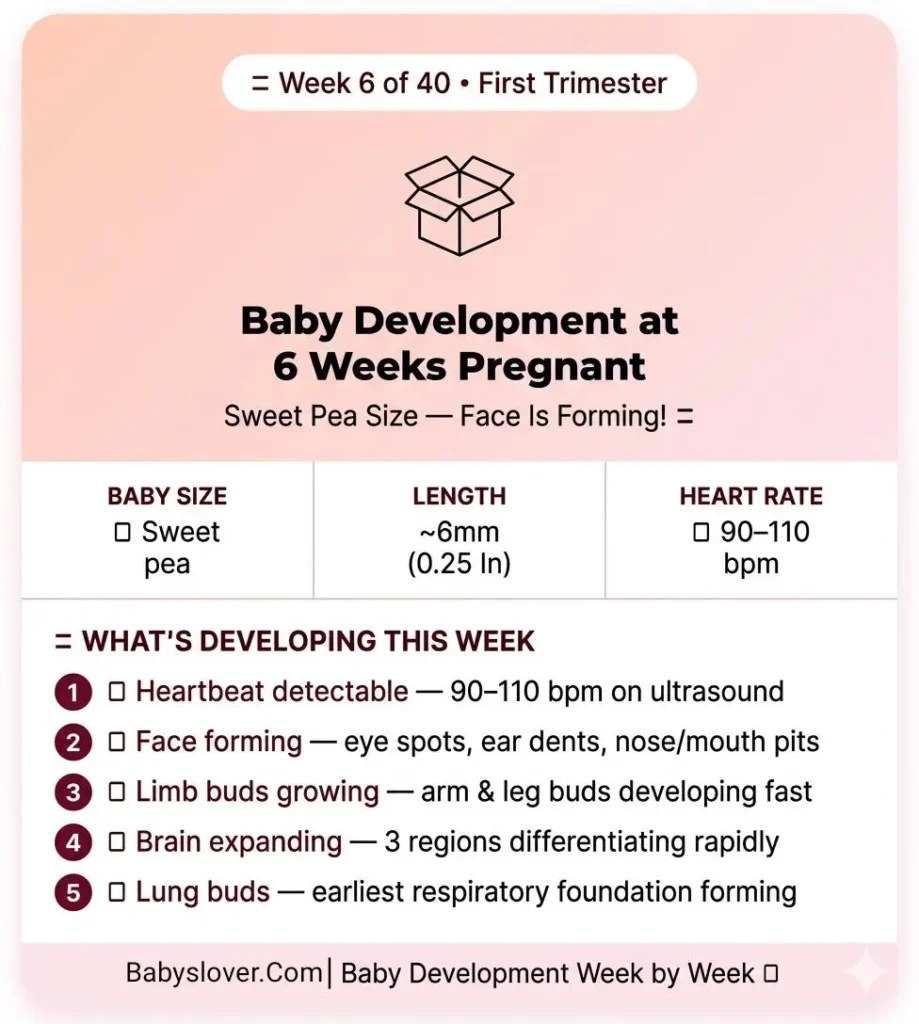
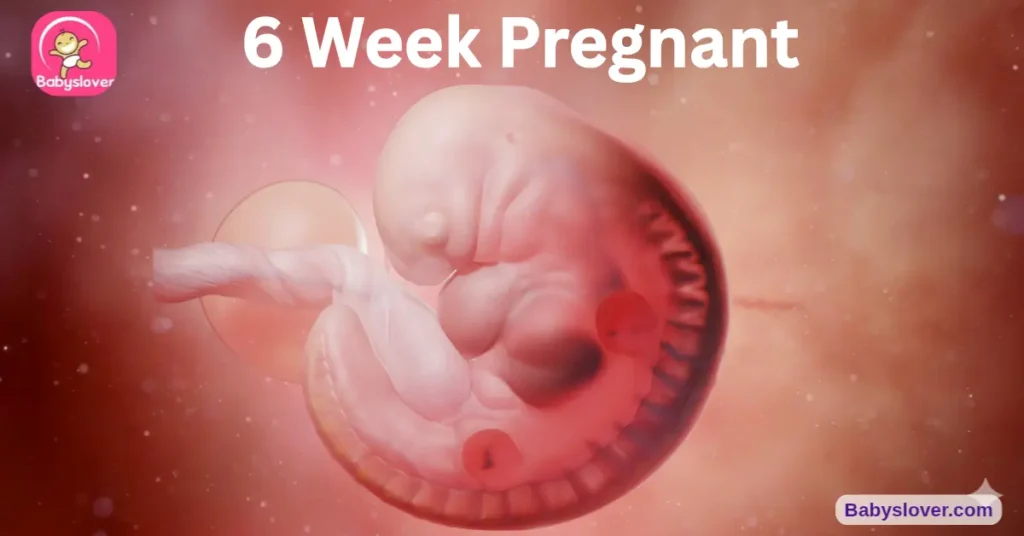
At 6 weeks pregnant, your baby has grown from a 2mm sesame seed to approximately 6mm — about the size of a sweet pea or lentil. That’s 3× the size of last week! And the changes aren’t just in size — this is one of the most rapid development weeks of the entire pregnancy.
| 🌱 Baby Development at 6 Weeks Pregnant | |
| Baby Size | 🫛 Sweet pea — approximately 6mm (0.25 inches) |
| Fruit Comparison | 🫛 Sweet pea / lentil |
| Weight | Less than 1 gram — still microscopic |
| Stage | Embryo — facial features, limb buds, rapid brain growth |
| Week / Trimester | Week 6 of 40 • First Trimester |
| Heart Rate | 💗 90–110 beats per minute — detectable on ultrasound! |
What Is Developing at Week 6
- 💗 Heartbeat visible on ultrasound: The primitive heart tube that began beating at Week 5 is now beating at approximately 90–110 beats per minute — and this week, it’s often detectable on a transvaginal ultrasound for the first time. This is a profound and emotional milestone for most parents. The heartbeat doesn’t just signal viability — it signals that the cardiac system is organizing and strengthening. By Week 9-10, the heart rate will rise to 170+ bpm as the baby’s growing body demands more oxygen.
- 👁️ Face beginning to form: Your baby’s face is starting to take shape this week — though it still looks more like a tadpole than a human. Dark spots are appearing where the eyes will be. Small depressions on either side of the head mark where the ears will develop. Tiny pits are forming where the nostrils will grow. The beginnings of the jaw and chin are visible under a microscope. It’s the earliest recognizable start of the face you will one day kiss every single day.
- 🦾 Arm and leg buds growing: The limb buds from Week 5 are now more developed — small paddle-shaped structures that will become arms and legs. The arm buds are slightly more advanced than the leg buds at this stage. Shoulder and hip structures are beginning to differentiate. The fingers and toes are many weeks away, but the blueprints are being drawn.
- 🧠 Brain growing rapidly: The brain is one of the fastest-growing structures this week. The neural tube has closed, and the three primary brain regions — the forebrain, midbrain, and hindbrain — are differentiating. The cerebral cortex (responsible for thinking, personality, and movement) is beginning to form. This is exactly why folic acid is still so critical — neural development is in overdrive.
- 🫀 Heart dividing into chambers: The primitive heart tube is beginning to loop and fold — the first step in dividing into the four chambers that will make up your baby’s fully formed heart. This structural division of the heart is an incredible feat of biological engineering that happens over the next several weeks.
- 🫁 Lung buds appearing: Tiny lung buds — the earliest foundations of the respiratory system — are beginning to form from the endoderm layer. These won’t be functional for many weeks, but the structural scaffold for breathing is starting now.
- 🏠 Amniotic sac fully developed: The amniotic sac is now fully formed around your baby, filled with the amniotic fluid that will cushion, protect, and regulate temperature for the embryo throughout the pregnancy. The umbilical cord is also becoming more structured, developing the blood vessels that will carry nutrients and oxygen from your placenta to your baby.
💡 Fun fact: Your baby grows by approximately 1mm per day during Week 6. That’s the fastest relative growth rate in any week of human development — before or after birth. Your sweet-pea-sized embryo is tripling in size this month.
6 Weeks Pregnant Symptoms — What to Expect
Week 6 is when pregnancy symptoms often intensify significantly for most women — especially morning sickness, which frequently peaks between Weeks 6–9. Here’s what’s normal at 6 weeks pregnant:
🤢 Morning Sickness — Often at Its Worst Now
If morning sickness was mild in Week 5, many women find it worsens noticeably at Week 6. Nausea that strikes at any hour, triggered by smells, food, movement, or nothing at all — this is the reality for up to 80% of pregnant women in the first trimester, per Mayo Clinic. The driver is still the rapidly rising hCG, which peaks around Week 10. For most women, relief comes after Week 12–14.
If you are vomiting so severely that you cannot keep liquids down for 24+ hours, are losing weight, or feel dangerously dehydrated, contact your OB immediately. This may be hyperemesis gravidarum (HG) — a serious condition affecting around 1-3% of pregnancies that requires medical treatment.
😴 Fatigue — Bone-Deep Exhaustion
Week 6 fatigue is often described by moms as one of the most surprising parts of early pregnancy. You may be sleeping 9-10 hours and still waking up exhausted. This is caused by the extraordinary demand your body is under: building a placenta, expanding blood volume, sustaining rapidly dividing embryo cells, and managing the sedating effect of progesterone. Rest is not optional — it’s essential.
🍈 Breast Tenderness
Your breasts continue to change rapidly this week — growing, becoming more tender, and preparing for the possibility of breastfeeding. The veins visible on your breasts may become more pronounced as blood flow increases. Many women go up a cup size within the first trimester. Wearing a soft, supportive bra (even at night) significantly reduces discomfort.
🫧 Bloating and Gas
Progesterone slows your digestive tract, causing bloating, gas, and constipation. You may already look slightly ‘puffy’ in your abdomen — not from the baby (still far too small), but from gas and slowed digestion. Eating smaller meals, staying hydrated, and including fiber-rich foods can help manage digestive discomfort.
🚽 Frequent Urination
The combination of increased blood volume (your kidneys filter more), hCG-driven pelvic blood flow, and your uterus beginning to press on your bladder means frequent bathroom trips are now a daily reality. Some women also experience mild urinary urgency — the feeling that you need to go right now, even when the bladder isn’t full.
🦷 Gum Sensitivity
One symptom many women don’t expect: swollen, sensitive gums that bleed easily when brushing. Rising progesterone increases blood flow to the gums and makes them more reactive. This is called pregnancy gingivitis, and it affects up to 70% of pregnant women. Continue brushing twice daily with a soft brush, floss gently, and let your dentist know you’re pregnant at your next appointment.
😢 Mood Swings and Heightened Emotions
The emotional volatility of early pregnancy continues — and Week 6 often adds a new layer: anxiety. The first prenatal appointment is still weeks away. You may be keeping the secret from most people. You’re still in the ‘waiting zone’ before miscarriage risk drops at 12 weeks. It’s completely normal to feel joy and fear simultaneously. Both are appropriate responses to the magnitude of what’s happening.
💭 6 Weeks Pregnant With No Symptoms — Still Normal
Some women have very few symptoms at 6 weeks and go on to have perfectly healthy pregnancies. Symptom intensity has no reliable correlation with pregnancy health. If you had symptoms earlier that seem to have faded, that can sometimes be normal hormonal fluctuation — but if you’re concerned, a call to your OB for reassurance is always appropriate.
💡 No morning sickness at 6 weeks doesn’t mean something is wrong. Many women with minimal first trimester symptoms go on to have healthy, full-term pregnancies. Symptoms vary enormously between individuals and between different pregnancies in the same person.
Your 6-Week Ultrasound — What You Can See
The 6-week ultrasound is one of the most anticipated and sometimes most anxiety-inducing appointments of early pregnancy. Here’s exactly what to expect — and how to interpret what you see (or don’t see).
What Type of Ultrasound Will You Have?
At 6 weeks, your OB will almost certainly recommend a transvaginal ultrasound (internal) rather than the abdominal ultrasound you might have seen in movies. This is because the embryo is still so tiny that the abdominal scan often cannot provide a clear enough image. The transvaginal wand is inserted a few inches into the vagina and provides a much clearer view of the uterine contents. It is safe, painless (though slightly uncomfortable), and will not harm your baby.
What Can You See at a 6-Week Ultrasound?
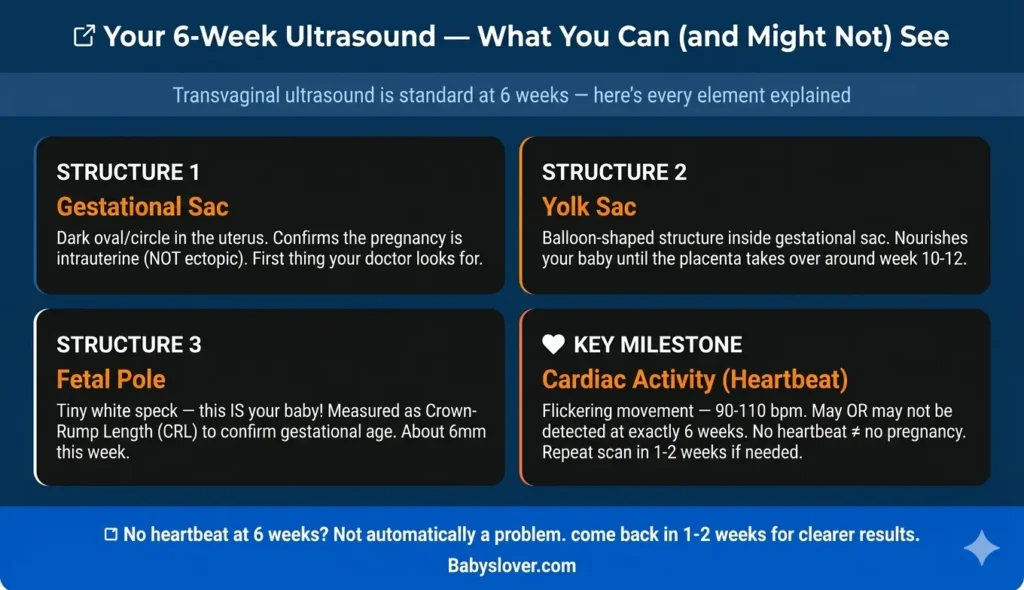
| What You See | What It Is | What It Means |
| Dark oval/circle | Gestational sac | Fluid-filled structure protecting embryo in uterus — confirms intrauterine pregnancy |
| Balloon-shaped structure | Yolk sac | Nourishing the embryo until placenta takes over — healthy size is reassuring |
| Small white speck | Fetal pole (embryo) | The earliest visible form of your baby — measures ~6mm this week |
| Flickering movement | Cardiac activity (heartbeat) | 90-110 bpm — confirms viability! May not be visible at exactly 6 weeks |
| Measurement line | Crown-Rump Length (CRL) | Measures embryo size to confirm/correct gestational age and due date |
What If There’s No Heartbeat at 6 Weeks?
This is one of the most common fears — and one of the most important things to understand: not seeing a heartbeat at exactly 6 weeks does not necessarily indicate a problem
The most common reasons no heartbeat is detected at 6 weeks:
- Gestational age miscalculation: If your cycle is irregular or ovulation happened later than average, you may be less far along than the dates suggest. What you think is 6 weeks may actually be 5+3 weeks — too early for a heartbeat.
- Equipment sensitivity: Even with transvaginal ultrasound, some embryos at exactly 6 weeks are simply too small for cardiac activity to be clearly detected. This is normal.
- Early booking: Many practices schedule early scans at exactly 6 weeks, when the heartbeat is only detectable in a portion of cases. Most will automatically schedule a repeat scan 1-2 weeks later for confirmation.
What your doctor will watch for: If the embryo measures 7mm or larger but shows no cardiac activity, that is more concerning and warrants careful evaluation. If the embryo measures less than 7mm without a heartbeat, a repeat scan in 1-2 weeks is standard practice.
💡 If you had a 6-week scan and didn’t see a heartbeat — take a breath. Ask your provider when they want to rescan. Waiting is extraordinarily hard, but a repeat scan in 1-2 weeks provides far more information than scanning again immediately.
Is a 6-Week Ultrasound Always Done?
Not routinely. Per ACOG guidelines, the first routine prenatal scan in a low-risk pregnancy is typically at 8–12 weeks. A 6-week scan is typically offered when: there is a history of ectopic pregnancy or miscarriage, the pregnancy occurred via IVF, there is bleeding or pain requiring evaluation, or the patient has other high-risk factors. If you don’t have an early scan booked, this is completely normal.
What to Eat at 6 Weeks Pregnant
Nutrition at 6 weeks pregnant is especially important — your baby’s brain, heart, face, and limbs are all forming simultaneously. Here’s what to prioritize, even if morning sickness makes eating a challenge:
| Nutrient | Why Critical at Week 6 | Best Sources |
| Folic Acid | Brain and neural development in overdrive this week | Leafy greens, lentils, avocado, fortified cereals, prenatal vitamin (400-800mcg) |
| Protein | Every cell in the embryo needs protein to divide and grow | Eggs, chicken, Greek yogurt, lentils, nuts, tofu |
| Iron | Blood volume expanding — iron demand rising rapidly | Lean beef, spinach, beans, fortified cereals, tofu |
| Vitamin B6 | Clinically proven to reduce morning sickness severity | Chicken, fish, bananas, chickpeas, potatoes (10-25mg 3x/day — ask OB) |
| Calcium | Bone and tooth structure developing | Dairy, fortified plant milk, tofu, salmon, kale |
| DHA (Omega-3) | Brain and vision development accelerating | Salmon (cooked), sardines, walnuts, DHA supplement |
Our best prenatal vitamins guide covers options that include DHA, B6, and iron in forms easier to tolerate on a nauseous stomach — worth reviewing before your next bottle.
Per the CDC, folic acid taken consistently through at least Week 12 significantly reduces the risk of neural tube defects. Don’t skip a single day.
For Your Partner — Week 6 Demands More
Week 6 is often when the reality of pregnancy becomes undeniable for both partners — and when the first serious support is needed.
- Be present for the ultrasound conversation: If an early scan is happening this week, attend it. If a heartbeat isn’t detected and a repeat scan is needed, this is an emotionally vulnerable time. Being there — not just physically but emotionally present — matters enormously.
- Don’t downplay the symptoms: ‘Other women had it worse’ or ‘at least you’re not sick in the hospital’ is not helpful. Her symptoms are real and they are happening to her. Validate them without comparison.
- Take over any tasks involving strong smells: Cooking, taking out trash, cleaning with strong products — these can trigger severe nausea in Week 6. Volunteering before being asked is the highest form of partnership right now.
- Learn what’s happening developmentally: Knowing that the baby’s face is forming and the heart is beating this week gives partners something concrete to connect to. You don’t need to feel every symptom to feel connected — read about the development, look at ultrasound images together, talk about it.
- Research first prenatal visit prep together: Look at our hospital bag checklist for mom and other preparation guides together. Getting involved in the planning now creates shared investment in the pregnancy journey.
- Watch for signs of perinatal anxiety: First-trimester anxiety is extremely common in pregnant women — especially before the 12-week mark when miscarriage risk drops. If your partner is spending significant time catastrophizing, struggling to sleep from worry, or expressing persistent hopelessness, gently encourage her to mention this to her OB. Perinatal anxiety is treatable and should not be minimized.
When to Call Your Doctor at 6 Weeks Pregnant
Call your OB immediately or go to the ER for these warning signs:
- Severe one-sided abdominal pain with dizziness, shoulder tip pain, or feeling faint: These are classic signs of ectopic pregnancy — a life-threatening emergency requiring immediate intervention.
- Heavy red bleeding: Light pink or brown spotting can be normal. Heavy bleeding (soaking a pad or passing clots) is not normal and requires urgent evaluation.
- Severe vomiting — cannot keep liquids down for 24+ hours: Hyperemesis gravidarum causes dangerous dehydration and requires medical treatment. Don’t wait.
- Fever above 100.4°F / 38°C: Infection in early pregnancy needs prompt evaluation and may require antibiotic treatment.
- Sudden complete loss of all symptoms after significant symptoms: While symptom fading can be normal, a sudden dramatic disappearance — especially if accompanied by cramping or bleeding — warrants a call to your OB.
- Painful or burning urination: Urinary tract infections are common in pregnancy and need prompt treatment — untreated UTIs can lead to kidney infections and preterm labor.
Your Week 6 Pregnancy Checklist
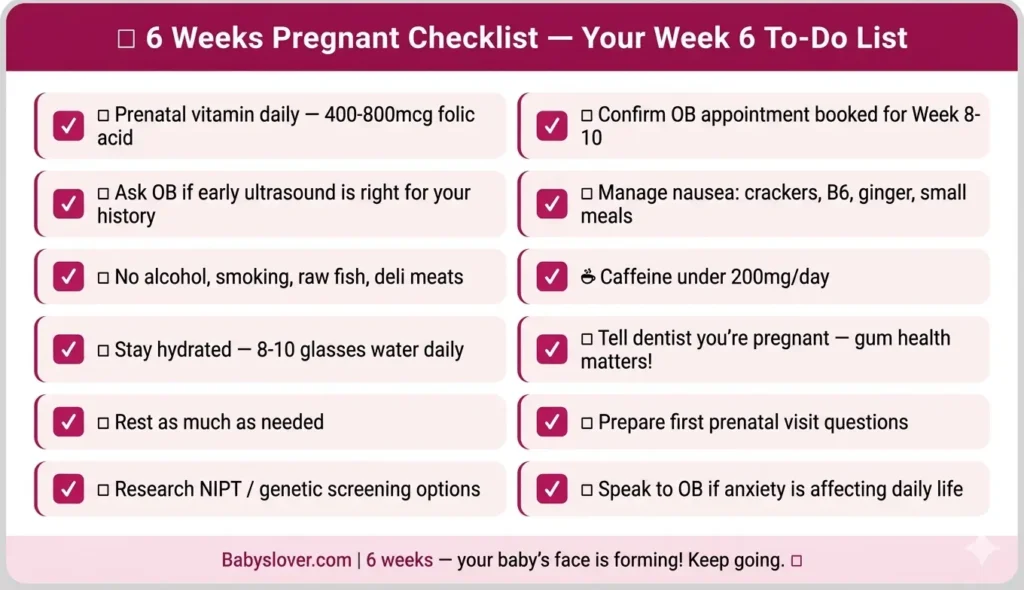
- ☑ Take prenatal vitamin daily — 400-800mcg folic acid, every single day
- ☑ Confirm your OB appointment is booked for Week 8-10
- ☑ Ask your OB if an early 6-7 week ultrasound is recommended for your history
- ☑ Manage morning sickness: crackers before rising, small frequent meals, B6, ginger
- ☑ Continue avoiding alcohol, smoking, raw fish, deli meats, high-mercury fish
- ☑ Keep caffeine strictly under 200mg per day
- ☑ Stay hydrated — 8-10 glasses of water daily, sip slowly
- ☑ Tell your dentist you’re pregnant — gum changes are real and need monitoring
- ☑ Rest as much as needed — first trimester fatigue is physiological, not laziness
- ☑ Continue tracking symptoms for your OB
- ☑ Research NIPT (Non-Invasive Prenatal Testing) available in the first trimester
- ☑ If experiencing anxiety, speak to your OB — perinatal anxiety is common and treatable
Frequently Asked Questions — 6 Weeks Pregnant
Can you see the heartbeat at 6 weeks pregnant?
Yes — sometimes. A heartbeat may be visible via transvaginal ultrasound at 6 weeks, beating at approximately 90–110 beats per minute. However, it’s not always detectable at exactly 6 weeks. If no heartbeat is seen, your provider will typically schedule a repeat scan 1-2 weeks later. Not seeing it at 6 weeks does not automatically indicate a problem.
What does 6 weeks pregnant feel like?
For most women, 6 weeks pregnant feels like Week 5 — but more intense. Nausea often worsens, fatigue deepens, and breast tenderness continues. Some women feel the first significant emotional anxiety this week — the waiting period before the first confirmed heartbeat can be stressful. Bloating may make you feel ‘pregnant-looking’ in a way that’s really just digestive slowdown.
How big is my baby at 6 weeks pregnant?
Your baby at 6 weeks pregnant is approximately 6mm — about the size of a sweet pea or lentil. That’s 3× the size of last week’s sesame seed! Despite its tiny size, your baby’s face is beginning to form, the heart is beating, and every major organ system is developing.
Is cramping normal at 6 weeks pregnant?
Mild cramping — similar to period cramps — is common at 6 weeks as the uterus grows and the placenta develops. If cramping is severe, one-sided, or accompanied by heavy red bleeding, call your doctor immediately as these can be signs of ectopic pregnancy or miscarriage.
Can I have a miscarriage at 6 weeks?
Miscarriage is most common in the first trimester. However, once a heartbeat is confirmed at 6-7 weeks, the risk drops significantly — to around 5% from a statistical 10-20% in the period before heartbeat confirmation. Most first-trimester losses are due to chromosomal abnormalities, not anything the mother did or didn’t do.
I’m 6 weeks pregnant with no morning sickness — is that normal?
Yes — completely normal. Many women experience little to no morning sickness throughout the first trimester and have perfectly healthy pregnancies. Symptom intensity has no reliable connection to pregnancy health or outcome. Don’t compare your experience to others.
What is leukorrhea at 6 weeks pregnant?
Leukorrhea is the increased clear or milky white discharge many women notice in early pregnancy. It’s caused by rising estrogen and increased blood flow to the cervix and vagina. It’s completely normal and serves as a protective barrier. If your discharge is green, yellow, has a strong unusual odor, or causes itching/burning, contact your OB as these may indicate infection.
When should I announce my pregnancy?
Most OBs suggest waiting until after 12 weeks — when miscarriage risk drops significantly and the first trimester screen results are in. This is, of course, entirely your personal choice. Many women choose to tell a close partner, best friend, or immediate family member much earlier, while keeping it from wider circles until the 12-week mark.
💗 The Emotional Reality of 6 Weeks — The Waiting Space
Six weeks is a strange, suspended place.
You know you’re pregnant. You feel it in every wave of nausea, every moment of crushing fatigue, every time your body reminds you something extraordinary is happening. And yet — you haven’t told most people. You may not have heard the heartbeat yet. You’re in the first trimester, where the statistics are still sobering and the silence feels heavy.
This is what pregnancy researchers call the ‘tentative pregnancy’ phase — when many parents hold back full emotional investment until they feel more certain of a healthy outcome. If that’s you: it’s valid. It’s one of the most human responses imaginable.
But here’s what we want you to know: you are allowed to love this baby right now. You are allowed to feel joy and fear and hope and grief all at once. You don’t have to choose between being realistic and being attached.
At Babyslover, we see you — in all the complexity of this moment. You are not alone in any of it. 💗
What Happens Next — 7 Weeks Pregnant Preview
Week 7 brings even more rapid development. Here’s what to expect from 7 weeks pregnant:
Stay with our complete pregnancy week by week guide as we follow your baby’s journey all the way from Week 1 to Week 40!
Week 6: The Flicker That Changes Everything
Being 6 weeks pregnant is being in the midst of one of the most extraordinary biological events in the universe — even if all you can feel is nausea and exhaustion.
Somewhere inside you, a sweet-pea-sized embryo has a beating heart, a forming face, and a brain that is already growing faster than it ever will again. Your body is doing things it has never done before — building a placenta, expanding its blood supply, growing an entirely new human being.
Keep going. Keep resting. Keep eating what you can. Keep taking those vitamins. And know that every moment of discomfort is your body doing exactly what it should. You’ve got this, mama. 💗 For more support, explore our pregnancy tips for first time moms — it was written with exactly Week 6 moms in mind.
1 thought on “6 Weeks Pregnant: Symptoms, Ultrasound & Baby Development”