

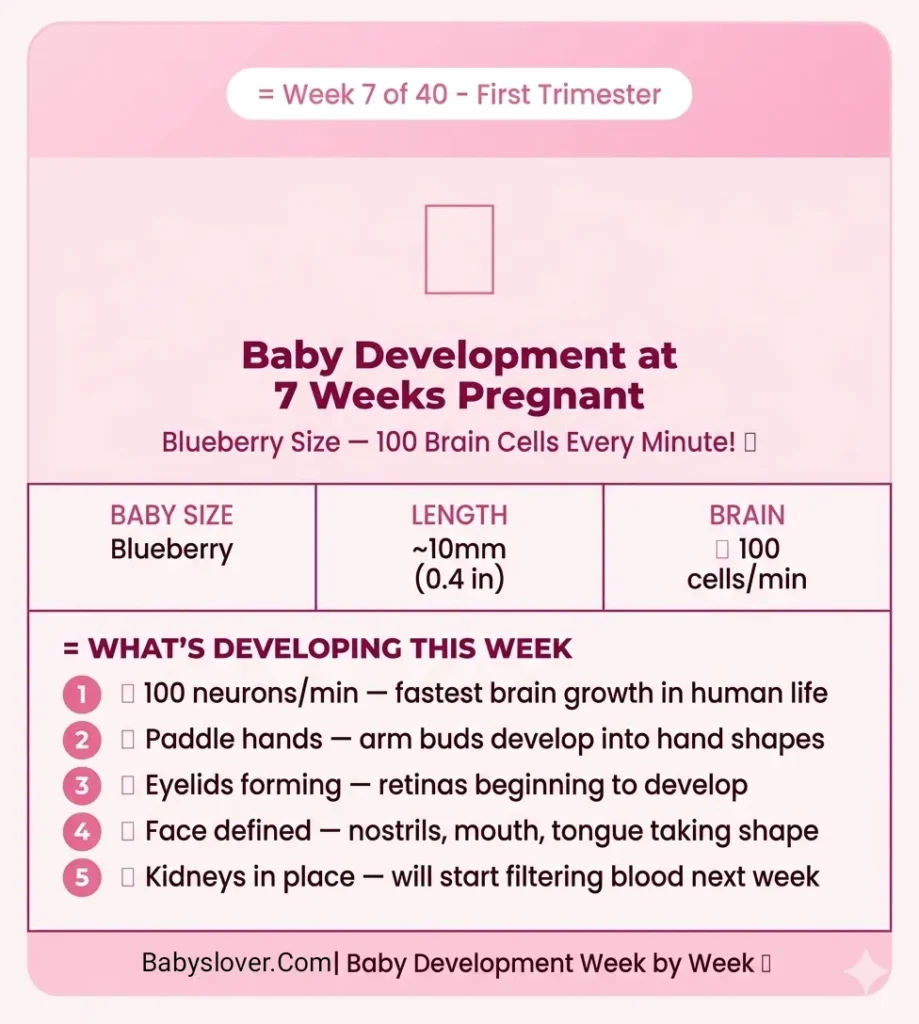
Your baby is making 100 new brain cells every single minute right now. At 7 weeks pregnant, your baby has grown from a sweet pea into a blueberry — roughly 10mm long, about the size of a small grape or blueberry. And while that might not sound impressive by weight or size, what’s happening inside that tiny body is nothing short of extraordinary.
The brain is growing at a pace it will never match again. Tiny paddle-shaped hands are forming. Eyelids are beginning to appear over developing eyes.
Welcome to Week 7. At Babyslover, we’ll walk you through everything happening this week — your baby’s remarkable development, what symptoms to expect (morning sickness often peaks between Weeks 6-9), and how to prepare for your first prenatal appointment, which is coming up soon. Just finishing last week? Read our 6 weeks pregnant guide first for context on the heartbeat milestone you may have just hit.

| 📋 Quick Summary — Week 7 of Pregnancy | |
| Week | Week 7 of 40 |
| Trimester | First Trimester |
| Baby Size | 🫐 Blueberry / small grape — 10mm (0.4 inches) |
| Baby Stage | Embryo — paddle hands forming, eyelids developing, brain exploding |
| Key Milestone | 🧠 100 NEW BRAIN CELLS EVERY MINUTE — fastest brain growth in all of human development |
| Heart Rate | 💗 120–160 bpm and rising each day |
| Symptoms | Morning sickness often at peak, extreme fatigue, breast tenderness, excess saliva, acne, bloating, mood swings, frequent urination |
| First Step | 📋 Prepare your question list for your first prenatal appointment — coming up in just 1-3 weeks! |
What’s Happening in Your Body at 7 Weeks Pregnant
At 7 weeks pregnant, you are now 18% through your pregnancy — and your body is continuing its extraordinary internal transformation, even if nothing is visible on the outside yet.
Your Uterus Is Now the Size of an Orange
Your uterus has grown from its pre-pregnancy pear size to roughly the size of a medium orange. Still tucked low in your pelvis, it won’t be visible as a bump for several more weeks. But internally, the space is expanding rapidly to accommodate the growing embryo, placenta, and amniotic fluid. Some women notice a subtle firmness or heaviness in their lower abdomen when they lie flat.
Mucus Plug Is Forming
By Week 7, your body has formed something important: the mucus plug. This thick, gel-like seal forms in the opening of the cervical canal and acts as a protective barrier — sealing off the uterus from bacteria, infection, and the outside world. The mucus plug will remain in place throughout the entire pregnancy and is released only when the cervix begins to dilate in preparation for labor. Its formation this early is a sign your body is already actively protecting your baby.
Kidneys Are Ramping Up
Your kidneys are now filtering significantly more blood than before pregnancy — and they’ll continue to ramp up throughout the first and second trimesters. This increased filtration is one reason you’re making so many trips to the bathroom. Staying well hydrated is essential: your kidneys are working harder than usual and need the support.
hCG Is Still Climbing
hCG levels are still rising rapidly at Week 7 — typically reaching into the 4,059–153,767 mIU/mL range by this point. This continued surge means your symptoms — especially morning sickness and fatigue — may still be intensifying. hCG peaks around Week 10, after which it gradually declines as the placenta fully takes over hormone production. For most women, symptom intensity follows this same arc: peaking around Weeks 8-10 and gradually improving after Week 12.
Skin Changes — Acne and Glow
Week 7 brings skin surprises in both directions. The famous ‘pregnancy glow’ — caused by increased blood volume and circulation giving the skin a flushed, luminous appearance — may begin now. But so can pregnancy acne. The same hormones driving nausea and fatigue are also increasing sebum (oil) production in your skin. Breakouts on the chin, jaw, and cheeks are common. Check with your OB before using any acne products — many common treatments (retinoids, salicylic acid in high doses) are not safe during pregnancy.
🌱 Baby Development at 7 Weeks Pregnant
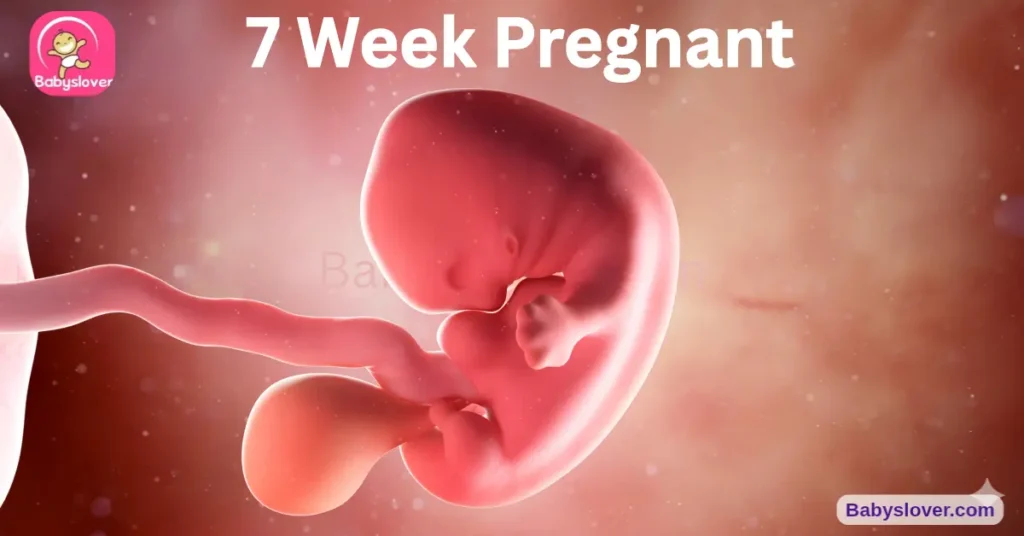
At 7 weeks pregnant, your baby — officially still called an embryo — has doubled in size since last week, growing from 6mm to approximately 10mm — the size of a blueberry or small grape. To put Week 7 in perspective: your baby has grown more than 10,000 times larger than the single fertilized cell it was at conception. And the pace isn’t slowing down.
| 🌱 Baby Development at 7 Weeks Pregnant | |
| Baby Size | 🫐 Blueberry / small grape — 10mm (0.4 inches) |
| Fruit Comparison | 🫐 Blueberry |
| Weight | About 0.33 ounces — just becoming measurable! |
| Stage | Embryo — all major organ systems developing simultaneously |
| Week / Trimester | Week 7 of 40 • First Trimester (18% complete) |
| Key Milestone | 🧠 100 new neurons per minute — fastest brain growth ever! |
What Is Developing at Week 7
- 🧠 Brain growing at 100 neurons per minute: This is the single most astonishing fact about Week 7 development. Your baby’s brain is generating approximately 100 new nerve cells every single minute — a rate of growth that no other part of the human body ever matches at any stage of life. The three primary brain regions (forebrain, midbrain, hindbrain) are becoming more distinct, and the cerebral cortex — the region responsible for thought, personality, language, and voluntary movement — is actively expanding. This is why folic acid remains critical through the first trimester: neural development is happening at a breathtaking rate.
- 🖐️ Paddle hands forming: Last week’s tiny limb buds have now developed into small paddle-shaped structures at the ends of the arm buds — the earliest form of hands. These ‘paddles’ will gradually separate over the coming weeks as webbing between the finger areas breaks down, creating individual fingers. Knees and elbows are also beginning to differentiate, giving the limbs their first bends. The arm buds are slightly more developed than the leg buds at this stage.
- 👁️ Eyelids forming, retinas developing: Eyelids are beginning to grow over the developing eyes this week — they won’t open again until Week 26–28. The tiny retinas, which are the light-sensitive layers at the back of the eye that make vision possible, are also starting to form. Your baby cannot see anything yet — but the biological infrastructure for a lifetime of sight is being built right now.
- 👃 Nostrils, mouth, and tongue defined: The facial features that began forming in Week 6 are becoming more distinct. Nostrils are visible as two small pits. The mouth is taking shape with a defined upper and lower jaw. The tongue is beginning to develop inside the oral cavity — though your baby won’t taste anything for many weeks yet. Tiny ear structures on the sides of the head are also becoming more pronounced.
- 🫀 Heart rate rising — 120-160 bpm: The heart, which began its primitive beating at Week 5, is now beating at 120–160 beats per minute and rising with each passing day. The four-chamber structure continues to develop. The heart is also beginning to push blood through early vessels to the developing brain, limbs, and organs — establishing the circulatory system that will sustain your baby for the rest of its life.
- 🫘 Kidneys in place: Your baby’s kidneys are now positioned where they need to be — though they haven’t yet begun filtering blood. This happens in the coming weeks, after which the kidneys will start producing urine. This urine is actually swallowed by the baby and becomes a significant component of the amniotic fluid. Yes — your baby will be drinking their own recycled urine for the rest of pregnancy. It’s completely sterile and normal!
- 🦠 Appendix and pancreas forming: The digestive system continues to develop, with the appendix and pancreas beginning to form this week. The intestines are also beginning to develop inside the umbilical cord (they’ll migrate into the abdomen around Week 10-12). The liver has already started producing blood cells this week — a function it maintains until the bone marrow takes over later in pregnancy.
💡 Fun fact: Your baby has grown more than 10,000 times larger than the single cell it was at conception — and it’s still only the size of a blueberry. The rate of growth happening right now (relative to body size) will never be matched at any other point in your baby’s entire life.
7 Weeks Pregnant Symptoms — What’s Normal
Week 7 is notorious for being one of the most symptom-heavy weeks of the first trimester. Morning sickness often peaks between Weeks 6–9, and many of the other symptoms of early pregnancy intensify before they improve. Here’s what to expect at 7 weeks pregnant:
🤢 Morning Sickness — Often Peaking Now
For many women, Week 7 is the height of morning sickness. The combination of peak hCG levels and maximum progesterone produces nausea that can strike at any hour, triggered by smells, movement, an empty stomach, or nothing at all. According to Mayo Clinic, up to 80% of pregnant women experience nausea in the first trimester, and for some it is debilitating.
If you haven’t already, try these evidence-backed strategies: Vitamin B6 (10-25mg three times daily) — ask your OB first — and ginger in any form are the most effective natural approaches. Eating small frequent meals and never letting your stomach go empty is essential. If you are vomiting so severely that you cannot keep any liquids down for more than 24 hours, contact your OB — this may be hyperemesis gravidarum requiring medical intervention.
😴 Extreme Fatigue
The bone-deep exhaustion of early pregnancy continues at Week 7 — and for many women, it’s the worst it gets. Your body is building a placenta, sustaining explosive embryonic growth, expanding blood volume, and managing a radical hormonal overhaul — all at the same time. Progesterone’s sedative effect makes it almost impossible to feel rested, regardless of sleep duration. Rest is not a luxury at this stage — it’s a biological requirement.
🫧 Bloating and Constipation
Progesterone’s effect on the digestive system continues — slowing transit time to allow maximum nutrient absorption. This creates bloating, gas, and constipation that can make you feel several weeks further along than you are. High-fiber foods (fruits, vegetables, whole grains, lentils), adequate water intake, and gentle walking can help keep things moving. If constipation is severe, ask your OB about safe fiber supplements — many common laxatives are not recommended during pregnancy.
💧 Excess Saliva — Ptyalism Gravidarum
One of the stranger and less-discussed pregnancy symptoms: excess saliva production (called ptyalism or sialorrhea gravidarum). Many women notice they are producing far more saliva than usual, which often accompanies or intensifies nausea. It’s hormonally driven and completely normal — though deeply uncomfortable. Chewing sugarless gum, using a mouthwash, or sucking on hard candy can provide some relief. For most women, this improves after the first trimester.
🌸 Acne and Skin Changes
Pregnancy hormones increase oil production in the skin, leading to acne breakouts — especially along the chin, jaw, and cheeks. Simultaneously, increased circulation may give your skin a flushed, luminous ‘pregnancy glow.’ Before using any topical acne treatments, check with your OB — retinoids (retinol, tretinoin) are not safe during pregnancy, and high-dose salicylic acid is best avoided. Gentle cleansing and non-comedogenic moisturizers are usually recommended.
🍈 Breast Tenderness and Growth
Your breasts continue to grow and change this week — many women need to size up in bras by Week 7-8. The veins on the breasts become more visible as blood supply increases, and the areolas may darken further. Montgomery glands (small bumps around the nipples) become more prominent as they prepare for breastfeeding. A comfortable, supportive bra — worn day and night — remains your best friend this trimester.
🚽 Frequent Urination
Your uterus is now the size of an orange and pressing on your bladder with increasing insistence. Your kidneys are also filtering a significantly higher volume of blood than before pregnancy. The result: a constant companion of bathroom urgency. This eases slightly in the second trimester as the uterus rises out of the pelvis, then returns with a vengeance in the third trimester.
💭 No Symptoms at 7 Weeks — Still Normal
7 weeks pregnant with no symptoms is common and does not indicate a problem. Many women experience minimal nausea, little fatigue, and no notable symptoms throughout the first trimester and have completely healthy pregnancies. Symptom absence is not a warning sign. Trust your prenatal care rather than comparing your experience to others.
💡 Every pregnancy is unique. Some women spend the first trimester feeling barely any different. Others are barely functional from nausea and exhaustion. Both are normal. Neither predicts how your pregnancy will go.
Your First Prenatal Visit — What to Expect
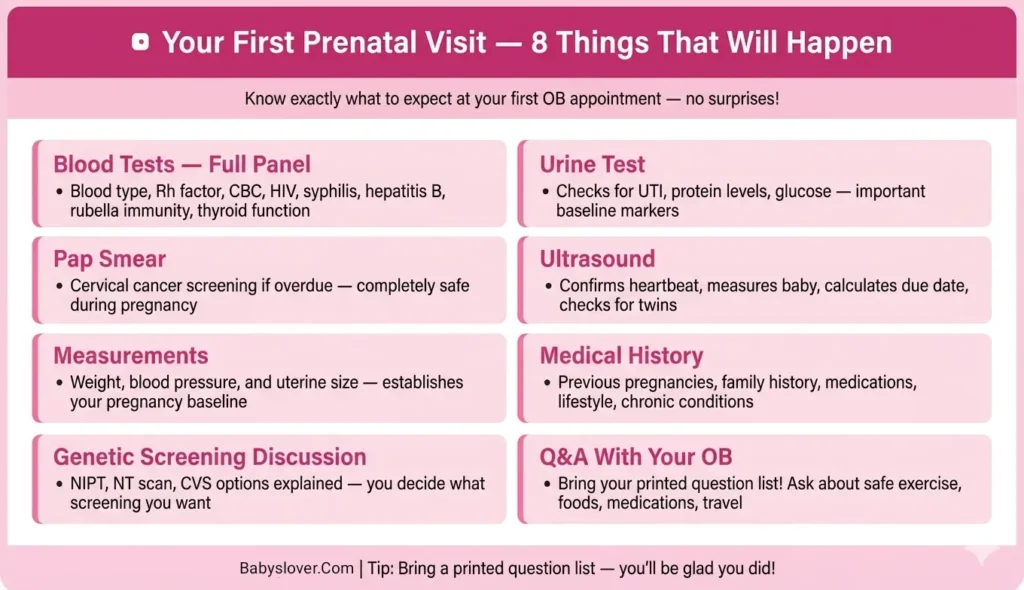
Your first prenatal appointment is one of the most anticipated and important appointments of your pregnancy. Most providers schedule it between Weeks 8–10 — so if you haven’t booked it yet, do it this week. Per ACOG, this visit is more thorough than any subsequent prenatal check, and it’s worth knowing exactly what’s coming.
What Happens at Your First Prenatal Appointment
| Test / Procedure | What It Checks / Why It Matters |
| Blood tests — full panel | Blood type and Rh factor, complete blood count (anemia), STI screening (HIV, syphilis, hepatitis B, chlamydia), rubella immunity, thyroid function, and sometimes genetic carrier screening |
| Urine test | Checks for urinary tract infection (very common in pregnancy), protein (preeclampsia risk marker), glucose (gestational diabetes early indicator) |
| Pap smear | Cervical cancer screening — done if you’re due for one. Safe during pregnancy. Results may take 1-2 weeks |
| Ultrasound | Confirms intrauterine pregnancy, measures embryo (Crown-Rump Length), verifies heartbeat, confirms number of embryos (twins?), calculates/adjusts due date |
| Blood pressure | Establishes baseline — compared at every visit. Early hypertension identified here |
| Weight and BMI | Establishes baseline for pregnancy weight gain tracking |
| Medical history | Previous pregnancies, family genetic history, current medications, chronic conditions, lifestyle factors |
| Genetic screening discussion | Options explained: NIPT (non-invasive prenatal testing, 10+ weeks), NT scan (nuchal translucency ultrasound, 11-14 weeks), CVS, amniocentesis |
Questions to Ask at Your First Prenatal Visit
- What genetic screening options do you recommend for my age and history?
- What is my due date based on today’s ultrasound?
- Is my weight/BMI within the recommended range for pregnancy weight gain?
- Are my current medications safe to continue during pregnancy?
- What exercises are safe — and which should I avoid?
- What are the signs that I should call you between appointments?
- What should I eat more of — and what should I completely avoid?
- Is it safe for me to travel during this pregnancy?
- What OTC medications are safe for headaches, colds, or allergies?
- When will my next appointment be, and what will it involve?
Consider printing this list and taking it with you. Our pregnancy tips for first time moms guide also has a comprehensive section on making the most of your prenatal visits.
What to Eat at 7 Weeks Pregnant
Eating well at 7 weeks pregnant is both critical and challenging — your baby’s brain is in explosive growth mode, but your stomach may barely tolerate food. Here’s a practical nutrition approach for Week 7:
| Nutrient | Why Critical at Week 7 | Best Sources |
| Folic Acid | Neural tube fully closed — brain now in explosive growth. Folic acid reduces birth defect risk throughout Q1 | Prenatal vitamin (400-800mcg), leafy greens, lentils, avocado, fortified cereals |
| Vitamin B6 | Proven to reduce morning sickness nausea severity | Chicken, fish, bananas, chickpeas, potatoes — or ask OB about B6 supplement |
| DHA (Omega-3) | Brain producing 100 neurons/minute — DHA is the brain’s primary structural fat | Cooked salmon, sardines, walnuts, flaxseed, DHA supplement in prenatal vitamin |
| Iron | Blood volume expanding rapidly — iron demand increasing weekly | Lean meat, spinach, beans, lentils, tofu, fortified cereals |
| Protein | Every new cell in the embryo requires protein — brain cells especially | Eggs, chicken, Greek yogurt, lentils, quinoa, nuts |
| Water | Kidneys are filtering more — dehydration worsens nausea and causes fatigue | 8-10 glasses/day — sip slowly; cold water often better tolerated when nauseous |
Per the CDC, continuing 400-800mcg of folic acid daily through the first trimester (and ideally the entire pregnancy) provides ongoing protection for neural development. Don’t skip a single day of your prenatal vitamin. If nausea makes swallowing capsules difficult, try taking it with food, switching to a gummy prenatal, or taking it before bed rather than in the morning. Our best prenatal vitamins guide covers the gentlest options for nausea-prone moms.
For Your Partner — Week 7 Action Items
The first prenatal appointment is approaching, and there’s meaningful preparation both partners can do right now:
- Book the appointment together if possible: If your OB’s office allows it, being the one to call and help book the first prenatal appointment is a small but meaningful act of shared ownership of this pregnancy. Partners who attend prenatal visits are consistently more engaged throughout the pregnancy.
- Learn what the first appointment involves: Read through the ‘First Prenatal Visit’ section of this post together. Knowing what blood tests, ultrasound, and screenings are coming removes anxiety for both partners — and means you can both contribute meaningful questions.
- Help manage the environment at home: Morning sickness at Week 7 is often at its worst. Keep the kitchen stocked with crackers, plain rice cakes, bland foods, ginger products, and whatever she can currently stomach. Remove food items that are triggering her nausea if possible.
- Don’t try to ‘fix’ her symptoms: Morning sickness is hormonally driven and not fixable. What helps is presence, patience, and practical support — not suggestions that she ‘push through it’ or ‘just eat something.’ Show empathy without trying to problem-solve symptoms that aren’t solvable right now.
- Research genetic screening options: NIPT (non-invasive prenatal testing) and the nuchal translucency scan are first-trimester options that many couples want to discuss with their OB at the first appointment. Researching these together so you can make a joint informed decision is excellent partnership.
- Protect your own mental health too: Partner anxiety in the first trimester is real and valid. The uncertainty of the first 12 weeks is hard for everyone. Find one trusted outlet — a friend, journal, or therapist — to process your own feelings so you can show up consistently for her.
When to Call Your Doctor at 7 Weeks Pregnant
Most Week 7 symptoms are normal — but seek immediate care for:
- Severe one-sided abdominal pain with shoulder tip pain, dizziness, or faintness: Classic ectopic pregnancy signs. This is a life-threatening emergency — go to the ER immediately, do not wait for an OB appointment.
- Heavy bleeding — soaking a pad or passing clots: Light pink or brown spotting can be normal. Heavy red bleeding requires urgent evaluation.
- Vomiting so severe you cannot keep any liquids down for 24+ hours: Hyperemesis gravidarum requires IV fluids and medical treatment. Don’t try to manage this at home.
- High fever (100.4°F / 38°C or above): Infection in the first trimester needs prompt evaluation and may require treatment.
- Burning or pain with urination: UTIs are very common in pregnancy and need antibiotic treatment — untreated UTIs can progress to kidney infections, which can cause preterm labor.
- Sudden dramatic decrease in symptoms after being very symptomatic: While symptom fading can be normal, a sudden and complete symptom disappearance — especially with cramping or bleeding — warrants a call to your provider for reassurance or evaluation.
Your Week 7 Pregnancy Checklist
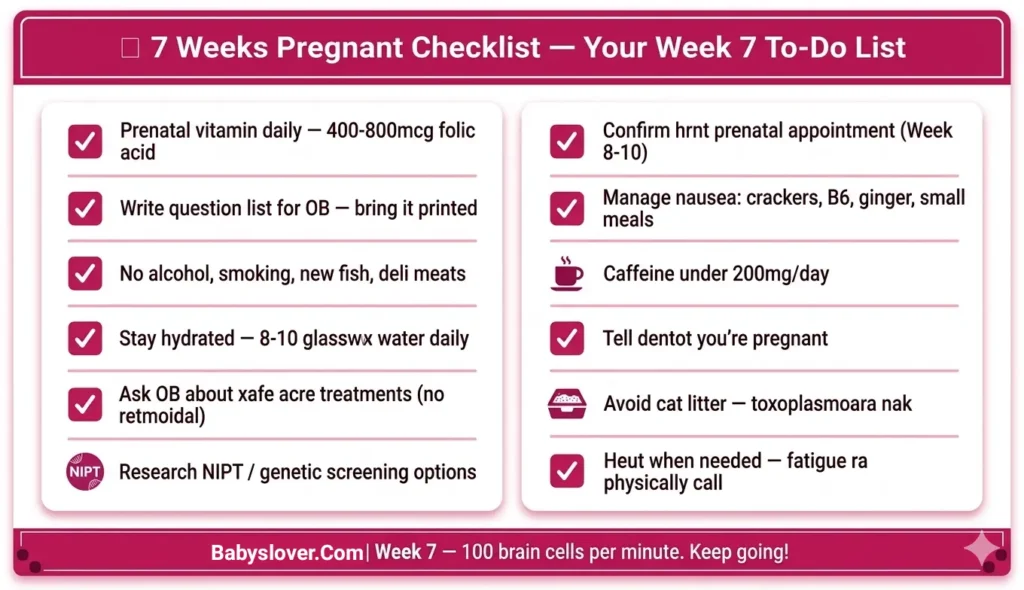
- ☑ Take prenatal vitamin daily — folic acid 400-800mcg, every single day
- ☑ Confirm first prenatal appointment is booked (aim for Week 8-10)
- ☑ Write your question list for the OB appointment — bring it printed
- ☑ Manage morning sickness: crackers, B6, ginger, small frequent meals
- ☑ Avoid alcohol, smoking, raw fish, deli meats, high-mercury seafood
- ☑ Keep caffeine strictly under 200mg per day
- ☑ Stay hydrated — 8-10 glasses water daily (cold often better tolerated)
- ☑ Tell your dentist you’re pregnant at your next visit — gum health matters
- ☑ Ask OB about safe acne treatments — avoid retinoids completely
- ☑ Avoid cat litter (toxoplasmosis risk from cat feces)
- ☑ Research NIPT and genetic screening options before your OB appointment
- ☑ Rest as much as needed — first trimester fatigue is physiological
Frequently Asked Questions — 7 Weeks Pregnant
What does 7 weeks pregnant feel like?
For most women, 7 weeks pregnant feels like the hardest week yet — morning sickness is often at or near its peak, fatigue is profound, and new symptoms like excess saliva and acne may appear. Emotionally, the anxiety of being in the first trimester (before the 12-week ‘safe zone’) combined with keeping the news secret can be exhausting. Many women also feel occasional moments of pure wonder — especially if they’ve seen a heartbeat on an ultrasound.
How big is my baby at 7 weeks pregnant?
Your baby at 7 weeks pregnant is approximately 10mm long — about the size of a blueberry or small grape. It now weighs around 0.33 ounces. Despite this tiny size, the brain, heart, face, hands, kidneys, and digestive system are all actively developing simultaneously.
Is cramping normal at 7 weeks pregnant?
Mild cramping — similar to menstrual cramps — is very common at 7 weeks as the uterus continues to grow and the round ligaments stretch. Cramping that is severe, persistent, one-sided, or accompanied by heavy bleeding should be evaluated immediately to rule out ectopic pregnancy or miscarriage.
Can you have a miscarriage at 7 weeks pregnant?
Miscarriage risk is still present at 7 weeks, but it decreases significantly with each week. Once a heartbeat is confirmed via ultrasound (typically at 6-8 weeks), the risk drops to around 5% or less — compared to 10-20% before confirmation. Most early miscarriages are caused by chromosomal abnormalities, not anything the mother did or didn’t do.
Why do I have so much saliva at 7 weeks pregnant?
Excess saliva (ptyalism gravidarum) is a common but little-discussed early pregnancy symptom caused by hormonal changes — especially rising estrogen. It’s often associated with nausea and morning sickness. It typically improves after the first trimester. Chewing sugarless gum, rinsing with mouthwash, and staying hydrated can provide some relief.
When is the first prenatal appointment?
Most providers schedule the first full prenatal appointment between Weeks 8–10. This timing is chosen because there’s enough to examine: a heartbeat is clearly visible, blood can be drawn for comprehensive testing, and the gestational age can be accurately confirmed on ultrasound. If you haven’t booked yet, call your OB this week — practices fill up quickly.
Is it safe to exercise at 7 weeks pregnant?
Yes — moderate exercise is safe and beneficial in a low-risk pregnancy. Walking, swimming, prenatal yoga, and light cardio are all encouraged. Avoid contact sports, high-impact activities with fall risk, exercises lying flat on your back for extended periods (after the first trimester), hot yoga, and anything that makes you significantly overheat. Always get clearance from your OB if you have any concerns.
Can I tell people I’m pregnant at 7 weeks?
Most OBs suggest waiting until after 12 weeks — when miscarriage risk drops significantly and first trimester screening results are in. However, this is entirely personal. Many women tell their closest support person (partner, best friend, mother) much earlier. The 12-week guideline is about managing the experience of loss if miscarriage occurs — but you know your own support network best.
💗 The Emotional Side of Week 7 — The Secret Weight
There’s a particular kind of exhaustion that comes from keeping a secret.
At 7 weeks pregnant, many women are carrying two loads simultaneously: the physical weight of an intensely symptomatic first trimester, and the emotional weight of holding this enormous news inside while navigating everyday life. Going to work and pretending you feel normal when you’re fighting nausea. Declining drinks at social events without explanation. Watching other people make plans for months ahead when all your mental energy is focused on just getting through to 12 weeks.
This is hard. And it’s okay to acknowledge that.
You are allowed to find Week 7 hard without feeling guilty for not feeling more grateful. You are allowed to be terrified about miscarriage while also being deeply hopeful. You are allowed to be completely exhausted — physically and emotionally — and still be doing pregnancy beautifully.
At Babyslover, we see everything you’re carrying right now. Week 12 is coming. The nausea will ease. And the secret won’t be a secret much longer. 💗
👶 What Happens Next — 8 Weeks Pregnant Preview
Week 8 is a big milestone — here’s what to expect from 8 weeks pregnant:
- Baby grows from blueberry to raspberry — about 16mm, 0.63 inches
- Fingers and toes beginning to separate — webbing is breaking down
- Heart rate at 150-170 bpm — a more mature rhythm forming
- All major organs are now present — development shifts from ‘forming’ to ‘growing’
- Baby starts making small spontaneous movements — though still too small to feel
- Tail (yes, embryos have a tail!) fully disappears this week
- Your first prenatal appointment is likely this week or next!
Keep following our complete pregnancy week by week guide — from Week 1 all the way to Week 40!
Week 7: The Week of 100 Miracles Per Minute
Being 7 weeks pregnant means carrying a blueberry-sized baby whose brain is building itself at 100 cells per minute. A baby whose tiny hands are taking shape. Whose eyelids are forming. Whose kidneys are settling into place.
None of it is visible from the outside yet. Nobody else may even know. But inside you, a level of creative activity is happening that puts every human achievement to shame.
Keep taking those vitamins. Keep resting. Keep eating what you can. The first prenatal appointment is coming — and with it, a little more certainty, a little more connection to this extraordinary journey. You’re doing great. 💗 For more guidance, read our pregnancy tips for first time moms — written for exactly this moment.