

Your baby just got a new name. At 9 weeks pregnant, the single most significant developmental milestone of the entire first trimester happens quietly, without fanfare:
Your baby officially transitions from embryo to fetus. That tiny grape-sized being inside you — measuring about 22mm and weighing just 2 grams — has completed the extraordinary work of building every major organ system from scratch. Now begins a new phase: growth, refinement, and the long journey to a fully formed baby.
And that’s not all. This week, your baby can make a tiny fist. All five of their major joints are functioning. Their tail — yes, human embryos have a tail — has completely disappeared. At Babyslover, we’ll walk you through everything happening at 9 weeks pregnant: what this milestone means, what your fetus looks like, what symptoms to expect, and what to do this week. Coming from last week? Our 8 weeks pregnant guide has the raspberry-to-grape growth story.

| 📋 Quick Summary — Week 9 of Pregnancy | |
| Week | Week 9 of 40 |
| Trimester | First Trimester (you’re 22% through!) |
| Baby Size | 🍇 Grape / olive — 22–25mm (about 0.9 inches) |
| Baby Weight | ~2 grams (0.07 oz) — just becoming measurable |
| KEY MILESTONE | 🎉 EMBRYO → FETUS! Baby’s name officially changes — all major organs now present |
| Other Milestones | Tail disappears • Baby can make a fist • Thumb sucking may begin • All 5 joints working • Eyelids fused shut • Teeth buds forming |
| Symptoms | Morning sickness (often near peak), extreme fatigue, bloating, frequent urination, headaches, mood swings, food aversions/cravings, heartburn |
| First Step This Week | 📋 Attend your first prenatal appointment if scheduled + start Kegel exercises today |
🎉 The Biggest Milestone of the First Trimester — Embryo to Fetus
At 9 weeks pregnant, your baby transitions from embryo to fetus — and this change is more significant than it might sound.
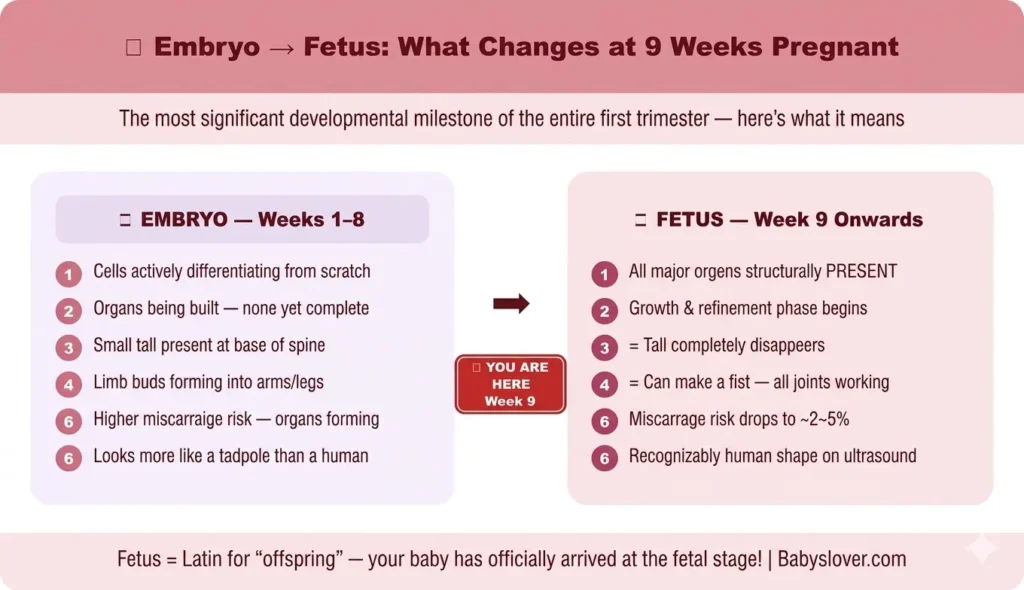
The word embryo describes the stage of development when cells are differentiating and all the major organ systems are being built from scratch. It’s the architectural phase — designing and constructing the foundations. The word fetus (Latin for ‘offspring’ or ‘bearing’) marks the transition to the growth phase — when the structures are in place and the work shifts to expanding, refining, and maturing them.
Here’s what has been accomplished in just 8 weeks of embryonic development:
- A beating, four-chambered heart that circulates blood
- A brain with three differentiated regions, generating neurons continuously
- Two eyes with developing retinas and eyelids now fused shut
- Two ears, a nose, a mouth, and a tongue
- Arms and legs with five distinct joints each
- Lungs, liver, kidneys, stomach, intestines, and pancreas — all in place
- A spinal cord enclosed in its protective column
- The beginnings of the reproductive system
All of that — built from a single fertilized cell — in 56 days. The fetal phase, by contrast, will last 217 more days. The embryonic phase was the extraordinary creative sprint. The fetal phase is the long, steady work of growth.
💡 The embryo-to-fetus transition also comes with a meaningful change in miscarriage statistics. Once the fetal stage is confirmed with a heartbeat at this point, miscarriage risk drops to approximately 2-5% — compared to the 10-20% risk early in the first trimester. Every week that passes, the odds continue to improve.
What’s Happening in Your Body at 9 Weeks Pregnant
Your Uterus Is Now the Size of a Grapefruit
Your uterus has expanded to approximately the size of a large grapefruit — though it’s still contained entirely within your pelvis. You may not look pregnant yet, but your waistbands may be feeling noticeably tighter. This is partly uterine growth and partly the hormone-driven bloating that affects the digestive system throughout the first trimester. Many women find their regular jeans uncomfortable by Week 9 and start reaching for the hair-tie waistband trick or maternity basics.
hCG Is Approaching Its Peak
Your hCG levels are now at some of their highest values of the entire pregnancy — typically in the range of 25,700–288,000 mIU/mL at Week 9. The hormone peaks around Week 10–12, after which it gradually declines as the placenta fully takes over progesterone production. This means morning sickness and other hCG-driven symptoms may still be intensifying this week before they begin to ease — usually around Week 12–14 for most women.
Heartburn and Digestive Changes
A new symptom that often arrives in force around Week 9: heartburn (acid reflux). Progesterone relaxes the lower esophageal sphincter — the valve between your stomach and esophagus — allowing stomach acid to back up. Combined with the slowed digestive system, this creates a burning sensation in the chest or throat, especially after meals. Eating smaller, more frequent meals, avoiding spicy and fatty foods, not lying down immediately after eating, and elevating the head of the bed slightly can all help. Ask your OB about safe antacids if it’s severe.
Round Ligament Stretching
As your uterus grows, the round ligaments that support it stretch to accommodate the expansion. This can cause sharp, sudden, or pulling sensations in the lower abdomen or groin — especially when you change position quickly, sneeze, or cough. Round ligament pain is completely normal in pregnancy. If pain is severe, persistent, or accompanied by bleeding or fever, contact your OB.
Visible Veins
Your blood volume is now 20-30% higher than before pregnancy — and it will increase by up to 50% by the third trimester. This increased circulation makes the veins under your skin more visible, especially on your breasts, abdomen, and legs. Blue or green veins visible on the breasts, in particular, are a normal and common sign of pregnancy at this stage. Some women also notice the first signs of spider veins on their legs.
🌱 Baby Development at 9 Weeks Pregnant
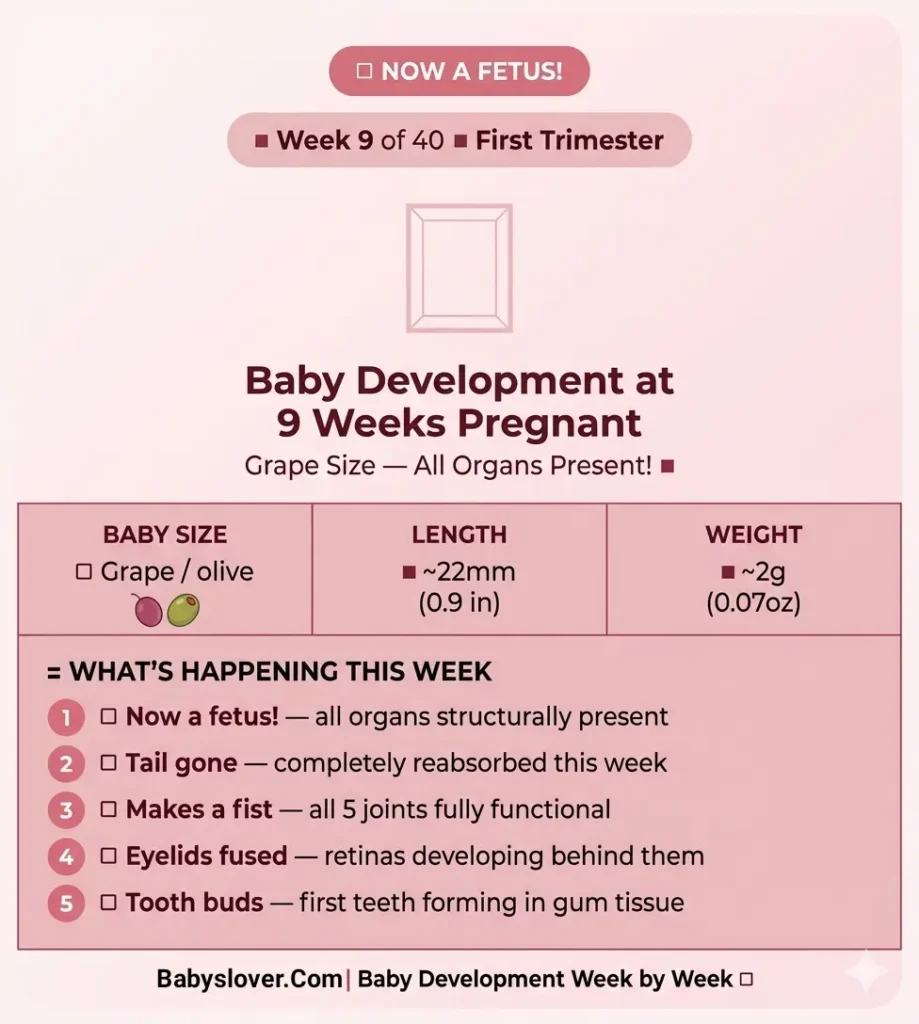
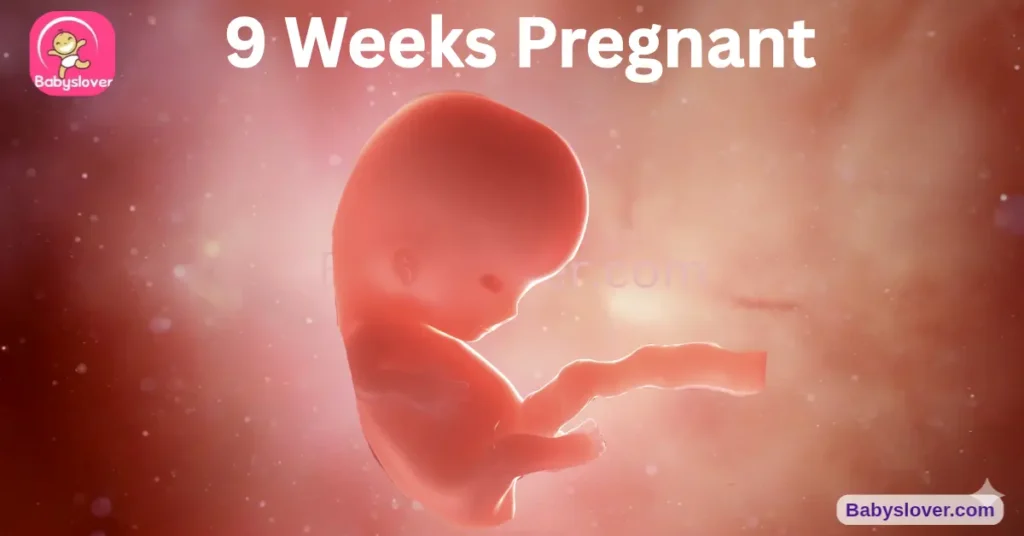
At 9 weeks pregnant, your fetus measures approximately 22–25mm (0.9 inches) — the size of a grape or olive — and weighs about 2 grams. The head is still large compared to the body (accounting for about half of the total length), but the body is growing rapidly to catch up. Externally, a 9-week ultrasound shows a recognizable human form — though the proportions still look more elfin than newborn.
| 🌱 Baby Development at 9 Weeks Pregnant | |
| Baby Size | 🍇 Grape / olive — 22–25mm (0.9 inches) |
| Fruit Comparison | 🍇 Grape or olive |
| Weight | ~2 grams (0.07 oz) |
| Stage | 🎉 FETUS — embryonic phase complete! |
| Week / Trimester | Week 9 of 40 • First Trimester |
| Heart Rate | 💗 140–170 bpm — rising with growing body needs |
What Is Developing at Week 9
- 🚫 Tail completely disappears: One of the most fascinating — and most surprising — facts about human embryonic development: embryos have a small tail. It’s a vestige of our evolutionary history, formed from the coccygeal region of the spine. By Week 9, this tail has been fully reabsorbed into the body and disappears completely. Your baby is now fully mammalian in external form — no tail, no gills, no features reminiscent of earlier evolutionary ancestors. Just a small, distinctly human-shaped fetus.
- ✊ Baby can make a fist: All five of your baby’s major joints — shoulders, elbows, wrists, knees, and ankles — are now functional and allowing free movement within the amniotic sac. Your baby’s hands have developed enough that they can actually curl their tiny fingers into a fist. This is one of the most emotionally resonant facts about Week 9 — that being the size of a grape, your baby already has the instinct and the physical capability to make a fist.
- 👍 Thumb sucking may begin: Along with fist-making, some babies at 9 weeks begin their very first thumb-sucking movements. This isn’t a conscious act of self-soothing yet — it’s a reflex being tested by a developing nervous system. But the physical capability is there: a mouth, a thumb, and a nervous system sophisticated enough to connect them. The sucking reflex is critical for feeding after birth, and the practice begins surprisingly early.
- 👁️ Eyelids completely fused shut: Your baby’s eyelids are now fully formed and have fused shut — they will remain sealed until approximately Week 26–28, when they open again. The retinas behind those sealed lids are continuing to develop their light-sensing cells. Though the eyes won’t open for months, the visual system is quietly building the infrastructure for sight.
- 🦷 Tooth buds forming: Tiny buds for your baby’s first (baby) teeth are forming in the gum tissue this week. These won’t emerge until approximately 6 months after birth — but the tooth formation begins right now. This is why calcium intake during pregnancy matters: the minerals you consume are contributing to the structure of your baby’s first teeth, months before you’ll ever see them.
- 👶 Nipples appearing: Tiny nipples are becoming visible on your baby’s chest this week. This happens in all embryos before sex differentiation is complete — nipple formation precedes the hormonal differentiation that determines whether testosterone or estrogen will dominate. Every human being, regardless of eventual sex, develops nipples first. It’s a beautiful example of the shared developmental blueprint we all begin with.
- 🧬 Reproductive organs beginning to form: The external genitalia are beginning their differentiation this week, though they won’t be distinguishable as definitively male or female until around Week 14–16 on ultrasound. The genetic sex was determined at fertilization — the physical expression of that determination is just now beginning to manifest externally.
- 🫁 All essential organs present: By Week 9, every major organ system — heart, brain, lungs, liver, kidneys, stomach, intestines, pancreas — is structurally present. None are fully functional yet, but none are still being built from scratch. The fetal phase is about growing and maturing what’s already there. The extraordinary act of creation — building every system simultaneously — is complete.
💡 Fun fact: Your 9-week fetus can already move independently within the amniotic sac — twisting, flexing, and even hiccupping. You won’t feel these movements for many weeks (usually Week 16-22 for first-time moms), but on a 9-week ultrasound, you may be able to watch your baby actively move. It’s one of the most remarkable things you can see in early pregnancy.
9 Weeks Pregnant Symptoms — What’s Normal
Week 9 falls right in the heart of peak first-trimester symptoms for most women. Here’s what’s completely normal at 9 weeks pregnant:
🤢 Morning Sickness — Still Strong for Most Women
Morning sickness typically peaks between Weeks 8–10 and then gradually improves toward Week 12–14. So if you’re at Week 9 and feeling like nausea is your permanent companion — you may be right at the top of the curve, with relief on the way soon. Per Mayo Clinic, the most effective approaches remain: Vitamin B6 (10-25mg three times daily) — ask your OB about the safe dose for you — ginger in any form, small frequent meals, and never letting your stomach become completely empty.
If you’re still experiencing hyperemesis gravidarum (severe vomiting that prevents keeping liquids down), talk to your OB about anti-nausea medications — several are safe in pregnancy and can be genuinely life-changing for severe cases. You don’t have to suffer through it.
😴 Fatigue — Still Profound
First-trimester fatigue remains near its peak at Week 9. Your body is sustaining an extraordinary level of physiological activity — the placenta isn’t yet fully functional (it takes over completely around Week 12), so your body is still managing the full hormonal load of early pregnancy. Rest whenever you can. It is not laziness. It is your body doing exactly what it needs to do.
🔥 Heartburn and Acid Reflux
As discussed above, heartburn often intensifies at Week 9. If you haven’t experienced it yet, this week may be when it arrives. The combination of relaxed esophageal muscles (progesterone), slower digestion, and an already-growing uterus pressing upward sets the stage for persistent reflux. Tums (calcium carbonate) is generally considered safe during pregnancy — but always confirm with your OB before taking any medication.
🤕 Headaches
Pregnancy headaches are common in the first trimester and are driven by the dramatic hormonal changes, increased blood volume, dehydration, and in some cases caffeine reduction (especially if you’ve cut back abruptly). Stay well hydrated, maintain regular sleep, and use acetaminophen (Tylenol) for relief — it’s the only OTC pain reliever considered safe during pregnancy. Avoid ibuprofen, aspirin, and NSAIDs entirely.
🍔 Food Cravings and Aversions
The notorious pregnancy cravings and aversions often arrive in full force around Week 9. Foods you loved may suddenly be revolting. Strange combinations may seem deeply appealing. This is driven by hormones affecting smell and taste perception, and by your body’s evolving nutrient needs. Cravings for salty foods often reflect the body’s need for sodium as blood volume expands. Aversions to meat and strong-smelling foods are extremely common in early pregnancy.
😢 Mood Swings and Anxiety
Estrogen and progesterone fluctuations continue to affect the brain’s mood-regulating systems. Mood swings, emotional sensitivity, unexpected crying, and anxiety are all normal at Week 9. The anxiety of still being in the first trimester — before the 12-week milestone when miscarriage risk drops significantly — compounds the hormonal emotional volatility. Many women find journaling, prenatal yoga, and honest conversations with their partner genuinely helpful.
💭 9 Weeks Pregnant With No Symptoms
Having few or no symptoms at 9 weeks is still completely normal and does not indicate a problem with your pregnancy. Many women have minimal morning sickness, little fatigue, and no notable symptoms throughout the first trimester and go on to have healthy, full-term pregnancies. Symptom intensity is not a reliable indicator of pregnancy health.
Start Kegel Exercises This Week
Week 9 is the perfect time to begin one of the most important exercises of your pregnancy: Kegel exercises. And unlike most exercises, Kegels can be done anywhere — sitting at your desk, watching TV, or lying in bed.
What Are Kegel Exercises?
Kegels are contractions of the pelvic floor muscles — the hammock of muscles that support your uterus, bladder, and bowel. During pregnancy, these muscles bear increasing weight as your baby grows. During birth, they stretch dramatically. Strengthening them now reduces the risk of urinary incontinence, supports the growing uterus, and significantly aids in postpartum recovery.
How to Do Kegels
- Find the right muscles: Imagine you are stopping the flow of urine mid-stream. The muscles you tighten to do this are your pelvic floor muscles.
- Contract: Squeeze these muscles and hold for 5 seconds. Don’t hold your breath — breathe normally.
- Release: Fully relax the muscles for 5 seconds. The release is as important as the contraction.
- Repeat: 10-15 repetitions, 3 times daily.
- Progress: Work up to holding each contraction for 10 seconds over several weeks.
Kegels are safe throughout the entire pregnancy. Most OBs recommend starting in the first trimester and continuing through postpartum recovery. Many women who practice Kegels consistently report significantly easier pushing during labor and faster recovery from childbirth. It takes just 5 minutes a day — start today.
What to Eat at 9 Weeks Pregnant
Nutrition at 9 weeks pregnant is complicated by the fact that nausea may make eating a constant challenge. Here’s how to prioritize what matters most:
| Nutrient | Why Critical at Week 9 | Best Sources |
| Folic Acid | Brain growth continues at 100+ neurons/min — neural development ongoing | Prenatal vitamin (400-800mcg), leafy greens, lentils, fortified cereals |
| Calcium | Tooth buds forming this week — calcium goes directly to baby’s dental structure | Dairy, fortified plant milk, sardines, kale, broccoli |
| Iron | Blood volume 20-30% higher now — iron demand rising rapidly | Lean meat, spinach, beans, tofu, fortified cereals + vitamin C to aid absorption |
| Vitamin B6 | Most evidence-backed approach to reducing morning sickness | Chicken, fish, bananas, chickpeas, potatoes |
| DHA (Omega-3) | Brain and retina development — DHA is critical structural fat for neural tissue | Cooked salmon, sardines, walnuts, DHA supplement |
| Water / Fluids | Prevents headaches, aids digestion, supports kidney function — all issues at Week 9 | 8-10 glasses/day; fruit-infused water, clear broth, coconut water if plain water triggers nausea |
Nausea making eating nearly impossible? Focus on the ‘survival mode’ approach: eat whatever you can actually keep down, keep taking your prenatal vitamin, and don’t stress about perfect nutrition right now. A nauseous body absorbing crackers is still building a healthy baby. The second trimester, when nausea usually eases, is when you can refocus on food quality. Our best prenatal vitamins guide covers options that are gentler on nauseous stomachs — including gummy and liquid formats.
For Your Partner — Preparing for What Comes Next
Week 9 is a transitional week — the embryonic phase of pregnancy is ending, and a new phase is beginning. Here’s how partners can show up meaningfully right now:
- Understand the significance of the embryo-to-fetus milestone: The fact that all major organs are now present — that the biological ‘building’ phase is complete — is genuinely remarkable. Taking a moment to acknowledge this milestone together, even informally, can deepen your shared connection to the pregnancy.
- Prepare for the first prenatal appointment: If the first OB appointment is this week or coming up, attend if at all possible. Bring a printed copy of questions you’ve both identified. Partners who attend the first appointment consistently report feeling more connected to the pregnancy — and having heard the heartbeat or seen the ultrasound is transformative in a way that’s hard to describe.
- Learn to navigate symptom conversations: By Week 9, morning sickness and fatigue have been present for several weeks. Your partner may be exhausted in a way that goes beyond physical tiredness — there’s also emotional exhaustion from managing symptoms while trying to function normally. Ask ‘what do you need from me right now?’ rather than offering solutions they didn’t ask for.
- Help research and decide on genetic screening: If NIPT (non-invasive prenatal testing) or the NT scan is being considered, Week 9 is the right time to research your options, understand what each test screens for, and make a joint decision about what level of screening feels right for your family. This is an important and emotionally complex conversation — don’t leave it entirely to your partner.
- Start thinking practically about announcements: The 12-week milestone is approaching. Many couples plan their pregnancy announcement around this time. Whether it’s a social media post, telling family, or a larger announcement — having a shared plan reduces the decision fatigue that comes later.
When to Call Your Doctor at 9 Weeks Pregnant
Most Week 9 symptoms are normal — but contact your provider promptly for:
- Severe one-sided lower abdominal pain with shoulder pain, dizziness, or faintness: Ectopic pregnancy signs. Go to the ER immediately — this is a medical emergency even at 9 weeks.
- Heavy bleeding (soaking a pad, passing clots): Light brown or pink spotting can be normal (often from implantation site healing or cervical sensitivity). Heavy red bleeding is not normal and requires urgent evaluation.
- Severe vomiting — cannot keep any liquid down for 24+ hours: Hyperemesis gravidarum requires IV fluids and possibly antiemetic medication. Don’t manage it alone.
- Fever above 100.4°F / 38°C: Any fever in the first trimester requires evaluation — infection can affect fetal development and needs prompt treatment.
- Painful or burning urination: UTIs are very common in pregnancy and require antibiotic treatment to prevent progression to kidney infection.
- Severe or persistent headache that doesn’t respond to Tylenol: While mild headaches are common, a severe headache — especially with visual changes or swelling — should always be reported to your OB.
Your Week 9 Pregnancy Checklist
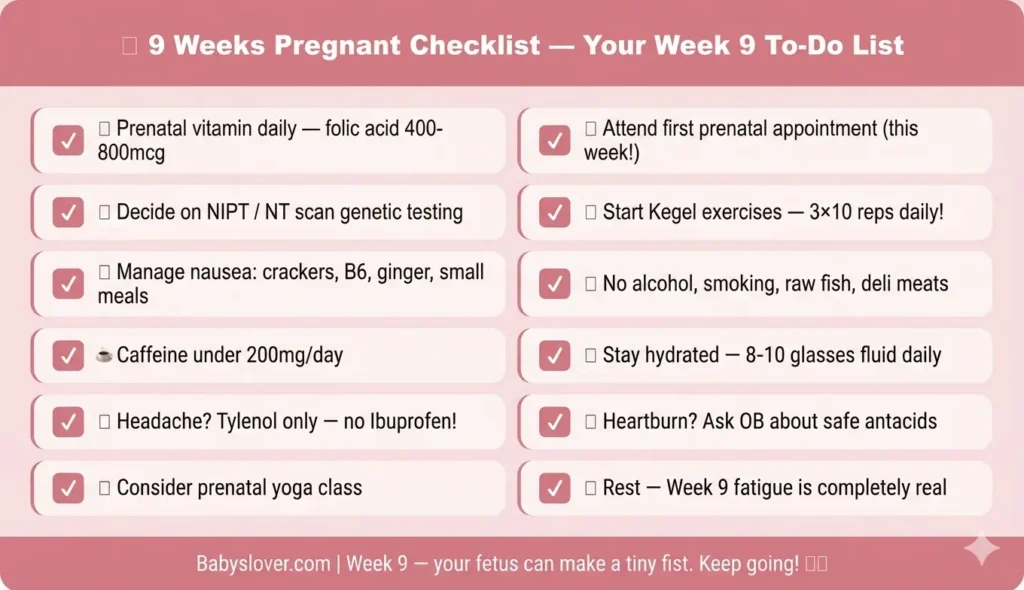
- ☑ Take prenatal vitamin daily — folic acid 400-800mcg
- ☑ Attend your first prenatal appointment (if this week) — bring your question list
- ☑ Decide with your partner on NIPT or NT scan genetic screening
- ☑ Start Kegel exercises today — 3 sets of 10, every day
- ☑ Manage morning sickness: crackers, B6, ginger, small frequent meals
- ☑ Avoid alcohol, smoking, raw fish, deli meats, high-mercury fish
- ☑ Keep caffeine under 200mg/day
- ☑ Stay hydrated — 8-10 glasses of fluid daily
- ☑ Use Tylenol only for headaches — avoid ibuprofen and aspirin
- ☑ Talk to OB about safe antacids if heartburn is severe
- ☑ If acne is bothering you, ask OB about safe treatments
- ☑ Join a prenatal yoga class if cleared by OB — many cities have first-trimester options
Frequently Asked Questions — 9 Weeks Pregnant
What does 9 weeks pregnant feel like?
For most women, 9 weeks pregnant feels like the first trimester at its most intense — nausea, fatigue, heartburn, bloating, mood swings, and headaches can all be present simultaneously. But there’s also the beginning of an important psychological shift: you’re approaching the end of the embryonic phase, the first prenatal appointment is near, and the 12-week milestone is coming into view. Many women feel cautious hope building alongside the physical difficulty.
How big is my baby at 9 weeks pregnant?
Your baby at 9 weeks pregnant is approximately 22–25mm — about 0.9 inches — the size of a grape or small olive. Weight is roughly 2 grams. Despite being smaller than a thumb, your fetus has all major organ systems structurally in place and can make a fist.
Is cramping normal at 9 weeks pregnant?
Mild cramping from uterine growth, round ligament stretching, and implantation site healing is common at 9 weeks. Cramping that is severe, one-sided, or comes with heavy bleeding requires immediate medical evaluation.
What is the miscarriage risk at 9 weeks?
Once a heartbeat is confirmed at 9 weeks, the miscarriage risk is approximately 2–5% — significantly lower than the 10–20% risk in the earliest weeks. This risk continues to fall with each passing week. By 12 weeks, the risk is below 2% for most pregnancies.
Can you feel your baby move at 9 weeks?
Your baby is making spontaneous movements at 9 weeks — twisting, flexing, and even hiccupping. However, they are far too small and deep in the uterus for you to feel these movements. Most first-time moms feel baby movement for the first time between Weeks 18–22. Women who have been pregnant before may notice it slightly earlier.
When does morning sickness end?
For most women, morning sickness begins to improve after Week 12–14 as hCG levels peak and then begin declining. However, approximately 10% of women experience nausea that extends into the second trimester, and a small percentage experience it throughout the entire pregnancy. If you’re in the middle of peak nausea at Week 9, relief is likely coming within the next 3-5 weeks for the majority of women.
What is NIPT and when can I get it?
NIPT (Non-Invasive Prenatal Testing) is a blood test that screens for chromosomal conditions — including Down syndrome (trisomy 21), trisomy 18, and trisomy 13 — using fetal DNA found in the mother’s blood. Per ACOG, it can be performed as early as 10 weeks. It’s optional but is increasingly offered to all pregnant women regardless of age. Discuss your options with your OB at your first prenatal appointment.
Is it safe to have sex at 9 weeks pregnant?
Yes — for most women, sex is completely safe throughout the first trimester and beyond. Your baby is protected by the amniotic sac and the mucus plug sealing the cervix. There is no risk of ‘hurting’ the baby. Your OB will advise you if there are any specific reasons to abstain in your individual case — such as placenta previa, cervical incompetence, or history of preterm labor.
💗 The Emotional Reality of Week 9 — Approaching the Corner
Week 9 has a specific emotional quality to it.
You’re close enough to Week 12 that you can see it on the horizon — the week when you can tell people, when the statistics improve dramatically, when the first-trimester fog is supposed to lift. But you’re not there yet. The symptoms are still real. The anxiety is still present. The secrecy is still exhausting.
Many women describe Week 9 as the ‘almost’ week — almost through the hardest part, almost at the announcement, almost at the end of the nausea. And ‘almost’ can be both hopeful and maddening.
Give yourself full permission to acknowledge how hard this has been — physically and emotionally. The first trimester is genuinely difficult for many women, and the cultural pressure to perform normalcy while experiencing it in private is real. You are handling something extraordinary.
At Babyslover, we want you to know: Week 12 is coming. You are almost there. And your fetus — your tiny, grape-sized, fist-making, possibly-already-thumb-sucking fetus — is waiting for you on the other side of this. 💗
👶 What Happens Next — 10 Weeks Pregnant Preview
Week 10 is another major milestone — here’s what to look forward to with 10 weeks pregnant:
- Baby grows to strawberry size — about 31mm (1.2 inches)
- Fingers and toes FULLY separated — no more webbing!
- Baby’s spine is visible on ultrasound
- Peach fuzz (lanugo) begins forming on the skin
- hCG reaches its absolute peak then begins its gradual decline
- Nausea may begin to SLOWLY ease as hCG starts dropping after Week 10
- NIPT blood test can now be taken (earliest available: 10 weeks)
Keep following our complete pregnancy week by week guide — from Week 1 all the way to your due date!
Week 9: The Week Your Baby Became a Fetus
Being 9 weeks pregnant means something remarkable has just happened inside you. An embryo — a collection of rapidly differentiating cells building itself from nothing — has completed its foundational work. Every organ. Every joint. Every system. Built. Now it’s a fetus, and its work is to grow.
Somewhere inside you, a grape-sized being is making tiny fists. Its eyelids are sealed over developing eyes. Its teeth are forming in gum tissue. Its heart is beating 140-170 times per minute.
Keep taking those vitamins. Start those Kegels today. And know that every single difficult day of Week 9 is a day your fetus is growing stronger. You are doing this. 💗 For more support throughout your pregnancy journey, read our pregnancy tips for first time moms — written for moms exactly at this point in the journey.
1 thought on “9 Weeks Pregnant: Baby Size, Symptoms & Fetus Milestone”