

Your baby’s fingers are free. After weeks of forming, separating, and shedding their webbing, your baby’s ten tiny fingers are now fully distinct — no more webbing between them.
At 10 weeks pregnant, your strawberry-sized fetus has reached one of those milestones that somehow makes everything feel more real: the hands that will one day hold yours have their complete set of fingers.
Week 10 is also the week that hCG — the hormone driving most of your first-trimester symptoms — begins its long-awaited peak and gradual decline. The hardest part may officially be behind you.
At Babyslover, we’ll walk you through everything happening at 10 weeks pregnant: your baby’s remarkable development, what’s changing in your body, the NIPT testing window that opens this week, and what to do right now. Coming from last week? Our 9 weeks pregnant guide covered the embryo-to-fetus transition and the first tiny fist.

| 📋 Quick Summary — Week 10 of Pregnancy | |
| Week | Week 10 of 40 — DOUBLE DIGITS! 🎉 |
| Trimester | First Trimester (25% complete!) |
| Baby Size | 🍓 Strawberry / kumquat — 31mm (1.2 inches) |
| Baby Weight | ~4 grams (0.14 oz) — growing fast now! |
| KEY MILESTONES | ✋ Fingers FULLY SEPARATED — no webbing! • Bones hardening • Taste buds forming • hCG begins to peak and decline • NIPT available NOW |
| hCG Range | 44,186–170,409 mIU/mL — at or near its peak for the entire pregnancy |
| Symptoms | Morning sickness near or at peak, extreme fatigue, round ligament pain, heartburn, bloating, veins visible, possible first bump in second/third-time moms |
| First Step | 🧬 Ask your OB about NIPT — the earliest screening test for chromosomal conditions is now available! |
What’s Happening in Your Body at 10 Weeks Pregnant
At 10 weeks pregnant, you’ve completed a quarter of your pregnancy. Your body has been quietly doing extraordinary work — and several important physical shifts are happening or about to happen this week.
hCG Is Peaking — And Beginning to Fall
Here is the most important thing happening in your body at Week 10: your hCG levels are reaching their highest point of the entire pregnancy — typically somewhere in the 44,186–170,409 mIU/mL range. After this peak, hCG will gradually decline over the coming weeks as the placenta fully takes over hormone production. This is the turning point that most first-trimester moms are waiting for: as hCG drops, nausea, fatigue, and other hCG-driven symptoms typically begin to ease. Most women notice a significant improvement between Weeks 12–14.
This also means Week 10 may feel like the worst week — precisely because you’re at the peak. If you are struggling right now, know that you are very likely at the top of the curve.
Placenta Is Nearing Full Functionality
Your placenta has been developing since the earliest weeks of pregnancy, and it is now nearly fully functional. By Week 12, the placenta will completely take over progesterone and hormone production from the corpus luteum. This transfer of hormonal responsibility is what drives the easing of first-trimester symptoms. The placenta is already supplying oxygen and nutrients to your baby through the umbilical cord and is filtering waste back out — a remarkable organ doing the work of several body systems simultaneously.
Round Ligament Pain Intensifying
As your uterus expands to accommodate your growing fetus, the round ligaments that support it are being stretched further and faster than they were designed for. Sharp, sudden pain in the lower abdomen or groin — especially when you change position quickly, sneeze, or cough — is round ligament pain. It’s completely normal and becomes more common through Weeks 10-20. Moving more slowly when rising or changing positions, and supporting your abdomen with your hands when you feel a sneeze coming, can help reduce the sharpness.
Veins More Visible Than Ever
Your blood volume is now 30% higher than pre-pregnancy — and it will increase by up to 50% total before birth. This expanded circulatory system makes the veins beneath your skin increasingly visible: blue or green veins on your breasts, across your chest and abdomen, and down your legs. This is called diastasis and is a normal, healthy sign that your body is routing extra blood flow to support the growing pregnancy. For most women, visible veins fade after delivery.
First Baby Bump — Maybe
For first-time moms, a visible bump before Week 12-16 is uncommon — the uterus is still largely within the pelvis at Week 10. However, many women notice a distinct fullness or rounding low in the abdomen that wasn’t there before. For women in their second or third pregnancy, the abdominal muscles are more relaxed and a small bump may be visible as early as Week 10. Body type, height, and the number of previous pregnancies all play a significant role in when you ‘show.’
🌱 Baby Development at 10 Weeks Pregnant
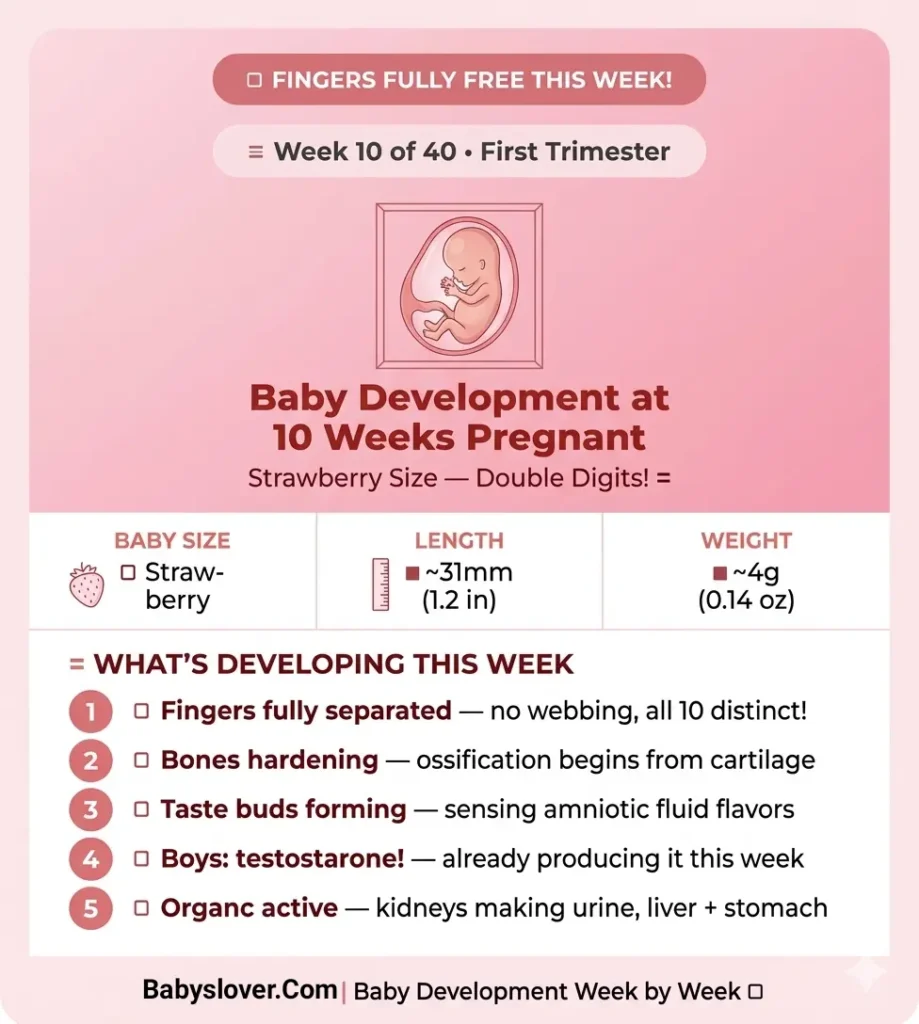
At 10 weeks pregnant, your fetus measures approximately 31mm — the size of a strawberry or small kumquat — and weighs about 4 grams. Body length will nearly double over the next three weeks as growth accelerates dramatically. But the most exciting development this week isn’t about size — it’s about fingers.

| 🌱 Baby Development at 10 Weeks Pregnant | |
| Baby Size | 🍓 Strawberry / kumquat — 31mm (1.2 inches) |
| Fruit Comparison | 🍓 Strawberry or kumquat |
| Weight | ~4 grams (0.14 oz) — growing 1mm+ per day! |
| Stage | Fetus — growth and maturation phase in full swing |
| Week / Trimester | Week 10 of 40 • First Trimester (25% done!) |
| KEY MILESTONE | ✋ Fingers FULLY SEPARATED — no webbing! Bones hardening, taste buds forming, organs functioning! |
What Is Developing at Week 10
- ✋ Fingers and toes fully separated — no more webbing: This is the headline development of Week 10. The thin webbing that connected your baby’s fingers and toes has completely broken down through a process called apoptosis — programmed cell death. Each finger and each toe is now fully distinct and individual. Ten fingers, ten toes — all free. This is also the week when tiny fingernails begin to form. The fact that your baby has complete, separated fingers at the size of a strawberry is one of the most quietly astonishing facts about early pregnancy.
- 🦴 Bones are hardening — ossification begins: Until now, your baby’s ‘skeleton’ has been made of soft cartilage. This week, the process of ossification begins — cartilage is being replaced by actual bone tissue. This process will continue throughout the entire pregnancy and even into early childhood, with some bones not fully hardened until late adolescence. The backbone, skull, arms, and leg bones are all beginning this transformation from flexible cartilage to rigid bone. This is exactly why calcium intake during pregnancy is so critical — the minerals you consume are the raw material for your baby’s developing skeleton.
- 👅 Taste buds forming on the tongue: Your baby’s taste buds are forming this week — tiny sensory structures on the surface of the tongue. Although your baby won’t taste food in the way adults do, these early taste buds are the beginning of a sensory system that will be active long before birth. By the second and third trimesters, babies swallow amniotic fluid and can detect flavors in it — research suggests that exposure to flavors through amniotic fluid may influence food preferences in early childhood. What you eat during pregnancy may literally shape your baby’s early palate.
- 🫀 Vital organs beginning to function: The kidneys are now producing significant quantities of urine — this urine enters the amniotic fluid and is swallowed by the baby in a continuous cycle. The liver is producing bile. The stomach is producing digestive juices. The intestines — which have been developing in the umbilical cord — are beginning to migrate back into the abdominal cavity as the body grows large enough to accommodate them. The brain is producing 250,000 new neurons per minute at this stage of development.
- 💪 Baby boys are already producing testosterone: One of the most surprising facts about Week 10: if you are carrying a boy, his testes are already producing testosterone this week. This hormone surge is what will drive the development of male external genitalia over the next few weeks. The testosterone surge at this stage is actually higher relative to body size than at puberty — it’s the foundational hormonal event that determines the biological development of the male reproductive system. This happens invisibly, at the size of a strawberry, before most parents even know the sex.
- 🤸 Moving and hiccupping: Your baby is actively moving inside the amniotic sac this week — kicking, flexing, twisting, and even hiccupping. The hiccups are caused by the diaphragm contracting as it develops — the same reflex that causes hiccups in adults. You won’t feel any of this movement until approximately Weeks 16-22, but on a 10-week ultrasound, you may be able to watch your baby move in real time.
- 🌸 Lanugo (peach fuzz) beginning to form: Fine, soft hair called lanugo is beginning to develop on your baby’s skin this week. This downy hair covers the entire body and serves to hold the vernix caseosa — a waxy protective coating — against the skin. Most of the lanugo will shed before birth or in the first few weeks of life. You may notice a lightly fuzzy skin on some newborns — this is the remnant of the lanugo that began forming at Week 10.
💡 Fun fact: Your baby’s body length will nearly double over the next three weeks — growing from 31mm at Week 10 to approximately 58mm by Week 13. This is one of the fastest growth spurts in the entire pregnancy, even faster than the growth seen in the third trimester.
🧬 NIPT Testing — The Window Opens This Week
One of the most important medical decisions of your first trimester arrives at Week 10: NIPT (Non-Invasive Prenatal Testing) — also called cell-free DNA testing or cfDNA screening — can now be performed. Here is everything you need to know to make an informed decision.
What Is NIPT?
NIPT is a simple blood draw from the mother that analyzes fragments of fetal DNA present in the maternal bloodstream. It screens for chromosomal conditions — primarily:
- Down syndrome (Trisomy 21) — most common chromosomal condition, ~99% detection rate
- Trisomy 18 (Edwards syndrome) — serious chromosomal abnormality
- Trisomy 13 (Patau syndrome) — serious chromosomal abnormality
- Sex chromosome abnormalities (Turner syndrome, Klinefelter syndrome, others)
- BONUS: Can reveal your baby’s biological sex — as early as 10 weeks! (Optional — you can decline this part)
Per ACOG, NIPT can be offered to all pregnant women regardless of age — it is no longer only recommended for women over 35. Results take approximately 1-2 weeks and are reported as low-risk or high-risk (not diagnostic). A high-risk result requires follow-up with confirmatory diagnostic testing.
NIPT vs NT Scan — What’s the Difference?
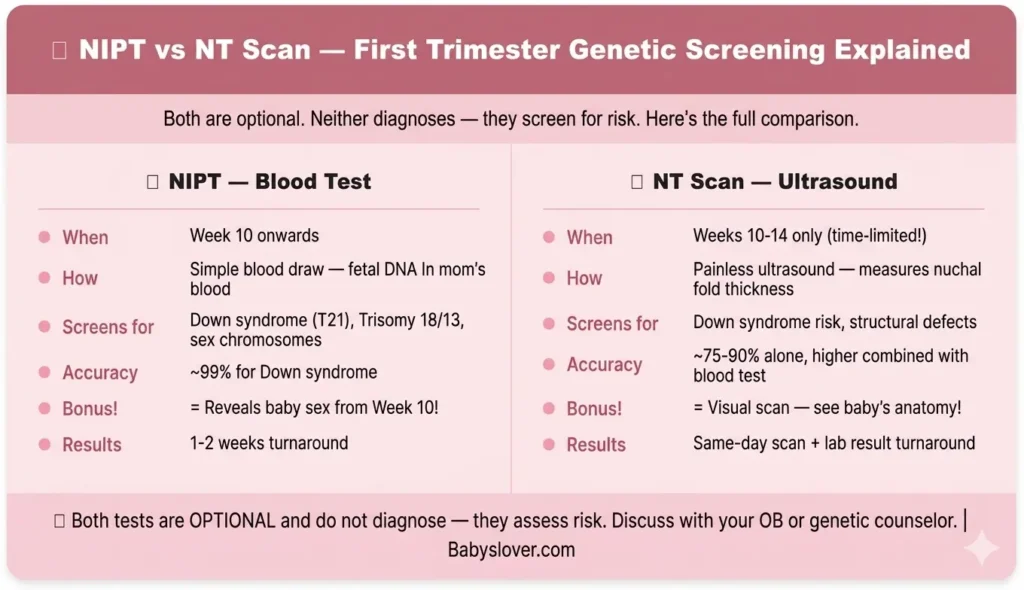
| Feature | NIPT (Blood Test) | NT Scan (Ultrasound) |
| When | Week 10 onwards | Weeks 10-14 |
| How | Blood draw — fetal DNA analysis | Painless ultrasound — neck fold measurement |
| Screens for | Trisomy 21, 18, 13, sex chromosome abnormalities | Trisomy 21 risk, major structural defects |
| Accuracy | ~99% for Down syndrome | ~75-90% alone; higher combined with blood test |
| Bonus info | Can reveal baby’s biological sex! | Checks nuchal fold thickness — structural view |
| Type | Screening (not diagnostic) | Screening (not diagnostic) |
| Results | 1-2 weeks turnaround | Same-day ultrasound + lab turnaround |
Both tests are entirely optional. Neither diagnoses a condition — they assess risk and probability. A high-risk result from either test leads to discussion of further diagnostic options (CVS at 10-13 weeks, or amniocentesis at 15-20 weeks). Many couples choose to have both for complementary information; others choose NIPT alone; some choose neither.
If you want to know your baby’s sex early — NIPT can tell you at Week 10, with very high accuracy. This is entirely your choice: you can request a ‘sealed envelope’ result, not be told at all, or find out immediately. Our is cord blood banking worth it guide also covers decisions made during this window of first-trimester testing.
💡 NIPT is a screening test — not a diagnosis. A positive (high-risk) result does not mean your baby definitely has a chromosomal condition. It means further evaluation is needed. A negative (low-risk) result does not guarantee the absence of all conditions. Discuss all results with your OB or a genetic counselor.
10 Weeks Pregnant Symptoms — What’s Normal
Week 10 falls at or near the peak of first-trimester symptoms for most women. Here is what is completely normal at 10 weeks pregnant:
🤢 Morning Sickness — At or Near the Peak
Nausea peaks around Weeks 8-10 for most women as hCG reaches maximum levels. If you are feeling at your worst right now, you may be at the very top of the hCG curve — which means improvement is likely just weeks away. Per Mayo Clinic, most women experience significant relief from nausea between Weeks 12-14 as hCG begins its decline. The most evidence-backed approaches remain: Vitamin B6 (ask your OB about dosing), ginger in any form, small frequent meals, and cold water. Avoid letting your stomach become completely empty, as an empty stomach intensifies nausea significantly.
😴 Extreme Fatigue — Placenta Almost Done
Your body is running at full capacity to sustain the pregnancy while the placenta completes its development. The deep, bone-heavy fatigue of the first trimester is almost universally reported by women in Weeks 8-12 — and it’s physiological, not psychological. Your body is building an entire organ (the placenta), expanding blood volume by 30%, sustaining 250,000 new neurons per minute in your baby’s brain, and managing hormonal levels that would challenge anyone’s energy reserves. Rest is the appropriate response, not willpower.
🔥 Heartburn and Bloating
Progesterone continues to relax the lower esophageal sphincter, causing persistent heartburn that may feel worse after meals, when lying down, or in the evening. Eating smaller meals, remaining upright after eating for at least 30-60 minutes, and avoiding acidic, spicy, or fatty trigger foods all help. Ask your OB about Tums if over-the-counter relief is needed — calcium carbonate antacids are generally considered safe in pregnancy.
🩻 Round Ligament Pain
Sharp, sudden pains in the lower abdomen or groin — particularly when changing position, sneezing, or laughing — are round ligament pain, which often intensifies around Week 10 as the uterus grows faster. This is normal and not dangerous. If you notice the pain is persistent, one-sided, or accompanied by fever or bleeding, contact your OB to rule out other causes.
💭 10 Weeks Pregnant With No Symptoms
Having few or no symptoms at 10 weeks is completely normal and does not indicate a problem with your pregnancy. Symptom intensity varies dramatically between women and between pregnancies. Trust your prenatal care rather than your symptom level as the primary indicator of pregnancy health.
💡 Week 10 is statistically significant: the miscarriage risk for a confirmed, heartbeat-verified pregnancy at 10 weeks is now approximately 1-2% — the lowest it has been at any point in your pregnancy so far. Every week that passes continues to improve these odds.
Start Your Bump Photo Series This Week
Week 10 is the perfect time to take your first official bump photo — even if there’s nothing visible yet. Here’s why this week matters:
- Having a Week 10 photo gives you a true ‘before’ reference point — even a flat belly documents where you started
- Consistency matters: same outfit, same wall, same lighting, same time of day — every single week
- Side profile shots show the most change over time
- You can decide later whether to share them publicly — but you’ll never regret having them
- Many moms make these into a flip-book, video reel, or printed photo book as a keepsake
Suggested format: plain fitted shirt or just a bra, same wall background, good natural lighting, same time each week (morning is best — before the day’s bloating). Start this week and you’ll have a complete 30-week series to look back on.
What to Eat at 10 Weeks Pregnant
| Nutrient | Why Critical at Week 10 | Best Sources |
| Calcium | Ossification begins this week — baby’s bones are hardening. Calcium is the building material | Dairy, fortified plant milk, sardines, kale, broccoli, almonds |
| Folic Acid | Brain producing 250,000 neurons per minute — neural development ongoing throughout Q1 | Prenatal vitamin (400-800mcg), leafy greens, lentils, fortified cereals |
| Iron | Blood volume now 30% higher — iron demand rising every week | Lean meat, spinach, beans, tofu + vitamin C for absorption |
| DHA Omega-3 | 250,000 neurons/min brain growth — DHA is the critical structural fat for neural tissue | Cooked salmon, sardines, walnuts, DHA supplement in prenatal |
| Vitamin B6 | Peak nausea week — B6 is the most evidence-backed natural anti-nausea approach | Chicken, fish, bananas, chickpeas, ask OB about dosing |
| Water | Kidneys filtering more, baby producing urine — hydration affects amniotic fluid volume | 8-10 glasses daily; cold often better tolerated with nausea |
Taste buds are forming this week — which means what you eat now may genuinely influence your baby’s early food preferences through the flavors present in amniotic fluid. This isn’t pressure to eat perfectly (especially if nausea is making that impossible) — but it is a fascinating reason to try to expose your baby to a variety of flavors when you can. Per the CDC, folic acid remains essential throughout the first trimester. Our best prenatal vitamins guide covers options with the most bioavailable calcium and iron for growing bones.
For Your Partner — Week 10 Preparation
Week 10 marks a practical transition point — the first trimester is in its final weeks, and there’s meaningful preparation both of you can do right now:
- Make the NIPT decision together: NIPT is available this week, and it’s a decision that genuinely benefits from being made jointly. Research together what NIPT screens for, what the accuracy rates are, what a high-risk result would mean practically, and whether knowing the baby’s sex early matters to both of you. This is not a medical decision to make unilaterally — it’s a partnership conversation.
- Start the bump photo series together: Take the first bump photo this week, even if there’s nothing to see yet. This creates a shared ritual that continues throughout the pregnancy — it’s one of the small, consistent acts that keeps partners connected to a pregnancy they can’t feel or experience directly.
- Acknowledge that you’re nearly through the hardest part: hCG is peaking this week, which means your partner may feel at her absolute worst right now. Naming this — ‘You’re at the peak. The hardest part is almost behind you’ — is genuinely validating in a way that practical help alone cannot replicate. She needs to hear it, not just have it managed around her.
- Research cord blood banking: The decision about cord blood banking needs to be made before birth — and the research takes time. Starting this conversation now, rather than at 36 weeks under pressure, allows for a calm, well-informed decision. Our full is cord blood banking worth it guide covers the evidence, costs, and considerations in detail.
- Plan the Week 12 announcement: The 12-week milestone is just two weeks away. Many couples plan their pregnancy announcement around this time — whether that means telling family, posting on social media, or both. Having a rough plan in place now means the announcement itself is intentional rather than reactive.
When to Call Your Doctor at 10 Weeks Pregnant
Seek immediate care for any of the following:
- Severe one-sided abdominal or pelvic pain with dizziness, shoulder pain, or faintness: Ectopic pregnancy can still be a concern at 10 weeks in rare cases. Go to the ER immediately.
- Heavy red bleeding — soaking a pad or passing clots: Light spotting can be normal, but heavy active bleeding requires same-day evaluation.
- Severe vomiting — unable to keep any liquids down for 24+ hours: Hyperemesis gravidarum requires IV fluids and possibly antiemetic medication. Don’t manage this alone.
- Fever above 100.4°F / 38°C: First-trimester fever needs prompt evaluation — some infections can affect fetal development.
- Burning or painful urination: UTIs require antibiotic treatment — untreated UTIs can progress to kidney infection and preterm labor.
- Sudden complete disappearance of all symptoms with cramping or bleeding: While symptom fading is often normal, this combination warrants a call to your provider for reassurance.
Your Week 10 Pregnancy Checklist
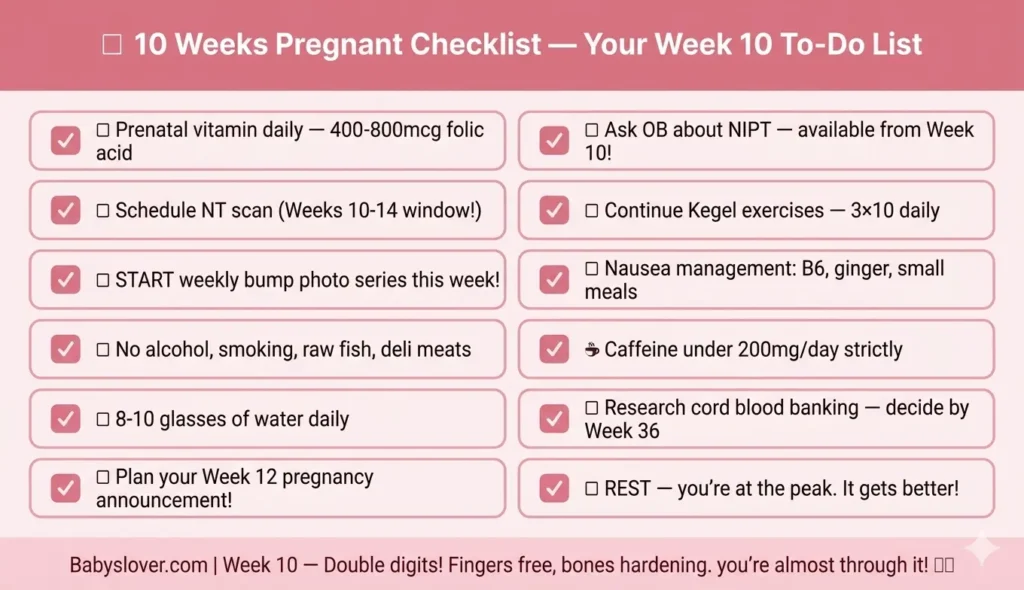
- ☑ Take prenatal vitamin daily — 400-800mcg folic acid, every day
- ☑ Ask OB about NIPT blood test — available from Week 10!
- ☑ Schedule NT scan ultrasound (available Weeks 10-14)
- ☑ Continue Kegel exercises — 3 sets of 10 per day
- ☑ Take your first bump photo — same outfit, same wall, same time weekly
- ☑ Manage morning sickness: B6, ginger, small frequent meals, cold water
- ☑ Avoid alcohol, smoking, raw fish, deli meats, high-mercury fish
- ☑ Caffeine strictly under 200mg per day
- ☑ Stay hydrated — 8-10 glasses of fluid daily
- ☑ Research cord blood banking before birth — start now for a calm decision
- ☑ Start planning your Week 12 pregnancy announcement!
- ☑ Rest — you are at the peak of first-trimester symptoms. It gets better from here.
Frequently Asked Questions — 10 Weeks Pregnant
What does 10 weeks pregnant feel like?
For most women, 10 weeks pregnant feels like the hardest week of the first trimester — morning sickness and fatigue are near their peak because hCG is at its highest level. But it also carries a particular kind of hope: you’re a quarter of the way through, the NIPT window is open, and Week 12 is just two weeks away. Many women describe Week 10 as the ‘almost there’ week of the first trimester.
How big is my baby at 10 weeks pregnant?
Your baby at 10 weeks pregnant is approximately 31mm long — the size of a strawberry or kumquat — and weighs about 4 grams. Over the next three weeks, your baby’s body length will nearly double as growth accelerates into the second trimester.
Can you find out the sex of your baby at 10 weeks?
Yes — if you choose NIPT (non-invasive prenatal testing), the blood test can determine your baby’s biological sex with approximately 99% accuracy from Week 10. You can choose to receive this information, keep it sealed, or not receive it at all. An ultrasound will not reliably reveal sex until around Weeks 16-20.
When does morning sickness end?
For most women, morning sickness peaks at Weeks 8-10 and begins to improve after Week 12 as hCG levels decline. Significant relief typically arrives between Weeks 12-16 for the majority of pregnant women. Approximately 10% of women experience nausea into the second trimester, and a small percentage experience it throughout pregnancy.
Is it safe to announce pregnancy at 10 weeks?
Many OBs and pregnancy resources suggest waiting until after Week 12 — when miscarriage risk drops to approximately 1-2% and first-trimester screening results are typically available. This is entirely your personal choice. Many couples choose to tell close family and friends earlier, while waiting for the broader announcement. There is no wrong time — only what feels right for you.
What is the NT scan and when do I get it?
The NT (nuchal translucency) scan is a painless ultrasound performed between Weeks 10-14. It measures the fluid at the back of your baby’s neck — a thicker nuchal fold is associated with higher risk for chromosomal conditions. When combined with a blood test (the First Trimester Screen), its accuracy improves to approximately 85-90%. It is optional but widely offered.
Why do I see so many veins on my body at 10 weeks?
Your blood volume has increased approximately 30% by Week 10 — and it will increase by up to 50% total before birth. This dramatic increase in circulating blood makes your veins much more visible through the skin, particularly on the breasts, chest, abdomen, and legs. This is completely normal and healthy — it’s your body routing extra blood flow to support the pregnancy. For most women, visible veins fade after delivery.
Is it normal to be showing at 10 weeks?
For first-time moms, a visible baby bump before Week 12-16 is uncommon — your uterus is still largely within the pelvis. However, many women notice a subtle fullness or rounding low in the abdomen. For second or third pregnancies, showing at 10 weeks is completely normal as the abdominal muscles are already stretched from previous pregnancies. Body shape, height, and fitness level all influence when you visibly show.
💗 The Emotional Reality of Week 10 — Almost There
Ten weeks.
You’re in double digits. You are a quarter of the way through. The week that most pregnancy resources identify as ‘peak symptoms’ is also, paradoxically, the week when relief is literally biologically on its way — hCG is turning the corner.
If you’ve been white-knuckling your way through the first trimester — hiding it at work, managing the nausea in bathroom stalls, powering through exhaustion you can’t explain to anyone — this is your moment to acknowledge how hard that has been. The first trimester demands an extraordinary amount from you in near-total secrecy. That’s a specific kind of difficult.
Week 12 is 14 days away. The announcement. The (usually) reduced symptoms. The scan that for many feels like the official beginning. You’re almost there.
At Babyslover, we’re here for every week — the hard ones and the joyful ones. And we want you to know: you are doing beautifully. 💗
👶 What Happens Next — 11 Weeks Pregnant Preview
Week 11 brings big visible changes on ultrasound — here’s what to look forward to with 11 weeks pregnant:
- Baby grows to fig size — about 41mm (1.6 inches), more than 30% longer than this week
- Fingers and toes fully developed with distinct fingernails growing
- Baby’s head still large (half the body) but body catching up fast
- Ears moving to final position on the sides of the head
- External genitalia beginning to differentiate — sex may be determinable at NT scan
- hCG continues to decline — nausea may begin easing for some women
- Baby starts swallowing amniotic fluid more actively — tasting the flavors of your diet!
Keep following our complete pregnancy week by week guide — from Week 1 all the way to Week 40!
Week 10: The Week Fingers Come Free
Being 10 weeks pregnant means carrying a strawberry-sized fetus whose ten fingers are now fully, individually, distinctly free. Whose bones are hardening. Whose taste buds are forming. Whose brain is producing 250,000 new neurons every minute. Who, if a boy, is already producing testosterone.
None of it is visible from the outside yet. The world doesn’t know. The announcement is still two weeks away. But inside you, something extraordinary is happening — and it has been, quietly, every single day.
Keep going. Take the NIPT test if it’s right for you. Start that bump photo series. Rest when you need to. And know that the turn is coming — the nausea, the exhaustion, the secrecy — it all starts to shift from Week 12 onward. You are almost there. 💗 For everything you need in these final first-trimester weeks, read our pregnancy tips for first time moms — written for exactly this moment.
1 thought on “10 Weeks Pregnant: Baby Size, Symptoms & NIPT Testing”