
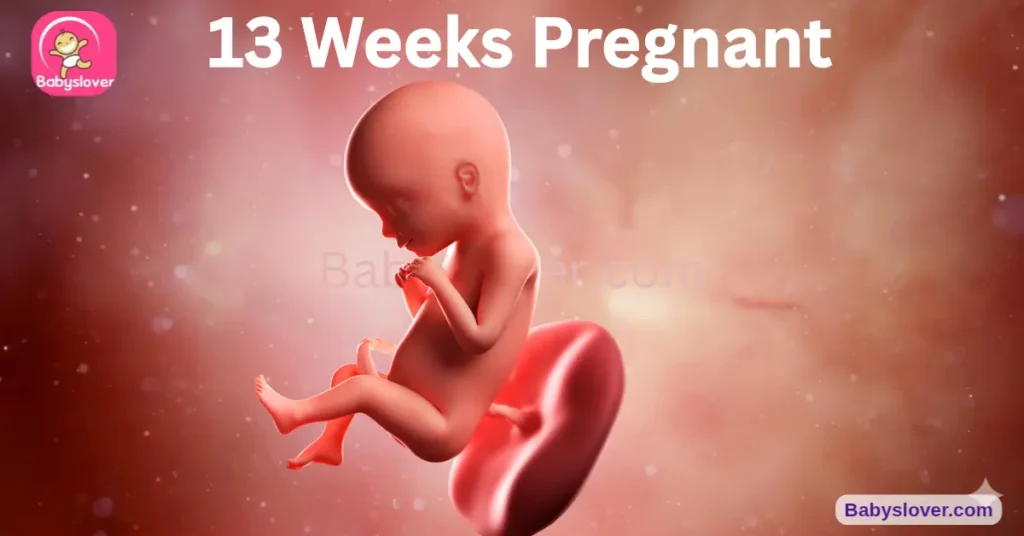
Your baby has fingerprints. At 13 weeks pregnant, the tiny ridges forming on the tips of your baby’s fingers are completely, permanently, uniquely its own — a pattern that has never existed before and will never exist again. No one else on earth, now or ever, will have these fingerprints. They were set this week, at peach size, before you’ve even felt a single kick.
Week 13 also marks the official beginning of something most first-trimester parents have been quietly counting toward: the second trimester. The golden period. The trimester where nausea fades, energy returns, the bump becomes visible, and pregnancy starts to feel like something you can actually enjoy rather than survive.
At Babyslover, here’s everything you need to know about 13 weeks pregnant: your baby’s remarkable new developments, what’s changing in your body, what the second trimester actually means for you, and what to do this week. Just arriving from last week?
Our 12 weeks pregnant guide covered the lime-sized baby, the 12-week scan, and the announcement milestone.

| 📋 Quick Summary — Week 13 of Pregnancy | |
| Week | Week 13 of 40 — SECOND TRIMESTER officially begins! 🌟 |
| Trimester | Second Trimester (Weeks 13-26) — the golden period! |
| Baby Size | 🍑 Peach — ~74mm (2.9 inches) |
| Baby Weight | ~23 grams (0.8 oz) — growing rapidly! |
| KEY MILESTONES | 👆 Unique fingerprints formed FOREVER • Head now 1/3 body length (was half!) • Thumb sucking begins • Lanugo appearing • Bones hardening (skull + long bones) • Amniotic fluid cycle fully active |
| Symptoms | Nausea easing for most, energy returning, bump may appear, round ligament pain, increased appetite, sex drive may return, pregnancy rhinitis |
| Heart Rate | ~150-175 bpm — active and strong |
| This Week | 🌟 Welcome to the GOLDEN PERIOD — Weeks 13-26 are widely the best trimester! |
🌟 Welcome to the Second Trimester — The Golden Period
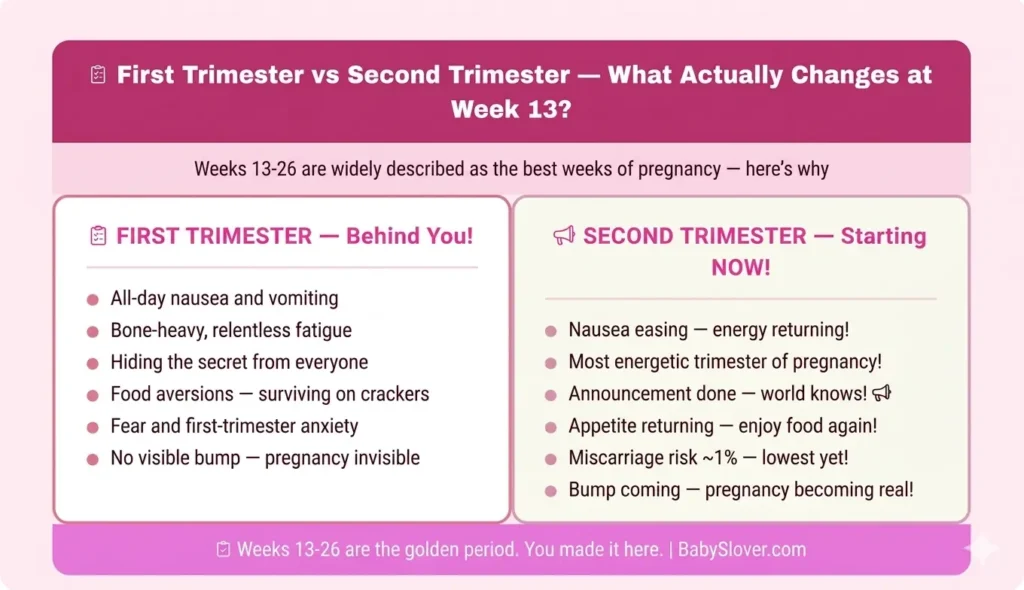
The second trimester — Weeks 13 through 26 — is widely described by OBs, midwives, and experienced moms as the best trimester of pregnancy. Here’s what that actually means for you:
What Changes at Week 13
- hCG has peaked and is declining — the hormonal driver of nausea and fatigue is retreating
- Placenta is fully functional — your body has offloaded its hormonal burden to an efficient dedicated organ
- Miscarriage risk is now approximately 1% — statistically, the lowest it will be throughout the pregnancy
- Energy levels begin a meaningful return for most women — the bone-heavy exhaustion of the first trimester starts lifting
- Nausea fades for the majority of women between Weeks 13-16 — food becomes appealing again
- The bump begins to be visible — the uterus is rising above the pubic bone and will soon be unmistakable
- For many couples, libido returns — estrogen rising, nausea retreating, and the constant worry of the first trimester easing
The second trimester is when most women describe feeling most like themselves during pregnancy — recognizably energized, visibly pregnant, and emotionally more settled than the anxiety-laden first trimester. Weeks 13-26 are the weeks that most pregnant women remember most fondly. Welcome to them.
💡 The ‘golden period’ of pregnancy is real — but individual. Some women feel dramatically better from Week 13. Others notice the shift more gradually over Weeks 13-16. Either is normal. The trend is unmistakably positive from here.
What’s Happening in Your Body at 13 Weeks Pregnant
Uterus Rising Out of the Pelvis — Bump Incoming
Your uterus is now rising above the pubic bone for the first time. At your next OB appointment, your provider will begin measuring fundal height — the distance from your pubic bone to the top of your uterus — as a regular way of monitoring your baby’s growth. As the uterus rises, it gradually moves away from the bladder, which means the intense urinary urgency many women felt in the first trimester begins to ease. (It returns in the third trimester when the uterus is much larger and the baby’s head presses down from above — but the middle trimester gives you a welcome break.)
Colostrum — Your Breasts Are Already Preparing
One of the most quietly remarkable things happening at Week 13: your breasts are beginning to produce colostrum — the first form of breast milk, sometimes called ‘liquid gold.’ Colostrum is thick, yellowish, and extraordinarily nutrient-dense. It contains concentrated antibodies, immune factors, and growth hormones. Some women notice they can express a tiny drop from the nipple when pressed from Week 13 onward, though most won’t notice any visible leakage until much later in pregnancy or after birth. Whether you intend to breastfeed or not, your body is quietly preparing for it from this week forward.
Stretch Marks — Prevention Starts Now
As your uterus expands out of the pelvis and your bump becomes more visible, stretch marks may begin appearing — typically on the abdomen, breasts, hips, and buttocks. These are caused by the rapid stretching of the skin’s middle layer (the dermis), which tears when stretched faster than the skin can accommodate. Genetics plays a significant role in who gets stretch marks — if your mother or sisters had them, you are more likely to as well. Keeping skin well moisturized from Week 13 onward (with cocoa butter, shea butter, or vitamin E oil applied when skin is slightly damp after showering) won’t eliminate the genetic component but can improve skin elasticity and reduce intensity. Gaining pregnancy weight slowly and steadily per ACOG guidelines also helps.
Pregnancy Rhinitis — The Stuffed-Up Nose
If your nose has been persistently congested for no apparent reason, welcome to pregnancy rhinitis — hormonal swelling of the nasal passages caused by increased estrogen and progesterone. It affects approximately 20-30% of pregnant women and typically worsens in the second trimester. Safe management options include: a saline nasal rinse (neti pot or spray), a humidifier in the bedroom, elevating your head slightly during sleep, and staying well hydrated. Avoid decongestant sprays unless specifically approved by your OB — many are unsafe during pregnancy.
Appetite Returning — And Growing
For women who spent the first trimester surviving on crackers, the return of appetite at Week 13 can feel like one of the most welcome changes of the entire pregnancy. As nausea eases and food aversions fade, healthy eating becomes both possible and important again. Your caloric needs are increasing — most guidelines recommend approximately 340 extra calories per day in the second trimester (above your pre-pregnancy maintenance intake). Use this window to rebuild nutritional reserves and eat the balanced, varied diet that first-trimester nausea may have made impossible.
🌱 Baby Development at 13 Weeks Pregnant
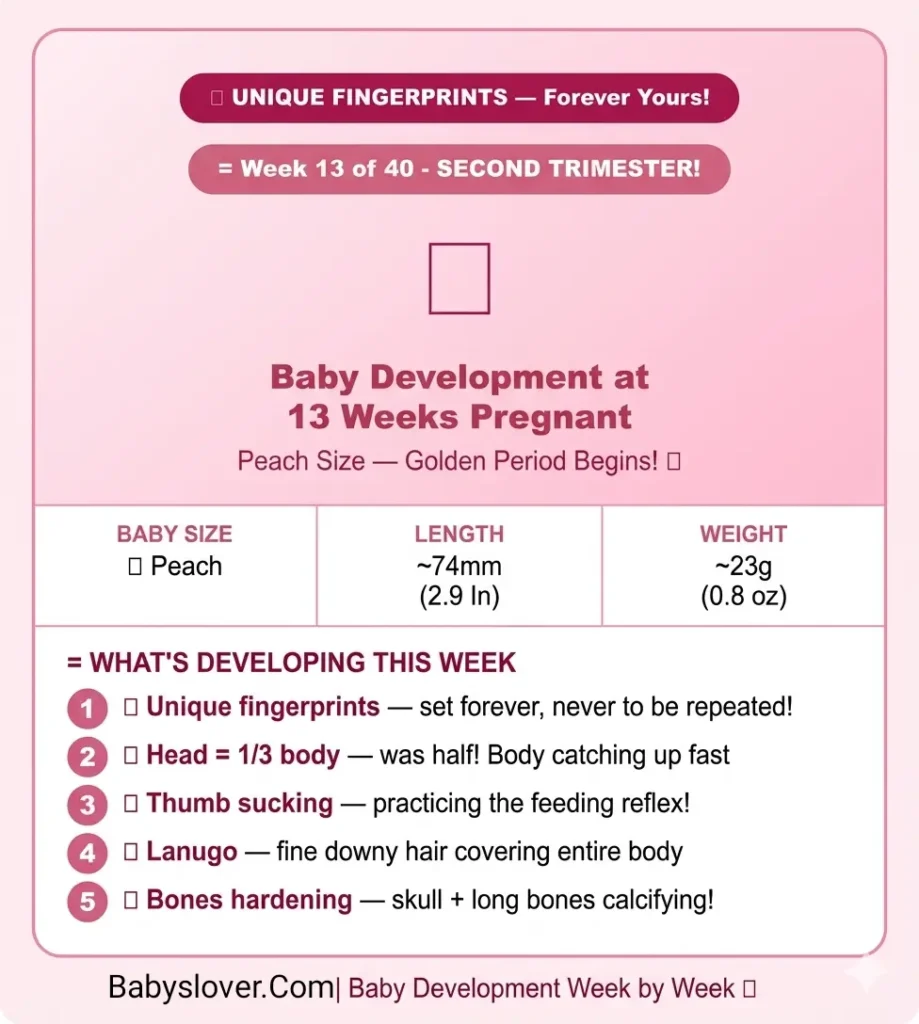
At 13 weeks pregnant, your baby measures approximately 74mm — the size of a peach — and weighs about 23 grams. The body length has grown by about 30% from Week 12’s lime size. But the most significant development this week isn’t about measurement — it’s about identity.
| 🌱 Baby Development at 13 Weeks Pregnant | |
| Baby Size | 🍑 Peach — ~74mm (2.9 inches) |
| Weight | ~23 grams (0.8 oz) — growing rapidly in Q2! |
| Head Proportion | Now 1/3 of total body length — was 1/2 just two weeks ago! |
| Heart Rate | ~150-175 bpm — active and strong |
| KEY MILESTONE | 👆 UNIQUE FINGERPRINTS — completely formed, never to be repeated in human history! |
What Is Developing at Week 13
- 👆 Unique fingerprints — completely formed and permanent: The tiny friction ridges forming on the pads of your baby’s fingers this week are entirely unique — no other person who has ever lived, or who will ever live, has or will have the same fingerprint pattern. These ridges form as a result of the combination of genetic instruction and the random physical stresses on the skin as it grows — like a snowflake, the pattern is never duplicated. The fingerprints that will one day identify your child on every form, database, and border crossing in their life were set this week, at 74mm, in a warm amniotic bath.
- 🧠 Head proportion shifts — now just 1/3 of body length: For the entire first trimester, your baby’s head accounted for approximately half its total body length. This week, the body is growing faster than the head, and the head-to-body ratio shifts to approximately one-third — a proportional shift that will continue throughout the pregnancy until the newborn head-to-body ratio of roughly 1:4 is reached. On the 13-week ultrasound, your baby’s body looks markedly more balanced than at the 12-week scan — less ‘tadpole,’ more ‘miniature person.’
- 👍 Thumb sucking begins: Your baby may be sucking its thumb this week — and this is not merely a charming random behavior. Thumb sucking serves a specific developmental purpose: it strengthens and coordinates the sucking reflex that your baby will rely on to breastfeed or bottle-feed within minutes of being born. The reflex that will sustain your baby’s nutrition for months is being practiced and refined right now, weeks before it’s needed. Some babies continue thumb sucking after birth — the in-utero habit often persists.
- 🦱 Lanugo — fine hair covering the entire body: A layer of fine, downy hair called lanugo is now covering your baby’s entire body. Lanugo serves as a kind of ‘anchor’ for the vernix caseosa — the waxy protective coating that will develop over coming weeks to protect the skin from the constant immersion in amniotic fluid. Most lanugo sheds before birth (or in the first 2-4 weeks after birth), though some babies — especially those born early — still have visible lanugo at delivery. The fine fuzz some parents notice on a newborn’s shoulders and back is lanugo that hadn’t yet shed.
- 🦴 Skull and long bones hardening: The ossification (bone hardening) that began at Week 10 is now advancing significantly in the skull and long bones of the arms and legs. These are the primary structural bones — the framework of the skeleton — and their calcification is directly related to your calcium and vitamin D intake. The bones are visible and measurable on ultrasound from Week 13 onward, and the femur (thigh bone) length becomes a standard measurement in the anatomy scan at Week 20.
- 💦 Amniotic fluid cycle — baby is swallowing and urinating: Your baby’s kidneys and urinary tract are fully functional this week. The baby is swallowing amniotic fluid, processing it through the kidneys, and urinating it back into the amniotic sac — a continuous cycle that your baby will maintain until birth. This cycle is not merely waste management: it’s how the baby practices breathing movements (the diaphragm must contract to draw in amniotic fluid through the mouth), how the digestive system is trained, and how amniotic fluid volume is regulated. The flavors of what you eat pass into the amniotic fluid and are tasted by your baby with every swallow.
- 🎙️ Vocal cords continuing to develop: The laryngeal structures forming at Week 12 are continuing to develop and refine. The vocal cord tissue is growing more complex this week — though of course it won’t produce sound until air first passes through it at birth. The first cry your baby produces in the delivery room will be the very first time these vocal cords have ever been used in the way they were designed. Everything until then is structural preparation.
💡 Fun fact: Identical twins have different fingerprints. Even though they share the same DNA, the random physical stresses on each baby’s developing skin during the finger ridge formation process at around Week 13 are slightly different — producing permanently distinct patterns. DNA determines the general category of the fingerprint pattern, but the precise ridges are physically unique.
Pregnancy Weight Gain — The Second Trimester Guidelines
Week 13 is the right time to understand healthy pregnancy weight gain, because the second trimester is when most of your pregnancy weight gain occurs
| Pre-pregnancy BMI | Total Recommended Gain | Q2/Q3 Rate | 1st Trim Gain |
| Underweight (BMI <18.5) | 28-40 lbs (12.5-18 kg) | ~1 lb/week | 2-4 lbs |
| Normal (BMI 18.5-24.9) | 25-35 lbs (11.5-16 kg) | ~1 lb/week | 2-4 lbs |
| Overweight (BMI 25-29.9) | 15-25 lbs (7-11.5 kg) | ~0.6 lbs/week | 2 lbs |
| Obese (BMI ≥30) | 11-20 lbs (5-9 kg) | ~0.5 lbs/week | 2 lbs |
| Twins | 37-54 lbs depending on BMI | ~1.5 lbs/week | 4-6 lbs |
Per ACOG, these are guidelines, not mandates — individual circumstances, body type, and pregnancy complications all influence what’s appropriate for a specific person. The more important principle is steady, gradual gain rather than large fluctuations. If you’re concerned about your weight gain pattern, your OB is the right person to guide you based on your specific circumstances.
13 Weeks Pregnant Symptoms — The Shift Begins
Week 13 symptoms are often described as a turning point — for most women, the first week where the trajectory of how they feel is unmistakably improving rather than intensifying.
🤢 Morning Sickness — Fading for Most
For most women, nausea begins meaningful improvement around Weeks 12-14 as hCG declines. If you’re at Week 13 and still feeling sick, know that the majority of women experience significant relief within the next 2-3 weeks. If nausea remains severe past Week 16, discuss this with your OB — persistent hyperemesis may need medical support beyond this point.
⚡ Energy Returning — The Most Welcome Symptom
The profound first-trimester fatigue — which was physiologically driven by the hormonal demands of building the placenta and sustaining the pregnancy on high hCG — begins its meaningful retreat at Week 13. Most women notice they can stay awake past 8pm again around this time. This is real, not imagined, and it will continue improving through the second trimester. Many women describe the second trimester as a period of genuine energy and productivity that surprises them after the first trimester’s exhaustion.
📈 Appetite Surging
After weeks of nausea-suppressed eating, your appetite is likely returning — and it may feel voracious compared to what you’ve been able to eat. This is your body rebuilding nutritional reserves depleted by the first trimester and increasingly serving the growing baby’s nutritional needs. The key is feeding the hunger with nutrient-dense foods rather than empty calories — though allowing yourself to genuinely enjoy eating again after the first trimester’s aversion is absolutely part of this week’s celebration.
😊 Libido Returning — Yes, It’s Normal
The combination of declining nausea, rising estrogen, and increased pelvic blood flow means that libido returns for many women around Week 13. Sex during pregnancy is entirely safe for low-risk pregnancies and is not harmful to the baby in any way — the baby is cushioned by amniotic fluid and the cervical mucus plug, and is completely protected. Light spotting after sex is common and normal due to the cervix’s increased sensitivity and vascularity — it does not indicate a problem. Heavy bleeding after sex should be reported to your OB.
🤧 Pregnancy Rhinitis — The Congested Second Trimester
Persistent nasal congestion without a cold is pregnancy rhinitis — hormonal swelling of the nasal passages that often starts or worsens around Week 13. A saline rinse, bedroom humidifier, and head elevation during sleep are the safest management approaches. It typically resolves within 2 weeks of delivery.
🔴 Stretch Marks May Begin Appearing
As the bump starts to show and skin begins stretching, stretch marks — pinkish or reddish streaks on the abdomen, breasts, hips, or thighs — may appear. Genetics is the primary predictor of who develops them (approximately 90% of pregnant women do). Starting a moisturizing routine now — applied generously to slightly damp skin after bathing — won’t eliminate them if your genetics predispose you, but may reduce their intensity. They fade significantly after delivery.
💭 13 Weeks Pregnant With No Symptoms
Having no symptoms at 13 weeks is completely normal — and in fact, many women have already felt well for a week or more by this point. Symptom absence is not a predictor of pregnancy outcomes. Your prenatal care and scans are the appropriate measures of pregnancy health.
What to Eat at 13 Weeks Pregnant — Second Trimester Nutrition Priorities
| Nutrient | Why Critical at Week 13 | Best Sources |
| Calcium | Skull and long bones hardening this week — calcium is the literal building material of your baby’s skeleton | Dairy, fortified plant milk, kale, sardines, almonds |
| Iron | Blood volume now 40-50% above normal — iron demand is at its second trimester peak | Lean meat, spinach, beans, fortified cereals + vitamin C for absorption |
| DHA Omega-3 | Baby’s brain growing rapidly throughout second trimester — DHA is the primary neural structural fat | Cooked salmon, sardines, walnuts, DHA supplement in prenatal |
| Vitamin D | Supports calcium absorption for bone ossification. Deficiency common in pregnancy | Fortified dairy/plant milk, egg yolks, cooked salmon, supplement |
| Protein | +25g/day above pre-pregnancy — muscles, organs, and blood all need amino acids for growth | Eggs, lean meat, fish, legumes, dairy, tofu, nuts |
| Fiber | Progesterone slows digestion — constipation worsens in Q2. Fiber is the most effective prevention | Whole grains, fruits, vegetables, legumes — plus 8-10 glasses water |
With appetite returning, Week 13 is when you can finally genuinely invest in second-trimester nutrition. The flavors passing into the amniotic fluid this week — which your baby is actively tasting via the swallowing cycle — may genuinely shape early food preferences. Varied, colorful eating now serves both of you. Per the CDC, folic acid remains important through the second trimester. Our best prenatal vitamins guide covers formulas with the complete second-trimester profile.
For Your Partner — Welcome to the Second Trimester
Week 13 is when partners often begin noticing a meaningful shift — from ‘survival mode’ to something that feels much more like a shared pregnancy adventure. Here’s what this week calls for:
- Acknowledge the first trimester explicitly: Your partner has just survived twelve weeks of pregnancy while largely concealing it from the world. This week — the beginning of the second trimester — is the natural moment to acknowledge what that took. Not practically (‘you did great’) but specifically: ‘You were sick, exhausted, and scared, and you handled it with more grace than I could have. I see that.’ This matters more than most partners realize.
- Embrace the changes coming: The second trimester is when pregnancy becomes more visible, more shared, and more celebratory. The bump will be unmistakable within weeks. The movements you’ll both feel — typically from Weeks 16-22 — are approaching. Plan together: start the hospital tour conversation, discuss the birth plan, consider whether a doula makes sense. These conversations are richer and calmer at Week 13 than they will be at Week 34.
- Stretch mark support: If your partner is beginning stretch mark prevention, offering to apply belly butter or cocoa butter at night is one of the most practical and intimate forms of connection the second trimester offers. It takes 2 minutes, it becomes a nightly ritual, and it keeps partners physically involved in the pregnancy’s daily reality in a way that is both helpful and connecting.
- Understand the appetite return: After weeks of managing nausea and limited eating, your partner’s appetite returning is genuinely good news — but it may be more voracious and more specific than you’re used to. Food cravings often intensify in the second trimester. Being flexible, creative, and unbothered about satisfying specific food requests without judgment is a concrete, daily way to show support.
- Start reading our hospital bag checklist for mom — yes, at Week 13: The birth feels far away right now — but the third trimester begins at Week 27, which is only 14 weeks from today. Starting birth preparation research at Week 13 gives you 14+ weeks of calm preparation rather than a few weeks of rushed scrambling. Start reading now.
When to Call Your Doctor at 13 Weeks Pregnant
- Heavy vaginal bleeding — soaking a pad or passing clots: Light spotting after sex is common and normal. Heavy red bleeding requires same-day evaluation.
- Severe abdominal pain — persistent, not brief round ligament pain: Round ligament pain is sharp, brief, and triggered by movement. Persistent, severe, or one-sided abdominal pain should be evaluated.
- Fever above 100.4°F / 38°C: Infection in pregnancy needs prompt evaluation.
- Signs of UTI — painful urination, urgency, frequency with burning: UTIs must be treated with antibiotics in pregnancy.
- Calf pain, swelling, redness, or warmth — one-sided: Deep vein thrombosis (DVT) risk increases in pregnancy. One-sided calf symptoms should be evaluated promptly.
- Nausea still severe past Week 13 with vomiting and inability to keep fluids down: Hyperemesis gravidarum can continue past the first trimester and requires medical management.
Your Week 13 Pregnancy Checklist
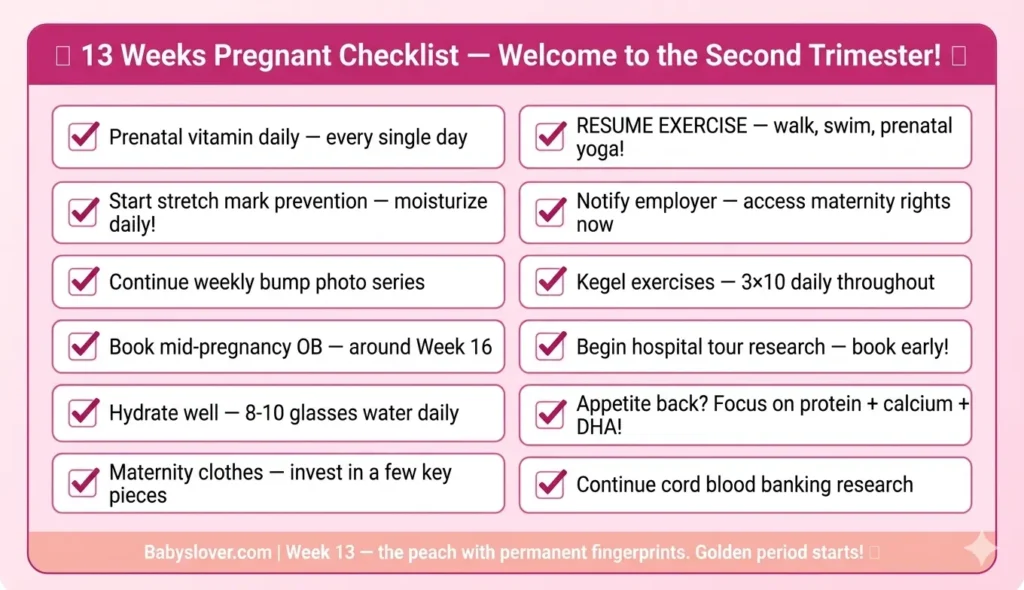
- ☑ Take prenatal vitamin daily — calcium, iron, DHA, folic acid
- ☑ RESUME EXERCISE — walking, swimming, prenatal yoga are all safe and beneficial
- ☑ Start stretch mark prevention — moisturize daily on damp skin after shower
- ☑ Notify your employer about the pregnancy — access your maternity rights now
- ☑ Continue weekly bump photo series — same outfit, same wall, same time
- ☑ Continue Kegel exercises — 3 sets of 10 daily throughout pregnancy
- ☑ Book mid-pregnancy OB appointment for around Week 16
- ☑ Begin hospital tour research — book early, spots fill up
- ☑ Continue cord blood banking research — decide before Week 36
- ☑ Add fiber-rich foods for constipation prevention — whole grains, fruits, veg
- ☑ Appetite returning? Focus on protein, calcium, DHA, and variety
- ☑ Maternity clothes — a few well-fitting staples make a real difference now
Frequently Asked Questions — 13 Weeks Pregnant
Is 13 weeks the second trimester?
Yes — the second trimester officially begins at Week 13 and runs through the end of Week 26. Week 13 is the first week of the second trimester. The first trimester was Weeks 1-12; the third trimester will be Weeks 27-40.
What does 13 weeks pregnant feel like?
For most women, 13 weeks pregnant feels like the beginning of a genuine shift — not always dramatically, but unmistakably. Nausea starts fading. Energy begins returning. Appetite comes back. The relentless secrecy of the first trimester is over. Many women describe Week 13 as the first week they felt cautiously, genuinely hopeful about how the pregnancy might actually feel for the next few months.
How big is my baby at 13 weeks pregnant?
At 13 weeks pregnant, your baby is approximately 74mm long — the size of a peach — and weighs about 23 grams. The head now accounts for only one-third of total body length, down from the half it occupied throughout the first trimester.
When will I start showing at 13 weeks?
For first-time moms, a visible bump typically appears between Weeks 14-20, though some women show a subtle roundness from Week 13. Women who have been pregnant before often show 2-4 weeks earlier because their abdominal muscles have already been stretched. Body shape, height, and abdominal muscle tone all influence timing. Your OB will measure fundal height from Week 13-16 onward as a consistent tracking tool regardless of visible bump size.
Is it safe to have sex at 13 weeks pregnant?
Yes — sex during pregnancy is completely safe for low-risk pregnancies and is not harmful to the baby in any way. The baby is fully cushioned by amniotic fluid and protected by the cervical mucus plug. Light spotting after sex is normal due to the cervix’s increased sensitivity. Heavy bleeding should be reported to your OB. Your libido may return around Week 13 — this is hormonal and entirely normal.
What are the most common 13 weeks pregnant symptoms?
The most common 13 weeks pregnant symptoms include: nausea beginning to ease, energy returning, appetite increasing, round ligament pain (sharp pains in lower abdomen from uterine stretching), pregnancy rhinitis (stuffy nose), pregnancy glow (increased blood flow and estrogen), and possibly the beginning of stretch marks. First-trimester symptoms like fatigue and nausea will still be present for some women at 13 weeks but are typically on a downward trend.
Do identical twins have the same fingerprints?
No — and this is one of the most fascinating facts about fingerprint development at Week 13. Identical twins have different fingerprints, despite sharing identical DNA. The ridge formation is influenced by random physical factors during the skin’s development — the precise way amniotic fluid touches the fingertip surface, the position in the womb, and slight variations in skin growth rate. DNA determines the general category of the fingerprint pattern, but the precise individual ridges are entirely unique to each person.
When will I feel the baby move?
First-time moms typically feel fetal movement — called quickening — between Weeks 18-22. Women who have been pregnant before may feel it earlier, around Weeks 14-16, because they recognize the sensation. The movements are happening now — your baby is kicking, turning, and stretching at 13 weeks — but the baby is still too small and the amniotic cushion too thick for the movement to be felt through the abdominal wall. Feeling movement is one of the most anticipated milestones of the second trimester.
💗 The Emotional Reality of Week 13 — Permission to Relax
The first trimester required you to hold a great deal, very quietly.
Fear about miscarriage. The effort of concealing something enormous while feeling profoundly unwell. Appointments you attended trying to read expressions on sonographers’ faces. The lonely particular exhaustion of caring deeply about something no one around you knew existed.
Week 13 is the week you get to put some of that down. Not all of it — pregnancy comes with its own ongoing set of worries — but the acute, baseline fear of the first trimester: that’s over. The statistics are on your side now. The placenta is carrying its load. The baby has fingerprints. Your body knows what it’s doing.
The second trimester is genuinely lighter. Not just physiologically — emotionally. The pregnancy is public (or becoming public). The bump is coming. The movements are coming.
At Babyslover, we want you to give yourself permission to enjoy this — not just endure it. Week 13 is where that becomes possible. 💗
👶 What Happens Next — 14 Weeks Pregnant Preview
The second trimester continues its momentum — here’s what to look forward to with 14 weeks pregnant:
- Baby grows to lemon size — ~87mm (3.4 inches), about 45 grams
- Baby’s neck more defined — the lopsided look is fading fast
- Red blood cells forming in the SPLEEN — liver hands off this role
- Baby’s sex becoming clearer — external genitalia more differentiated
- Squinting, frowning, grimacing — facial expressions beginning!
- Hands becoming active — grasping, touching face, finger movements
- Your bump growing — uterus rising noticeably above pubic bone
Keep following our complete pregnancy week by week guide — from first kick to final countdown. The best weeks are unfolding now!
Week 13: The Peach With Permanent Fingerprints
Being 13 weeks pregnant means carrying a peach-sized person whose fingerprints are already set forever — uniquely, unrepeatabably theirs. Whose head is smaller relative to its body than just two weeks ago. Who is practicing the sucking reflex that will sustain it from its first minutes of life. Whose skin is covered in the finest downy hair, whose skull is hardening around the brain building its first language connections, and whose bones are drinking the calcium from your diet to become the skeleton you’ll one day watch learn to walk.
The second trimester is here. The golden period is real. The nausea is retreating. The bump is coming. The movements are coming.
You made it through the hardest part. What comes next is the part most pregnant women look back on with genuine joy. Let yourself enter it fully. 💗 For everything ahead, our pregnancy tips for first time moms is ready to walk with you through every week of the second trimester.
1 thought on “13 Weeks Pregnant: Baby Size, Symptoms & Second Trimester”