

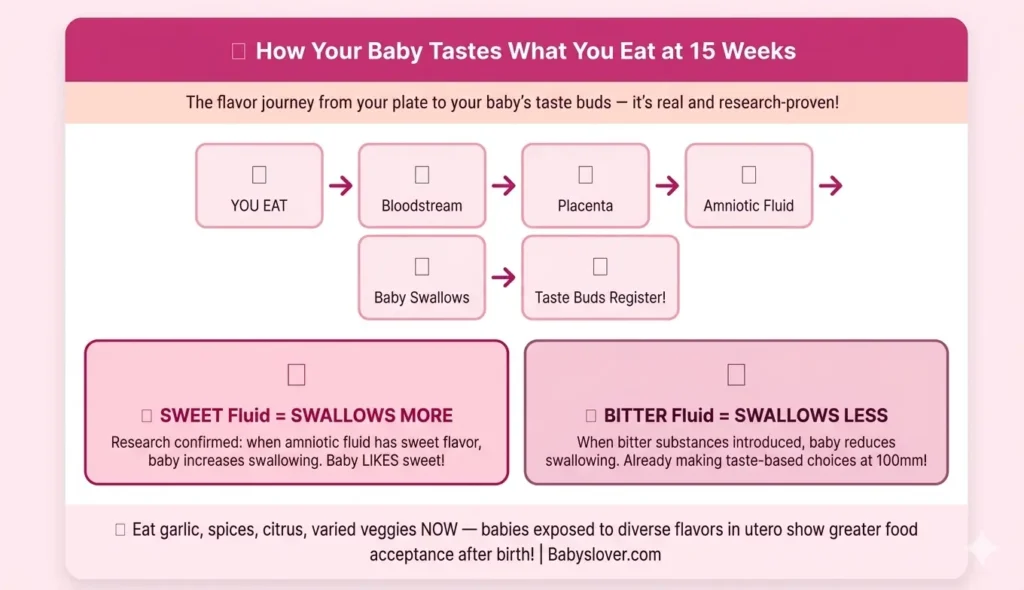
Your baby can taste your dinner. At 15 weeks pregnant, your apple-sized baby’s taste buds are fully developed and actively connected to the brain — and research has confirmed something remarkable: when the amniotic fluid carries a sweet flavor, your baby swallows more of it. When it tastes bitter, your baby swallows less.
The food you eat today is passing flavor molecules into the amniotic fluid, and your baby is experiencing those flavors right now — making taste-driven choices at 100mm long, in complete darkness, weeks before anyone knows what food it will one day prefer.
Week 15 is also the week the skeleton becomes visible on X-ray, eyes begin responding to light through closed lids, and the heart pumps approximately 26 quarts of blood every single day — a figure that puts into perspective what is happening inside that apple-sized body.
At Babyslover, here is everything about 15 weeks pregnant: your baby’s extraordinary sensory awakening, what’s changing in your body, the amniocentesis and quad screen window, and what to do this week. Just arriving from last week?
Our 14 weeks pregnant guide covered the lemon-sized baby, brain-driven facial expressions, and the anatomy scan booking reminder.

| 📋 Quick Summary —15 Weeks Pregnant | |
| Week | Week 15 of 40 — Second Trimester, Week 3 🌟 |
| Trimester | Second Trimester — golden period continuing |
| Baby Size | 🍎 Apple / navel orange — ~100mm (4 inches) |
| Baby Weight | ~70 grams (2.5 oz) — 3× Week 13’s weight! |
| KEY MILESTONES | 👅 Taste buds FULLY developed — baby tastes amniotic fluid! • 🦴 Skeleton visible on X-ray • 💡 Eyes react to light (closed lids) • 🦶 Toenails forming • 💓 Heart pumping 26 quarts blood/day • 🤧 Hiccups begin! |
| Symptoms | Heartburn arriving, shortness of breath, nosebleeds, gum sensitivity, fundal height measurements begin, pregnancy glow, round ligament pain, skin & hair changes continuing |
| Heart Rate | ~140-160 bpm — steady second trimester rhythm |
| This Week | 🧪 Quad screen & amniocentesis window NOW OPEN — discuss with OB this week! |
What’s Happening in Your Body at 15 Weeks Pregnant
Fundal Height Measurements Begin
Starting around Week 15-16, your OB or midwife will begin measuring fundal height at every prenatal appointment — the distance in centimeters from the top of your pubic bone to the top of your uterus. This simple tape-measure check becomes one of the most important routine assessments in prenatal care because fundal height closely tracks gestational age: after Week 20, fundal height in centimeters should approximately equal the number of weeks pregnant (a fundal height of 25cm at 25 weeks, for example). Measurements that track consistently above or below expectations prompt further evaluation. Your bump is now externally palpable — and it’s getting more prominent each week.
Heartburn — Welcome to the Second Trimester’s Most Common Complaint
Heartburn — that burning sensation in the chest and throat after eating — typically arrives or intensifies around Weeks 14-16, and Week 15 is when many women first notice it as a consistent presence. The cause is dual: progesterone relaxes the lower esophageal sphincter (the valve between the esophagus and stomach), allowing stomach acid to reflux upward, while the growing uterus increasingly pushes the stomach upward. Safe and effective management includes: smaller, more frequent meals; avoiding lying down for 30-60 minutes after eating; elevating the head of the bed slightly; avoiding known triggers (spicy, fatty, citrus, chocolate, carbonated drinks); and pregnancy-safe antacids (calcium carbonate versions are doubly useful as they also contribute to your calcium intake). Ask your OB before taking any antacid regularly.
Shortness of Breath — Your Lungs Are Getting Crowded
Finding yourself slightly breathless climbing stairs or talking quickly? This is entirely normal at Week 15. As the uterus grows upward, it begins competing with the lungs for space in the torso, reducing lung expansion capacity. Simultaneously, your blood volume is 40-50% higher than normal and the body needs to exchange more oxygen and carbon dioxide than ever before. The diaphragm will eventually be pushed up by about 4cm by the third trimester. Slowing down, maintaining good posture (which maximizes the space available for lung expansion), and sleeping with extra pillows to keep the upper body slightly elevated all help.
Pregnancy Pillow — Now Is the Right Time
If sleep is becoming less comfortable — more difficult to find a position, lower back aching, hip pressure when lying on your side — a pregnancy pillow now is better than one at Week 28 when you’ve already spent 13 weeks sleeping badly. Left-side sleeping is generally recommended from the second trimester onward because it optimizes blood flow to the placenta and kidneys. A wedge or C-shaped pillow supporting the belly, back, and between the knees makes left-side sleeping significantly more comfortable. Investing now makes the entire second trimester’s sleep measurably better.
Nosebleeds — More Frequent Now
Increased blood volume and hormonally expanded blood vessels in the nasal passages make nosebleeds common throughout the second trimester. They’re typically harmless — lean forward (not back) and pinch the soft part of the nose for 10-15 minutes. Staying well hydrated, using a bedroom humidifier, and applying a thin layer of petroleum jelly inside the nostrils to prevent drying all reduce frequency. Contact your OB if a nosebleed lasts more than 20 minutes or recurs frequently in a single day.
🌱 Baby Development at 15 Weeks Pregnant
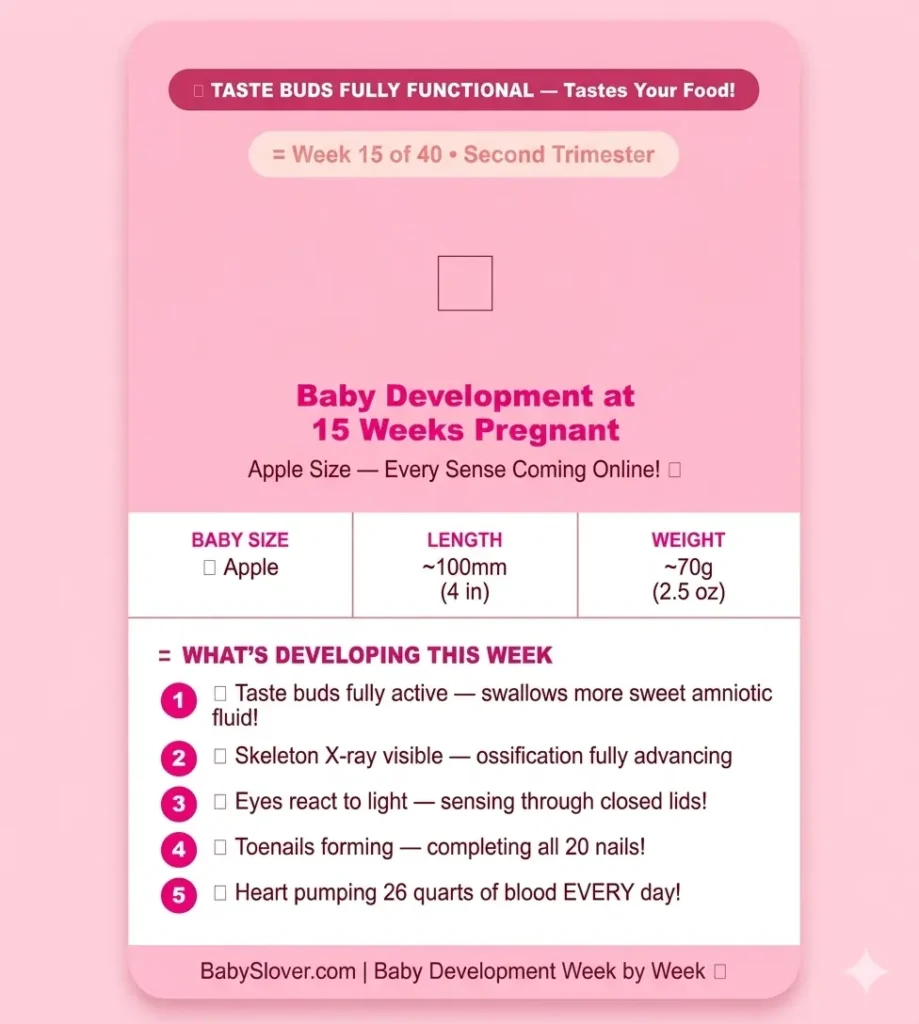
At 15 weeks pregnant, your baby measures approximately 100mm — the size of an apple — and weighs about 70 grams. That’s triple the weight of Week 13’s peach. Growth in the second trimester is rapid and sustained — your baby’s body mass is doubling and tripling in short windows as the skeleton hardens, organs mature, and the sensory systems come fully online. And this week, one of the most remarkable sensory awakenings of the entire pregnancy happens.

| 🌱 Baby Development at 15 Weeks Pregnant | |
| Baby Size | 🍎 Apple / navel orange — ~100mm (4 inches) |
| Weight | ~70 grams (2.5 oz) — growing fast! |
| Heart | Pumping ~26 quarts (24.6 liters) of blood every day! |
| Senses | All 5 senses at least partially active — taste, touch, light, hearing developing, smell |
| KEY MILESTONE | 👅 Taste buds FULLY developed — swallows more sweet amniotic fluid, less bitter. Baby is tasting YOUR food today! |
What Is Developing at Week 15
- 👅 Taste buds fully developed — baby tastes what you eat: By Week 15, your baby’s taste buds are completely developed and functionally connected to the brain. Research has confirmed that when sweet-tasting substances are introduced into the amniotic fluid, the baby swallows significantly more of it — and when bitter substances are introduced, the baby swallows less. The flavors of what you eat — garlic, vanilla, carrot, spices, citrus — cross the placenta into the amniotic fluid, and your baby is tasting them right now. This is not trivial: studies suggest that fetuses exposed to diverse, flavorful diets in utero show greater acceptance of those specific flavors after birth. What you eat at Week 15 may genuinely influence how adventurous an eater your child becomes.
- 🦴 Skeleton visible on X-ray — ossification advancing: Your baby’s bones have hardened to the point that if an X-ray were taken this week, the complete skeleton would be clearly visible — every bone of the skull, spine, ribs, arms, and legs. The ossification process that began at Week 10 has advanced enough to produce genuine radiographic density. The bones are still growing rapidly — each long bone calcifies outward from the center while the cartilage at the ends continues to extend — but the structural skeleton is now a visible, mineralized reality. This is why calcium intake this week matters: the material for that visible skeleton is coming directly from your dietary intake and supplement.
- 💡 Eyes sensitive to light through closed lids: Your baby’s eyelids remain fused shut — they won’t open until approximately Week 28. But from Week 15, the eyes are sensitive enough to detect bright light through the closed lids. When a bright light is shone on the mother’s abdomen, the fetus will often turn away from it. This is not conscious perception — the visual cortex that processes sight is still developing — but the light-detection pathway from the retina to the brain is now active and responsive. Your baby is having its very first, rudimentary experience of the difference between light and darkness.
- 🦶 Toenails beginning to develop: Fingernails have been forming since Week 10 — this week, toenails begin their development. Like fingernails, they start as thin layers of cells differentiating from the skin at the nail bed, and they will grow slowly across the fingertip surface throughout the remainder of the pregnancy. Some babies are born with nails long enough to scratch themselves — a perfectly normal sign of a full-term pregnancy. Others arrive with very soft, barely visible nails that harden within days after birth. Toenail growth at 15 weeks is the completion of the nail system across all twenty digits.
- 💓 Heart pumping 26 quarts of blood per day: Your baby’s four-chambered heart — beating at approximately 140-160 bpm — is pumping approximately 26 quarts of blood every single day. That is roughly 6.5 gallons — the volume of approximately 52 standard water bottles. For context, an adult human heart pumps approximately 6,000 quarts of blood per day at rest — meaning your baby’s heart is already working at enormous relative output for its size. The circulatory system is delivering oxygen and nutrients to every developing organ and tissue with a remarkable efficiency that fully operational adult hearts achieve only at rest.
- 🤧 Hiccups begin: Your baby may be experiencing its first hiccups this week — the result of the diaphragm practicing the rhythmic contractions it will use for breathing after birth. Fetal hiccups produce tiny, rhythmic jerking movements that are visible on ultrasound and will eventually be felt by the mother as small, regular tapping sensations (typically from around Week 20-24 onward). They are entirely normal, typically brief, and actually indicate good neurological development — the phrenic nerve that drives the diaphragm is functioning normally.
- 🚶 Legs lengthening — becoming proportionate: At earlier weeks, the arms were proportionally longer than the legs — the arms develop ahead of the legs in fetal development. From Week 15 onward, the legs are growing faster and catching up to arm length. The femur (thigh bone) is lengthening rapidly and will become one of the key measurements at the 20-week anatomy scan — femur length is one of the four standard biometric measurements (along with head circumference, abdominal circumference, and biparietal diameter) used to assess fetal growth.
- 👦👧 Boys and girls move differently in the womb: Here’s a fascinating fact that most competitors miss: research shows that at around Week 15, baby girls open and close their mouths more frequently than baby boys. Boys and girls also show different movement patterns on ultrasound from this point forward — girls tend to show more mouth and facial movements, while boys tend to show more whole-body and limb movements. The reasons are not fully understood, but the sex-based behavioral differences that will characterize your child’s development begin to appear this early.
💡 Fun fact: Your baby’s heart has already beaten approximately 15,800,000 times by Week 15 — counting from the first heartbeat at Week 5-6. Every single one of those 15.8 million beats happened before you could feel a single movement. The work going on inside is extraordinary.
🧪 Amniocentesis & Quad Screen — The Windows Are Open Now
Week 15 opens the window for two important optional diagnostic and screening tests. This is the right time to discuss both with your OB if you haven’t already:
Amniocentesis — The Diagnostic Test
Amniocentesis is a diagnostic test — not a screening test — that involves inserting a thin needle through the abdomen into the amniotic sac to withdraw a small amount of amniotic fluid. The fetal cells in that fluid are then analyzed for chromosomal abnormalities (including Down syndrome, trisomy 18, trisomy 13) and specific genetic conditions with near-100% accuracy.
The standard amniocentesis window is Weeks 15-20, with most performed between Weeks 15-18. The procedure carries a small risk of miscarriage — approximately 0.1-0.3% (1 in 300-1000) in experienced hands — which is lower than it was in previous decades. Per ACOG, amniocentesis is offered to all pregnant women regardless of age, though it is most often chosen by those who have had abnormal screening results (NIPT, NT scan, or quad screen), have a family history of chromosomal or genetic conditions, or are over 35.
Quad Screen — The Blood Screening Test
The quad screen (also called the maternal serum quad test or second-trimester screen) is a blood test available from Weeks 15-22 that measures four substances — AFP, hCG, estriol, and inhibin A — to assess statistical risk for Down syndrome, trisomy 18, and neural tube defects.
It is a screening tool, not a diagnostic one — it tells you the probability of a condition, not whether your baby has it. Accuracy for Down syndrome detection is approximately 80-85%. If you had NIPT earlier in your pregnancy, the quad screen provides somewhat overlapping information — discuss with your OB whether it adds meaningful additional value for your specific situation. The quad screen is most useful for women who did not have NIPT or an NT scan.
💡 Neither the quad screen nor amniocentesis is mandatory. Both are offered as options, and the decision to have either test is entirely personal — based on your age, risk factors, previous screening results, and what you would do with the information. Your OB is the right guide for this conversation.
15 Weeks Pregnant Symptoms — What’s Normal
🔥 Heartburn — The Second Trimester’s Arrival
Heartburn is one of the most common second-trimester symptoms and often first appears or intensifies at Week 15. Smaller, more frequent meals are the single most effective dietary strategy — large meals distend the stomach and increase reflux pressure. Calcium carbonate antacids (like Tums) are pregnancy-safe and double as a calcium supplement — check with your OB before taking them regularly. Avoid: spicy food, fatty food, citrus, chocolate, carbonated drinks, and eating within 2 hours of lying down.
😤 Shortness of Breath — Normal and Worsening
Mild breathlessness during activity is completely normal from Week 15 and will increase as the pregnancy progresses. The uterus is gradually pushing the diaphragm upward and reducing lung expansion capacity. Good posture, slowing your pace, and avoiding lying flat on your back (which further compresses the inferior vena cava) all help. Severe shortness of breath at rest, chest pain, or racing heart should be evaluated promptly.
🩸 Nosebleeds — Second Trimester Staple
Increased blood volume plus hormonal vascular dilation in the nasal passages = nosebleeds. They’re typically harmless. Lean forward, pinch the soft nose for 10-15 minutes. A humidifier and petroleum jelly inside the nostrils reduce frequency. Contact your OB if bleeding exceeds 20 minutes or is unusually heavy.
🦷 Sensitive Gums and Bleeding
Pregnancy gingivitis — swollen, tender, bleeding gums — peaks in the second trimester. Brush gently with a soft-bristle toothbrush twice daily, floss once daily, and get a dental cleaning if you haven’t already. Untreated gum disease in pregnancy has been associated with preterm birth and low birth weight — this is a real clinical concern, not merely cosmetic. Your dental team is aware that pregnancy affects gum health and can adapt their approach accordingly.
🌙 Sleep Getting Harder
Finding a comfortable sleeping position is becoming more challenging as the bump grows. Left-side sleeping is recommended from the second trimester onward as it optimizes circulation to the placenta. A pregnancy pillow between the knees and under the belly makes this position significantly more comfortable. Short-term discomfort in sleeping at Week 15 grows steadily — investing in sleep support now pays dividends for the next 25 weeks.
💭 15 Weeks Pregnant With No Symptoms
Feeling well at 15 weeks is completely normal. Many women in the second trimester have minimal symptoms — good energy, manageable appetite, and nothing dramatic to report. Feeling good is not a warning sign. Your prenatal measurements, scans, and OB appointments are the appropriate gauges of your pregnancy’s health — not how unwell you feel.
What to Eat at 15 Weeks Pregnant — And Why Flavor Variety Matters
Week 15 is the week to think about flavor variety alongside nutritional quality — because your baby is now tasting everything you eat, and what flavors it encounters now genuinely influences its postnatal food preferences.
| Nutrient | Why Critical at Week 15 | Best Sources |
| Calcium | Skeleton now X-ray visible — ossification advancing rapidly. Calcium is the mineral being laid down in every bone this week | Dairy, fortified plant milk, kale, broccoli, sardines, almonds, calcium antacids |
| Iron | Blood production ongoing — heart pumping 26 quarts/day requires hemoglobin, which requires iron | Lean meat, spinach, lentils, tofu, fortified cereals + vitamin C for absorption |
| Vitamin D | Calcium can’t be absorbed without vitamin D — bone mineralization depends on both | Fortified dairy/plant milk, egg yolks, cooked salmon, vitamin D supplement |
| DHA Omega-3 | Brain and eyes developing rapidly — DHA is the structural fat of neural and retinal tissue | Cooked salmon, sardines, walnuts, chia seeds, DHA supplement in prenatal |
| Fiber | Heartburn + constipation both intensifying — fiber and hydration are the safest long-term intervention | Whole grains, fruits, vegetables, legumes, chia seeds — plus 8-10 glasses water |
| VARIETY | Baby’s taste buds are ACTIVE — varied, flavorful eating NOW shapes postnatal food acceptance! | Garlic, spices, citrus, diverse vegetables, herbs — all pass flavor into amniotic fluid |
The ‘flavor variety’ row is not a standard nutrition recommendation — but the research supporting it is real. Fetuses in studies showed significantly greater acceptance of carrot, garlic, and other strong flavors after birth when their mothers consumed those foods during pregnancy. Week 15’s taste bud development makes this the ideal time to eat with deliberate variety. Per the CDC, the second trimester requires approximately 340 extra calories/day above pre-pregnancy baseline. Our best prenatal vitamins guide covers formulas with optimal calcium-vitamin D-DHA combinations for the second trimester.
For Your Partner — Week 15 Practical Contributions
Week 15 is a week for practical support — the kind that makes a tangible difference to daily comfort and wellbeing:
- The pregnancy pillow conversation: If sleep is getting uncomfortable, a good pregnancy pillow is one of the most practically useful investments of the second trimester. Research options together — C-shaped, U-shaped, and wedge pillows all serve different needs. A quality pregnancy pillow purchased at Week 15 serves for the entire remainder of pregnancy and often through the postpartum recovery period as well.
- Heartburn support at the table: Managing heartburn often requires dietary changes that affect the whole household — smaller portions, less spicy or fatty food in shared meals, avoiding large dinners late at night. Being an active partner in these adjustments (rather than eating triggering foods in front of her while she manages symptoms alone) is meaningful, practical support.
- Eat the varied diet too: The baby is tasting what she eats — which means that making mealtimes adventurous, varied, and genuinely enjoyable is a form of early parenting. Cooking with garlic, herbs, spices, and diverse vegetables; trying new cuisines; making meals that are as flavorful as they are nourishing — all of this contributes to a developing palate that you’ll both benefit from in the years of mealtimes ahead.
- The amniocentesis conversation: If your partner is considering or has been offered amniocentesis, this week is the time for a genuine joint conversation about it — not a research session to deliver a conclusion, but an honest exploration of what each of you would do with different results, what risks you’re each comfortable with, and what feels right together. This decision deserves to be made jointly. Start the conversation now while the window is open.
- Build her a sleep environment: Positioning pillows, keeping the room cool, eliminating screens before bed, and being considerate about movement and light in the bedroom — small adjustments that are easy for you and increasingly meaningful for her. Our hospital bag checklist for mom gives you both a useful preview of the birth preparation conversations coming up.
When to Call Your Doctor at 15 Weeks Pregnant
- Heavy vaginal bleeding: Soaking a pad or passing clots requires same-day OB contact.
- Severe abdominal pain: Persistent, severe, or one-sided pain — distinct from brief round ligament pain — needs evaluation.
- Fever above 100.4°F / 38°C: Prompt evaluation needed.
- Severe headache with visual changes: Don’t manage at home — seek prompt evaluation.
- Shortness of breath at rest or chest pain: Distinct from the mild exertional breathlessness of normal pregnancy — chest pain or rest SOB requires evaluation to rule out pulmonary embolism, which has elevated risk in pregnancy.
- Nosebleed lasting more than 20 minutes: Call your OB.
- Painful urination or suspected UTI: UTIs must be treated in pregnancy — do not wait.
Your Week 15 Pregnancy Checklist
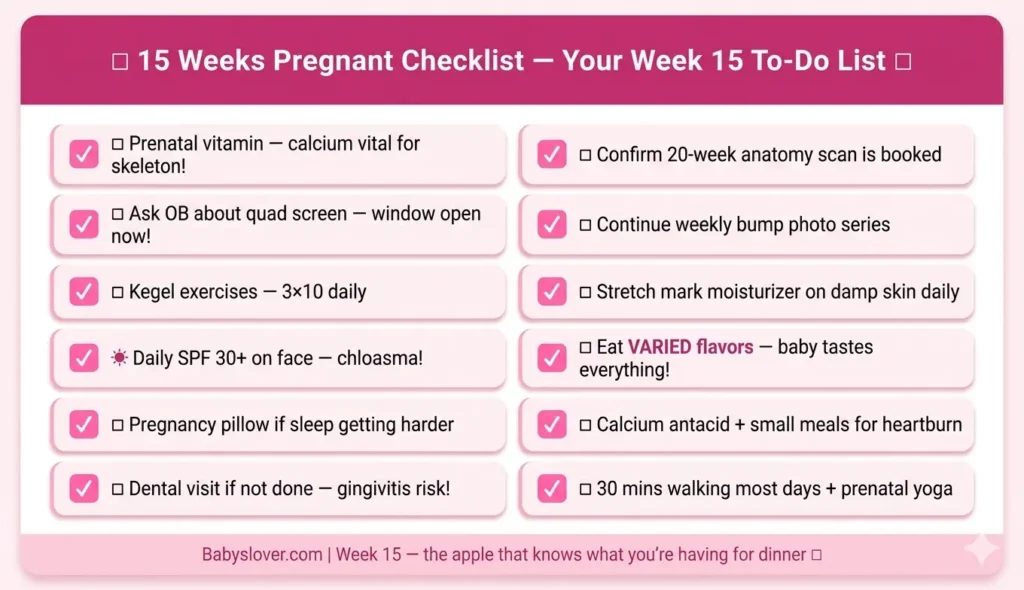
- ☑ 💊 Prenatal vitamin daily — calcium + vitamin D critically important for skeleton!
- ☑ 📅 Confirm your 20-week anatomy scan appointment is booked
- ☑ 🧪 Ask your OB about the quad screen this week — window is now open
- ☑ 📸 Continue weekly bump photo series — same outfit, wall, time
- ☑ 🏋️ Kegel exercises — 3 sets of 10 daily
- ☑ 🧴 Stretch mark moisturizer daily on damp skin
- ☑ ☀️ Daily SPF 30+ on face for chloasma
- ☑ 🍎 Eat VARIED, FLAVORFUL foods — baby is tasting everything! Garlic, spices, variety!
- ☑ 🌙 Pregnancy pillow if sleep is becoming uncomfortable
- ☑ 💧 Calcium antacid + small meals for heartburn
- ☑ 🦷 Dental visit if not done — pregnancy gingivitis has real risks
- ☑ 🏃 Gentle exercise — 30 mins walking most days, prenatal yoga
Frequently Asked Questions — 15 Weeks Pregnant
What does 15 weeks pregnant feel like?
Being 15 weeks pregnant typically feels like a settled, relatively comfortable point in the second trimester. Most first-trimester symptoms have resolved, energy is good, the bump is becoming visible, and the pregnancy feels more real and tangible than before. New arrivals this week — heartburn, shortness of breath, the start of sleep challenges — are manageable and expected. Many women describe Week 15 as feeling genuinely pregnant without feeling particularly unwell.
How big is my baby at 15 weeks pregnant?
At 15 weeks pregnant, your baby is approximately 100mm long (4 inches) — the size of an apple or navel orange — and weighs about 70 grams (2.5 oz). Growth is now very rapid in the second trimester, with weight roughly doubling every two to three weeks.
Can my baby really taste what I eat at 15 weeks?
Yes — this is supported by genuine research. By Week 15, taste buds are fully developed and connected to the brain. Flavor molecules from your diet cross the placenta into the amniotic fluid. Studies have confirmed that fetuses swallow more amniotic fluid when it tastes sweet and less when it tastes bitter. Research has also shown that babies whose mothers ate specific strong flavors (like carrot) during pregnancy showed greater acceptance of those flavors after birth. Eating varied, flavorful food at Week 15 may genuinely influence your child’s postnatal food preferences.
When will I start feeling baby move at 15 weeks?
Your baby is very active at 15 weeks — kicking, stretching, hiccuping. But first-time moms typically don’t feel movement until Weeks 18-22. Women who have been pregnant before may feel earlier, around Weeks 14-16, because they recognize the sensation. The first movements are often described as flutters, bubbles, or the feeling of light gas — very easy to mistake for digestion at first. By Week 20-22, the movements are unmistakable.
What is the quad screen and when is it done?
The quad screen is a blood test available from Weeks 15-22 that measures four substances to assess statistical risk for Down syndrome, trisomy 18, and neural tube defects. It is a screening test (probability-based) not a diagnostic one — and carries no procedural risk. Its accuracy for Down syndrome detection is approximately 80-85%. If you had NIPT earlier, ask your OB whether the quad screen provides meaningful additional information in your specific situation.
Is shortness of breath normal at 15 weeks pregnant?
Yes — mild shortness of breath with activity is completely normal from the second trimester onward. The growing uterus gradually pushes the diaphragm upward, reducing lung expansion capacity. Blood volume is also 40-50% higher than normal, requiring more respiratory effort. Maintain good posture, slow your pace when breathless, and sleep with extra pillow support. Severe breathlessness at rest, chest pain, or a racing heart should be evaluated promptly — these can occasionally indicate pulmonary embolism, which has elevated risk in pregnancy.
How much weight should I have gained by 15 weeks?
For women with a normal pre-pregnancy BMI, approximately 5-10 pounds (2.3-4.5 kg) total gain by Week 15 is typical — though there is wide individual variation and some women gain more or less without any pregnancy problems. If you experienced significant nausea and weight loss in the first trimester, you may not have gained much yet. Total second-trimester gain should be approximately 1 pound per week for normal-BMI women. Your OB tracks weight gain at each appointment and is the right guide for your individual situation.
Do boys and girls move differently in the womb?
Interestingly, yes — research shows sex-based movement differences from around Week 15. Baby girls tend to open and close their mouths more frequently, while baby boys tend to show more whole-body and limb movements. These differences are subtle on individual scans but statistically significant across large groups. The reasons aren’t fully understood but reflect the sex-based neurological and hormonal differences that influence behavior throughout life.
💗 The Emotional Reality of Week 15 — The Ordinary Miracle
There’s something particular about Week 15. The dramatic milestones of the first trimester — the positive test, the heartbeat, the 12-week milestone — have passed. The major second-trimester milestones — the anatomy scan, the first kick — are still weeks away. Week 15 is, on the surface, an ordinary week of pregnancy.
But ordinary at 15 weeks means: a 100mm apple is swallowing amniotic fluid and choosing, based on taste, to swallow more of the sweet stuff. A skeleton is hardening toward the bone structure that will one day hold up a person. Eyes are sensing light for the first time. A heart has already beaten more than fifteen million times.
The ordinary at Week 15 is genuinely extraordinary. It just doesn’t announce itself the way the early milestones did. At Babyslover, we think this quiet extraordinary deserves acknowledgment — not just the milestone weeks, but the unassuming weeks in between, where most of the real work is getting done. 💗
👶 What Happens Next — 16 Weeks Pregnant Preview
One of the most anticipated milestones of the second trimester is approaching — here’s what’s coming with 16 weeks pregnant:
- Baby grows to avocado size — ~116mm (4.6 inches), ~100 grams
- QUICKENING — first fetal movements felt! Most first-time moms notice flutters now or very soon
- Eyes begin moving behind closed lids — slow, side-to-side
- Ears now in final position — hearing developing rapidly
- Nervous system more sophisticated — baby responds to sound
- Scalp hair pattern established — even though still just fine wisps
Keep following our complete pregnancy week by week guide — the first movements are just around the corner! 💗
Week 15: The Apple That Knows What You’re Having for Dinner
Being 15 weeks pregnant means carrying an apple-sized person who is tasting your food, reacting to light, hiccuping as it learns to breathe, and pumping 26 quarts of blood through a heart that has already beaten fifteen million times. Whose skeleton is now visible on X-ray, built from the calcium and vitamin D you’ve been taking. Whose toenails are beginning — the last set of nails, completing the nail system started at Week 10.
Week 15 is an ordinary week that is doing extraordinary things. Eat varied, flavorful food. Sleep on your left side. Book the anatomy scan if you haven’t. And know that inside the apple, every system is running at full tilt.
The first kicks are coming soon. For everything you need in the weeks ahead, our pregnancy tips for first time moms guide is right there with you.
1 thought on “15 Weeks Pregnant: Baby Size, Symptoms & Development”