
Your baby can hear you right now. Not eventually — not in a few more weeks. At 16 weeks pregnant, your avocado-sized baby’s ears have moved into their final position on the sides of the head, the auditory structures are developed, and sound is traveling through the amniotic fluid to a brain that is actively processing it. Your voice — the one you use on the phone, talking to your partner, singing in the car — is already reaching your baby. And research has confirmed something remarkable: babies born after routine prenatal exposure to their mother’s voice recognize it immediately at birth, orienting toward it preferentially over unfamiliar voices within hours of delivery. The bond you’re building by talking and singing to your bump right now is neurologically real.
Week 16 is also when quickening — the first felt fetal movements — may begin: those famous flutters, bubbles, and butterfly sensations in the lower abdomen that suddenly distinguish themselves from ordinary digestion. Your baby is entering a massive growth spurt this week that will see its size nearly double by Week 20. And eyes that have been fused shut since Week 11 are now making slow, side-to-side movements behind the lids. At Babyslover, here is everything about 16 weeks pregnant — the extraordinary sensory and developmental milestone week that marks the true peak of the golden period.
Joining from last week? Our 15 weeks pregnant guide covered taste buds fully developed, skeleton visible on X-ray, and the amniocentesis window.
| 📋 Quick Summary — Week 16 of Pregnancy | |
| Week | Week 16 of 40 — Second Trimester, Week 4 🌟 |
| Trimester | Second Trimester — golden period at peak |
| Baby Size | 🥑 Avocado — ~116mm (4.6 inches) |
| Baby Weight | ~100 grams (3.5 oz) — doubled from Week 13! |
| KEY MILESTONES | 👂 Ears in FINAL position — baby HEARS your voice, recognizes at birth! • 🦋 QUICKENING may begin — first felt movements! • 👁️ Eyes moving side-to-side • 🚿 Kidneys making urine every 45 minutes • 📈 GROWTH SPURT launches — doubles by Week 20! |
| Symptoms | Pregnancy brain (momnesia), bump more visible, back pain increasing, heartburn, nosebleeds, round ligament pain, pregnancy glow, stretched/dry eyes possible |
| Heart Rate | ~140-160 bpm |
| This Week | 🗣️ START talking and singing to your baby — they can hear you and will remember your voice at birth! |
🦋 Quickening — Your Baby’s First Hello
There is no single moment in the second trimester that more women describe as transformative than quickening — the first time you feel your baby move inside you. At Week 16, it may be beginning.
First movements are notoriously easy to miss or misidentify. They don’t feel like the kicks and rolls you’ll feel clearly by Week 22-24. Quickening is subtle, brief, and easy to attribute to something else — especially with a first pregnancy. The four most commonly reported sensations are:
- 🦋 Butterfly flutters — light, airy, briefly repeated, low in the abdomen
- 🫧 Gas bubbles — a fizzing or bubbling feeling that doesn’t move up the digestive tract
- 🍿 Popcorn popping — soft, quick pops in the lower belly that come and go
- 👆 A gentle muscle twitch — a quick, barely-there contraction with no pain
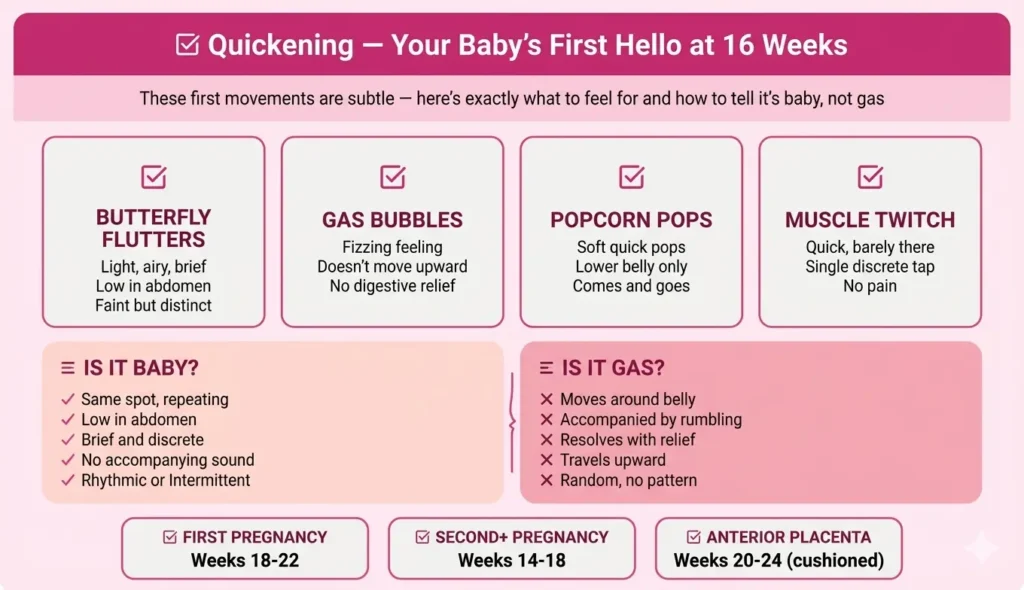
The key distinction from gas: baby movements tend to come from the same location repeatedly, are brief and discrete, occur in the lower abdomen, and don’t produce any sound or digestive sensation. Ordinary gas tends to migrate, rumble, and resolve with a sense of relief. Baby movement does not.
When to expect quickening by pregnancy type:
- First pregnancy: Most commonly Weeks 18-22 — don’t worry if you don’t feel anything yet at Week 16
- Second or subsequent pregnancy: May feel it as early as Weeks 14-16 — you already know what to look for
- Placenta position: If your placenta is anterior (attached to the front uterine wall), it acts as a cushion and movements may take longer to feel — perfectly normal
💡 Not feeling movement at 16 weeks is completely normal — especially with a first pregnancy. Your baby is moving actively inside you, but at this size and with amniotic cushioning, most first-time moms don’t feel it until Weeks 18-22. If you’re past Week 22 and still uncertain, mention it to your OB.
🌱 Baby Development at 16 Weeks Pregnant
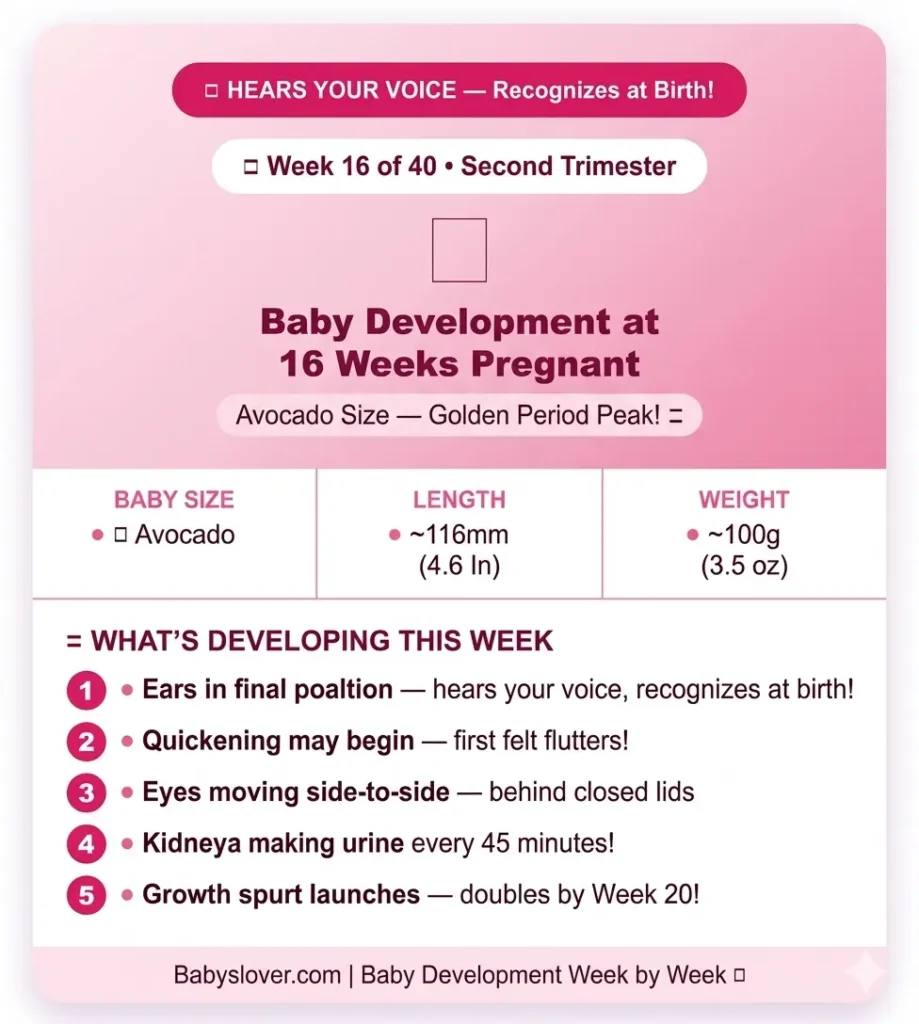
At 16 weeks pregnant, your baby measures approximately 116mm — the size of an avocado — and weighs about 100 grams. The growth rate this week is extraordinary: over the next four weeks, your baby will nearly double in size, reaching approximately 25-26cm by Week 20’s anatomy scan. Every organ system is maturing, every sense is either fully or partially online, and the baby moving around inside you is doing so with coordinated purpose.

| 🌱 Baby Development at 16 Weeks Pregnant | |
| Baby Size | 🥑 Avocado — ~116mm (4.6 inches) |
| Weight | ~100 grams (3.5 oz) |
| Growth Ahead | Will nearly DOUBLE in size by Week 20’s anatomy scan! |
| Head | Now fully upright — no longer tilted toward chest |
| KEY MILESTONE | 👂 EARS IN FINAL POSITION — baby hears your voice and will RECOGNIZE it at birth! |
What Is Developing at Week 16
- 👂 Ears in final position — baby hears your voice, will recognize it at birth: Your baby’s ears have completed their migration from the sides of the neck (where they began forming) to their permanent position on the sides of the head. The auditory structures are developed and functional — sound waves traveling through the amniotic fluid are being detected and processed. Your voice, your partner’s voice, music, the sounds of the household — all of these are reaching your baby’s developing auditory cortex. The research on prenatal hearing is striking: newborns can distinguish their mother’s voice from a stranger’s voice within hours of birth and will preferentially orient toward it. The recognition is built from this week’s exposure onward. Start talking, reading, and singing to your bump now — the auditory memory being formed is real.
- 👁️ Eyes moving side-to-side behind closed lids: Your baby’s eyes have been fused shut since Week 10 — they won’t open until approximately Week 26-28. But from Week 16, the eyes are making slow, deliberate side-to-side movements behind the closed lids. These are not random; they reflect the developing oculomotor muscles — the six muscles that control eye movement — being exercised by the brain’s developing motor systems. The smooth, coordinated eye movements a newborn makes in the first hours of life trace back to weeks of practice that started at Week 16.
- 📈 Growth spurt begins — doubles in size by Week 20: Week 16 marks the launch of the most dramatic growth acceleration of the second trimester. From 116mm today, your baby will grow to approximately 250-260mm by the 20-week anatomy scan — more than doubling in length in just four weeks. Weight will increase proportionally. This is why nutritional density between Weeks 16-20 matters so much — the building material for this explosive growth is coming from what you eat. Protein, calcium, iron, and DHA are all in particularly high demand during this window.
- 🚿 Kidneys producing urine every 45 minutes: Your baby’s kidneys are functioning at remarkable speed — producing and expelling urine into the amniotic fluid approximately every 45 minutes. This urine becomes the primary component of amniotic fluid from the second trimester onward — which is then swallowed, processed, and re-produced in a continuous cycle that both exercises the digestive system and maintains the amniotic fluid environment. By Week 20, your baby’s urine output will be the dominant source of amniotic fluid. The amniotic fluid you see on ultrasound scans is largely your baby’s recycled urine — a remarkable and completely hygienic closed system.
- 🤸 Coordinated movements — arms and legs together: Until recently, your baby’s limb movements were largely reflexive and uncoordinated. By Week 16, the brain has matured enough to begin coordinating arm and leg movements together — reaching, stretching, and kicking with increasing purpose. The head is now fully upright, held erect rather than tilted forward. On ultrasound at Week 16, you may see your baby actively moving, potentially thumb-sucking, gripping the umbilical cord, or stretching out the limbs with what looks like deliberate intent.
- 💇 Scalp hair pattern established: The follicles that will produce your baby’s permanent scalp hair have settled into the growth pattern they’ll follow — the whorl, the part direction, the hairline shape. The hair itself is still extremely fine and sparse, and its color may not reflect the final color at all (most babies shed their newborn hair anyway). But the blueprint for the hair pattern is set at Week 16 — one of the many invisible decisions being made inside the avocado.
- 💓 Circulatory system at full operation: Your baby’s four-chambered heart is pumping approximately 25 quarts of blood per day at Week 16 — a figure that will grow to approximately 1,900 quarts per day by Week 40 as the baby grows. The umbilical cord is carrying the full load of oxygen and nutrient delivery between placenta and baby, with the fetal circulatory system operating independently of the mother’s. By Week 40, the baby’s heart will be pumping 75 times more blood per day than it does this week.
💡 Fun fact: The amniotic fluid surrounding your baby at Week 16 is being replaced completely approximately every 3 hours — filtered through the baby’s swallowing and urination cycle and through the amniotic membrane. The ‘fluid’ you see on an ultrasound scan is a living, dynamic environment, not a static pool.
👂 Talk to Your Baby — The Science Behind It
Now that your baby can hear, talking and singing to your bump has genuine neurological purpose — not just as a bonding ritual, but as a form of early auditory brain development.
Research in neonatal audiology has established that newborns show clear preference for sounds they were exposed to in utero. A baby whose mother read a particular story aloud repeatedly in the third trimester showed recognizable response to that specific story — distinct from an unfamiliar one — in studies using heart rate and sucking rate measurements. The voice, the melody, the rhythm and cadence of familiar sounds are being encoded in the auditory cortex from Week 16 onward.
What to do:
- Talk naturally throughout the day — narrate your activities, describe what you’re doing
- Read aloud — it doesn’t matter what, the rhythm and language structure are what matters
- Sing — your baby’s preference for the melodies you sing now is measurable in studies
- Play music — particularly if you want your baby to recognize it; exposure now means familiarity at birth
- Have your partner speak directly to the bump — baby will recognize their voice too
💡 The voice your baby is memorizing at Week 16 is the same voice it will turn toward in its first minutes of life — looking for you before it can see you. That recognition is built note by note, word by word, starting now. 💗
What’s Happening in Your Body at 16 Weeks Pregnant
🧠 Pregnancy Brain — ‘Momnesia’ Is Real
Forgetting words mid-sentence. Walking into a room and not remembering why. Losing track of what you were just doing. Pregnancy brain — also called momnesia — typically peaks in the second trimester and is reported by the majority of pregnant women. It is real and neurologically documented: research has shown measurable changes in memory processing, working memory capacity, and attentional focus during pregnancy. The cause is a complex combination of hormonal shifts (particularly progesterone), sleep disruption, increased cognitive load of preparation and worry, and the brain’s literal structural remodeling that occurs during pregnancy. The hippocampus — the brain’s primary memory center — undergoes changes during pregnancy that prioritize emotional attunement and care-related processing over information recall.
Pregnancy brain is temporary. Most women report full resolution within a few months postpartum — though new-parent sleep deprivation has its own cognitive effects to contend with. Practical management: write everything down, use phone reminders, keep to-do lists, and don’t expect yourself to remember details that you’d normally retain effortlessly. Reduce the cognitive load wherever possible — this is not weakness, it’s the brain doing what it’s biologically programmed to do right now.
😰 Back Pain — Worsening From Week 16
Lower back pain in pregnancy has three concurrent causes by Week 16: the uterus’s growing weight shifting the center of gravity forward, relaxin hormone softening the sacroiliac and pelvic ligaments, and the postural compensation the body makes by arching the lower back. The result is the characteristic ‘pregnancy waddle’ posture that develops gradually through the second trimester. Supportive footwear (not heels), a maternity support belt, prenatal yoga, and swimming all meaningfully reduce lower back pain. Avoid lifting heavy objects, particularly with a twisting motion. If back pain is severe or radiates down a leg, mention it to your OB — sciatica is also common in the second trimester and responds well to targeted stretches.
👁️ Dry or Stretched Eyes
Hormonal fluid retention and changes in tear composition can cause dry, scratchy, or uncomfortable eyes during the second trimester. Contact lens wearers may find their usual lenses uncomfortable. Pregnancy-safe lubricating eye drops (preservative-free artificial tears) are safe and effective. If you wear contacts, glasses may be more comfortable during the pregnancy. Note: avoid eye drops with vasoconstrictors (redness-reducers) without your OB’s approval.
🌙 Sleep Position — Left Side Now
From Week 16 onward, sleeping on your back compresses the inferior vena cava — the large vein that returns blood from your lower body to your heart — under the growing uterus. This reduces cardiac output and blood flow to the placenta. Left-side sleeping is recommended from now through delivery. A pregnancy pillow under the belly and between the knees makes left-side sleeping significantly more comfortable and is one of the most consistently useful purchases of the second trimester.
🌴 The Babymoon — Book It Now
The babymoon — a last pre-baby trip — has an ideal booking window that many first-time parents miss. The absolute best time for a babymoon is Weeks 14-24 of pregnancy: past the first-trimester exhaustion and nausea, well before third-trimester discomfort, and before many airlines and cruise lines impose gestational age restrictions (most airlines restrict travel after Week 36, many cruises after Week 24-28).
Week 16 sits in the optimal window: energy is good, the bump is visible but not yet limiting, and the booking lead time for Weeks 18-24 travel is right. A few practical considerations:
- Domestic travel: fine throughout the second trimester with OB clearance
- International travel: check destination’s Zika risk status and required vaccinations before booking — some destinations are not recommended in pregnancy
- Flying: safe in the second trimester; walk the aisle every 90 minutes to reduce DVT risk; stay hydrated
- Travel insurance: purchase travel insurance with pregnancy coverage — standard policies often exclude pregnancy complications
- Medical access: know the location of the nearest medical facility at your destination
- Activity level: second trimester is the time for gentler itineraries — the beach, city walking, scenic drives — rather than demanding physical travel
💡 If a babymoon is something you want, book it this week or next. The Week 20-26 window is the sweet spot for actually taking it. After Week 28, travel becomes progressively less comfortable and more restricted.
👙 Maternity Bra Fitting — This Week
Breast size increases significantly throughout pregnancy — typically by 1-2 cup sizes, with further increases postpartum when milk comes in. By Week 16, most women find their pre-pregnancy bras uncomfortable or too small. A professional maternity bra fitting at this stage is genuinely useful: maternity and nursing bras are designed with wider straps for weight distribution, expandable hook-and-eye backs to accommodate ribcage expansion, and full-coverage cups.
Key features to look for: wide straps, full cups, expandable back hooks, soft non-underwire construction (underwire can restrict expanding breast tissue and milk ducts). For exercise, a pregnancy sports bra with full support is important — inadequate support during second-trimester exercise puts uncomfortable load on breast tissue that is actively expanding. You will likely need to be refitted again in the third trimester and again postpartum.
What to Eat at 16 Weeks Pregnant — Fueling the Growth Spurt
Week 16 launches your baby’s most dramatic growth acceleration. The nutritional demands of the next four weeks — as your baby nearly doubles in size — make this a critical window for dietary quality.
| Nutrient | Why Critical at Week 16 | Best Sources |
| Protein | Baby nearly doubles in size by Week 20 — every new cell requires protein. Highest demand period of Q2 | Lean meat, eggs, Greek yogurt, legumes, tofu, cottage cheese — aim 70-100g/day |
| DHA Omega-3 | Brain developing rapidly — auditory cortex, eye motor muscles, neural coordination all expanding this week | Cooked salmon, sardines, walnuts, chia, prenatal with DHA |
| Calcium | Skeleton hardening during growth spurt — bone mineral density built now is permanent | Dairy, fortified plant milk, kale, broccoli, almonds, calcium supplement |
| Iron | Expanding blood volume continuing — heart pumping 25 quarts/day needs adequate hemoglobin | Lean meat, spinach, lentils, fortified cereals + vitamin C for absorption |
| Magnesium | Leg cramps common from Week 16 as uterus grows and circulation shifts — magnesium helps significantly | Almonds, pumpkin seeds, dark leafy greens, whole grains, banana |
| Water | Amniotic fluid replenished every 3 hours — adequate hydration directly supports amniotic fluid volume | 8-10 glasses daily minimum — more if active or in warm weather |
The protein row deserves special attention at Week 16 — the coming four-week growth spurt is the highest protein-demand period of the second trimester. Greek yogurt, eggs, and legumes are particularly practical because they’re also high in calcium and other nutrients simultaneously. Our best prenatal vitamins guide covers the most complete second-trimester formulas including those with adequate DHA for the brain development sprint happening right now.
For Your Partner — Week 16’s Most Meaningful Actions
- Talk to the baby — now. Today: Your partner has been meaning to tell you for weeks that the baby can hear. Here it is again, with clinical weight: the baby hears voices from this week, and builds auditory recognition of familiar voices that carries through to birth. Your voice is one the baby can learn. Speaking directly to the bump — your name, plans you have together, things you’re looking forward to — is not a gesture. It is early bonding that is neurologically received.
- The babymoon conversation: If a babymoon is possible, this is the week to initiate the conversation and start booking. The window is Weeks 18-24 — and booking lead time means starting now. A weekend away doesn’t need to be expensive or far. It needs to be a focused, intentional few days before a baby makes that kind of spontaneity much harder. Ask what she wants from it — and let her answer drive the planning.
- Maternity bra: Suggest and support a professional fitting this week — not as a comment on how she looks, but as a practical comfort upgrade that makes a noticeable difference. Offering to come along or to look after other children so she can go is how this help becomes real.
- Pregnancy brain: If your partner is more forgetful than usual, more easily distracted, losing words mid-sentence — know that this is neurologically real, not a personality change. The kindest response is a whiteboard in the kitchen, shared calendar reminders, and patience. Not jokes about it. Not highlighting it. Just compensation that makes the daily logistics easier.
- Start the nursery research: You don’t need to buy anything this week — but starting the research means you have actual data when the anatomy scan confirms things and decisions feel more real. Our hospital bag checklist for mom gives a good picture of the full arc of preparation you’re building toward.
When to Call Your Doctor at 16 Weeks Pregnant
- Heavy vaginal bleeding: Soaking a pad or passing clots — same-day OB contact.
- Severe abdominal pain — not brief round ligament twinges: Persistent or severe pain needs evaluation.
- Fever above 100.4°F / 38°C: Prompt OB contact.
- Signs of UTI — painful urination, frequency, blood in urine: UTIs in pregnancy require antibiotic treatment — don’t wait.
- Shortness of breath at rest, chest pain, racing heart: Distinct from normal exertional breathlessness — seek prompt evaluation for pulmonary embolism.
- Severe headache with visual changes: Don’t manage at home — seek evaluation.
- Reduced or absent fetal movement after Week 24: At Week 16, not feeling movement is normal. After Week 24, if you have established a movement pattern and notice a significant decrease, contact your OB.
Your Week 16 Pregnancy Checklist
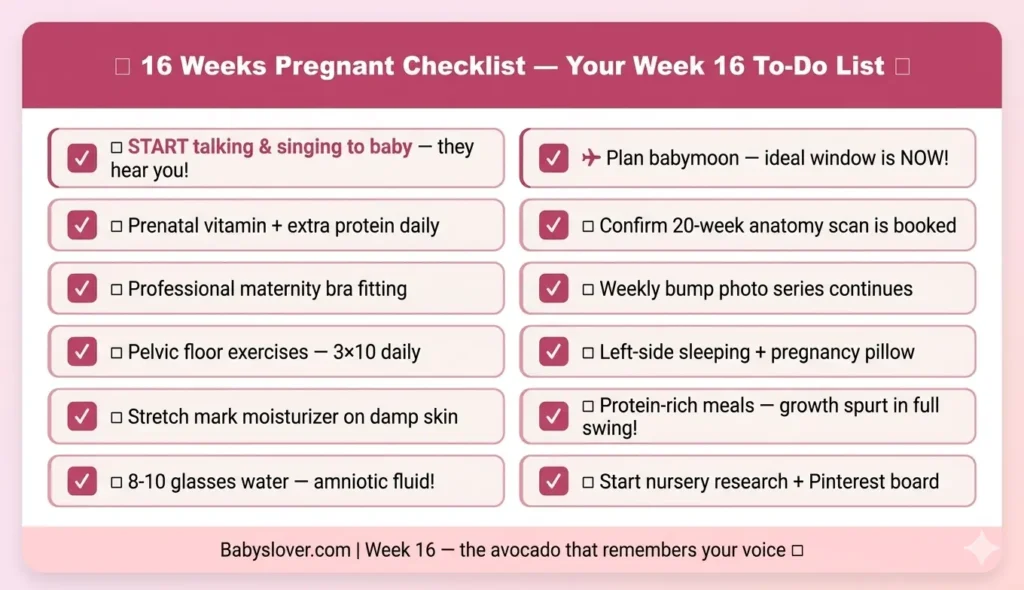
- ☑ 🗣️ START talking, reading, singing to your baby — they hear you and will remember!
- ☑ 💊 Prenatal vitamin daily — extra protein focus this week for growth spurt!
- ☑ 📅 Confirm 20-week anatomy scan is booked — call if not
- ☑ ✈️ Babymoon — discuss and start planning this week if desired
- ☑ 👙 Professional maternity bra fitting — comfort upgrade is overdue
- ☑ 📸 Weekly bump photo — same outfit and wall
- ☑ 🏋️ Pelvic floor exercises — 3 sets of 10 daily
- ☑ 🌙 Left-side sleeping + pregnancy pillow if not already
- ☑ 🧴 Stretch mark moisturizer daily on damp skin
- ☑ 🥗 Protein-rich meals daily — growth spurt in full swing
- ☑ 💧 8-10 glasses of water — amniotic fluid replenished every 3 hours!
- ☑ 📝 Start nursery research — Pinterest board, brand research, budget
Frequently Asked Questions — 16 Weeks Pregnant
Can my baby hear me at 16 weeks pregnant?
Yes. By Week 16, your baby’s ears have moved into their final position and the auditory structures are functional. Sound travels through the amniotic fluid to your baby’s developing auditory cortex. Research has confirmed that newborns recognize their mother’s voice immediately at birth, preferentially orienting toward it over unfamiliar voices — a recognition built from in-utero exposure starting around this week. Talking, reading aloud, and singing to your bump from Week 16 onward creates auditory memories that your baby carries into birth and beyond.
What does quickening feel like at 16 weeks?
Quickening — the first felt fetal movements — is most commonly described as butterfly flutters, gentle gas bubbles, or soft popcorn popping low in the abdomen. It’s very easy to miss at first or mistake for ordinary digestion. The key distinction: baby movement tends to come from the same spot repeatedly, is brief and discrete, and does not resolve with any digestive sensation. First-time moms most commonly feel definitive movement between Weeks 18-22; women in subsequent pregnancies may feel it earlier, including at Week 16.
Is it normal to not feel baby move at 16 weeks?
Completely normal. Most first-time moms don’t feel movement until Weeks 18-22. If your placenta is anterior (attached to the front of the uterus), it cushions movements and may delay when you feel them further. Your baby is very active at 16 weeks — the timing of when you feel it is determined by anatomy and experience, not by how active or healthy your baby is.
What size is baby at 16 weeks pregnant?
At 16 weeks pregnant, your baby is approximately 116mm long (4.6 inches) — the size of an avocado — and weighs about 100 grams (3.5 oz). This week marks the beginning of a major growth spurt: by the 20-week anatomy scan just four weeks away, your baby will have nearly doubled in length.
What is pregnancy brain and is it real?
Pregnancy brain — sometimes called momnesia — is real and neurologically documented. Research has confirmed measurable changes in working memory, word recall, and attentional focus during pregnancy. The causes include hormonal shifts (particularly progesterone), sleep disruption, and literal structural brain changes that prioritize emotional attunement over information recall. It is temporary and resolves postpartum, though early sleep deprivation has its own effects. Managing it: write everything down, use phone reminders, reduce avoidable cognitive load.
When is the best time for a babymoon?
The ideal babymoon window is Weeks 14-24 of pregnancy. By Week 14, first-trimester nausea and fatigue have typically resolved. Before Week 24, the bump is manageable, travel is comfortable, and airline and cruise restrictions haven’t yet kicked in. Weeks 18-22 are considered the sweet spot — anatomy scan done, energy at its best, and well before the third-trimester discomfort. Book now at Week 16 for travel in the Weeks 18-22 window.
Can you see the sex at a 16 week ultrasound?
Sometimes, but not reliably. At 16 weeks, external genitalia are developing and may be visible on ultrasound — particularly for boys, where the scrotum and penis are easier to see. For girls, determination is less reliable at this stage. The 20-week anatomy scan remains the most accurate ultrasound method for sex determination. If you had NIPT blood testing at Weeks 10-12, you already have a highly accurate sex result regardless of what the 16-week ultrasound shows.
Why does my back hurt at 16 weeks pregnant?
Lower back pain at 16 weeks has three concurrent causes: the growing uterus shifting your center of gravity forward, relaxin hormone softening pelvic and sacroiliac ligaments, and the postural compensation your back muscles are making. Supportive footwear, prenatal yoga, swimming, and a maternity support belt are the most effective management strategies. If pain radiates down a leg, mention it to your OB — pregnancy sciatica responds well to targeted stretches and physical therapy.
💗 The Emotional Reality of Week 16 — The First Conversation
Week 16 is the week the pregnancy becomes, in a very literal sense, mutual.
Until now, the relationship has been entirely one-way: you have been carrying, protecting, nourishing, and monitoring a baby that has had no awareness of you. This week, that changes. Your baby can hear your voice. It cannot understand it. It cannot respond to it. But it is receiving it — and recording it — in the developing auditory cortex, building the neural pattern of a voice it will recognize at birth.
The first conversation of your relationship has already begun. You are already in the process of becoming familiar to each other.
That fluttering you may have started to feel — those tentative bubbles or butterflies — is the baby’s end of that conversation. It is the only response available to something 116mm long. But it is a response. And when you feel it, you will know. At Babyslover, we think that’s worth sitting with for a moment, before the checklists and appointments and practical preparations resume. 💗
👶 What Happens Next — 17 Weeks Pregnant Preview
The second trimester continues with more extraordinary developments coming in 17 weeks pregnant:
- Baby grows to pear size — ~130mm, ~140 grams
- Vernix caseosa — the protective white cheesy coating — begins forming over skin!
- Skeleton now shifting from cartilage to hardened bone throughout
- Baby increasingly active — rolling, flipping, somersaults in amniotic fluid
- Sense of hearing continues developing — responds to sudden sounds
- Umbilical cord thickening as blood volume through it increases
Keep following our complete pregnancy week by week guide — every week from here brings something new, and the kicks that are just beginning will be unmistakable soon. 💗
Week 16: The Avocado That Remembers Your Voice
Being 16 weeks pregnant means carrying an avocado-sized person who is recording your voice in its developing auditory cortex, whose eyes are practicing the movements that will one day look into yours, whose kidneys make urine every 45 minutes in a closed amniotic cycle, and who is at the beginning of a four-week growth sprint that will nearly double its size by the time the anatomy scan shows you its face.
The first flutters may come this week — or next week, or in four weeks. They will be easy to miss at first, and unmistakable soon enough.
Talk to your bump. Sing if you feel like it. Read the words aloud. The voice your baby knows at birth is the one being memorized right now. For everything ahead, our pregnancy tips for first time moms guide is walking this journey with you, week by week.
1 thought on “16 Weeks Pregnant: Baby Size, Symptoms & Development”