
At 20 weeks pregnant, your banana-sized baby has undergone 20 weeks of extraordinary development — the nervous system, the skeleton, the sensory organs, the heart, the immune system, all built from a single cell. And this week adds milestones that belong in a category of their own: the bone marrow activates and takes over red blood cell production from the liver — a permanent organ handoff that only happens once in a lifetime.
The lungs are practicing breathing with rhythmic diaphragm contractions, pulling in amniotic fluid rather than air. Brown fat is forming — the specialized thermal fat that will keep your baby warm in the first moments after birth. Fingernails have reached the end of the digits. And colostrum — your baby’s first food — may already be appearing in your nipples.
This is also anatomy scan week — the most comprehensive prenatal assessment of the entire pregnancy, where everything from brain symmetry to bladder function to placenta position is systematically reviewed. At Babyslover, here is the complete guide to 20 weeks pregnant: your baby’s remarkable halfway-point milestones, the anatomy scan explained in full detail, your body’s new changes, and everything to focus on right now.
Just completed Week 19? Our 19 weeks pregnant guide covered the sensory brain wiring all five senses simultaneously and the amniotic fluid flavor education.

| 📋 Quick Summary — Week 20 of Pregnancy — HALFWAY! 🎉 | |
| Week | 🎉 WEEK 20 OF 40 — HALFWAY! Second Trimester, Week 8 |
| Trimester | Second Trimester — the golden period at its peak |
| Baby Size | 🍌 Banana — ~160mm crown to rump (6.3 inches) |
| Baby Weight | ~320 grams (11.3 oz) — more than half a pound! |
| KEY MILESTONES | 🩸 BONE MARROW activates — now making red blood cells FOR LIFE! • 🫁 PRACTICE BREATHING — rhythmic diaphragm contractions • 🤎 BROWN FAT forming — baby’s built-in heater! • 💅 FINGERNAILS complete — reached end of digits • 🤱 COLOSTRUM may appear in nipples — first milk! • 💦 Swallowing 400-500ml amniotic fluid daily |
| Anatomy Scan | 🏥 THE anatomy scan this week — 45-60 min, checks brain/heart/spine/face/limbs/placenta/sex organs. The most important appointment of the second trimester. |
| Symptoms | Shortness of breath beginning, leg swelling (edema), Braxton Hicks possible, back pain intensifying, skin changes, nasal congestion, stronger quickening kicks |
| This Week | 🍌 HALFWAY! Take the bump photo. Write in the pregnancy journal. Let it land. You built a person to this point — 20 more weeks finishes the job. 💗 |
🌱 Baby Development at 20 Weeks Pregnant
At 20 weeks pregnant, your baby measures approximately 160mm crown-to-rump — the length of a banana — and weighs about 320 grams. The proportions are now recognizably newborn: the head-to-body ratio has normalized, the limbs are correctly proportioned, and the face — with its forming eyebrows, complete eye structures behind fused lids, and developing features — is increasingly the face that will be born. And this week, several of the most significant developmental transitions of the entire pregnancy happen in rapid succession.

| 🌱 Baby Development at 20 Weeks Pregnant — HALFWAY! 🎉 | |
| Baby Size | 🍌 Banana — ~160mm (6.3 inches) crown to rump |
| Weight | ~320 grams (11.3 oz) — more than doubled since Week 12! |
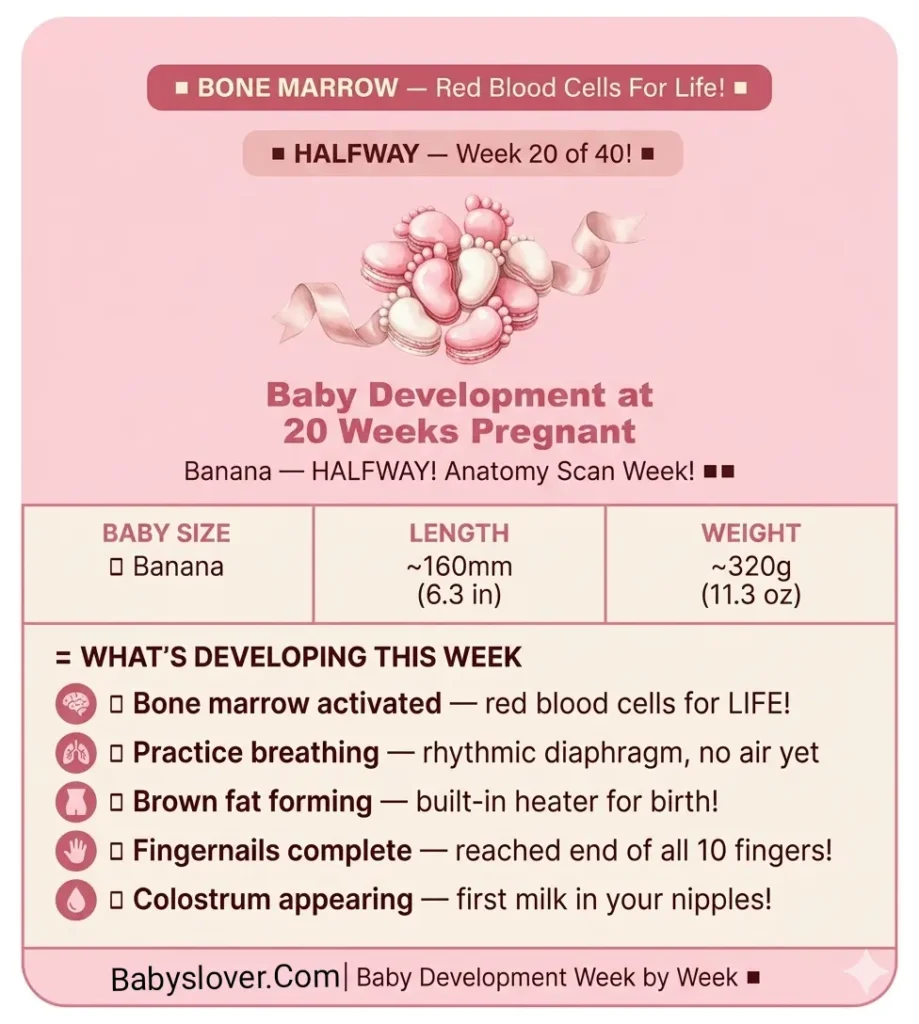
| KEY MILESTONE | 🩸 BONE MARROW activates as primary red blood cell production site — the liver’s temporary hematopoietic role transfers to bone, permanently, this week. |
What Is Developing at Week 20
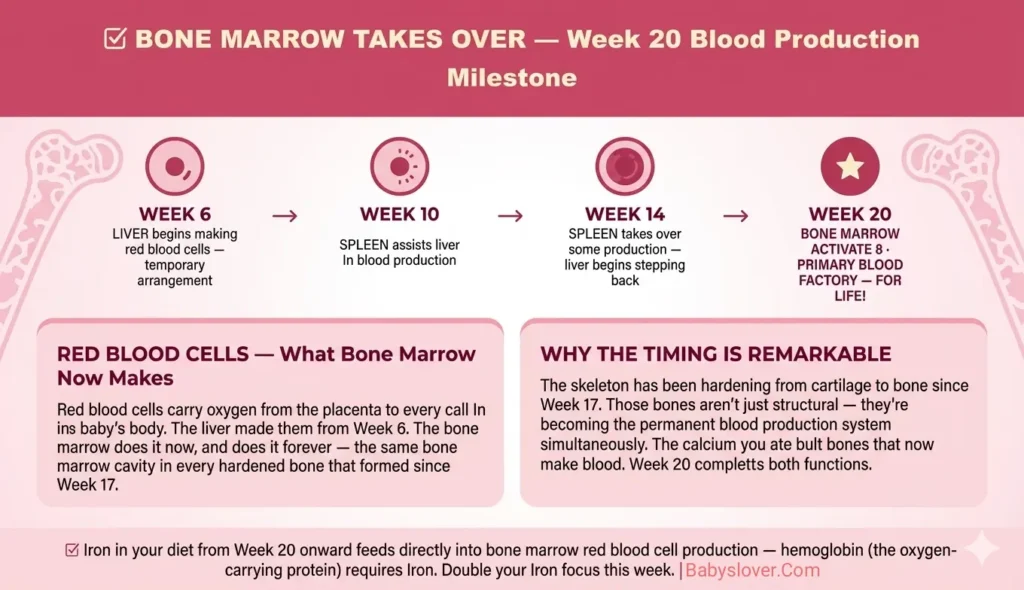
- 🩸 Bone marrow takes over red blood cell production — permanently: From Week 6, it was the liver that made red blood cells for the developing baby — a temporary arrangement for the early weeks when the skeleton was still soft cartilage without the infrastructure to perform this function. As the skeleton has hardened from cartilage to bone through the second trimester, the bone marrow cavities within those bones have been preparing for their permanent role. At Week 20, the bone marrow activates as the primary site of red blood cell production — a role it will hold for the entire remaining life of that person. The liver’s hematopoietic function is gradually handed off and eventually ceases. The same bones that were built from dietary calcium over the past several weeks are now also becoming the blood factory. This is why iron intake from Week 20 onward is particularly critical — the bone marrow making new red blood cells requires iron for hemoglobin synthesis.
- 🫁 Practice breathing — lungs contract with no air: The lungs will not be functional for breathing air until approximately Week 28 at the earliest (even then, with intensive support) and are not mature enough for unassisted breathing until approximately Week 34-36. But at Week 20, the diaphragm begins contracting in rhythmic, breathing-like movements — pulling amniotic fluid into the developing airways with each ‘inhale.’ This is not purposeful breathing; it is practice. The mechanical movement of the respiratory muscles during these practice sessions strengthens the diaphragm and intercostal muscles needed for actual breathing at birth. It also stimulates lung tissue development — the physical expansion and contraction promotes alveolar growth and surfactant-producing cell development. The baby may practice breathe for 30-90 minute intervals, then rest. These practice breathing sessions are sometimes visible on detailed ultrasound as rhythmic chest wall movements — occasionally visible at the anatomy scan this week.
- 🤎 Brown fat forming — the built-in heater: Not all fat is created equal, and at Week 20 the fat beginning to accumulate under the baby’s skin includes a critical specialized type: brown adipose tissue (BAT). Brown fat is metabolically unique — unlike white fat, which stores energy, brown fat is densely packed with mitochondria and is specifically designed to burn energy and produce heat through a process called non-shivering thermogenesis. Newborns cannot shiver to generate warmth; they rely almost entirely on their brown fat reserves for temperature regulation in the critical first days after birth, before they can reliably maintain body temperature. The brown fat depositing at Week 20 through the end of pregnancy will be concentrated around the neck, shoulders, and between the shoulder blades — the areas of greatest heat loss in newborns — and its abundance at birth directly affects thermoregulatory stability in the newborn period.
- 💅 Fingernails complete, toenails developing: By Week 20, the fingernails have grown to reach the ends of all ten fingers — fully formed, and in some cases long enough that newborns occasionally scratch their own faces in the first days of life. Toenails are following the same development slightly behind the fingernails. The nail plate, nail bed, and surrounding nail folds are all structurally complete. Hair continues growing from all the scalp follicles established over the previous weeks.
- 💦 Swallowing 400-500ml amniotic fluid daily: Your baby is now swallowing approximately 400-500 milliliters of amniotic fluid every single day — a volume that will increase to approximately 1 liter per day by the third trimester. This fluid is not wasted: it passes through the digestive system, is absorbed in the intestine, filtered by the kidneys, and returned to the amniotic sac as urine. The swallowing practice develops the entire gastrointestinal tract — the esophagus, stomach, intestine, and digestive enzyme systems are all exercised by the daily fluid processing. The amniotic fluid also provides a small amount of genuine nutrition (proteins, carbohydrates, and immune factors) in addition to all the developmental practice.
- 🎤 Yawning, stretching, making faces: Detailed ultrasound at 20 weeks can capture yawning, stretching, grimacing, and complex facial expressions — not emotional expressions, but the brain-directed motor sequences that are building facial muscle coordination. Yawning at 20 weeks serves a developmental purpose: it stretches the jaw, exercises the muscles of the mouth and throat, and may play a role in brain maturation — similar developmental yawning occurs in all vertebrates at the same gestational stage. The anatomy scan this week sometimes captures these moments on screen, and they are among the most memorable images parents take home.
💡 Fun fact: Your baby’s fingernails are complete at 20 weeks — sometimes long enough to scratch their own face. Some newborns arrive with scratches from in-utero fingernail contact. Those tiny nails that took a full 20 weeks to grow to the tip of each finger will need trimming in the first week of life. 💅
🏥 The 20-Week Anatomy Scan — Complete Guide
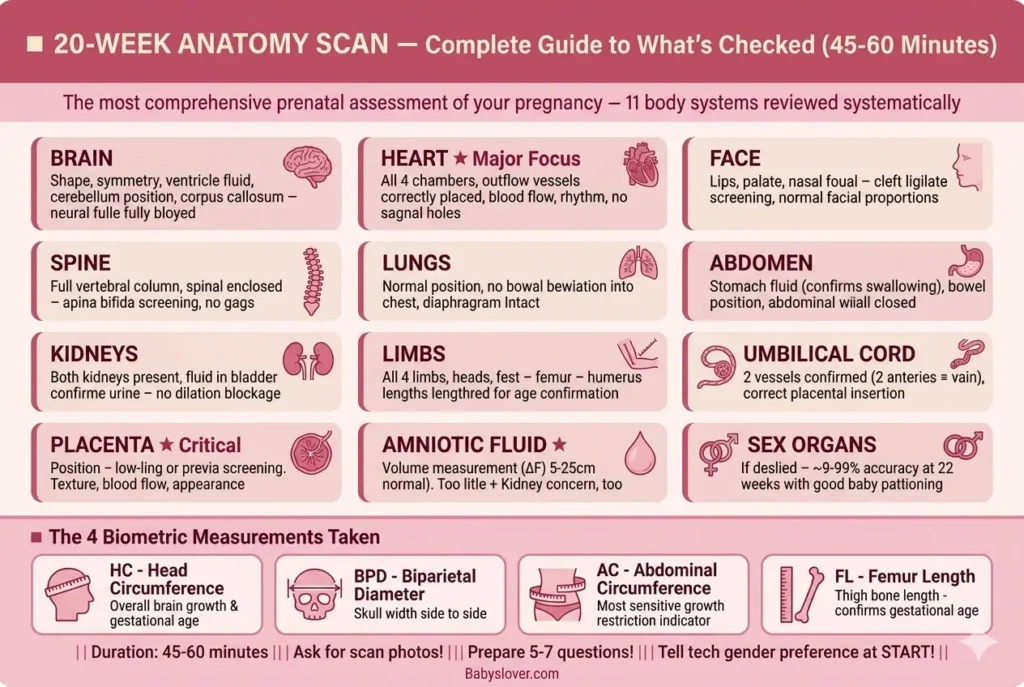
The anatomy scan — also called the anomaly scan or the 20-week ultrasound — is the most comprehensive prenatal assessment performed during pregnancy. It is longer (approximately 45-60 minutes), more systematic, and covers more ground than any other prenatal appointment. Here is exactly what it checks and what each assessment means:
What the Anatomy Scan Checks — System by System
| Body Part | What’s Checked | What They’re Looking For |
| 🧠 Brain | Both hemispheres, ventricles, cerebellum, corpus callosum | Normal symmetry, normal fluid levels in ventricles, cerebellum shape and position, neural tube fully closed |
| 🫀 Heart | 4 chambers, outflow vessels, blood flow, heart rate | All 4 chambers present and normal size, outflow vessels correctly positioned, no holes in septum, rhythm |
| 😊 Face | Lips, palate, nose, nasal bone, eye spacing | Cleft lip screening, nasal bone presence (soft marker), normal facial proportions |
| 🦴 Spine | Full vertebral column, cervical to sacral | All vertebrae present, spinal cord enclosed (neural tube closed), no gaps in the spine (spina bifida screening) |
| 🫁 Lungs | Position, appearance, diaphragm | Normal position, no herniation of bowel into chest, diaphragm intact |
| 🟡 Abdomen | Stomach, intestines, liver, abdominal wall | Stomach fluid confirms swallowing, bowel position, abdominal wall closed (gastroschisis screening) |
| 🫘 Kidneys | Both kidneys, bladder | Both kidneys present, fluid in bladder confirms urine production, no dilation suggesting blockage |
| 💪 Limbs | All 4 limbs, hands, feet, bone lengths | Arms, legs, hands, feet all present, femur and humerus measured for growth/age confirmation |
| 🪢 Umbilical Cord | Vessel count, cord insertion | 3 vessels confirmed (2 arteries + 1 vein — 2-vessel cord can indicate kidney or heart abnormality), correct placental insertion |
| 🫄 Placenta | Position, appearance, previa | Low-lying placenta or previa identified (may resolve as uterus grows). Placental texture and blood flow |
| 💦 Amniotic Fluid | Volume measurement (AFI) | Normal range 5-25cm. Too little (oligohydramnios) suggests kidney concern; too much (polyhydramnios) may suggest swallowing difficulty |
| ⚥ Sex Organs | External genitalia (if desired) | Male: scrotum and penis visible. Female: labia visible. Accuracy ~95-99% at 20 weeks with good positioning |
The Four Biometric Measurements
The sonographer takes four key measurements to calculate estimated fetal weight and confirm gestational age:
- HC — Head Circumference: measures overall brain growth and gestational age
- BPD — Biparietal Diameter: width across the skull from one side to the other
- AC — Abdominal Circumference: measures the largest diameter of the baby’s abdomen — the most sensitive indicator of growth restriction
- FL — Femur Length: the length of the thigh bone — used to confirm gestational age alongside head measurements
These four measurements together produce an estimated fetal weight (EFW) and confirm that the baby is measuring appropriately for gestational age. Measurements within approximately 2 weeks of expected values are considered normal.
If a Finding Requires Follow-Up
If the sonographer or OB identifies something at the anatomy scan that requires further evaluation, this is a moment to breathe before reacting. The vast majority of follow-up referrals lead to normal findings — the scan is designed to be thorough and conservative, and many findings that prompt a second look turn out to be positional artifacts, normal variations, or soft markers that resolve independently. What you should ask:
- What exactly was seen, and how significant does it appear?
- Is this a definitive finding or a soft marker requiring surveillance?
- What is the next step — a repeat scan, specialist referral, or additional testing?
- What is the timeline for follow-up?
- What range of outcomes is possible based on this finding?
💡 The anatomy scan is usually a positive, reassuring experience — and it is for the vast majority of women. Walking in informed and prepared makes it more useful and less anxiety-provoking. Come with questions written. Know whether you want to learn the sex. Plan something meaningful for afterward — this appointment is a genuine milestone worth marking. 💗
Questions to Ask at the Anatomy Scan
- Is everything measuring within normal range for 20 weeks?
- Where is the placenta positioned — is it low-lying or covering the cervix?
- How is the amniotic fluid volume?
- What is the estimated fetal weight?
- Did the cord show 3 vessels?
- Are there any findings that need follow-up, and what would that involve?
- Can we have the scan images — in print or digital format?
- (If gender desired) How confident is the sex determination at this gestation?
What’s Happening in Your Body at 20 Weeks Pregnant
🤱 Colostrum — Your Body Has Started Making Baby’s First Food
One of the least-discussed but most remarkable changes at Week 20: many women notice a yellowish, thick fluid on or near the nipples — sometimes crusting, sometimes a few drops when the nipple is compressed. This is colostrum — the first milk your body produces, which will be your baby’s exclusive food for the first 2-3 days after birth before mature milk comes in. It is extraordinarily nutrient-dense: concentrated with antibodies, growth factors, white blood cells, and high levels of protein relative to fat and carbohydrate. The body begins producing colostrum from as early as Week 16-20 and continues producing it throughout the rest of pregnancy. It is completely normal for colostrum to appear at 20 weeks. Do not squeeze or express it — stimulating the nipples releases oxytocin, which in early pregnancy can cause uterine contractions. If it leaks spontaneously, breast pads manage the small amounts comfortably.
😤 Shortness of Breath — The Uterus Pushes Up
As the uterus rises to belly button level at Week 20 and continues growing upward, it begins pushing against the diaphragm and lungs, reducing the space available for lung expansion. The result: feeling winded more easily than before, needing to pause on stairs that previously required no effort, and finding that lying flat makes breathing more difficult. This is normal physiology — your lung capacity has physically decreased — but the blood oxygen level remains normal because the body compensates by breathing more efficiently. Sitting upright and sleeping slightly propped improves symptom severity. Severe shortness of breath at rest, or shortness of breath accompanied by chest pain or racing heartbeat, warrants same-day OB evaluation.
🦶 Leg Swelling (Edema) — Begins in Earnest
Mild swelling in the feet, ankles, and lower legs — called edema — is extremely common from Week 20 onward. It is caused by the combination of expanded blood volume, the growing uterus pressing on pelvic veins (slowing blood return from the legs), and the effects of relaxin on blood vessel walls. Management: elevating legs when sitting or lying, walking regularly to activate the calf muscle pump, wearing compression socks, staying hydrated, and reducing dietary sodium. Sudden, rapid, or asymmetrical swelling — especially of one leg — should prompt same-day OB contact to rule out deep vein thrombosis. Swelling in the face or hands, or swelling accompanied by headache and visual changes, requires urgent evaluation as it may indicate preeclampsia.
🤰 Braxton Hicks — Practice Contractions May Begin
Some women first notice Braxton Hicks contractions around Week 20 — a sudden tightening of the entire uterus that lasts 30-60 seconds, is not painful (though it can be uncomfortable), and is irregular in timing. These are practice contractions — the uterus rehearsing the muscle coordination needed for labor. They are triggered by dehydration, physical activity, sexual activity, a full bladder, or simply by the baby’s movements. They do not indicate preterm labor and are completely normal. Distinguishing Braxton Hicks from true preterm contractions: Braxton Hicks are irregular, don’t increase in intensity over time, and resolve with rest and hydration. Regular contractions every 10 minutes or less before 37 weeks warrant OB contact.
📏 Fundal Height — Now Measured Every Visit
From this week, your OB or midwife will measure your fundal height at every prenatal appointment — the distance in centimeters from the top of the pubic bone to the top of the uterus. From Week 20 onward, fundal height in centimeters should approximately match the number of weeks pregnant (a 20cm measurement at 20 weeks). Consistent measurements more than 3cm above or below expected trigger further investigation — too large can indicate gestational diabetes, twins, or polyhydramnios; too small can indicate growth restriction or low fluid. Your uterus at Week 20 has risen to approximately belly-button level.
After the Anatomy Scan — What to Think About Now
The anatomy scan results open several practical conversations to have in the weeks immediately following. At Week 20, if you haven’t yet researched cord blood banking, now is the time — the window for enrollment closes before delivery, and understanding the options (public donation, private banking, or hybrid programs) takes more time than most parents realize. Our complete guide to is cord blood banking worth it covers the medical evidence, costs, and the decision framework in full. This is also the week when many parents feel settled enough to begin the baby registry in earnest — the sex is confirmed (if you wanted to know), and the anatomy scan results bring a layer of reassurance that makes planning feel real.
What to Eat at 20 Weeks Pregnant — Iron for the Bone Marrow
Bone marrow activation at Week 20 makes iron the most critical nutrient of the week — it is the raw material for hemoglobin, the protein in red blood cells that carries oxygen. Combined with the ongoing fat deposition, lung development, and growth, the Week 20 nutritional priorities are comprehensive.
| Nutrient | Why Critical at Week 20 | Best Sources |
| Iron | BONE MARROW activating — hemoglobin synthesis for red blood cells requires iron. Also prevents pregnancy anemia and fatigue | Lean beef, spinach + vitamin C, lentils, tofu, fortified cereals. Pair with vitamin C for best absorption. Avoid calcium at same meal |
| DHA Omega-3 | Brain growing rapidly — DHA structural fat for neural tissue. Brown fat deposits also incorporate essential fatty acids | Cooked salmon 2x/week, sardines, walnuts, chia, flaxseed, DHA prenatal vitamin |
| Calcium + Vit D | Skeleton mineralization continuing — bones hardening AND now producing blood cells, both require calcium structure | Dairy, fortified plant milk, kale, almonds, sardines, sunshine + vitamin D supplement |
| Protein | Brown fat tissue, muscle fibers, and continuing organ development all require protein scaffolding. ~70-100g/day | Eggs, Greek yogurt, lean meat, legumes, cottage cheese, tofu |
| Magnesium | Leg cramps intensifying, Braxton Hicks management, bone mineralization — magnesium deficiency drives all three | Almonds, pumpkin seeds, dark leafy greens, whole grains, avocado |
| Fiber + Water | Constipation, heartburn, edema management — fiber and hydration are the safest consistent long-term approach | 25-30g fiber daily, 8-10 glasses water. Reduce dietary sodium for edema |
Iron is the headliner at Week 20 — but the practical tip is the pairing: eat iron-rich food with vitamin C and avoid calcium at the same meal. Calcium actively inhibits iron absorption; vitamin C actively enhances it. So spinach with lemon dressing (iron + vitamin C) is excellent. Spinach with dairy (iron + calcium) reduces the benefit significantly. Our best prenatal vitamins guide covers the formulas with the best iron and DHA combinations for the second half of pregnancy.
For Your Partner — Week 20 Meaningful Actions
- The anatomy scan — be fully present: This is the appointment of the pregnancy. Be there. Not on your phone, not distracted — fully present. You will see the brain, the beating heart with four visible chambers, the spine, the face in profile, possibly a yawn or a thumb in the mouth. Take notes on what the sonographer says — she may be processing it emotionally and may not retain the clinical detail. Ask the questions you wrote together. If there is a finding that needs follow-up, be the calm presence while she processes it. If everything is normal, help her feel that reassurance fully.
- Celebrate halfway: Week 20 is a genuine milestone worth marking intentionally. Not just acknowledging — actually marking. A dinner, a meaningful gift, a handwritten note about this point in the journey. The second trimester’s golden period is at its peak, and in a few weeks the third trimester begins its own demands. Halfway deserves to feel like halfway.
- Colostrum — know what it is: If she mentions or you notice yellowish fluid on her nipples at Week 20, this is colostrum — completely normal, completely healthy, and the first preview of her body’s feeding capacity. The important thing to know: do not massage or express it — nipple stimulation can trigger contractions. Breast pads manage the small amounts that may appear.
- Cord blood banking decision: The window for enrollment closes before delivery — and for private banking, the kit needs to be ordered and waiting at home before the birth. If you haven’t had this conversation, Week 20 is the right time. Our cord blood banking guide covers the full evidence and decision framework. Research it together this week.
- Edema management: Leg swelling from Week 20 onward is real and uncomfortable. The practical contributions: ensuring she has good compression socks (research and order them if needed), propping her feet when she’s sitting, reducing household sodium, and not commenting on visible swelling in a way that adds self-consciousness. Swelling in pregnancy is normal physiology — not weight gain, not aesthetic change — and framing matters.
- Hospital bag conversation: You are halfway to a birth. The hospital bag checklist for mom is a useful place to start the conversation about what preparation looks like from here to delivery. It doesn’t need to be packed yet — but knowing what’s on the list, and when to begin, is a useful Week 20 orientation for both of you.
When to Call Your Doctor at 20 Weeks Pregnant
- Heavy vaginal bleeding: Soaking a pad or passing clots — same-day OB contact.
- Sudden or severe swelling of face, hands, or one leg: Face and hand swelling may indicate preeclampsia — urgent evaluation. One-leg swelling may indicate DVT — same-day evaluation.
- Severe shortness of breath, chest pain, or racing heartbeat: Same-day evaluation.
- Regular contractions before 37 weeks: Tightenings every 10 minutes or more frequently, or that increase in intensity over time, need OB evaluation to rule out preterm labor.
- Fever above 100.4°F / 38°C: Prompt OB contact.
- Fluid leaking from vagina: Any persistent or sudden gush of clear fluid — same-day evaluation.
- Anatomy scan follow-up referrals: If the scan produced a finding requiring further evaluation, follow the referral timeline your OB specified — do not delay.
Your Week 20 Pregnancy Checklist
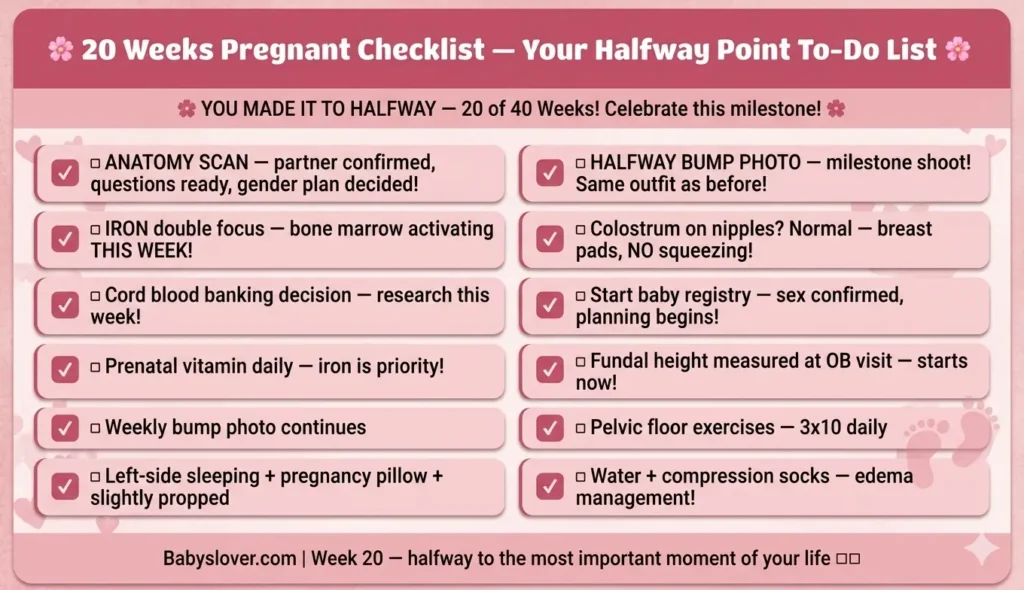
- ☑ 🏥 ANATOMY SCAN — confirmed, partner attending, questions written, gender plan decided
- ☑ 🎉 HALFWAY BUMP PHOTO — milestone shoot in same outfit as Week 1!
- ☑ 💊 Prenatal vitamin — IRON is the priority this week for bone marrow!
- ☑ 🩸 Iron-rich meals daily — pair with vitamin C, avoid calcium at same meal
- ☑ 🤱 Colostrum on nipples? Normal — use breast pads, do NOT squeeze or express
- ☑ 💭 Cord blood banking decision — research and decide before third trimester
- ☑ 🧸 Begin baby registry if not started — sex confirmed, planning can begin!
- ☑ 📏 Fundal height measured at next OB visit — starts now!
- ☑ 📸 Weekly bump photo continues
- ☑ 🏋️ Pelvic floor exercises — 3 sets of 10 daily
- ☑ 🌙 Left-side sleeping + pregnancy pillow + slightly propped
- ☑ 🧴 Stretch mark oil/butter on damp skin daily
- ☑ 💧 8-10 glasses water + fiber + compression socks for edema
Frequently Asked Questions — 20 Weeks Pregnant
Is baby fully developed at 20 weeks?
No — at 20 weeks, the baby has significant developing still to do. All major organ systems are present and functioning at a basic level, but the lungs are not viable for breathing air until approximately Week 24-28 (with intensive support), the brain continues major development through birth and beyond, and the fat deposits that give newborns their characteristic appearance are still building. Week 20 is the halfway point — the baby has 20 more weeks of development ahead before it’s ready for birth.
What does the 20-week anatomy scan check?
The anatomy scan systematically checks 11 body systems in approximately 45-60 minutes: brain structure and symmetry, heart (4 chambers and outflow vessels), face (cleft lip/palate screening), full spine, lungs, abdominal organs, kidneys and bladder, all four limbs with bone measurements, umbilical cord vessel count, placenta position, and amniotic fluid volume. It also assesses sex organs if you want to know. Four biometric measurements — head circumference, biparietal diameter, abdominal circumference, and femur length — confirm gestational age and estimate fetal weight.
What if the anatomy scan finds something?
If the anatomy scan identifies a finding that requires follow-up, breathe before reacting. The scan is designed to be thorough and conservative — many findings prompt a second look that turns out to be a normal variation, a positional artifact, or a soft marker that resolves on its own. Ask your OB exactly what was seen, how significant it appears, what the next step is (repeat scan, specialist referral, additional testing), and what range of outcomes is possible. The scan does not diagnose conditions — it identifies findings that may warrant further evaluation.
How big is my baby at 20 weeks pregnant?
At 20 weeks pregnant, your baby is approximately 160mm long (about 6.3 inches) from crown to rump — the size of a banana — and weighs about 320 grams (11.3 oz). From 20 weeks onward, length is often measured head to heel rather than crown to rump; that measurement is approximately 25-26cm (10 inches) total.
Is it normal to feel short of breath at 20 weeks?
Yes — shortness of breath is normal from Week 20 onward as the uterus rises and begins pressing on the diaphragm and lungs. Your functional lung capacity has physically decreased. Blood oxygen levels remain normal because the body compensates with more efficient breathing. Shortness of breath on exertion is expected; shortness of breath at rest, or accompanied by chest pain or racing heartbeat, warrants same-day evaluation.
Is colostrum normal at 20 weeks pregnant?
Yes — colostrum can appear from as early as Week 16-20, and noticing a yellowish, thick fluid on the nipples at Week 20 is completely normal. It’s the first milk your body produces, and it means your body is preparing to feed your baby. Do not squeeze or express it — nipple stimulation releases oxytocin, which can cause uterine contractions. If it leaks spontaneously, breast pads manage the small amounts comfortably. Colostrum production continues throughout the remainder of pregnancy.
What is brown fat in a baby?
Brown adipose tissue (BAT), or brown fat, is a specialized type of fat that begins forming at Week 20 and is concentrated around the neck, shoulders, and upper back. Unlike white fat (which stores energy), brown fat is designed to burn energy and produce heat — through a process called non-shivering thermogenesis. Newborns cannot shiver to generate warmth, so they rely almost entirely on their brown fat reserves for temperature regulation in the critical first days after birth. The amount of brown fat accumulated in the final 20 weeks of pregnancy directly affects thermoregulatory stability as a newborn.
Can I find out baby’s gender at the anatomy scan?
Yes — the anatomy scan typically allows sex determination with approximately 95-99% accuracy at 20 weeks, provided the baby is in a position where the genitalia are visible. Tell the sonographer at the start of the appointment whether you want to know — if you do, they’ll share what they see; if you don’t, they’ll avoid showing or telling. Some parents ask for the sex to be written in a sealed envelope for a reveal later. Accuracy is highest when baby is cooperative in positioning.
💗 The Emotional Reality of Week 20 — Halfway
You made it to halfway.
Not just the number — the weight of it. Twenty weeks ago, there was a positive test and a racing heartbeat and enormous uncertainty about how the first trimester would unfold. Now there is a bump that’s unmistakably visible, a baby that may be kicking, fingernails that are complete, a bone marrow that is making blood, a brown fat reserve that will keep a newborn warm.
And there is an anatomy scan — a screen full of a beating heart with four visible chambers, a spine complete from cervical to sacral, a face in profile that is your child’s face.
Week 20 is the week that the pregnancy becomes impossible to minimize. It’s too real, too complete, too remarkable. Whatever the second half brings — and it brings its own demands and discomforts — the first half built something extraordinary.
At Babyslover, we think halfway deserves to be felt. Not just noted. Felt. 💗
👶 What Happens Next — 21 Weeks Pregnant Preview
The second half of pregnancy begins — 21 weeks pregnant brings new developments:
- 🍆 Endive / large carrot size — ~27cm, ~360 grams
- Digestive system secreting enzymes — practicing breaking down nutrients!
- Kicks becoming stronger and more consistent — track your kickcounting!
- Bone marrow fully transitioned — liver’s blood-making role complete
- Bone marrow now also producing white blood cells and platelets
- Eyebrows and eyelashes now well-formed and visible on ultrasound
- Limb movements more coordinated — baby may grip the umbilical cord!
Keep following our complete pregnancy week by week guide — the second half has begun, and every week from here brings the birth closer. 💗
Week 20: The Banana That Made It Halfway
Being 20 weeks pregnant means carrying a banana-sized person whose bone marrow just activated — permanently taking over the production of every red blood cell for the rest of that person’s life. Whose lungs are practicing the rhythm of breathing with no air to breathe yet. Whose brown fat is building the thermal reserve that will keep them warm in the first moments outside the womb. Whose fingernails are complete. Whose first milk is already appearing in your body.
The anatomy scan showed you a brain, a heart, a face. A person, measurably real and demonstrably healthy, at the halfway point.
Twenty more weeks. For everything ahead, our pregnancy tips for first time moms guide is with you, from this halfway point all the way to the finish line. 💗
1 thought on “20 Weeks Pregnant: Baby Size, Anatomy Scan & Development”