
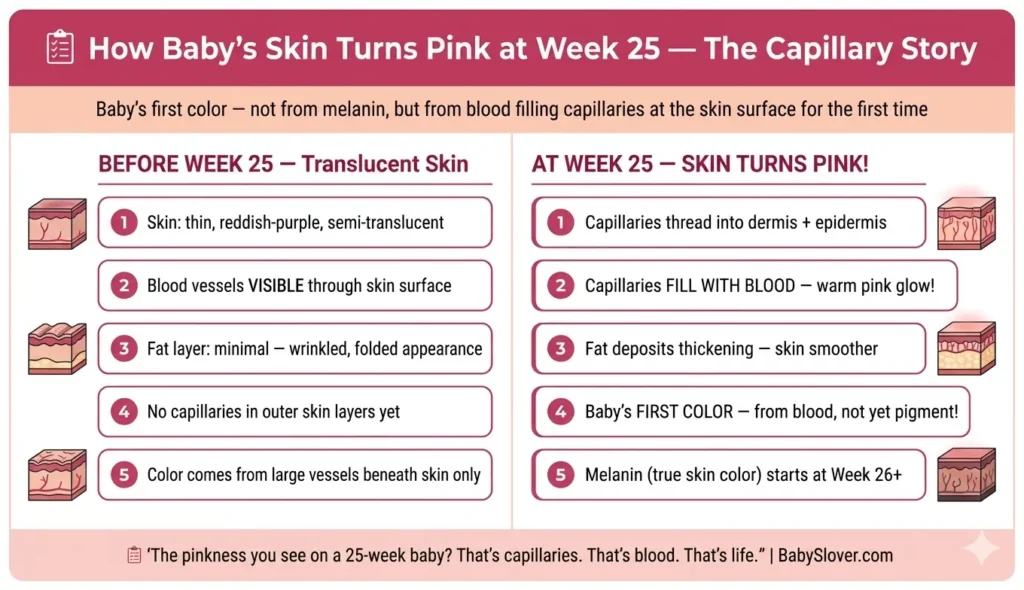
The skin that was translucent just weeks ago is now turning pink. Not from melanin — that comes later. But from capillaries threading through the skin layers and filling with blood for the first time, giving your baby a warm, flushed glow that is the first real color this body has ever had. It is not pigment. It is blood. It is circulation. It is the network of tiny vessels that will one day make a toddler’s cheeks go rosy when they’re running, making their appearance for the first time at Week 25 under skin that is just beginning to fill out.
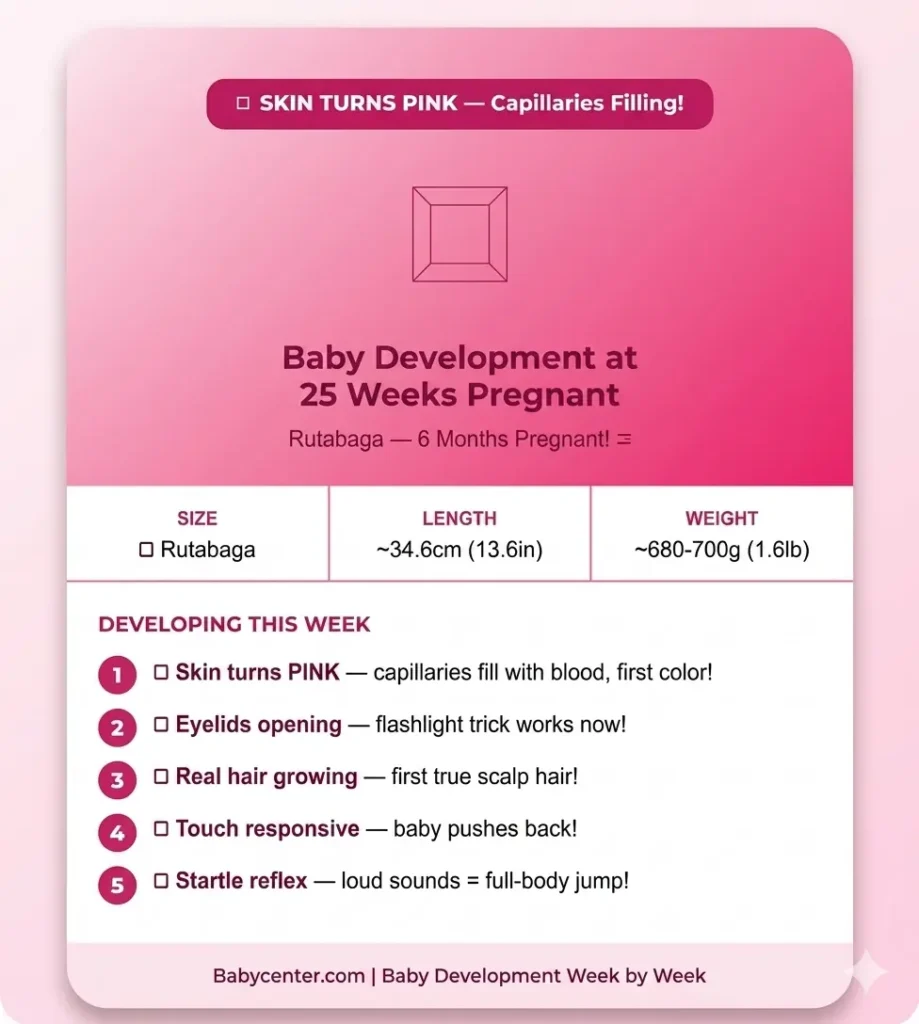
At 25 weeks pregnant, your baby measures approximately 34.5cm (about 13.6 inches) from head to heel — the size of a rutabaga — and weighs somewhere between 660 and 700 grams, approaching a pound and a half. This is also the week that eyelids may begin to open — still within the amniotic fluid, able to detect only light and dark, but unsealing for the first time after months shut. The real hair on your baby’s head is growing. The hands are fully formed and the grip reflex is strengthening to the point where the baby grasps the umbilical cord regularly. And something worth trying right now: place your hand firmly on the bump where you last felt movement. Press gently. Your baby may push back. The tactile awareness and responsiveness that make that possible are active at Week 25.
Week 25 is also six months pregnant — a milestone that deserves its own acknowledgment. The third trimester begins in three weeks. At Babyslover, here is everything happening in Week 25: the capillary story in full, the eyelid timeline, the touch-response explained, and the symptoms your body is producing right now that nobody talks about enough — including restless leg syndrome, which affects one in five pregnant women and is almost entirely ignored by most week-by-week guides. Coming from last week? Our 24 weeks pregnant guide covered viability fully and walked you through the GD screening process.

| 📋 Quick Summary — Week 25 of Pregnancy | |
| Week | Week 25 of 40 — Second Trimester, Final Weeks (Third Trimester in 3 weeks!) |
| Baby Size | 🥬 Rutabaga — ~34.5cm head-to-heel (13.6 inches) |
| Baby Weight | ~660–700 grams (1.5 lbs) — gaining ~100g per week |
| KEY MILESTONES | 🩸 SKIN TURNS PINK — capillaries threading through skin and filling with blood, first color! • 👁️ EYELIDS MAY OPEN THIS WEEK — flashlight trick now works! • 💇 Real hair growing on scalp — first true head hair! • ✋ Touch response active — baby pushes back when you press the bump! • 🔊 Startle reflex — loud sounds = full-body jump! • Hands fully formed, grip reflex strong |
| Milestone | 🎉 6 MONTHS PREGNANT! Third trimester begins Week 28 — just THREE weeks away. |
| Symptoms | Restless leg syndrome (1 in 5 pregnant women!), leg cramps, vision changes (blurry/dry eyes), belly itching, carpal tunnel tingling in hands, heartburn and back pain worsening, Braxton Hicks increasing, swollen ankles/feet |
| Act Now | Try the flashlight trick on your belly — eyelids are opening! Press the bump gently and wait — baby may push back. Book hospital tour if not yet done — third trimester in 3 weeks! |
🌱 Baby Development at 25 Weeks Pregnant
At 25 weeks pregnant, your baby is the size of a rutabaga — about 34.5cm (13.6 inches) from head to toe and 660–700 grams (approaching one and a half pounds). The proportions of the body are increasingly close to a newborn’s: the head, while still larger relative to body size than at term, is no longer the dominant feature it was in early development. The limbs are fully formed and functional. The face — with eyebrows, eyelashes, defined lips, a formed nose, and ears in their final position — looks like the face that will appear in the delivery room, in the first photograph, and for the rest of your child’s life.

| 🌱 Baby Development at 25 Weeks | |
| Baby Size | 🥬 Rutabaga — ~34.5cm head-to-heel (13.6 inches) |
| Weight | ~660–700 grams (1.5 lbs) — 100g/week weight gain continuing |
| KEY MILESTONE | 🩸 SKIN TURNS PINK — capillaries threading into skin layers and filling with blood. Baby has color for the first time — not from pigment, from blood flow itself. |
What Is Developing at Week 25
- 🩸 Capillaries — the skin turns pink for the first time: Until now, your baby’s skin has been relatively thin, reddish, and semi-translucent — blood vessels were visible through the surface, giving the body a dark reddish-purple appearance that is characteristic of extremely premature babies. At Week 25, capillaries — the smallest blood vessels — are threading into the outer layers of the skin (the dermis and upper epidermis) and filling with blood. For the first time, the skin has a warm, pink flush — not yet from melanin (true skin pigment), which begins producing at Week 26, but from blood circulation at the surface. This is the first color this baby has ever had. The pinkness of a baby’s cheeks, the rosiness of newborn hands — this is the beginning of that, happening now.
💡 Try the flashlight experiment — tonight. Hold a bright phone flashlight or small flashlight directly against your belly in a dark room and move it slowly. Your baby’s eyelids may be opening this week, and even if not fully open yet, the light detection system in the retina is active. Many women at Week 25 report feeling movement in response to the light — the baby turning toward or away from the illuminated area. That’s your 25-week-old responding to visual stimulus for the first time. 👁️
- 👁️ Eyelids beginning to open — the first visual experience: The eyelids, which have been sealed since early in the second trimester to protect the developing cornea and retina from the amniotic fluid environment, begin to unseal and open around Week 25–26. The timing is variable — some babies’ eyelids begin to part at 25 weeks, others at 26 or 27. Once open, the eyes are in a medium-lit environment (light filters through the belly wall and uterine tissue at reduced intensity). The retina can detect light and dark — not shapes or colors, which require a far more mature visual cortex — but the fundamental difference between illuminated and non-illuminated environments. The pupils contract and dilate in response to light changes. By Week 28, the eyes will be fully open and blinking regularly.
- 💇 Real hair growing on the head — the first true scalp hair: The fine downy lanugo hair that has covered the body since Week 19-20 is not the same as the hair that will be on your baby’s head at birth. At Week 25, real scalp hair — with the texture and growth pattern your baby will actually have — is growing from the hair follicles on the scalp. The color and curl pattern are genetically determined and already set. The hair is still extremely fine and sparse at this stage, but it is the actual hair — growing from follicles that have been dormant, beginning the same process that will produce whatever hair this person will have for their entire life. Some babies at Week 25 have a visible fuzz on their heads on ultrasound; others won’t develop obvious hair until the third trimester or after birth.
- ✋ Touch responsiveness — baby pushes back: The skin’s sensory receptors — particularly mechanoreceptors that detect pressure and touch — are developed and connected to the spinal cord and brain at Week 25. When you press firmly on the bump, the baby can feel the pressure through the uterine wall and amniotic fluid and may respond by pushing back, moving away, or going still. This is not random movement — it is a specific sensory response to external tactile stimulus. Research on fetal touch response shows that babies at this gestational age demonstrate measurable reactions to gentle belly manipulation, including hand-to-face and hand-to-belly movements in response to external pressure. The responsiveness will increase each week through the third trimester.
- 🔊 Startle reflex — loud sounds cause a full-body jump: With hearing well-established and the nervous system increasingly mature, your baby now has a startle reflex (Moro reflex) — sudden loud noises, sharp impacts, or abrupt changes in environment cause a brief, involuntary full-body startle response: arms and legs extend outward suddenly and then draw back in. You may feel this as a sudden strong kick or flutter in response to a car door slamming, a dog barking suddenly, or loud music. The Moro reflex is present at birth and is one of the reflexes pediatricians test on newborns — but it is already active and functional at Week 25.
- 🧠 Nervous system — rapid maturation continuing: The nervous system is developing quickly at Week 25, with myelination — the insulating coating that speeds up nerve signals — accelerating through the brainstem and spinal cord. The brain’s surface is folding with increasing complexity. The cerebellum is growing rapidly, building the coordination architecture that will govern the baby’s motor control after birth. The connections between sensory organs (ears, skin, eyes now) and the brain’s processing centers are strengthening, which is why the startle reflex, touch response, and light response are all becoming more pronounced this week.
- ⚖️ Fat and lung development continuing: Subcutaneous fat continues to deposit beneath the skin — the skin is noticeably less wrinkled than it was at Week 22-23, with a smoother, plumper appearance developing week by week. In the lungs, surfactant production is increasing and the capillary network surrounding the developing alveoli is expanding — both of which contribute to the improving viability odds at this stage.
💡 Fun fact: When a loud noise startles your baby at Week 25, the full-body jump you feel is the same Moro reflex that pediatricians test on every newborn at the hospital. The reflex that your OB will check in the first hours of your baby’s life is already fully operational inside you, right now. That sudden kick after the car backfired? That was the Moro reflex. 🔊
What’s Happening in Your Body at 25 Weeks Pregnant
🦵 Restless Leg Syndrome — The Symptom Nobody Talks About
Approximately one in five pregnant women experiences restless leg syndrome (RLS) during pregnancy — making it one of the most common pregnancy symptoms of the second trimester, and one of the most underreported. RLS is characterized by an irresistible urge to move the legs, accompanied by uncomfortable sensations in the legs described as crawling, tingling, aching, pulling, or itching — sensations that are typically worst in the evening and at rest, and that are temporarily relieved by movement. In pregnancy, RLS is thought to be driven by iron deficiency anemia, folate deficiency, and the effects of estrogen on dopamine pathways.
RLS is at its worst in the third trimester but is commonly noticed from Week 25 onward as iron and folate demands peak. It makes falling asleep and staying asleep significantly harder — the legs feel most uncomfortable exactly when trying to be still
What helps most:
- Address iron and folate levels — have your OB check ferritin and folate, and supplement appropriately if deficient; this is the most effective treatment
- Magnesium-rich foods and magnesium supplementation (discuss dose with OB) — magnesium glycinate is generally well-tolerated in pregnancy and may help with both RLS and leg cramps
- Moderate daily walking or low-impact exercise — physical activity improves dopamine regulation
- Leg massage, warm (not hot) baths, and applying warmth or coolness to the legs for symptomatic relief
- Avoiding caffeine — even small amounts can worsen RLS symptoms significantly
- Timing iron supplement intake away from caffeine and calcium (both reduce absorption) and toward bedtime when paired with vitamin C
⚠️ RLS that is severe, rapidly worsening, or accompanied by leg pain, swelling of one leg only, or redness and warmth in one leg requires OB evaluation — severe unilateral leg symptoms can indicate deep vein thrombosis (DVT), which requires same-day evaluation.
👁️ Vision Changes — Blurry Eyes and Dry Contacts
Many women notice a change in vision quality during the second trimester that they don’t think to mention to their OB: blurry vision, dry eyes, and contact lenses that no longer fit comfortably. These are common and usually benign. The cause is fluid retention — the same hormonal mechanism that causes ankle swelling also causes the cornea to thicken slightly and change its curvature due to increased fluid content. This alters the refractive power of the eye, causing mild blur at a distance that may not be fully correctable with existing glasses or contacts. Contact lens prescription and fit can change enough that switching to glasses temporarily during pregnancy is often more comfortable.
Dry eye symptoms (gritty, scratchy sensation, light sensitivity) are also common due to hormonal effects on tear production. Preservative-free artificial tears are safe to use in pregnancy.
⚠️ Vision changes that require same-day OB contact: sudden blurring or vision loss, seeing spots, floaters, flashes of light, or visual disturbances accompanied by headache, upper abdominal pain, or swelling. These can be symptoms of preeclampsia and require immediate evaluation — they are not normal pregnancy vision changes.
🧴 Belly Itching — Normal vs. PUPPP
The skin on the abdomen is stretching rapidly as the uterus grows — by Week 25, the fundus (top of the uterus) is approximately at navel height. This stretching puts tension on the skin and the nerve fibers within it, causing the itch that most women notice from the second trimester onward. The management is straightforward: apply a rich, fragrance-free moisturizer twice daily to the belly, breasts, and hips — areas under the most tension. Hydrating from the inside with adequate water intake also helps. Avoid hot showers and harsh soaps, which strip skin oils and dramatically worsen itching.
A minority of women develop PUPPP (pruritic urticarial papules and plaques of pregnancy) — an intensely itchy rash of red, raised bumps that typically begins in the stretch marks of the abdomen and can spread to the thighs, buttocks, and arms. PUPPP is harmless to the baby but can be severe and miserable for the mother. It is more common in first pregnancies, multiple pregnancies, and with significant weight gain. If itching is severe, involves a visible rash, or extends beyond the belly — contact your OB.
🤲 Carpal Tunnel — Tingling Hands in Pregnancy
Tingling, numbness, or pain in the hands and wrists — particularly at night or upon waking — is pregnancy carpal tunnel syndrome, affecting up to 60% of pregnant women. The cause is fluid retention compressing the median nerve as it passes through the carpal tunnel at the wrist. Symptoms are typically worst in the dominant hand and often peak in the third trimester, but many women first notice them in the second trimester around Week 24–26. Wrist splints worn at night are the most effective non-medical management and are completely safe in pregnancy. Avoiding sleeping with wrists flexed, taking breaks from repetitive hand motions, and elevating the hands while resting also help. Symptoms almost always resolve postpartum.
🦶 Leg Cramps — Why They Happen and What Actually Helps
Sudden, severe muscle cramping in the calf — typically at night — is extremely common from Week 25 onward. The precise cause in pregnancy is incompletely understood but is associated with magnesium and calcium imbalance, dehydration, reduced circulation in the legs from the growing uterus, and nerve compression. What consistently helps:
- Stretching the calf before bed: stand facing a wall, hands on wall, step one foot back, press heel flat to floor, hold 30 seconds each side
- Magnesium supplementation — magnesium glycinate or citrate; discuss dose with OB; typical pregnancy doses are 200–350mg/day
- Adequate hydration — 8-10 glasses of water daily; cramps are significantly worse with dehydration
- Potassium-rich foods — bananas, sweet potatoes, beans, yogurt
- During a cramp: flex the foot upward immediately (toes toward shin), not pointed down; this stretches the calf muscle and stops the cramp faster than any other technique
Nutrition at 25 Weeks — Magnesium Is the Star This Week
With leg cramps peaking, restless leg syndrome most common at this stage, Braxton Hicks increasing (magnesium helps muscle relaxation throughout the body including the uterus), and the nervous system under high development demand, magnesium steps into the spotlight at Week 25 alongside DHA and iron.
| Nutrient | Why Critical at Week 25 | Best Sources |
| Magnesium | Leg cramps + RLS management (muscle relaxation). Nerve conduction — nervous system maturing rapidly. Uterine muscle relaxation — reduces Braxton Hicks. 350-360mg/day target in pregnancy. | Pumpkin seeds (highest!), dark chocolate (70%+), almonds, spinach, black beans, edamame, whole grains, avocado. Supplement: magnesium glycinate preferred — gentler on digestion. |
| DHA Omega-3 | Eyes opening this week — retinal development requires DHA for photoreceptors. Brain folding continuing. Myelination of nervous system accelerating. 200-300mg/day minimum. | Cooked salmon 2x/week, sardines, DHA-fortified eggs, walnuts, chia seeds. DHA prenatal supplement if fish limited. |
| Iron + Vit C | RLS peak correlated with iron deficiency — iron is the most impactful treatment for pregnancy RLS. Anemia continuing to be common. Myelination requires iron for nerve insulation. | Beef, lentils, spinach — ALWAYS pair with vitamin C. Bell peppers + iron foods. Supplement with OB guidance. Avoid tea/coffee within 1hr of iron. |
| Vitamin C | Iron absorption (critical for RLS). Collagen synthesis for skin stretching (belly itching, stretch marks). Capillary integrity — capillaries threading through skin this week need vitamin C for vessel wall structure. | Bell peppers (highest), strawberries, kiwi, broccoli, citrus. Pair with iron. 85mg/day target but more is fine from food sources. |
| Potassium | Leg cramps — electrolyte balance with magnesium. Fluid balance — reduces edema in feet and ankles. Blood pressure regulation at the approach to third trimester. | Bananas, sweet potatoes, yogurt, beans, salmon, avocado, spinach. Most easy from whole foods — no supplement needed. |
| Calcium | Baby skeleton mineralization continuing. Leg cramp prevention (works alongside magnesium). Blood pressure regulation. 1000mg/day target. Take separately from iron supplement. | Dairy, fortified plant milk, sardines with bones, tofu, leafy greens. Never take calcium and iron supplement together — they compete for absorption. |
The golden meal this week: salmon with spinach and a squeeze of lemon — DHA + iron + vitamin C in one dish. Add a small dark chocolate square afterward for the magnesium. Your best prenatal vitamins guide covers which prenatal formulas include meaningful magnesium amounts alongside DHA and iron.
For Your Partner — Week 25
- Try the flashlight trick together: Tonight. Hold a bright flashlight against the belly in a dark room and move it slowly. The eyelids are opening this week — the baby is beginning to have a first visual experience, detecting changes in light and dark. You may feel movement in response. This is your first visual interaction with your baby — happening through the belly wall, with a nearly-25-week-old person who is looking back toward the light from the inside. It’s a remarkable thing to do together.
- Press the bump and wait: Find a quiet moment when she’s relaxed and the baby has recently been active. Place your hand firmly on the area of most movement and press gently — not hard, just enough to create noticeable pressure. Wait 30 seconds. If the baby is awake, it may push back. This tactile responsiveness is new at Week 25 and is one of the earliest forms of interactive exchange with the baby before birth. Many partners describe this as the moment the pregnancy becomes unmistakably real.
- Restless leg syndrome — take it seriously: If she mentions crawling, tingling, or aching sensations in her legs at night that make lying still uncomfortable or impossible — this is RLS and it’s real, it’s involuntary, and it affects about 20% of pregnant women. The least helpful response is suggesting she ‘just try to sleep.’ The most helpful: check whether her prenatal vitamin has sufficient iron (ferritin should be tested), make sure she’s eating enough magnesium-rich foods, and replace caffeinated drinks in the evening. A leg massage before bed — 10 minutes of calf and foot massage — provides significant symptomatic relief.
- Hospital tour — is it booked?: Third trimester begins in three weeks. The hospital tour needs to happen in the next 4–6 weeks — before Week 32 is ideal. If it isn’t booked, this is the week to call. Our hospital bag checklist for mom gives you a full list to work through together — some items take time to source (specific nursing bras, nipple cream, particular personal items), and having them prepared before Week 36 is the target.
- GD screening — has it happened?: If the glucose challenge test hasn’t been done yet, Week 25 is still within the 24–28 week window. Confirm the appointment is scheduled. If the 1-hour test showed a high result and the 3-hour OGTT is pending, be available to accompany her to that appointment — it is a 3-hour commitment and significantly more stressful than the initial screen.
When to Call Your Doctor at 25 Weeks Pregnant
- Preterm labor signs: Regular contractions every 10 minutes or more frequently, persistent rhythmic back pain, pelvic pressure, changes in discharge — same-day OB contact.
- Vision changes with headache or swelling: Sudden blurring, spots, floaters, flashes of light — possible preeclampsia — urgent evaluation.
- Severe one-sided leg symptoms: Swelling, redness, warmth, or pain in one leg only — possible DVT — same-day evaluation. Different from bilateral leg cramps or RLS.
- Intense or spreading belly rash: If itching involves red bumps or rash spreading beyond belly — possible PUPPP — contact OB for evaluation and treatment.
- Decreased fetal movement: If established regular movement goes quiet — lie on left side, count for one hour. Fewer than 10 movements in a consistent kicker — call your OB.
- Severe carpal tunnel symptoms: Numbness, tingling, or weakness in hands that is affecting sleep or function — mention at next prenatal visit; wrist splints can be prescribed.
- Fever above 100.4°F / 38°C: Contact OB.
Your Week 25 Pregnancy Checklist
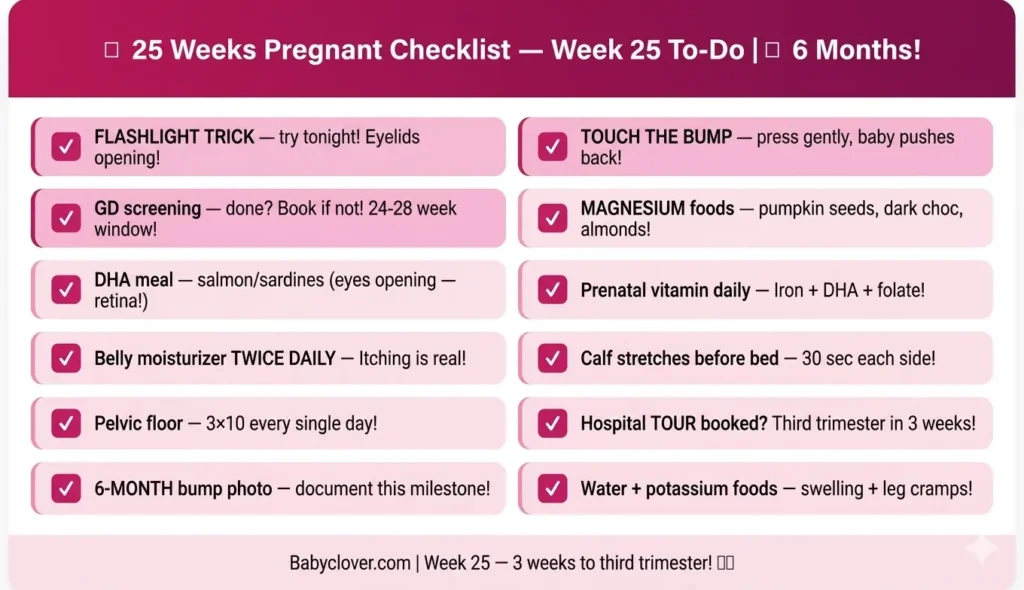
- ☑ 🔦 FLASHLIGHT TRICK — try it tonight! Eyelids are opening this week!
- ☑ ✋ TOUCH THE BUMP — press gently and wait for baby to push back!
- ☑ 🩺 GD screening — done? If not, book this week (24-28 week window)!
- ☑ 💊 Prenatal vitamin daily — iron + DHA + folate + magnesium!
- ☑ 🥬 Magnesium-rich foods this week — pumpkin seeds, dark chocolate, almonds!
- ☑ 🐟 DHA meal — salmon or sardines (eyes are opening — retina needs DHA!)
- ☑ 🏋️ Pelvic floor exercises — 3×10 EVERY DAY
- ☑ 🧴 Belly moisturizer twice daily — prevent and relieve belly itching!
- ☑ 🦵 Calf stretches before bed — 30 sec each side, leg cramps prevention!
- ☑ 🏥 Hospital tour — BOOKED? Third trimester in 3 WEEKS!
- ☑ 👜 Hospital bag — actively gathering items!
- ☑ 📸 6-MONTH BUMP PHOTO — document the milestone!
- ☑ 💧 8-10 glasses water + potassium foods (leg cramps + swelling)
- ☑ 🌙 Left-side sleeping + pregnancy pillow + elevated hands if carpal tunnel
Frequently Asked Questions — 25 Weeks Pregnant
How big is my baby at 25 weeks pregnant?
At 25 weeks pregnant, your baby is approximately 34.5cm (13.6 inches) from head to heel — the size of a rutabaga — and weighs between 660 and 700 grams (about 1.5 pounds). The baby is gaining approximately 100 grams per week at this stage and will continue this pace through the third trimester, more than doubling in weight by the time of delivery.
Can my baby open its eyes at 25 weeks?
Yes — the eyelids begin to open around Weeks 25–26, having been sealed shut since early in the second trimester to protect the cornea and retina. Once open, the baby can detect light and dark — the retina is functional at this level. You can try placing a bright flashlight against your belly in a dark room and may notice movement in response to the light. Full eye opening with regular blinking develops by Week 28.
Why is my baby’s skin turning pink at 25 weeks?
The pinkness is from capillaries — tiny blood vessels — threading into the outer skin layers and filling with blood for the first time. Before Week 25, the skin was reddish-translucent with blood vessels visible through the surface. At Week 25, the vascular network moves into the dermis and epidermis directly, giving the skin a warm pink flush. This is not yet melanin (true skin pigment), which begins at Week 26 — it is literally blood flow visible near the surface. It is the beginning of the skin color your baby will have for life.
What is restless leg syndrome in pregnancy?
Restless leg syndrome (RLS) is an irresistible urge to move the legs due to uncomfortable crawling, tingling, aching, or itching sensations — worst at rest and in the evening. It affects approximately 1 in 5 pregnant women, peaks in the second and third trimester, and is strongly associated with iron and folate deficiency. The most effective treatments are addressing those nutritional deficiencies, magnesium supplementation, daily moderate exercise, and avoiding caffeine in the evening. Leg massage and warm baths help symptomatically. Always report RLS to your OB so ferritin and folate can be tested.
Why are my hands tingling at 25 weeks pregnant?
Tingling, numbness, or pain in the hands — especially at night or upon waking — is most likely pregnancy carpal tunnel syndrome, affecting up to 60% of pregnant women. Fluid retention compresses the median nerve at the wrist. Wrist splints worn at night are the most effective management. Symptoms almost always resolve after delivery. Mention it to your OB if it’s affecting sleep or daily function.
How do I stop leg cramps in pregnancy?
Pregnancy leg cramps are most effectively managed by: stretching calves before bed (stand facing wall, heel flat to floor, 30 seconds each side); magnesium supplementation (discuss dose with OB; magnesium glycinate is well-tolerated); adequate hydration; and potassium-rich foods (bananas, sweet potatoes, beans). During a cramp: immediately flex the foot upward (toes toward shin) — this stops the cramp faster than any other technique. Avoid pointing the foot, which worsens the cramp.
Is belly itching normal at 25 weeks?
Yes — mild to moderate belly itching from skin stretching is normal and common. Apply a rich fragrance-free moisturizer twice daily to the belly, breasts, and hips; drink adequate water; avoid hot showers. Contact your OB if itching is intense, involves a visible rash spreading beyond the belly (possible PUPPP), or if itching is accompanied by jaundice (yellow skin or eyes) and occurs in the third trimester (possible cholestasis of pregnancy — requires testing).
Is 25 weeks 6 months pregnant?
Yes — 25 weeks pregnant is approximately 6 months pregnant. Pregnancy weeks and months don’t divide evenly (40 weeks ÷ 9 months = ~4.4 weeks per month), but the sixth month generally covers Weeks 21–24, placing Week 25 at the beginning of the seventh month in most counting methods. Most healthcare providers use weeks, not months, for precision. The third trimester begins at Week 28 — three weeks away.
💗 The Emotional Reality of Week 25 — Six Months
Six months. The belly that began as a subtle fullness you had to announce is now unmistakably, visibly, undeniably a pregnancy. People offer seats on public transit. Strangers make comments (some welcome, some less so). The body that was entirely yours for the first 24 years or 30 years or however many years has been shared for six months
Inside, there is a person who is pink now — actually pink, with blood in capillaries at the surface of the skin — who has eyes that are starting to open, who has hair growing, who will push back against your hand when you press on the outside. Who has been listening to your voice for months and whose brain has been building a template of the sound of you. Who is, at 25 weeks, still three months from being ready to meet you. But unmistakably already someone.
Take the six-month photo. Press the bump tonight. Try the flashlight.
At Babyslover, we think six months is worth marking — not with a party, but with a moment of acknowledgment that this is extraordinary. And that there are twelve weeks left of this particular magic. 💗
👶 What’s Next — 26 Weeks Pregnant Preview
26 Weeks Pregnant brings the transition into the final stretch of the second trimester:
- 🥬 Large rutabaga — ~36cm, ~760 grams (1.7 lbs)
- Melanin production BEGINS — baby’s true skin color starting to develop!
- Eyes fully open — blinking, responding to light changes regularly
- Brain activity increasingly complex — sleep-wake cycles more defined
- Lungs: air sacs (alveoli) multiplying rapidly — each week adds thousands
- Immune system developing — antibodies transferring from placenta increasing
Two weeks to the third trimester. Follow our pregnancy week by week guide for everything that comes next. 💗
Week 25: The Rutabaga That Pushed Back
At 25 weeks pregnant, you are carrying a person who is pink — genuinely, capillary-pink — whose eyes are beginning to open to their first light, whose real hair is growing for the first time, who can hear a door slam and flinch, who will push back against your hand because it felt you there. Six months of building a person. Three more months of finishing them.
Press the bump tonight. Wait.
For everything still ahead, our pregnancy tips for first time moms is with you from here to the end. 💗
1 thought on “25 Weeks Pregnant: Baby Size, Symptoms & Development”