

The color you will recognize for the rest of your life starts today.
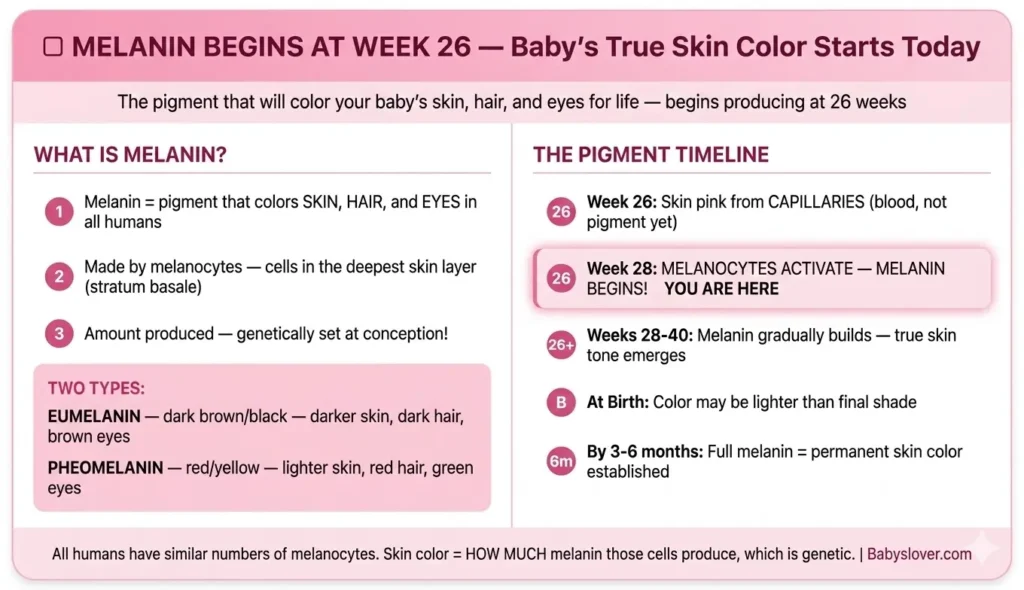
On toddler cheeks at the park. In school photographs. At the dinner table for the next eighteen years. On a wedding day. The skin color that will be your child’s for their entire life — melanin production begins at 26 weeks pregnant. Melanocytes, the specialized cells in the skin that produce pigment, activate for the first time this week and begin generating the melanin that will gradually build to its full expression over the coming months. The amount and type of melanin — eumelanin for darker tones, pheomelanin for lighter and red tones — is set in the DNA and has been waiting since conception for this week. It starts today.
Week 26 is also the week your baby’s eyes are fully open and blinking for the first time — the eyelids, sealed for months and beginning to unseal over the last two weeks, are now fully parted, responding to light changes in the womb. And something remarkable: the brain is producing event-related electrical responses to sound — detectable from outside the womb with instruments placed on the mother’s abdomen. The brain at 26 weeks is not simply growing. It is already responding, in measurable ways, to the world it is preparing to enter.
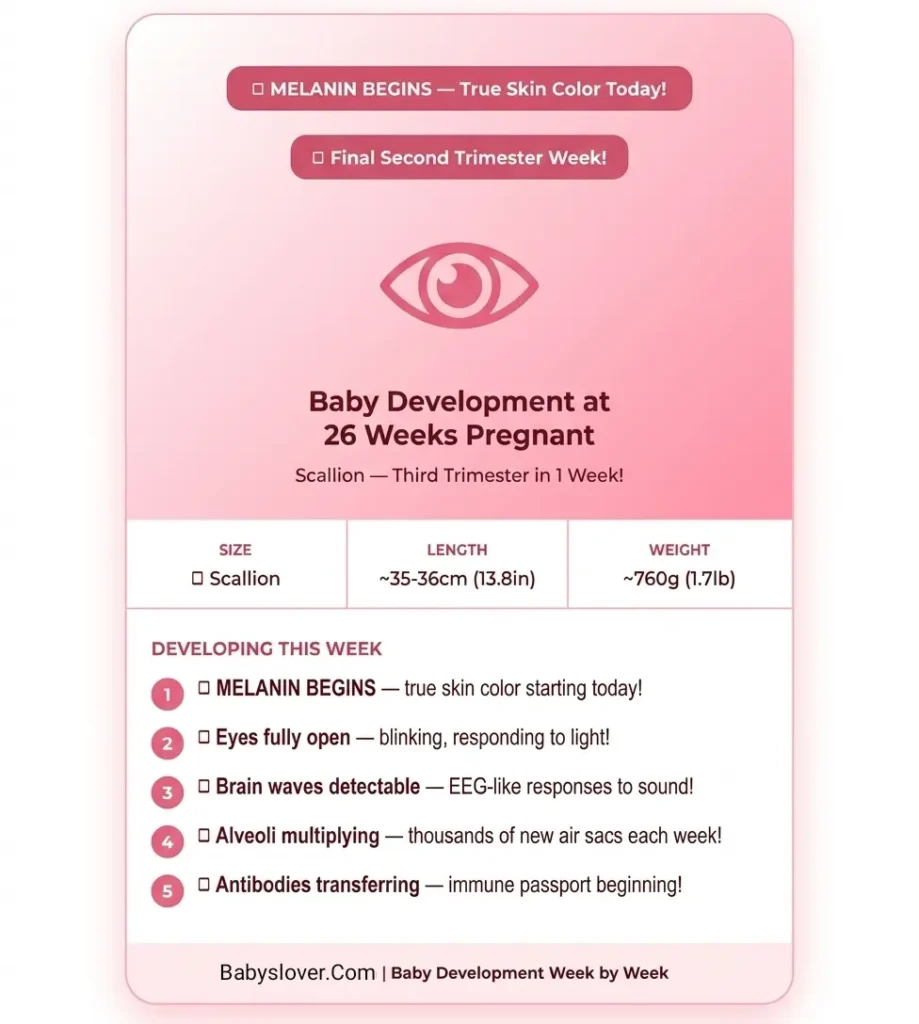
At 26 weeks pregnant, your baby is approximately 35–36cm (about 13.8 inches) and weighs around 760 grams — nearly 1.7 pounds. In the lungs, the alveoli (air sacs) are multiplying rapidly — each week adds thousands of new sacs to the total surface area that will eventually extract oxygen from every breath. The immune system is receiving its first external boost as maternal antibodies begin transferring across the placenta in larger quantities. And this is the final week of the second trimester — the third trimester begins in one week at Week 27. At Babyslover, here is everything about Week 26: the melanin milestone explained fully, the eye and brain developments, the second trimester farewell, and the symptoms peaking right now. Coming from last week? Our 25 weeks pregnant guide covered capillaries, eyelids opening, and restless leg syndrome.

| 📋 Quick Summary — Week 26 of Pregnancy | |
| Week | Week 26 of 40 — FINAL Second Trimester Week (Third Trimester begins at Week 27!) |
| Baby Size | 🥬 Scallion / large spring onion — ~35–36cm head-to-heel (13.8 inches) |
| Baby Weight | ~760 grams (1.7 lbs) — gaining ~100g per week |
| KEY MILESTONES | 🎨 MELANIN PRODUCTION BEGINS — true skin color starts today! • 👁️ EYES FULLY OPEN + BLINKING — responding to light changes! • 🧠 BRAIN WAVES DETECTABLE — event-related potentials externally measurable! • 🫁 ALVEOLI MULTIPLYING RAPIDLY — thousands of new air sacs each week! • 🛡️ Maternal antibodies transferring via placenta — immune boost beginning! |
| MILESTONE | ⏰ FINAL SECOND TRIMESTER WEEK — Third trimester begins at Week 27. Hospital tour, childbirth class, birth plan — this week is the last easy window before the third trimester pace. |
| Symptoms | Sciatica / pelvic girdle pain (SPD), shortness of breath as uterus rises, hemorrhoids worsening, heartburn intensifying, Braxton Hicks stronger, leg cramps and swelling, back pain, pregnancy brain, difficulty sleeping |
| Act Now | 🏥 Book hospital tour THIS WEEK if not done. 📋 Start birth plan draft. 🎓 Research childbirth classes and enroll. Third trimester in one week — preparation accelerates from here. |
🌱 Baby Development at 26 Weeks Pregnant
At 26 weeks pregnant, your baby measures approximately 35–36cm from head to heel — the size of a long scallion or spring onion — and weighs about 760 grams. The body is becoming proportionally more like a newborn’s with each passing week: fat is filling in under the skin, eliminating the deep wrinkles of extreme prematurity, the limbs are fully developed and actively kicking, and the face — with its fully formed features — would now be immediately recognizable as the face that will arrive on the due date. The baby’s eyes are open. They are looking, in whatever limited way a brain at 26 weeks can look, at the filtered amber light that passes through the uterine and abdominal walls.

| 🌱 Baby Development at 26 Weeks | |
| Baby Size | 🥬 Scallion — ~35–36cm head-to-heel (13.8 inches) |
| Weight | ~760 grams (1.7 lbs) — nearly doubling from birth weight of 12 weeks ago! |
| KEY MILESTONE | 🎨 MELANIN PRODUCTION BEGINS — melanocytes activate for the first time, producing the pigment that will determine your baby’s permanent skin, hair, and eye color. This color has been genetically set since conception. It starts expressing at Week 26. |
What Is Developing at Week 26
- 🎨 Melanin production begins — true skin color starts today: Melanin is the biological pigment responsible for skin color, hair color, and eye color in all humans. It is produced by melanocytes — specialized cells that live in the deepest layer of the skin (the stratum basale) — and at Week 26, these cells activate for the first time in your baby’s development and begin generating pigment. There are two primary types: eumelanin (dark brown and black pigments, responsible for darker skin tones and dark hair) and pheomelanin (red and yellow pigments, responsible for lighter skin tones and red hair). The ratio of these two types is genetically encoded — it has been determined in the DNA since the moment of conception and is now finally being expressed physically. Importantly, all humans — regardless of eventual skin tone — are born with essentially the same number of melanocytes. What differs is how much melanin those cells produce, which is determined by genetics. At Week 26, production is just beginning; the full expression of skin color continues to develop for several months after birth, which is why newborns of all ethnicities are often somewhat lighter at birth than they will be at three to six months.
💡 Your baby’s eye color is also determined by melanin — and it won’t be fully established at birth. Iris melanin continues developing after birth; babies of all ethnicities are often born with blue-grey or dark eyes that may shift over the first six to twelve months as melanin production in the iris continues. The final eye color is typically set by twelve months of age, though it can continue shifting slightly through early childhood. 👁️
- 👁️ Eyes fully open and blinking — the first real visual experience: The eyelids that were sealed through the first and second trimesters began to unseal at Week 25, and at Week 26 they are fully open and capable of blinking. The baby’s eyes are now open in the amniotic fluid — in a dim, amber-filtered environment where the only light is what passes through the layers of skin, fat, muscle, and uterine tissue. The retina, which began forming its photoreceptor layers in previous weeks, can now detect changes in light and darkness. The pupils dilate and constrict in response to light changes. The eyes move. By Week 28, the baby will blink regularly and may begin responding to bright lights shone at the belly with noticeable movement. The flashlight trick — holding a bright light against the belly — is now reliably effective and can be a remarkable form of early interaction.
- 🧠 Brain waves externally detectable — the brain is responding: One of the most remarkable developments of Week 26 is that the baby’s brain is now producing event-related electrical potentials in response to sound stimuli — and these brain wave patterns can be detected from outside the womb using instruments placed on the mother’s abdomen. This is not simply general brain activity; it is specific, measurable neural responses to sensory input — the brain receiving a sound, processing it, and generating a detectable electrical response. Research has demonstrated that a 26-week fetus responds to auditory stimuli with organized brain wave patterns. This is the same mechanism as the EEG (electroencephalogram) used to measure brain activity in adults — detecting the electrical signals that neurons generate when they fire. The brain at Week 26 is not just growing. It is listening, processing, and responding.
- 🫁 Alveoli multiplying rapidly — each week adds thousands: The terminal alveoli — the tiny air sacs at the end of the lung’s branching airways where gas exchange actually occurs after birth — are multiplying at an accelerating pace from Week 26 onward. At 24 weeks, the number of functional alveoli is extremely limited — enough for marginal NICU survival with heavy respiratory support. By Week 26, the alveolar count has increased substantially, and will continue multiplying through Week 36 and beyond. Each week adds both more alveoli and more surfactant to coat them — both of which directly improve the lungs’ ability to function outside the womb. The enormous improvement in preterm survival outcomes between Week 24 and Week 32 is largely due to this rapid alveolar multiplication happening right now.
- 🛡️ Maternal antibodies transferring — the first immune passport: From Week 26 onward, the placenta actively transfers immunoglobulin G (IgG) antibodies from your bloodstream to your baby’s in increasing quantities. These antibodies — built from a lifetime of your own immune exposures, vaccinations, and infections — provide the baby’s immune system with a head start that will last the first several months of life, until the baby’s own immune system matures enough to generate its own. This is why vaccines you received before and during pregnancy (flu, Tdap) provide your newborn with passive immunity during their most vulnerable early weeks. The transfer accelerates significantly in the third trimester — Week 28 onward — but it begins meaningfully at Week 26.
- 🌡️ Fat filling in, lanugo beginning to shed: The subcutaneous fat deposits that have been building since Week 22 are now significant enough that the baby’s appearance is visibly smoother and rounder compared to the earlier second trimester. The fine downy lanugo hair that covered the body is beginning to shed in some areas as the fat takes over the insulation function it was serving. The baby is swallowing the shed lanugo along with amniotic fluid — it becomes part of the meconium (first stool). Some lanugo may still be present at birth, particularly on the shoulders, back, and face of babies born before 38 weeks.
💡 Fun fact: Your baby’s brain is producing detectable electrical signals this week — measurable from outside your belly. When a researcher or OB places a sensor on the abdomen and a sound is played, the 26-week brain responds with an organized electrical event. That is the same fundamental mechanism as an EEG used in adult neurology. The brain inside you is not just growing — it is already producing the signatures of awareness. 🧠
What’s Happening in Your Body at 26 Weeks Pregnant
⚡ Sciatica and Pelvic Pain — When It’s More Than Back Pain
Two distinct pain conditions are common at Week 26 that are often lumped together as ‘back pain’ but have different causes and different management approaches:
Sciatica in pregnancy: The sciatic nerve runs from the lower back through the buttocks and down each leg. As the uterus grows and shifts the center of gravity forward, the lower back curves more deeply (lumbar lordosis), and the growing uterus can press directly on the sciatic nerve or the surrounding structures. The result: sharp, shooting, burning, or electric pain that radiates from the lower back or buttock down one leg, sometimes as far as the foot. It may be worse when sitting, standing from a seated position, or climbing stairs. Management: maternity support belt to redistribute the belly weight; sleeping with a pillow between the knees; prenatal yoga or physiotherapy; warm packs on the lower back; and avoiding prolonged sitting or standing in one position. Chiropractic care or physiotherapy specifically targeting pregnancy sciatica can be very effective.
Symphysis Pubis Dysfunction (SPD) / Pelvic Girdle Pain: The symphysis pubis is the joint at the front of the pelvis where the two pubic bones meet. During pregnancy, relaxin softens this joint — and in some women, it softens too much, causing the joint to become unstable and painful. SPD produces: pain at the front of the pelvis (the pubic bone area), pain that radiates into the inner thighs, worsening when walking, climbing stairs, turning in bed, or spreading legs. It is significantly different from back pain — it is sharp, centered at the pubic symphysis, and worsens with leg abduction (separating the legs). Management: keep legs together when getting in and out of the car and when getting out of bed; use a pelvic support belt; sleep with a pillow between the knees; physiotherapy. Contact your OB if pelvic pain is severe — it is a recognized pregnancy condition with specific management protocols, not something to simply endure.
💨 Shortness of Breath — The Uterus Is Rising
By Week 26, the fundus (top of the uterus) is approximately 2–3 inches above the navel and rising steadily. As the uterus expands upward, it pushes against the diaphragm — reducing its range of motion and limiting the lungs’ ability to fully expand. The result is the shortness of breath that many women first notice noticeably at Week 24–28: a feeling of breathlessness with mild exertion (stairs, brisk walking), difficulty taking a deep breath when lying flat, or a sense of having to breathe more shallowly. This is entirely normal — the lungs are not compromised, the diaphragm simply has less room. Sleeping propped on pillows rather than flat, taking stairs slowly, and pausing to breathe during physical activity all help. The shortness of breath will temporarily improve in the last 2–4 weeks before delivery when the baby ‘drops’ (lightening/engagement) — creating more room between the baby’s head and the diaphragm.
⚠️ Shortness of breath accompanied by chest pain, palpitations, severe breathlessness at rest, or blue-tinged lips or fingers is not normal breathlessness and requires same-day OB or emergency evaluation.
🩸 Hemorrhoids — The Uncomfortable Truth
Hemorrhoids — swollen veins in or around the rectum — affect a majority of pregnant women by the third trimester, with many first noticing them in the second trimester around Week 24–28. The cause is twofold: increased blood volume and pressure from the growing uterus on the pelvic veins, combined with the constipation that iron supplementation and reduced physical activity contribute to. Symptoms: itching, burning, or pain around the anus, bright red blood on toilet paper or in the toilet after a bowel movement, or visible soft lumps. Straining during bowel movements makes them significantly worse — which is why preventing constipation (adequate fiber 25–30g/day + 8–10 glasses water) is the most important management. Witch hazel pads, cold compresses, and sitz baths provide symptomatic relief. Most hemorrhoids resolve after delivery; a persistent or significantly symptomatic case should be discussed with your OB.
Second Trimester Farewell — What to Complete Before Week 27
The second trimester is, for many women, the most comfortable period of pregnancy — the nausea of the first trimester has passed, the third trimester’s size and discomfort hasn’t fully arrived, and energy levels are generally higher than either end of the pregnancy. Week 26 is the last week of this window. There are things that are significantly easier to accomplish now than they will be at Week 34 or Week 38:
| Task | Why Do It NOW | Action |
| Hospital Tour | Physically easier now than Week 34+. Knowing the labor floor reduces delivery-day anxiety significantly. | Call the hospital’s L&D unit or maternity ward this week. Most hospitals offer free prenatal tours. |
| Childbirth Class | Classes typically run 4–8 weeks. Starting at Week 26–28 means completing before Week 34. | Search your hospital or local area for Lamaze, Bradley Method, or hospital-based classes. Book this week. |
| Birth Plan Draft | First draft now. Review with OB at next visit. Revise through Week 36. | Begin with: labor preferences (epidural/natural?), delivery positions, cord cutting, skin-to-skin, feeding intentions. |
| Hospital Bag | Sourcing specific items (nursing bras, nipple cream, specific toiletries) takes time. Third trimester = less energy. | Use the hospital bag checklist for mom. Buy items progressively over the next 6–8 weeks. |
| Maternity Leave Paperwork | Notification timelines for HR, state disability, or FMLA often require 30–60 day advance notice. | Check your employer’s policy and state requirements. Most recommend notifying by Week 30 at the latest. |
| Pediatrician Research | Good pediatricians book up. Many require a prenatal interview. Week 26–28 is the right time. | Ask for recommendations from your OB and local parents. Book prenatal consultation visits now. |
Nutrition at 26 Weeks — Final Second Trimester Priorities
As the second trimester ends, the nutritional demands of the third trimester are approaching: the baby will gain approximately 500 grams per week in some weeks of the third trimester. Establishing the right nutritional habits now — before the fatigue and appetite disruption of the third trimester arrive — matters.
| Nutrient | Why Critical at 26 Weeks | Best Sources |
| DHA Omega-3 | Eyes fully open — retina photoreceptor development requires DHA. Brain event-related potentials forming — DHA is structural fat for neural tissue. Alveoli multiplying — surfactant has DHA component. | Cooked salmon 2x/week, sardines, DHA-fortified eggs, walnuts, chia. DHA prenatal supplement 200-300mg minimum. |
| Iron + Vit C | Antibody transfer beginning — iron supports immune function. Anemia still common at 26 weeks. Hemorrhoid bleeding can worsen iron status. Always pair with vitamin C. | Beef, lentils + bell peppers, spinach + lemon. Avoid tea/coffee within 1hr of iron. Supplement per OB guidance. |
| Calcium + Vit D | Baby skeleton continues mineralizing rapidly. Maternal bone density being drawn on if dietary intake low. Immune function — vitamin D supports antibody transfer. | Dairy, fortified plant milk, sardines. Vitamin D 1000-2000 IU supplement (discuss with OB). |
| Fiber + Water | HEMORRHOID PREVENTION — fiber is the most effective hemorrhoid management in pregnancy. Constipation with iron supplementation. Adequate hydration reduces swelling and supports amniotic fluid. | 25-30g fiber: oats, pears, prunes, broccoli, beans, whole grains. 8-10 glasses water. Small frequent meals. |
| Vitamin C | Iron absorption for continued anemia prevention. Collagen synthesis for the skin stretching that is now significant. Supports antibody function and immune transfer beginning this week. | Bell peppers, strawberries, kiwi, broccoli, citrus, tomatoes. |
The third trimester, which starts next week, will increase caloric needs by approximately 300–450 additional calories per day above pre-pregnancy baseline — primarily from protein, fat, and complex carbohydrates. Starting those nutritional habits now, before the third trimester’s fatigue arrives, sets a stronger foundation. Our best prenatal vitamins guide helps you evaluate whether your current prenatal covers these increasing third-trimester demands.
For Your Partner — Week 26: Final Second Trimester Actions
- Hospital tour — this is the week: If the tour hasn’t been booked, make the call today. Third trimester begins next week and the energy and motivation to do logistical tasks will decrease as the pregnancy progresses. Walk the labor and delivery floor together: labor rooms, delivery suite, newborn nursery/NICU location (just for orientation), parking, entrance, registration desk. The single biggest anxiety reducer on labor day is physical familiarity with the space
- Childbirth class — enroll this week: A quality childbirth class (Lamaze, Bradley Method, or the hospital’s own program) covering pain management techniques, labor stages, intervention options, and newborn care is most valuable when completed before the anxiety of the third trimester peaks at Week 36–38. Classes typically run 4–8 weeks. Enrolling at Week 26 means finishing comfortably before Week 34. This is also one of the most meaningful things a partner can do — it builds knowledge, confidence, and a shared framework for the birth experience.
- Begin the hospital bag: The hospital bag checklist for mom is the most practical gift a partner can give right now. Buy three or four specific items this week — start with the things that need to be sourced (specific nursing bras, nipple cream, your own toiletry bag for the hospital). Spreading the purchases over the next 8 weeks means everything is ready well before Week 36.
- Sciatica and pelvic pain support: If she is experiencing shooting pain down one leg (sciatica) or pain at the front of the pelvis when walking (SPD), these are real physical conditions with real management needs — not general discomfort to push through. A maternity support belt (available at most pharmacies) distributed the belly weight differently and can provide immediate relief. Offer a slow, firm massage along the lower back and buttocks. Drive rather than ask her to walk when possible. Avoid activities requiring her to spread her legs or take large steps if SPD is present.
When to Call Your Doctor at 26 Weeks Pregnant
- Preterm labor signs: Regular contractions every 10 minutes, persistent rhythmic back pain, pelvic pressure, changes in discharge — same-day OB contact.
- Shortness of breath with chest pain or palpitations: Not normal breathlessness — urgent evaluation.
- Sudden severe pelvic pain: Distinguished from the gradual SPD ache — sudden severe onset requires evaluation.
- Decreased fetal movement: Lie on left side, count 1 hour. Under 10 movements in a consistent kicker — call OB.
- Heavy rectal bleeding: Small amounts of bright red blood on toilet paper are typical with hemorrhoids — large amounts or blood that is dark in color requires same-day OB contact.
- Severe headache, vision changes, swelling of face and hands: Possible preeclampsia — urgent OB contact.
- Fever above 100.4°F / 38°C: Contact OB.
Your Week 26 Pregnancy Checklist
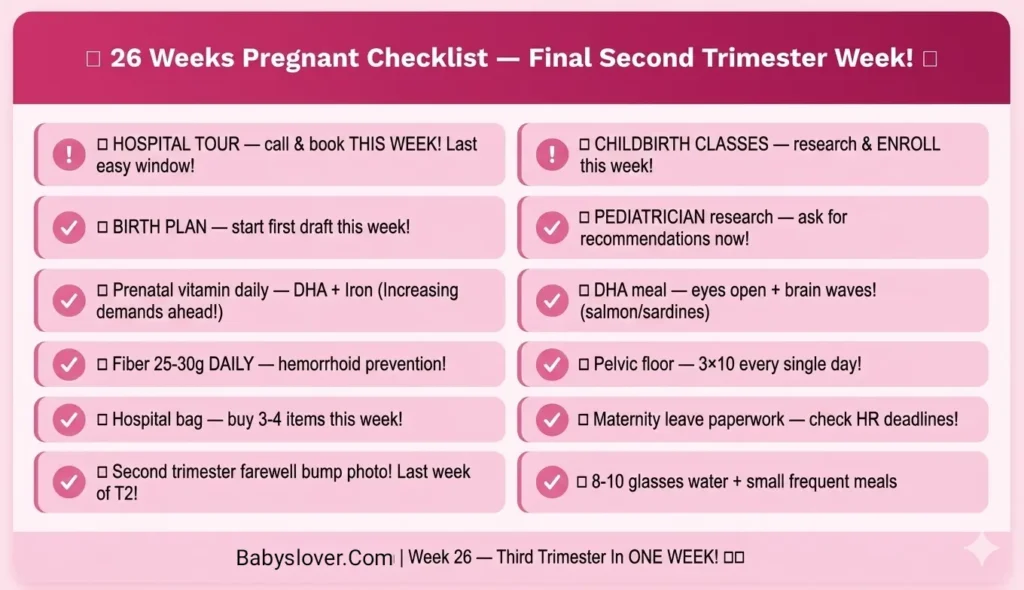
- ☑ 🏥 HOSPITAL TOUR — call and book THIS WEEK (last easy second trimester window!)
- ☑ 🎓 Childbirth class — research and ENROLL this week!
- ☑ 📋 Birth plan — start first draft this week!
- ☑ 👶 Pediatrician research — start asking for recommendations now
- ☑ 💊 Prenatal vitamin daily — DHA + iron + calcium (increasing demands ahead!)
- ☑ 🐟 DHA meal — eyes open + brain waves! Salmon or sardines!
- ☑ 🥗 Fiber 25–30g daily — hemorrhoid prevention is nutrition-based!
- ☑ 🏋️ Pelvic floor — 3×10 EVERY DAY
- ☑ 🧴 Belly moisturizer twice daily
- ☑ 👜 Hospital bag — buy 3-4 items this week, continue next
- ☑ 📋 Maternity leave paperwork — check deadlines with HR
- ☑ 📸 Second trimester farewell bump photo — last week of T2!
- ☑ 💧 8-10 glasses water + small frequent meals
- ☑ 🌙 Left-side sleeping + head elevated for shortness of breath
Frequently Asked Questions — 26 Weeks Pregnant
How big is my baby at 26 weeks pregnant?
At 26 weeks pregnant, your baby is approximately 35–36cm (13.8 inches) from head to heel — roughly the size of a scallion or long spring onion — and weighs about 760 grams (1.7 pounds). The baby is gaining approximately 100 grams per week and will continue this pace or faster through the third trimester.
When does melanin production start in babies?
Melanin production — the process that determines permanent skin, hair, and eye color — begins at approximately 26 weeks of pregnancy. Before this week, the skin’s pink appearance was due to capillaries (blood at the skin surface), not pigment. At Week 26, melanocytes (the pigment-producing cells in the skin) activate and begin generating melanin. The full expression of skin color continues building through the remainder of pregnancy and the first several months after birth — which is why newborns of all ethnicities are often slightly lighter at birth than they will be at three to six months.
Can my baby see at 26 weeks pregnant?
Your baby’s eyes are now fully open and responding to light at 26 weeks. The retina can detect changes between light and dark — not shapes, colors, or detail, which require a far more mature visual cortex. When light shines on the belly, the pupils contract; in darkness, they dilate. The baby may move toward or away from a bright light placed against the belly. Full visual development continues rapidly through the third trimester and the first year after birth.
What are brain waves in a 26-week fetus?
Research has demonstrated that a fetus at 26 weeks produces measurable event-related electrical potentials in response to sounds — detectable from sensors placed on the mother’s abdomen. These are organized neural responses: the auditory cortex receives a sound, processes it, and generates an electrical signal. This is the same fundamental mechanism as the EEG (electroencephalogram) used to measure brain activity in adults and children. The brain at 26 weeks is not simply growing — it is already generating the organized electrical responses that are the signatures of sensory processing.
What is SPD in pregnancy?
Symphysis pubis dysfunction (SPD), also called pelvic girdle pain, is pain caused by instability in the symphysis pubis — the joint at the front of the pelvis where the two pubic bones meet. Relaxin softens this joint during pregnancy, and in some women it becomes unstable and painful. The characteristic symptom is sharp pain at the pubic bone — front of the pelvis, between the hip bones — that worsens with walking, climbing stairs, turning in bed, or separating the legs. Management includes a pelvic support belt, physiotherapy, and keeping the legs together during transfers. Mention it to your OB — it is a recognized condition with specific management, not something to simply tolerate.
Why am I so out of breath at 26 weeks?
Shortness of breath at 26 weeks is caused by the growing uterus pushing upward against the diaphragm, reducing its range of motion and limiting the lungs’ ability to fully expand. The lungs are functioning normally — there is simply less space. The breathlessness typically worsens through the third trimester and improves in the last 2–4 weeks before delivery when the baby descends (lightening). Contact your OB immediately if breathlessness is accompanied by chest pain, palpitations, or blue-tinged lips or fingertips.
Is 26 weeks the end of the second trimester?
Yes — Week 26 is the final week of the second trimester. The third trimester begins at Week 27 (some sources say Week 28, depending on how the three equal-thirds division is calculated). Clinically, most OBs and midwives consider the third trimester to begin between Week 27 and Week 28. Either way, Week 26 is the last week of this phase — the most comfortable trimester for most women ends here, and the preparation phase for birth accelerates from Week 27 onward.
💗 The Emotional Reality of Week 26 — The Last Quiet Week
The second trimester is ending. For most women, it was the easier one — the weeks when pregnancy started to feel like living
The third trimester ahead is different. It is the countdown. The discomfort will increase. The appointments become more frequent. The to-do list grows. The due date moves from abstract to real. The fear and excitement and physicality of what is coming starts to press closer.
Week 26 is worth sitting with for a moment before it ends. Inside you, melanin is beginning its lifelong work. Your baby’s eyes are open — open, in the dark, in the warm amber light of the womb, with brain waves already rising in response to sound. There is a person in there who is already perceiving the world in the small ways available to them. Already responding to light and sound. Already wearing, in the first molecular traces of pigment, the color they will have for life.
Second trimester: you were good. 💗
👶 What’s Next — 27 Weeks Pregnant Preview
27 Weeks Pregnant— the first week of the third trimester — brings significant new developments:
- 🥦 Head of broccoli — ~36.6cm, ~875 grams (almost 2 lbs!)
- THIRD TRIMESTER BEGINS — new energy, new purpose, final 13 weeks
- Sleep-wake cycles more established — baby now has noticeable active and quiet periods
- Hiccups become noticeable as rhythmic pulses — diaphragm practice!
- Eyelashes fully present — eyebrows thick
- Immune antibody transfer accelerating rapidly
- Prenatal appointments now every 2 weeks in many practices
Third trimester in one week. Follow our pregnancy week by week guide for everything from Week 27 through delivery. The final chapter starts next week. 💗
Week 26: The Color That Starts Today
At 26 weeks pregnant, melanin is beginning to paint the canvas of your baby’s skin — the exact shade that will be theirs for their entire life, starting its expression today. The eyes that first opened last week are fully open now, looking at the amber-filtered light of the womb while a brain that is already producing measurable, organized responses to sound listens to everything you say. The second trimester is ending with a baby who is nearly 1.7 pounds, whose immune system is receiving its first passport of protection from your bloodstream, whose lungs are adding thousands of new air sacs every week.
One week to the third trimester. The last chapter begins. For everything still ahead, our pregnancy tips for first time moms is with you from Week 26 to the end. 💗
1 thought on “26 Weeks Pregnant: Baby Size, Symptoms & Development”