

You will feel it before you understand what it is. A rhythmic pulsing from a single spot in the belly — repeating every two to three seconds, steady as a metronome, completely unlike the unpredictable jabs and rolls you’ve been feeling for weeks. It goes on for two minutes, stops, then starts again from the same place. It is nothing like a kick. And that’s exactly the point — because it isn’t one. That is your baby hiccupping: the diaphragm contracting with each small inhale of amniotic fluid, exactly as it will contract millions of times over a lifetime of breathing air.
Fetal hiccups have been happening since Week 9, but most women don’t feel them clearly until the third trimester begins — when the baby is large enough that even diaphragm contractions transfer a noticeable pulse through the belly wall.
At 27 weeks pregnant, that moment has arrived. And the reason hiccups are becoming prominent right now, at the start of the third trimester, is not coincidence: the nervous system is entering the most intensive maturation period of the entire pregnancy. The brain is growing faster in the third trimester than at any other point in development. The diaphragm nerve connections strengthening enough to produce feelable hiccups are part of the same neurological sprint that will, over the next 13 weeks, produce the brain your baby will use to experience the world.
At 27 weeks pregnant, your baby is approximately 36.6cm (14.4 inches) from head to heel — roughly the size of a head of broccoli — and weighs approximately 875 grams (approaching 2 pounds). Sleep-wake cycles are more established than ever, including REM sleep with the rapid eye movements and brain wave patterns of dreaming. Eyelashes are fully formed. The face is complete. And this is, by most clinical conventions, the first week of the third trimester — the final 13 weeks. At Babyslover, here is everything about Week 27: hiccups fully explained, the sleep-wake story, vivid pregnancy dreams, and the symptoms that are shifting as your body transitions into the third trimester.
Coming from last week? Our 26 weeks pregnant guide covered melanin beginning, eyes opening, and the second trimester farewell checklist.

| 📋 Quick Summary — Week 27 of Pregnancy | |
| Week | Week 27 of 40 — THIRD TRIMESTER (first week!) — 13 weeks to go! |
| Baby Size | 🥦 Head of broccoli — ~36.6cm head-to-heel (14.4 inches) |
| Baby Weight | ~875 grams (1.9 lbs) — will DOUBLE in weight over the next 10 weeks |
| KEY MILESTONES | 🫁 HICCUPS NOW CLEARLY FELT — diaphragm practicing breathing, amniotic fluid inhaling! • 😴 REM SLEEP + SLEEP-WAKE CYCLES — more established than any prior week, with possible dreaming! • 👁️ EYELASHES COMPLETE — full lashes, thick eyebrows! • 🧠 NERVOUS SYSTEM SPRINT BEGINS — fastest brain maturation of entire pregnancy! • 🩸 Fat filling in — skin smoothest yet! |
| MILESTONE | 🎉 THIRD TRIMESTER! The final chapter of pregnancy begins at Week 27. Biweekly OB appointments start at Week 28. The nervous system and brain will gain more complexity in the next 13 weeks than in the entire previous second trimester. |
| Symptoms | Braxton Hicks increasing in frequency and strength, vivid dreams / pregnancy insomnia, back pain and sciatica progressing, shortness of breath increasing, leg cramps and restless legs, increased Braxton Hicks, fatigue returning, swelling ankles and feet |
| Act Now | 📅 Book biweekly OB appointments starting Week 28. 👊 Begin kick counting — 10 movements in 1 hour. 🏥 Hospital tour if not done. Third trimester has begun — the pace of preparation accelerates. |
🌱 Baby Development at 27 Weeks Pregnant
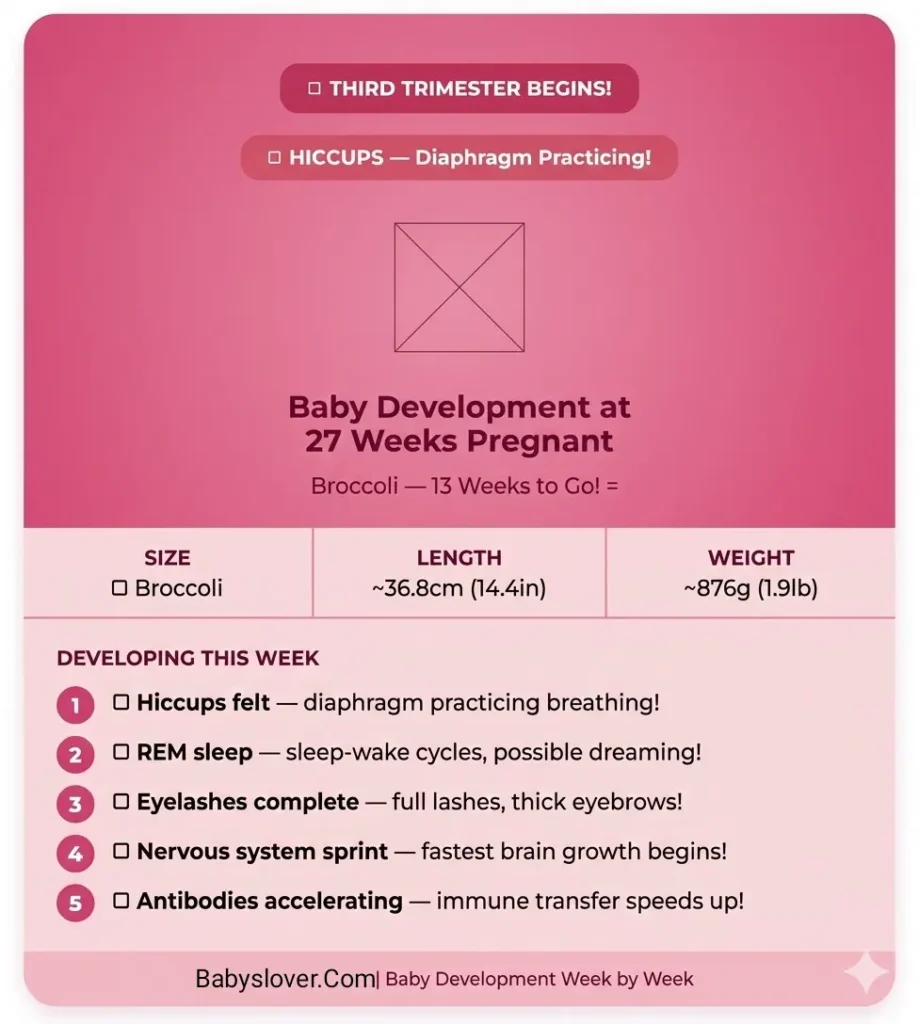
At 27 weeks pregnant, your baby is approximately 36.6cm from head to heel — the size of a head of broccoli — and weighs around 875 grams. The body is filling out rapidly: the subcutaneous fat depositing since Week 22 is now substantial enough that the extreme wrinkled appearance of the early preterm is gone. The skin is smoother, pinker (from the capillaries that filled in at Week 25), and beginning to show the early pigmentation of melanin production that began at Week 26. The face has full eyebrows, complete eyelashes, a formed nose, defined lips, and ears in their final position. On ultrasound at 27 weeks, a baby’s face is immediately, unmistakably recognizable as a face — not an approximation of one. The proportions of the body are close to a newborn’s.

| 🌱 Baby Development at 27 Weeks | |
| Baby Size | 🥦 Head of broccoli — ~36.6cm head-to-heel (14.4 inches) |
| Weight | ~875 grams (1.9 lbs) — approaching 2 pounds, will more than double by term! |
| KEY MILESTONE | 🫁 HICCUPS NOW CLEARLY FELT — baby inhaling amniotic fluid causes the diaphragm to contract rhythmically. What you feel as a repetitive pulse from one spot is your baby’s diaphragm doing its first breathing practice — the same muscle that will power every breath for life. |
What Is Developing at Week 27
- 🫁 Hiccups — the diaphragm’s breathing rehearsal: Your baby has been hiccupping since approximately Week 9, but at Week 27 the hiccups become noticeable from the outside for the first time — because the baby is now large enough that each diaphragm contraction registers as a distinct pulse through the belly wall. The mechanism is straightforward: the baby inhales amniotic fluid into the developing lungs. This causes the diaphragm — the dome-shaped muscle that powers breathing — to contract suddenly, exactly as it does when air rushes into adult lungs too quickly. The result is a hiccup: an involuntary, rhythmic diaphragm spasm that the baby cannot stop, just as adults cannot stop hiccups on demand. This is not a problem. It is essential respiratory practice — the diaphragm is building the strength and reflex coordination it will need to power independent breathing at birth. Fetal hiccups are controlled by the phrenic nerve (the nerve that controls the diaphragm), and the regularity and strength of hiccups at this stage is a confirmation that this nerve pathway — from brain to diaphragm — is intact and functioning.
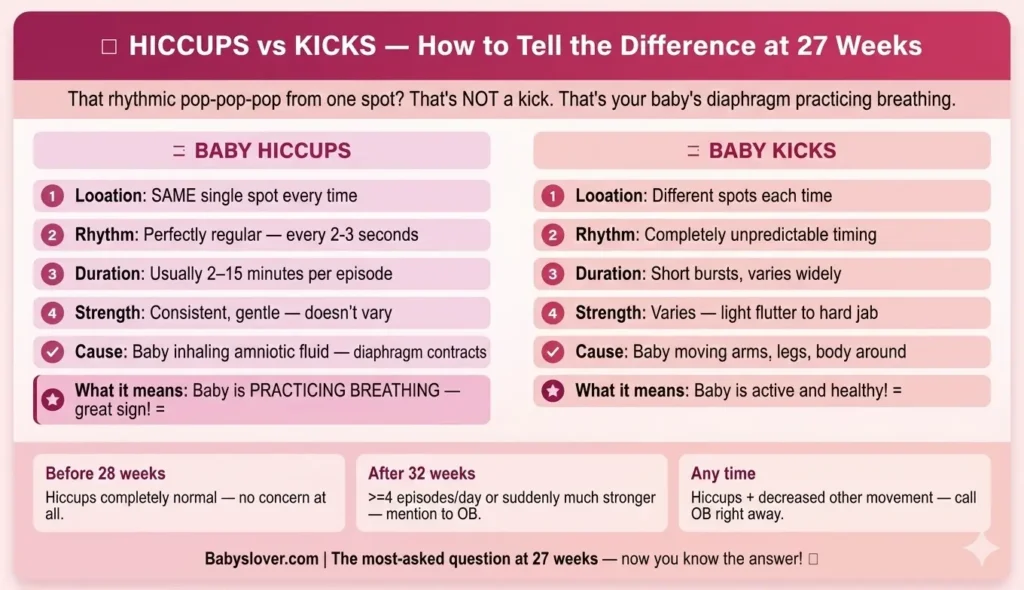
💡 HOW TO TELL HICCUPS FROM KICKS: Hiccups come from the SAME single spot in the belly, repeat every 2–3 seconds in a perfectly regular rhythm, and go on for 2–15 minutes before stopping. Kicks come from different locations, have unpredictable timing, and vary in strength. When you feel that rhythmic pop-pop-pop that never varies its location or its timing — that’s a hiccup. That’s your baby breathing. 🫁
- 😴 REM sleep and sleep-wake cycles — baby may be dreaming: Sleep in the fetus has been developing since around Week 20, but at Week 27 the sleep-wake cycles are more organized and defined than at any previous point. Your baby now cycles between active states (movement, higher heart rate, brain activity) and quiet sleep states multiple times per day, spending approximately 90–95% of time in sleep — which makes sense given the enormous energy demands of development. Within sleep, REM (Rapid Eye Movement) sleep is present at Week 27: the brain wave patterns characteristic of the dreaming stage of sleep can be measured in fetuses at this gestational age. During REM phases, the baby’s eyes move beneath the closed or partially open lids. Brain activity during REM sleep in the fetus is associated with sensory processing and neural circuit consolidation — the brain is using quiet time to strengthen and organize the connections built during active development. Whether there is a subjective experience of dreaming at this stage remains unknown, but the neurological architecture of dreaming — the REM brain state — is present.
- 👁️ Eyelashes complete — eyebrows thick: The eyelashes, which began growing earlier in the second trimester, are fully formed at Week 27 — framing eyes that are now open, blinking, and responsive to light. The eyebrows are prominent. These features, along with the formed nose and lips, give the baby’s face a completeness that is remarkable on ultrasound: the 27-week face is the face of the person who will be born. The hair on the scalp continues growing — some babies have a visible and substantial amount of scalp hair by Week 27, while others have very little; both are normal, and birth hair doesn’t predict adult hair density or type.
- 🧠 Nervous system sprint — the most intensive maturation of the pregnancy: The third trimester is when the human brain undergoes its most explosive growth of the entire developmental period. The cortex — the outer layer responsible for thought, sensory processing, and voluntary movement — is folding rapidly, with the gyri (ridges) and sulci (grooves) that give the adult brain its characteristic wrinkled appearance increasing in complexity every week. Myelination — the insulating coating of nerve fibers that dramatically speeds up nerve signal transmission — is accelerating through the brainstem and beginning to extend into the cortex. The cerebellum, which controls motor coordination, is growing rapidly. The entire nervous system is, from Week 27 through Week 36, undergoing maturation at a pace it will never experience again. This is why premature birth at 27 weeks has substantially better outcomes than at 24–25 weeks — but also why each additional week in the third trimester matters so significantly.
- 🩸 Fat filling in — skin smoothest yet: Subcutaneous fat deposits are now significant enough that your baby’s body has lost the deeply wrinkled, translucent appearance of the early second trimester. The skin is smoother, more opaque, and has the warm pinkish tone from the capillaries that filled in at Week 25. The fat serves multiple functions: insulation (allowing independent temperature regulation after birth), energy reserve (critical fuel for the first days of newborn life), and the characteristic ‘baby chubby’ appearance of a full-term infant. This fat will continue depositing at an accelerating rate through the third trimester — the baby will gain approximately 200+ grams per week in the coming weeks.
- 🛡️ Immune antibodies — transfer accelerating: The transfer of maternal IgG antibodies across the placenta, which began meaningfully at Week 26, accelerates significantly from Week 27 onward through the remainder of the pregnancy. The third trimester is when the baby accumulates the majority of the immune protection that will carry it through the first months of life, before its own immune system matures enough to produce its own antibodies. Each week in the third trimester adds to this immune reserve.
💡 Fun fact: Your baby spends approximately 90–95% of each day asleep at Week 27 — and that is not laziness, it is the most productive thing they can do. Sleep is when the brain consolidates connections made during active periods, when growth hormone is released at its highest levels, and when the enormous energy demands of development are met most efficiently. The baby you barely feel some days? They’re building the brain that will know you. 😴
What’s Happening in Your Body at 27 Weeks Pregnant
💤 Vivid Dreams and Pregnancy Insomnia — Why the Third Trimester Disrupts Sleep
One of the most universally reported — and universally underexplained — symptoms of the third trimester is vivid, strange, intense dreams. Women who rarely remember their dreams suddenly find themselves waking up with detailed, emotionally intense dream sequences that feel more real than usual. The explanation connects directly to what is happening in the baby’s development: pregnancy significantly alters sleep architecture. The hormonal changes of the third trimester — particularly progesterone and estrogen — affect the depth and cycling of sleep stages, causing more frequent waking during REM phases (when dreaming occurs). Each time you wake from REM sleep, you are more likely to remember the dream you were in. The content of pregnancy dreams — birth scenarios, the baby, anxiety about the future, the body changing — reflects the emotional processing of one of the most significant transitions in a person’s life.
Physical contributors to disturbed sleep at Week 27 include: the growing belly making comfortable positioning harder, Braxton Hicks contractions at night, restless leg syndrome, leg cramps, the need to urinate frequently, heartburn that worsens when lying flat, and the shortness of breath that comes with the diaphragm being compressed. The management is about reducing physical barriers rather than eliminating them entirely — because they will continue:
- A full-length pregnancy pillow between the knees, under the belly, and behind the back simultaneously is the single biggest sleep quality improvement for most women at this stage — it takes 2–3 nights to get used to but dramatically reduces the body mechanics that cause discomfort
- Sleeping on the left side — improves blood flow to the placenta and reduces pressure on the vena cava; the right side is also fine, but flat-on-back sleeping should be avoided from now on as the uterus can compress the vena cava and reduce circulation
- Elevating the head of the bed 30–45 degrees (or stacking pillows) if heartburn is disrupting sleep — lying flat dramatically worsens reflux
- Small snack before bed with complex carbohydrates and protein (oatmeal, almond butter on whole grain toast) — stabilizes blood sugar through the night and can reduce leg cramps and restlessness
- Limiting fluids in the two hours before bed — reduces nighttime urination frequency without reducing total daily hydration
⚠️ Severe insomnia that is causing significant daytime impairment, or vivid dreams accompanied by symptoms of depression or anxiety that feel out of proportion — mention to your OB. Perinatal anxiety and depression are common, and effective support is available.
🤱 Braxton Hicks — Stronger Now, and More Frequent
The practice contractions that most women first notice in the second trimester become significantly more noticeable in the third trimester — at Week 27, many women are experiencing Braxton Hicks that they would not have noticed a month ago. Braxton Hicks are irregular, painless or mildly uncomfortable tightening of the uterus that do not follow a regular pattern, do not increase in intensity over time, and typically resolve with movement, position change, or hydration. They are the uterus ‘practicing’ the coordinated muscle contractions it will use during labor — the same fundamental mechanism as fetal hiccups practicing breathing.
Key differences between Braxton Hicks and real contractions:
| Braxton Hicks | Real Labor Contractions | |
| Timing | Irregular — no pattern | Regular — getting closer together |
| Duration | Varies, usually under 60 seconds | 30–70 seconds, lengthening over time |
| Intensity | Stays the same or fades | Gets progressively stronger |
| With movement | Usually stop or lessen | Continue regardless of position |
| With hydration | Often resolve after drinking water | No effect |
| Pain | Tight sensation, not painful | Increasingly painful as labor progresses |
⚠️ Before 37 weeks — if contractions feel regular (every 10 minutes or more frequently), increase in intensity, are accompanied by pelvic pressure, back pain, or changes in discharge — contact your OB immediately. Preterm labor contractions can feel like Braxton Hicks initially.
🦶 Kick Counts — Starting This Week
Week 27 is the appropriate time to begin daily kick counts — formally tracking fetal movement as a way of monitoring your baby’s wellbeing. The standard method:
- Choose the same time each day when your baby is typically active — often after a meal or in the evening
- Lie on your left side or sit comfortably
- Count movements (kicks, rolls, swishes, jabs) until you reach 10
- Note how long it takes to reach 10 movements
- Over time, you will learn your baby’s normal active pattern — this baseline is what matters
The goal is not an exact number per hour but rather consistency with YOUR baby’s normal pattern. A baby who is usually very active going suddenly quiet for a full day is more concerning than a less active baby who is quiet in the morning (their normal). If you count and reach 10 movements comfortably within an hour, the baby is well. If you don’t reach 10 movements in two hours — drink cold water, lie on your left side, and try again. If still fewer than 10 — call your OB.
Third Trimester Begins — What Changes From Week 27
The transition into the third trimester is not just a calendar milestone — it changes your prenatal care schedule and the nature of what you are preparing for
| 📅 What Changes in the Third Trimester — Starting Week 27 | |
| Prenatal Appointments | From Week 28: biweekly (every 2 weeks) instead of monthly. Weeks 28, 30, 32, 34, 36. Then weekly from Week 37 until delivery. Book your Week 28 appointment NOW if not already scheduled. |
| Kick Counts | Begin daily kick count tracking this week. 10 movements in 1 hour = reassuring. Establishes your baseline for the rest of pregnancy. |
| Tdap Vaccine | Recommended between Weeks 27–36 in EVERY pregnancy. Protects the newborn from whooping cough (pertussis) before they can be vaccinated at 2 months. Book it at your Week 28 appointment. |
| Group B Strep Test | GBS swab done at Week 35–37. Begin planning: if positive, you will receive IV antibiotics during labor — not an emergency, just a protocol. |
| Baby Position | Baby is still moving freely and often in breech (bottom-down) position — 1 in 3 babies are breech at Week 27. This is not a concern at this stage; most babies turn head-down by Week 36. |
| Brain Growth | The brain grows more in the third trimester than any other period. DHA intake is critical — the brain is building its functional architecture right now. |
Nutrition at 27 Weeks — Third Trimester Fuel
The third trimester increases caloric needs by approximately 300–450 calories per day above pre-pregnancy baseline — and the quality of those calories matters enormously because the nervous system sprint happening right now is directly shaped by what you eat. The two most critical nutrients for Week 27 onward are DHA and protein:
| Nutrient | Why Critical at Week 27 | Best Sources |
| DHA Omega-3 | BRAIN GROWTH SPRINT — the cortex is folding rapidly, neurons multiplying at the fastest rate. DHA is the primary structural fat in brain tissue. Most impactful window for DHA supplementation is right now through Week 36. 300mg/day minimum. | Cooked salmon 2×/week (300mg DHA per serving!), sardines, DHA eggs, walnuts, chia seeds. DHA prenatal supplement if fish limited — check your prenatal vitamin DHA content. |
| Protein | Baby gaining 200+ g/week — all from you. Muscle, organ, and brain tissue building requires amino acids. Minimum 70–100g/day in third trimester. Protein also helps stabilize blood sugar and reduce leg cramps. | Eggs, Greek yogurt, lean beef, chicken, salmon, lentils, edamame, cottage cheese. Aim for protein at every meal. |
| Iron + Vit C | Maternal blood volume at peak — anemia risk highest now. Immune antibody production increasing. Myelination (nerve insulation) requires iron. Restless legs often iron-driven. | Beef, lentils + bell pepper, spinach + lemon. Keep iron and calcium supplements separated — they compete. Avoid tea/coffee within 1hr of iron. |
| Calcium + Vit D | Baby skeleton mineralizing rapidly — the third trimester bone growth is the most intensive of pregnancy. Maternal bone density is being drawn on. Muscle cramps and Braxton Hicks linked to calcium/magnesium balance. | Dairy, fortified plant milk, sardines, tofu. Vitamin D 1000-2000 IU (discuss with OB). Take calcium away from iron. |
| Magnesium | Leg cramps (worsening in T3), restless legs, Braxton Hicks (magnesium relaxes uterine muscle), sleep quality. 350-360mg/day. Magnesium glycinate is gentlest form. | Pumpkin seeds (highest!), dark chocolate, almonds, black beans, spinach, avocado. Magnesium glycinate supplement — discuss dose with OB. |
Key third trimester shift: eat more frequently in smaller portions. As the uterus rises and compresses the stomach, a full meal becomes increasingly uncomfortable. Five to six smaller meals spaced through the day maintains caloric intake without triggering heartburn and the extreme fullness that becomes common from Week 28 onward. Your best prenatal vitamins guide covers which prenatals have meaningful DHA alongside iron — this combination is increasingly important from Week 27.
For Your Partner — Week 27: Third Trimester Begins
- Book the Week 28 appointment right now: Biweekly appointments begin at Week 28. If the next appointment is not yet scheduled, call the OB’s office today. The appointments at Weeks 28, 30, 32, 34, and 36 each have specific things to address (Tdap vaccine at 28, GBS swab at 35–37, Group B discussions) — being on schedule matters. Many OB practices have waitlists for third trimester slots.
- Feel the hiccups together: Ask her where the baby has been active most recently. Place your hand there and wait during a quiet evening moment. When you feel a rhythmic, perfectly regular pulsing from a single spot — that is a hiccup. That is the diaphragm of a 27-week person practicing the breathing that will sustain their life from the moment of birth. No kick feels like that. It is one of the most remarkable sensations of the pregnancy to feel from the outside, and most partners don’t know to look for it differently from kicks.
- Sleep support is now a physical project: If there isn’t a full-length pregnancy pillow in the bed, this is the week to get one. The 13 remaining weeks of pregnancy will increasingly require physical support at night — between the knees, under the belly, behind the back. A quality pregnancy pillow (U-shape or C-shape) genuinely changes sleep quality and reduces the morning back pain and hip stiffness that is becoming routine. Adjust your own sleep arrangement to accommodate the pillow — this is worth doing.
- Start the hospital bag in earnest: The hospital bag checklist for mom has everything. Go through it together this week and identify what’s already in the house, what needs to be bought, and what needs to be made or gathered. Spread purchases over the next 8–10 weeks. The goal is a packed bag by Week 36 — and Week 27 is exactly the right time to start building it intentionally rather than scrambling later.
- Tdap vaccine — you need it too: The Tdap vaccine protects against whooping cough (pertussis). She will get it at Week 27–36. Partners, grandparents, and anyone who will be in close contact with the newborn should also get a Tdap booster if it’s been more than 10 years since their last one. Newborns cannot be vaccinated until 2 months and are vulnerable to whooping cough — the strategy of vaccinating everyone around them to create a protective ‘cocoon’ is called cocooning. Talk to your own doctor about getting up to date.
When to Call Your Doctor at 27 Weeks Pregnant
- Signs of preterm labor: Regular contractions (every 10 minutes or more frequent), pelvic pressure, persistent lower back pain, increased or changed vaginal discharge, fluid leaking — same-day OB contact.
- Decreased fetal movement: Fewer than 10 movements in 2 hours of active counting — call OB. No movement for a full day — call immediately.
- Severe headache with swelling: Face and hands swelling plus headache, vision changes, or upper abdominal pain — possible preeclampsia — urgent evaluation.
- Excessive Braxton Hicks: More than 4–6 Braxton Hicks in an hour, especially if they feel different from usual — contact OB.
- Sudden or severe shortness of breath: Chest pain with breathlessness — not normal pregnancy breathlessness — urgent care.
- Insomnia severely affecting function: Mention to OB — perinatal anxiety or depression treatment is available and effective.
- Fever above 100.4°F / 38°C: Contact OB.
Your Week 27 Pregnancy Checklist
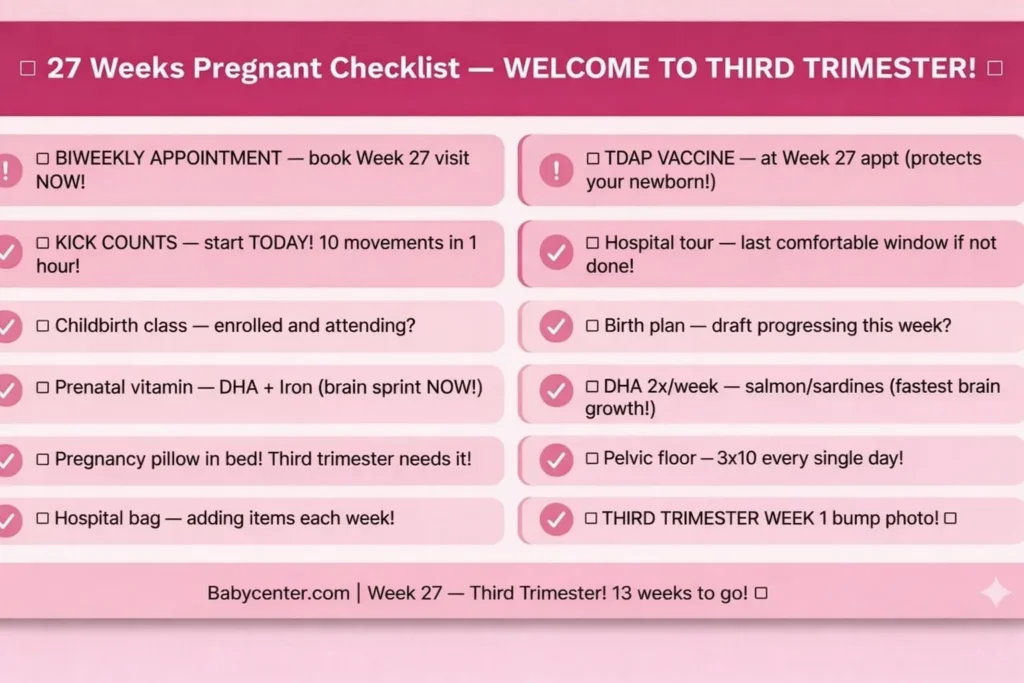
- ☑ 📅 BIWEEKLY OB APPOINTMENT — book Week 28 visit RIGHT NOW!
- ☑ 💉 TDAP VACCINE — schedule at Week 28 appointment (protects newborn from whooping cough!)
- ☑ 👊 KICK COUNTS — start daily from this week! 10 movements in 1 hour!
- ☑ 🏥 Hospital tour — done? If not, THIS WEEK is the last comfortable window!
- ☑ 🎓 Childbirth class — enrolled and attending?
- ☑ 📋 Birth plan — draft progressing this week?
- ☑ 💊 Prenatal vitamin daily — DHA + iron (brain sprint happening NOW!)
- ☑ 🐟 DHA-rich meal 2×/week — salmon or sardines (brain growing fastest now!)
- ☑ 🏋️ Pelvic floor — 3×10 EVERY DAY
- ☑ 🛌 Pregnancy pillow — in bed? Third trimester sleep is a physical project!
- ☑ 🧴 Belly moisturizer twice daily — stretching continues
- ☑ 👜 Hospital bag — adding items each week (aim for packed by Week 36)
- ☑ 💧 Small frequent meals — stomach is getting compressed now
- ☑ 📸 THIRD TRIMESTER WEEK 1 bump photo! The final chapter starts here!
Frequently Asked Questions — 27 Weeks Pregnant
How big is my baby at 27 weeks pregnant?
At 27 weeks pregnant, your baby is approximately 36.6cm (14.4 inches) from head to heel — about the size of a head of broccoli — and weighs around 875 grams (1.9 pounds). The baby will more than double in weight over the next 10 weeks, gaining 200+ grams per week in the most rapid growth phase of the pregnancy.
What does baby hiccups feel like at 27 weeks?
Baby hiccups feel like a rhythmic, repetitive pulsing from a single fixed spot in the belly — repeating every 2–3 seconds in a perfectly regular pattern, continuing for 2–15 minutes per episode. They feel completely different from kicks, which come from varying locations and have unpredictable timing. The pop-pop-pop that comes from one area and never varies its rhythm is almost certainly hiccups. They are caused by the baby inhaling amniotic fluid, which causes the diaphragm to contract — the same mechanism as adult hiccups, just with amniotic fluid instead of air.
Is 27 weeks the third trimester?
There is some variation in how trimesters are defined. Dividing 40 weeks exactly into thirds gives 13.3 weeks per trimester, placing the third trimester at Week 27. Most clinical guidelines place the third trimester beginning between Week 27 and Week 28 — meaning both Week 27 and Week 28 are cited by different authoritative sources as the start. What is clinically consistent: biweekly OB appointments typically begin at Week 28, and the developmental priorities of the third trimester (rapid brain growth, fat deposition, lung maturation, antibody transfer) are clearly underway at Week 27.
Can my baby dream at 27 weeks pregnant?
At Week 27, your baby has established REM sleep — the brain state associated with dreaming in adults and children — as part of its sleep-wake cycling. During REM phases, the brain generates the electrical wave patterns characteristic of dreaming, and the eyes move beneath the lids. Whether there is a subjective experience of dreaming — images, narrative, sensation — in a 27-week brain is not something current science can definitively answer. But the neurological hardware of dreaming is present. The brain at 27 weeks is in REM sleep. What happens during that REM sleep, beyond the measurable brain activity, remains one of the genuinely unknown questions of developmental neuroscience.
When should I start kick counts?
Most guidelines recommend beginning daily kick counts between Week 26 and Week 28 — Week 27 is an ideal time to start. The goal is not a specific number per hour but establishing your baby’s normal baseline. Count at the same time each day during your baby’s usual active period. Reach 10 movements in under 2 hours = reassuring. Under 10 movements in 2 hours = drink cold water, lie on left side, try again. Still under 10 = call your OB.
Why am I having such vivid dreams at 27 weeks?
Vivid pregnancy dreams in the third trimester are caused by disrupted sleep architecture from hormonal changes and physical discomfort that causes more frequent waking during REM (dreaming) sleep. Each time you wake from REM, you are more likely to remember the dream vividly. The content of pregnancy dreams — birth, the baby, the body, the future — reflects the emotional processing of a major life transition. The intensity of these dreams is normal and will largely resolve postpartum.
What is the Tdap vaccine in pregnancy?
Tdap protects against tetanus, diphtheria, and pertussis (whooping cough). It is recommended in every pregnancy between Weeks 27 and 36 because maternal antibodies against pertussis transfer across the placenta, giving the newborn protection from birth until their own first vaccines at 2 months. Whooping cough can be life-threatening for newborns. Getting Tdap in every pregnancy (even if vaccinated before) ensures maximum antibody transfer to the baby. Partners and family members in close contact with the newborn should also have an up-to-date Tdap.
💗 The Emotional Reality of Week 27 — The Beginning of the End
Third trimester. The final 13 weeks. The countdown that is no longer abstract.
Something shifts in Week 27 — the due date moves from ‘eventually’ to something that is coming, specifically, on a particular date that is now close enough to plan around. The preparation that has been theoretical becomes immediate. The hospital tour. The bag. The birth plan. The biweekly appointments. The childbirth class. The nursery. All of it, in the next 13 weeks.
Inside you, a person who weighs nearly two pounds is hiccupping — practicing the breathing they will do for the first time in a room with you, surrounded by people waiting for them, in fewer than 90 days. That person is in REM sleep right now. Their brain is building, in its sleep, the circuits that will light up when they hear your voice for the first time from the outside. The eyelashes you saw on the ultrasound are the ones that will flutter when they finally close their eyes in your arms.
This is what Week 27 is. 💗
👶 What’s Next — 28 Weeks Pregnant Preview
28 Weeks Pregnant is a milestone week in prenatal care:
- 🍆 Large eggplant — ~37.6cm, ~1,000 grams (over 2 lbs — first KILO!)
- BIWEEKLY APPOINTMENTS BEGIN — Weeks 28, 30, 32, 34, 36
- TDAP VACCINE — given at Week 28 appointment
- Third trimester blood work — hemoglobin, Rh factor check
- Baby’s eyes respond to light reliably — open and closing regularly
- Brain waves during sleep fully established — definitive REM cycles
- Hiccups even more noticeable — diaphragm strengthening every day
Week 28 brings the first of many biweekly appointments. Follow our pregnancy week by week guide for every development from now to delivery. 💗
Week 27: The Baby Who Is Breathing in There
At 27 weeks pregnant, that rhythmic pulsing you’re feeling — or will feel for the first time this week — is a person’s diaphragm practicing the breathing that will sustain their life from the first seconds after birth. The nervous system making that hiccup possible is entering the fastest growth period it will ever experience. The eyes that hiccupped-person has — with their full eyelashes and thick brows — were in REM sleep this morning, doing something that resembles dreaming in every measurable way.
Thirteen weeks left. The breathing is already practicing. 💗
For everything from here through delivery, our pregnancy tips for first time moms is with you every step. 💗