
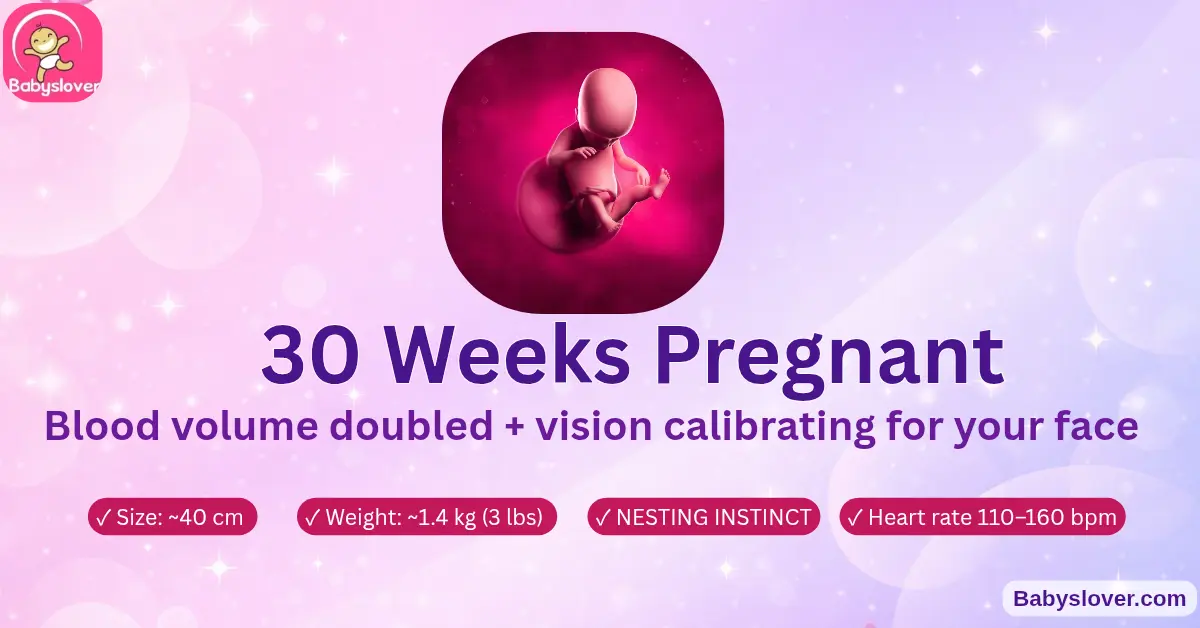
At 30 weeks pregnant, your blood volume has doubled from what it was before pregnancy. Your heart is pumping twice as much. Your baby’s toenails are fully formed. The hair on their head is thickening. Their eyes — still closed for much of the day — are being calibrated by your body to a very specific focal length: the exact distance between your face and their face when you hold them to your breast.
There is also a very good chance that this week, you want to clean, organize, or rearrange something. We’ll explain exactly why.
Here’s everything happening at 30 weeks pregnant. Coming from last week? Our 29 weeks pregnant guide covered the second trimester farewell checklist.
Quick Summary: 30 Weeks Pregnant
| Detail | Info |
| Baby size | Cabbage or large head of lettuce — ~40 cm, ~1.4 kg (3 lbs) |
| Trimester | Third trimester — Week 3 of T3 |
| Months pregnant | 7.5 months pregnant |
| Weeks remaining | 10 weeks to go |
| Top milestone | Blood volume doubled + vision calibrating for your face |
| This week’s action | Enroll in antenatal classes (last good window) + test-drive hospital route |
What’s Happening in Your Body at 30 Weeks Pregnant
At 30 weeks pregnant, your uterus sits roughly 4 inches above your belly button and your body has undergone changes so significant that it can be hard to connect the current version of yourself with the one that existed 30 weeks ago.
Your blood volume has now doubled. Before pregnancy, the average person circulates roughly 5 liters of blood. At 30 weeks, that figure is closer to 10 liters. Your heart is pumping all of it, continuously, while also managing the demands of a rapidly growing baby and placenta. This is part of why fatigue can feel so all-consuming right now — your cardiovascular system is working harder than it ever has.
Swelling in your feet, ankles, and hands is common and usually harmless. It happens because increased blood volume leads to more fluid in body tissues, and gravity pulls it toward your lower extremities by the end of the day. Elevating your feet, staying hydrated, and avoiding long periods of standing all help.
Swelling that requires urgent attention:
- Sudden or severe swelling in the face, hands, or feet
- Swelling combined with headache, vision changes, or pain under the ribs
- Rapid weight gain over just a few days
These symptoms can indicate preeclampsia — a serious pregnancy complication that requires immediate evaluation. Always call your provider if you are unsure.
What to expect at your Week 30 appointment:
- Blood pressure check — preeclampsia monitoring intensifies from here
- Urine protein test
- Fundal height — should be approximately 28–32 cm
- Baby’s heartbeat
- Review of Tdap vaccination status
- Kick count check-in
- Baby’s position — though this becomes most relevant after Week 36
Baby Development at 30 Weeks Pregnant

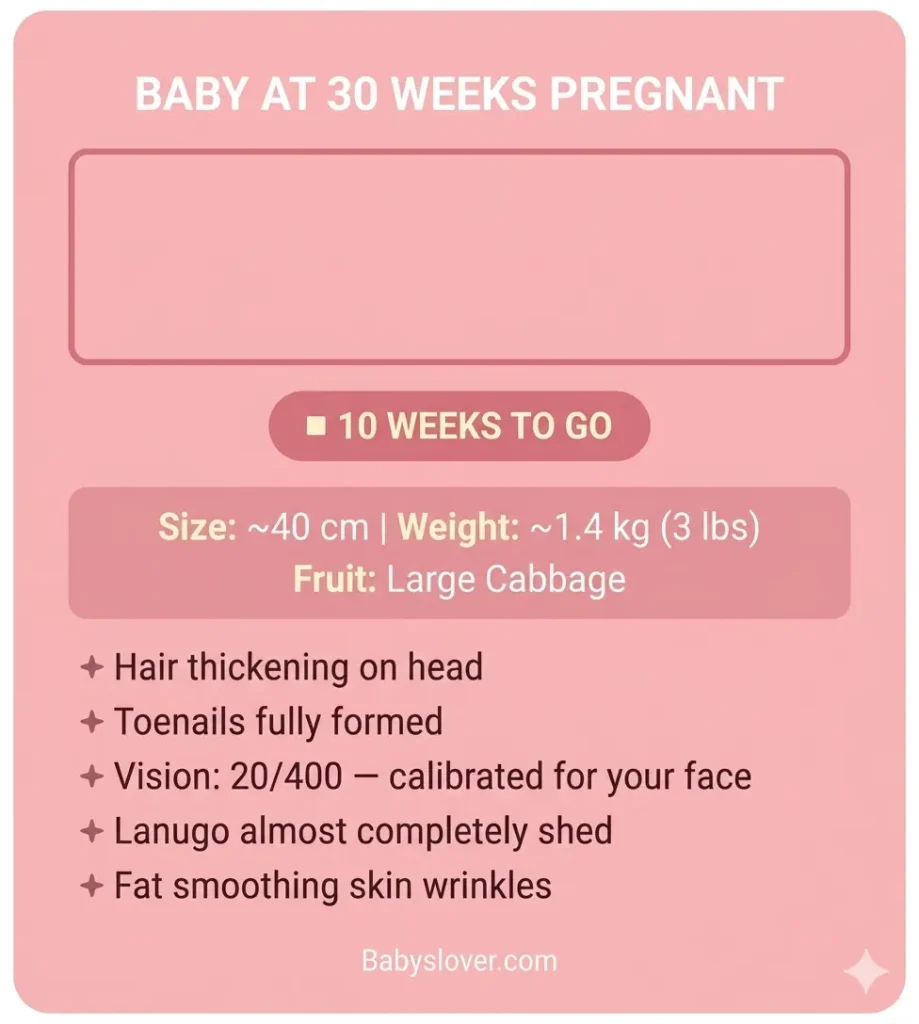
At 30 weeks pregnant, your baby measures approximately 40 cm from head to heel and weighs around 1.4 kg — roughly the size and weight of a large head of cabbage.
| Detail | Measurement |
| Length | ~40 cm (about 15.7 inches) |
| Weight | ~1.3–1.4 kg (approx. 3 lbs) |
| Size comparison | Large cabbage or head of lettuce |
| Heart rate | 110–160 bpm |
| Space left | Getting cramped — rolls replacing kicks |
Key developments this week:
- Hair thickening on the head: The hair follicles that formed earlier in pregnancy are now actively growing. Some babies are born with a thick head of hair. Others arrive nearly bald. Both are entirely normal — it’s purely genetic.
- Lanugo almost gone: The fine downy hair that covered your baby’s body is nearly shed by Week 30. What remains will mostly disappear before birth — though some babies, especially those born early, still have traces on their shoulders and back.
- Toenails fully formed: Toenails are now completely developed and visible. At birth, some babies already need a trim.
- Vision calibrating to 20/400: Your baby’s visual system is developing in a very specific way. Newborn vision at birth is approximately 20/400 — meaning your baby can only focus clearly on objects 8 to 12 inches away. That is precisely the distance between your face and your baby’s face during breastfeeding or bottle feeding. This is not a coincidence. It is how a newborn recognizes their mother from day one.
- Eyes open and track light: Baby’s eyes can now fully open and close, and they follow light sources. A flashlight on your belly may cause your baby to track toward or away from it.
- Fat deposits smoothing wrinkles: The fat accumulating under the skin is filling in the wrinkles of earlier weeks. Your baby is beginning to look more like a newborn and less like a developing fetus.
- Bone marrow fully operational: All red blood cells, white blood cells, and platelets are now made in the bone marrow — the system that will do this job for the rest of your baby’s life.
- Brain growth accelerating: The cerebral cortex continues its rapid folding. More gyri and sulci are forming each week, packing more neurons and connections into the growing skull.
Why Your Baby’s Vision Is 20/400 — And Why That’s Perfect
Most pregnancy guides mention that newborn vision is limited. Very few explain why — and the reason is remarkable.
A newborn’s eyes can only focus clearly at a distance of about 8 to 12 inches. Outside that range, everything is blurry. At 20/400, a newborn would fail a standard vision test dramatically. But this isn’t a developmental lag. It’s precision calibration.
8 to 12 inches is the exact distance between a mother’s face and her baby’s face during breastfeeding. It is also the typical distance during bottle feeding, burping, and skin-to-skin contact. Your newborn cannot see across a room — but they can see your face with crystal clarity the moment you hold them.
This focal calibration is set before birth, during the visual system development happening right now at Week 30. What your baby’s eyes are being tuned to is not generic distance vision — it is the face of the person who will feed them.
Vision continues developing rapidly after birth. By 3 months, babies can track moving objects. By 6 months, visual acuity is approaching normal adult range. But those first weeks of 20/400 vision serve an irreplaceable purpose.
30 Weeks Pregnant Symptoms
Nesting Instinct
Many women at 30 weeks pregnant notice a sudden, powerful urge to clean, organize, rearrange furniture, wash baby clothes, stock the pantry, or complete house projects they’ve been postponing for months.
This is called the nesting instinct — and it has a neurobiological explanation.
Research suggests nesting behavior is driven by a combination of hormonal shifts and the brain’s threat-detection and preparation systems activating as birth approaches. In an evolutionary context, preparing the physical environment before delivery increases survival odds. The brain treats this as a priority task — which is why the urge can feel urgent and hard to ignore.
Nesting is healthy and normal. The only caution: don’t overdo it. Climbing ladders, moving heavy furniture, or cleaning with harsh chemicals are not safe at this stage. Direct your energy toward tasks that don’t require physical risk.
Vivid Dreams and Nightmares
A 2016 study published in BMC Pregnancy and Childbirth found that nightmare frequency peaks in the third trimester — particularly in the final 10 weeks. Many women at 30 weeks pregnant report intensely vivid, sometimes disturbing dreams about the birth, the baby, or losing something.
These dreams are driven by a combination of disrupted sleep architecture (lighter, more fragmented sleep means more dream recall), rising anxiety about birth and parenthood, and hormonal fluctuations affecting REM sleep.
They are a normal part of pregnancy. Journaling about anxiety before bed, limiting screen time in the final hour before sleep, and talking openly with your partner about fears can reduce their intensity. If nightmares are severely disrupting your sleep, mention it to your provider.
Braxton Hicks Contractions Intensifying
By Week 30, Braxton Hicks are more frequent and more noticeable. Some women describe them as increasingly uncomfortable — a tight squeeze across the entire front of the belly.
| Braxton Hicks | Real Labor Contractions | |
| Pattern | Irregular — no consistent timing | Regular — getting closer together |
| Location | Front of belly only | Wraps from back around to front |
| Duration | Brief — usually under 30 seconds | 60–90+ seconds, growing longer |
| Intensity | Stays the same or eases | Intensifies over time |
| Response to movement | Often stop with position change | Continue regardless of position |
| When to call | More than 4 in an hour, or painful | Any time you think it might be real |
Shortness of Breath
Your diaphragm has been pushed up by roughly 4 cm from its pre-pregnancy position. Your lung capacity is reduced. This is why climbing a flight of stairs at 30 weeks pregnant can leave you breathless. It’s normal — but still worth mentioning to your provider if it’s severe or sudden.
Relief typically comes in the last few weeks of pregnancy when your baby ‘drops’ lower into the pelvis — a process called lightening or engagement. You’ll breathe more easily, but feel more pelvic pressure.
Back Pain and Posture Changes
As your belly grows, your center of gravity shifts forward. Many women unconsciously lean backward to compensate — creating an exaggerated lumbar curve called lordosis. This places significant strain on the lower back muscles.
What helps: pregnancy-safe stretching, sleeping with a pillow between your knees, switching to flat supportive shoes (this is the week to retire the heels entirely), and prenatal yoga if you haven’t tried it yet.
Carpal Tunnel Syndrome
Carpal tunnel affects up to 60% of pregnant women, peaking in the third trimester. It’s caused by fluid retention and swelling compressing the median nerve in the wrist. Symptoms include tingling, numbness, and weakness in the thumb, index, and middle fingers — often worse at night.
Wrist splints worn at night keep the wrist in a neutral position and provide significant relief for most women. Symptoms almost always resolve after delivery as swelling subsides.
Edema — Managing Swelling in the Third Trimester
Generalized swelling (edema) in the feet, ankles, and hands is expected at this stage. Here’s a practical guide to managing it:
| Strategy | Why It Helps | How Often |
| Elevate feet above heart level | Encourages fluid return to circulation | 30–60 min, 2–3x daily |
| Compression stockings — on before rising | Prevents pooling before gravity pulls fluid down | Every day from Week 28 |
| Drink more water (8–10 glasses) | Counterintuitively reduces water retention | Daily |
| Reduce sodium intake | Sodium causes the body to hold more fluid | Ongoing |
| Avoid standing for long periods | Gravity intensifies pooling with prolonged standing | Daily awareness |
| Ankle rotation exercises | Stimulates circulation in lower legs | Several times daily |
| Sleep on left side | Reduces IVC compression, improves kidney function | Every night |
If swelling is sudden, severe, or asymmetrical (one leg much more swollen than the other), contact your provider immediately. Asymmetrical swelling can indicate a blood clot.
Preeclampsia — Symptoms Every Mom at 30 Weeks Must Know
Preeclampsia affects approximately 5–8% of pregnancies and is most common in the third trimester. It is a serious condition requiring prompt medical attention. The CDC identifies it as one of the leading causes of maternal mortality in the United States.
Knowing the symptoms is not meant to cause anxiety — it’s meant to ensure you act quickly if they appear.
| Warning Sign | What It Looks Like | What to Do |
| High blood pressure | Readings at or above 140/90 on two occasions | Call provider immediately |
| Severe headache | Persistent, not relieved by rest or Tylenol | Call provider immediately |
| Vision changes | Blurred vision, seeing spots or flashing lights | Emergency — call provider now |
| Sudden face/hand swelling | Rapid, significant puffiness especially in face | Call provider today |
| Pain under ribs | Right side, upper abdominal pain | Emergency — call provider now |
| Rapid weight gain | More than 2 lbs in a week | Call provider — may signal fluid retention |
Your blood pressure is checked at every prenatal visit for this reason. If you ever feel ‘something is wrong’ — even without specific symptoms — trust that instinct and call your provider.
Antenatal Classes — Why Week 30 Is the Right Time to Enroll
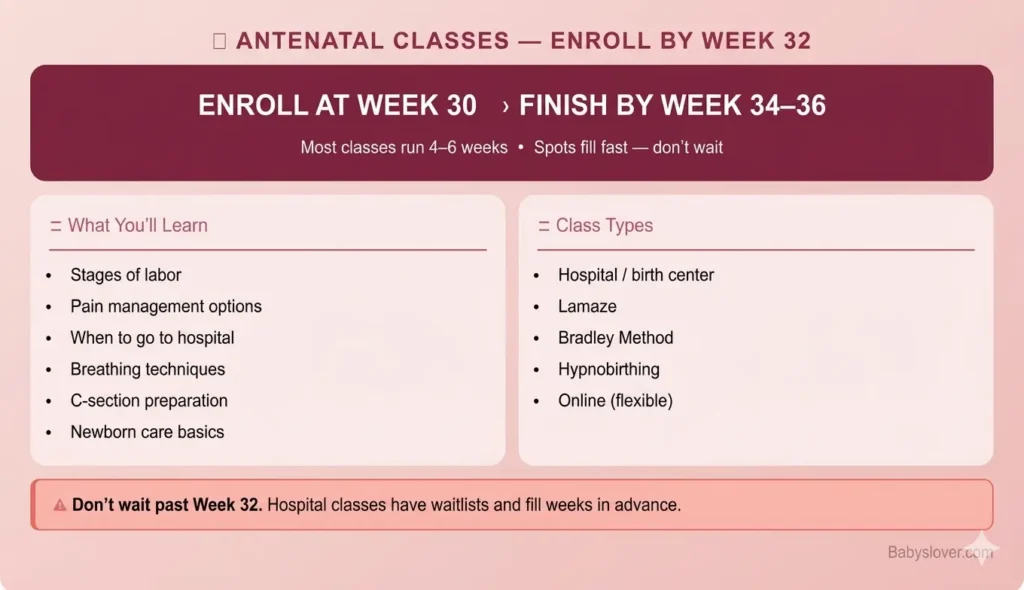
Most antenatal (childbirth preparation) classes run over 4–6 weeks. If you enroll at Week 30, you’ll complete the course by Week 34–36 — right when the information becomes most immediately relevant.
Enrolling later than Week 32 cuts it close. Classes fill up quickly, and some hospital-based programs have waiting lists.
What good antenatal classes cover:
- Stages of labor — early, active, transition, pushing, delivery, third stage
- Pain management options — epidural, nitrous oxide, IV medication, unmedicated approaches
- When to go to the hospital — what to time, what constitutes ‘active labor’
- Breathing and relaxation techniques
- C-section — what happens, what to expect, recovery
- Newborn care basics — feeding, bathing, settling, safe sleep
- Postpartum recovery — physical and emotional
- Partner role during labor and delivery
Types of antenatal classes:
| Type | Best For | Where to Find |
| Hospital/birth center classes | Familiarity with your delivery location | Ask your provider or hospital directly |
| Lamaze | Breathing techniques + natural birth focus | lamaze.org |
| Bradley Method | Partner-coached birth, unmedicated focus | bradleybirth.com |
| Hypnobirthing | Mindset + relaxation for all birth types | Search local practitioners |
| Online classes | Flexibility for busy schedules | Expecting and Empowered, The Birth Hour |
Nutrition at 30 Weeks Pregnant
| Nutrient | Why It Matters at Week 30 | Best Sources |
| Iron | Blood volume doubled — iron demand is at peak. Deficiency causes severe fatigue and affects oxygen delivery to baby | Red meat, lentils, spinach, fortified cereals + vitamin C to boost absorption |
| Calcium | Baby pulling calcium from your bones to harden skeleton — get 1,000 mg daily to protect your bone density | Dairy, fortified plant milks, sardines with bones, almonds, leafy greens |
| DHA (Omega-3) | Brain cortex development continuing at rapid pace | Salmon, sardines, eggs, prenatal vitamins with DHA |
| Magnesium | Leg cramps peak in T3 — magnesium glycinate helps significantly | Almonds, pumpkin seeds, dark chocolate, leafy greens |
| Fiber + Water | Constipation and hemorrhoid prevention — critical | Oats, beans, prunes, fruits, vegetables + 8–10 glasses water daily |
| Vitamin D | Supports calcium absorption + immune function + baby’s bone development | Fortified milk, eggs, fatty fish, sunlight, supplements (ask provider) |
Partner Tips for Week 30
- Enroll in antenatal classes together this week — this is the ideal window and classes fill up
- Do a test drive to the hospital or birth center — time it at different hours if possible. Know the route cold before labor starts.
- Help manage the nesting instinct safely — she’ll want to do everything. Take the ladder tasks, the heavy lifting, the chemical cleaning.
- Learn the preeclampsia warning signs yourself — you may be the one who notices a change she dismisses
- Read the birth plan she’s drafted — this week is a good time to have a real conversation about preferences and fears
- Start thinking about the first few weeks home — childcare logistics, leave timing, who visits and when
- The hospital bag should be started this week if it isn’t already — aim to have it packed by Week 36
30 Weeks Pregnant Checklist
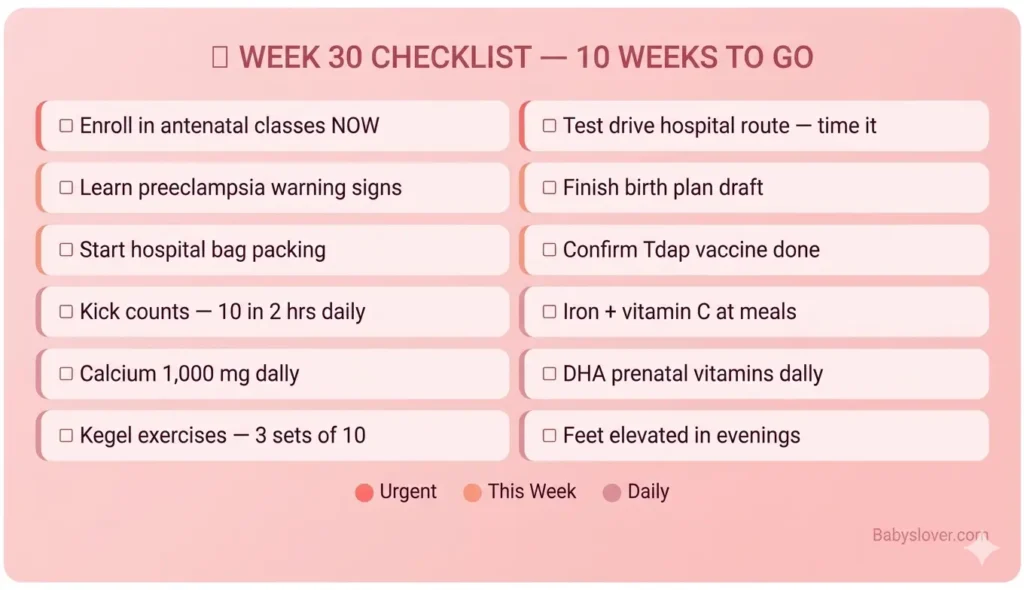
| Task | Priority |
| Enroll in antenatal/childbirth classes NOW (before Week 32) | URGENT |
| Do a test drive to the hospital — time the route | This week |
| Continue kick counts daily — 10 in 2 hours | Daily |
| Learn preeclampsia warning signs (share with partner) | This week |
| Start or continue birth plan — finish draft this week | This week |
| Start hospital bag — aim to pack fully by Week 36 | This week |
| Compression stockings daily if swelling is significant | Daily |
| Wrist splints at night if carpal tunnel symptoms present | As needed |
| Confirm Tdap vaccine is done | Confirm this week |
| Iron + vitamin C at meals daily | Daily |
| Calcium-rich foods daily — 1,000 mg goal | Daily |
| Prenatal vitamins with DHA — continue daily | Daily |
| Kegel exercises — 3 sets of 10 | Daily |
| Feet elevated in evenings to reduce swelling | Daily |
Follow our pregnancy week by week guide for every development from now to delivery.
Frequently Asked Questions — 30 Weeks Pregnant
What trimester is 30 weeks pregnant?
30 weeks pregnant is the third week of the third trimester. Third trimester runs from Week 28 through Week 40. You have approximately 10 weeks remaining until your due date.
How many months is 30 weeks pregnant?
At 30 weeks pregnant, you are approximately 7.5 months pregnant. Pregnancy spans approximately 9.5 calendar months — which is why ‘9 months pregnant’ slightly undercounts the full 40-week journey.
How much does a baby weigh at 30 weeks pregnant?
At 30 weeks pregnant, your baby weighs approximately 1.3–1.4 kg (around 3 lbs) and measures about 40 cm from head to heel — roughly the size of a large head of cabbage. From here, baby gains approximately 200–250 grams per week until birth.
Can a baby survive at 30 weeks?
Yes. Survival rates for babies born at 30 weeks are approximately 95–98% with NICU care. Lung development is advanced, though most 30-weekers require some respiratory support. Long-term outcomes are generally very good with appropriate care. Every additional week of gestation continues to improve outcomes.
What is the nesting instinct at 30 weeks pregnant?
Nesting instinct is the strong urge to clean, organize, and prepare the home that many women experience in the third trimester. It’s driven by hormonal and neurological changes as birth approaches — an evolutionary preparation behavior. It’s healthy and normal. The caution is to avoid physically risky tasks like climbing ladders, heavy lifting, or using harsh chemicals.
Is shortness of breath normal at 30 weeks pregnant?
Yes. Your diaphragm has been displaced upward by your growing uterus, reducing lung capacity. Shortness of breath during normal activity is very common from Week 28 onward. If shortness of breath is sudden, severe, comes with chest pain or palpitations, contact your provider immediately.
What causes carpal tunnel syndrome in pregnancy?
Pregnancy carpal tunnel is caused by fluid retention and swelling compressing the median nerve in the wrist. It affects up to 60% of pregnant women and is most common in the third trimester. Symptoms include numbness, tingling, and weakness in the thumb and first two fingers. Wrist splints worn at night help significantly. It almost always resolves after delivery.
Why are my dreams so vivid at 30 weeks pregnant?
Third trimester is peak time for vivid and disturbing pregnancy dreams, according to research published in BMC Pregnancy and Childbirth. The cause is a combination of disrupted sleep (lighter sleep means more dream recall), rising anxiety about birth, and hormonal shifts affecting REM sleep. They’re normal — talking through your fears with your partner can reduce their intensity.
Looking Ahead: 31 Weeks Pregnant
At 31 weeks pregnant, your baby passes the 1.5 kg mark, begins turning head-down in preparation for birth, and their brain continues its rapid folding phase. Sleep challenges intensify, but so does the nearness of everything you’ve been working toward.
Ten weeks. One test drive. One birth plan. You’re ready for all of it. Keep going.