

Eight weeks from now, you will be holding this baby. That sentence will land differently depending on where you are today. Excited, terrified, ready, not ready, all of the above at once. All of those responses are exactly right.
At 32 weeks pregnant, your baby’s skeleton is completely formed. Every bone is there. But every bone is also still soft and pliable – deliberately so. A rigid skull cannot travel through a birth canal. The flexibility built into your baby’s skeleton right now is not immaturity. It is engineering.
Your baby’s lungs are in their final development sprint. They are not done yet – but they are close. Practice breathing movements happen 30 to 40 percent of the time now. The body is rehearsing.
And if you have been feeling unusually forgetful lately – losing your keys, forgetting words mid-sentence, walking into rooms and having no idea why – there is a neurological explanation for that too. We will get into it.
Here is everything happening at 32 weeks pregnant.

Quick Summary: 32 Weeks Pregnant
| Detail | Info |
| Baby size | Pineapple or large cantaloupe – ~42 cm, ~1.7-1.8 kg (3.7-4 lbs) |
| Trimester | Third trimester – Week 5 of T3 |
| Months pregnant | 8 months pregnant |
| Weeks remaining | 8 weeks to go |
| Top milestone | Skeleton fully formed + lungs in final sprint |
| This week’s action | Get car seat installed + RSV vaccine if not done |
What’s Happening in Your Body at 32 Weeks Pregnant
At 32 weeks pregnant, you are gaining approximately half a pound per week – and about half of that is going directly to your baby. Your total weight gain at this point typically falls between 22 and 28 pounds, though this varies significantly and both lower and higher numbers can be entirely normal depending on your starting weight and your provider’s guidance.
Your uterus now extends roughly 5 inches above your belly button. The space inside you that was once roomy enough for your baby to do full somersaults is now tight. You will notice this in how movement feels – fewer sharp kicks, more rolling, stretching, and shifting of weight.
The pressure on every organ below your ribcage is significant. Your stomach is compressed, which is why small meals feel filling. Your bladder has almost no capacity. Your lungs have reduced room to expand. Your diaphragm is displaced. All of this is temporary – and all of it is making room for a human being who will be ready to meet you in eight weeks.
What to expect at your Week 32 appointment:
- Blood pressure and urine protein – preeclampsia monitoring continues
- Fundal height – should be approximately 30-34 cm
- Baby’s heartbeat
- Baby’s position – head-down, breech, or transverse
- Confirmation of Tdap and RSV vaccine status
- Discussion of Group B Strep (GBS) test – scheduled for Weeks 35-37
- Review of your birth plan if ready to share
- Kick count check-in
Baby Development at 32 Weeks Pregnant

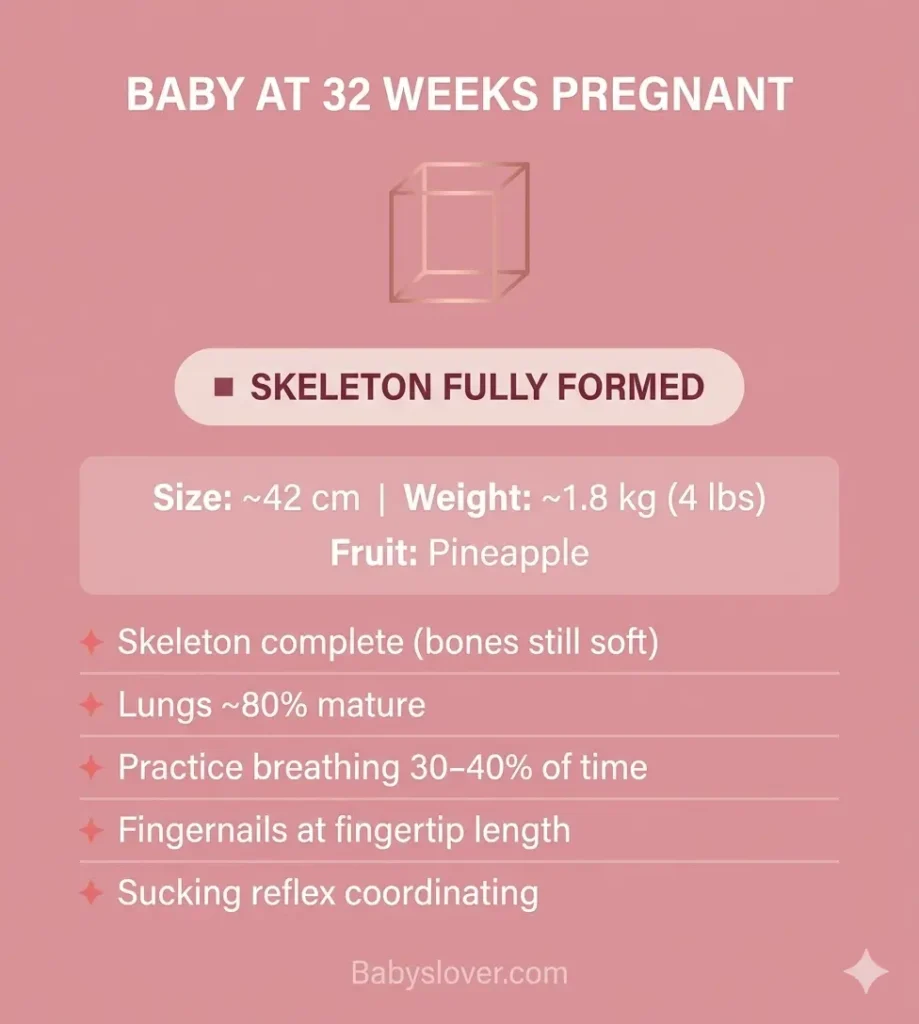
At 32 weeks pregnant, your baby measures approximately 42 cm from head to heel and weighs around 1.7 to 1.8 kg – roughly the size and weight of a pineapple or large cantaloupe.
| Detail | Measurement |
| Length | ~42 cm (about 16.5 inches) |
| Weight | ~1.7-1.8 kg (approx. 3.7-4 lbs) |
| Size comparison | Pineapple / large cantaloupe |
| Heart rate | 110-160 bpm |
| Practice breathing | Occurring 30-40% of the time now |
Key developments this week:
- Skeleton fully formed, deliberately soft: Every bone in your baby’s body is now present – but they are not yet hard. The skull is made of separate, flexible plates. The long bones are pliable. This is not a developmental stage to be passed through. It is the final condition your baby needs for birth. A fully hardened skull cannot compress to fit through the birth canal. Softness is the design.
- Lungs in final development sprint: Surfactant – the substance that prevents the lungs from collapsing between breaths – is now approximately 80 percent of what it will be at term. Practice breathing movements occur 30-40 percent of the time. The lungs are rehearsing a process they have never performed before.
- Fingernails reaching fingertips: Fingernails are now growing to the ends of the fingers. Some babies are born needing a trim within the first few days. Baby nail files (not clippers) are the safest tool in the first weeks.
- Skin smooth and opaque: The skin is no longer translucent. Fat underneath the skin has filled in enough that light no longer passes through. Your baby is beginning to look like the newborn you will meet.
- Sucking reflex strengthening: The sucking reflex – present since Week 28 – is becoming more coordinated and powerful. At birth, this reflex needs to be strong enough to create and maintain suction during feeding, whether breast or bottle.
- Immune antibody transfer accelerating: The transfer of maternal immunoglobulins across the placenta is at peak rate this week. Most of the passive immunity your baby carries at birth is transferred in the final 8-10 weeks of pregnancy – which means this week’s transfer is among the most impactful.
- Toenails at toe tips: Toenails are fully visible and reaching the tips of the toes. Your newborn may have toenails that curl slightly at birth – this is normal and resolves on its own.
Why Your Baby’s Bones Are Soft by Design
A common misconception about fetal bone development is that soft bones represent an incomplete stage. They do not.
Your baby’s skeleton is fully formed at 32 weeks. Every bone is present. But the process of ossification – the hardening of cartilage into bone – is intentionally incomplete at birth for one specific reason: the birth canal.
The narrowest part of the birth canal is roughly 10-11 cm. A fully ossified newborn skull would be too rigid to navigate this passage safely. The six plates that make up a newborn’s skull – held together by flexible seams called sutures – can overlap and compress during delivery, reducing the skull’s circumference by up to 1 cm. After birth, the plates spring back into position over the following days.
The fontanelles – the soft spots you feel on a newborn’s head – are not gaps where bone is missing. They are the meeting points of these flexible plates, left intentionally open for compression during birth and for rapid brain growth in the months that follow.
Full ossification of the skull doesn’t complete until early adulthood. The flexibility that seems like vulnerability is, in reality, precision engineering for one of the most physically demanding passages any human being will ever make.
The Lungs at 32 Weeks – How Close Are They?
Lung maturity at birth is one of the most critical factors in newborn survival. Here is exactly where things stand at 32 weeks pregnant.
| Week | Lung Development Status | Survival Without Surfactant |
| Week 24 | Surfactant production begins – minimal | Very poor without medical intervention |
| Week 28 | Surfactant at ~40% maturity | Possible with intensive NICU support |
| Week 32 | Surfactant at ~80% maturity – practice breathing 30-40% of time | Good – most 32-weekers breathe with some support |
| Week 34-35 | Surfactant at ~90% maturity | Very good – minimal support typically needed |
| Week 36-37 | Near full maturity | Excellent – most breathe independently |
| Week 39-40 | Full maturity | Optimal |
This is why each week from 28 to 36 makes such a measurable difference in outcomes. The lungs are not done at 32 weeks – but they are close enough that a baby born now has very good odds with the right support.
32 Weeks Pregnant Symptoms
Pregnancy Brain – The Neuroscience
If you have been forgetting words, misplacing things, or finding it harder to concentrate than usual, you are experiencing what is commonly called pregnancy brain – and there is real neuroscience behind it.
Research published in Nature Neuroscience found that the hippocampus – the brain region responsible for memory formation and spatial navigation – physically decreases in gray matter volume during pregnancy, particularly in the third trimester. The reduction is measurable on MRI. It is not imagination.
The changes are selective. The areas most affected are linked to social cognition – the ability to read others’ emotions, understand social cues, and respond to a dependent person’s needs. Researchers believe this is an adaptive change, not a deficit. Your brain is reorganizing its priorities toward parenting.
The good news: the changes are temporary. Studies show full recovery of hippocampal volume within two years of delivery in most women. Your memory will come back. Your keys, however, you may need to keep in one designated spot.
Vaginal Discharge Increasing – Normal vs. Concerning
A noticeable increase in vaginal discharge is very common at 32 weeks pregnant. This is called leukorrhea – a milky white or clear, mild-smelling discharge that increases as your body produces more cervical mucus in preparation for labor.
| Discharge Type | What It Looks Like | What to Do |
| Leukorrhea (normal) | Milky white or clear, thin, mild smell | Normal – wear a panty liner if preferred |
| Yeast infection | Thick, white, cottage cheese texture, itching | Call your provider – treatable safely in pregnancy |
| Bacterial vaginosis | Gray or yellow, fishy odor | Call your provider – requires treatment |
| Amniotic fluid leaking | Watery, colorless, continuous trickle or gush, no smell or sweet smell | Call provider immediately or go to hospital |
| Bloody show | Pink or brown tinged mucus, possibly with mucus plug | Note the time and call your provider |
| Bright red bleeding | Fresh blood, significant amount | Emergency – go to hospital immediately |
The key distinction to know at 32 weeks: if you are unsure whether fluid is discharge or amniotic fluid, put on a clean pad and lie down for 30 minutes. If the pad is wet when you stand up, the fluid may be amniotic. Call your provider. Do not wait until morning.
Heightened Braxton Hicks
Braxton Hicks contractions at Week 32 can be frequent enough to be alarming – particularly if you are active, dehydrated, or on your feet for extended periods. They are almost always irregular, front-only, and stop with position change or hydration.
Real preterm labor contractions at 32 weeks come in a regular pattern, intensify over time, and do not stop with rest or water. Any contraction pattern that is regular, becomes more frequent, or is accompanied by pelvic pressure, back pain, or discharge changes should prompt a call to your provider.
Insomnia and Sleep Fragmentation
At 32 weeks pregnant, sleeping through the night is essentially impossible for most women. The combination of physical discomfort, heartburn, bathroom trips, leg cramps, baby movement, anxiety, and an enormous belly means that 6-7 hours of total sleep is now achieved in fragments.
The advice most guides give – ‘sleep on your left side, use a body pillow’ – is correct but incomplete. Here is what else helps:
- Accept fragmented sleep rather than fighting it – lying awake in frustration adds cortisol that makes sleep harder
- Get out of bed if you have been awake for more than 20 minutes – do something quiet and return when sleepy
- A cold, dark room matters more than usual when your body runs warmer in T3
- Audiobooks or podcasts at low volume can distract an anxious mind back toward sleep
- The second trimester sleep quality you are mourning will return – eventually
Gum Sensitivity and Pregnancy Gingivitis
Progesterone causes increased blood flow to the gums, making them more sensitive, more prone to swelling, and more likely to bleed during brushing in the third trimester. This is called pregnancy gingivitis and it affects up to 75% of pregnant women.
If you haven’t had a dental checkup during your pregnancy, Week 32 is a good time. Untreated gum disease has been associated with preterm labor and low birth weight in multiple studies. Dental work – including x-rays with appropriate shielding – is safe throughout pregnancy.
Switch to a soft-bristled toothbrush, brush gently twice daily, floss daily, and rinse with warm salt water if gums are inflamed. Symptoms typically resolve within weeks of delivery.
The RSV Vaccine – A New Recommendation You Need to Know
The CDC now recommends a maternal RSV vaccine – Abrysvo – between Weeks 32 and 36 of pregnancy. This is a relatively new recommendation that many pregnant women and even some providers are not yet fully aware of.
RSV (Respiratory Syncytial Virus) is the leading cause of hospitalization in infants under 12 months in the United States. In the first weeks of life, before your baby’s immune system is developed, RSV can cause severe bronchiolitis and respiratory distress.
| Question | Answer |
| What is Abrysvo? | A maternal RSV vaccine that works the same way as Tdap – antibodies transfer across the placenta to protect your newborn |
| When to get it | Weeks 32-36 of pregnancy – earlier in this window provides more time for antibody transfer |
| Who needs it | All pregnant women – every pregnancy, just like Tdap |
| Is it safe? | FDA-approved 2023. Clinical trials showed no increased risk of preterm birth at correct timing. Given after Week 32 to reduce preterm birth signal seen at earlier timing. |
| Does it replace infant RSV shots? | No – but it provides critical bridge protection in the first months before infant vaccines are given |
| Cost | Typically covered by insurance with ACA-compliant plans – confirm with your provider |
If you are already at Week 32 or beyond and haven’t had this vaccine, bring it up at your next appointment. Week 32 is actually the ideal time to get it.
Car Seat Installation – Why Week 32 Is the Right Time
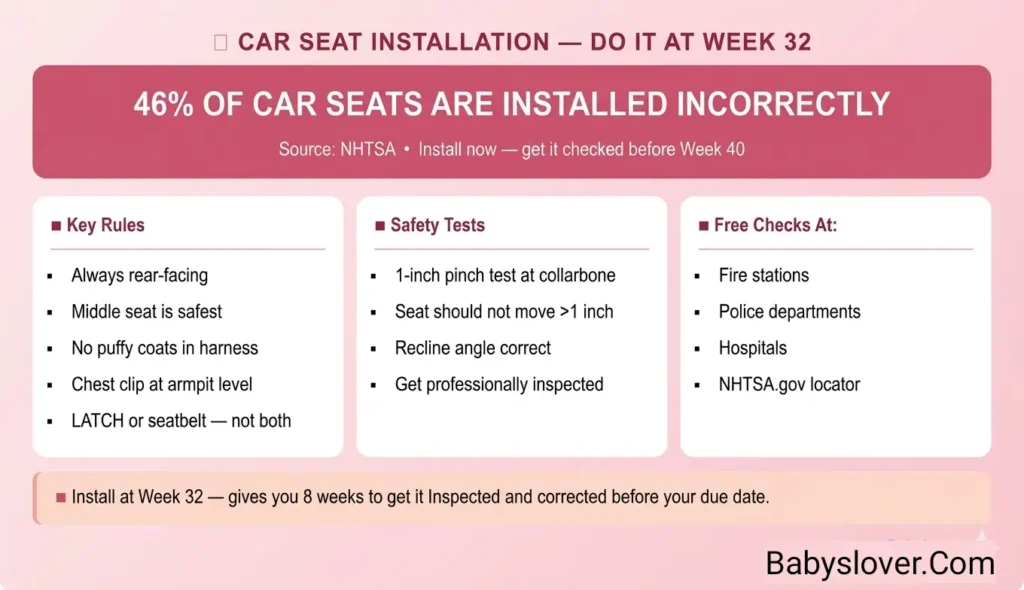
Statistics from the NHTSA show that approximately 46% of car seats are installed incorrectly. Of those incorrect installations, the most common errors are using the wrong recline angle, using both the LATCH system and the seatbelt simultaneously, and installing too loosely.
Week 32 gives you 8 weeks to get this right before it matters. Installing now – rather than rushing in the hospital parking lot at the end of labor – gives you time to:
- Attend a free inspection at a certified child passenger safety technician station
- Re-read the manual if anything is unclear (yes, actually read it)
- Practice removing and reinstalling it – you will need to remove it every time you take baby out of the car
- Adjust if your vehicle is unusual or the first installation is wrong
Car seat basics that every parent at 32 weeks pregnant should know:
| Rule | Detail |
| Rear-facing always | Newborns must be rear-facing. Keep baby rear-facing until they reach the seat’s maximum rear-facing weight/height limit – not just their first birthday. |
| Middle seat is safest | The center rear seat is the furthest from any impact point in a crash. Use it when possible. |
| No coat in the car seat | Puffy coats create dangerous slack in harness straps. Use thin layers and drape a blanket over the harness. |
| 1-inch pinch test | After buckling, try to pinch the harness strap at the collarbone. If you can pinch fabric, tighten more. |
| Chest clip at armpit level | The chest clip holds the harness in place – it belongs at armpit height, not on the stomach. |
| LATCH OR seatbelt, not both | Use one attachment method. Using both simultaneously can actually be unsafe in some configurations. |
Free car seat checks are available at many fire stations, police departments, and hospitals. The NHTSA website has a locator tool to find the nearest certified inspection station.
Group B Strep – What to Expect at Week 35-37
At your appointment around Weeks 35-37, your provider will perform a Group B Streptococcus (GBS) swab test. This is worth knowing about now so it doesn’t catch you off guard.
GBS is a type of bacteria that lives in the digestive and lower reproductive tract of approximately 25% of healthy adults. It causes no symptoms and is not a sexually transmitted infection. Carrying GBS is not a health problem – but passing it to a newborn during vaginal delivery can cause serious infection in the baby.
| Question | Answer |
| How is it tested? | A simple swab of the vagina and rectum – takes seconds, no discomfort |
| If GBS positive? | You will receive IV antibiotics during labor – this effectively eliminates transmission risk |
| If GBS negative? | No action needed |
| Does it affect birth plan? | GBS-positive mothers need to arrive at the hospital early enough to receive at least 4 hours of antibiotics before delivery |
| Is it permanent? | No – GBS status can change between pregnancies. It is tested every pregnancy. |
| Risk if untreated? | Without antibiotics, GBS-positive mothers have roughly a 1 in 200 chance of passing it to the baby. With antibiotics, the risk drops to approximately 1 in 4,000. |
You don’t need to do anything about GBS right now. But knowing it’s coming means you won’t be alarmed by the swab and you’ll understand exactly what a positive result means – and doesn’t mean.
Nutrition at 32 Weeks Pregnant
| Nutrient | Why It Matters at Week 32 | Best Sources |
| Iron | Passive immunity transfer requires peak blood volume – iron deficiency causes fatigue and affects oxygen delivery to baby | Red meat, lentils, fortified cereals, spinach + vitamin C to boost absorption |
| Calcium + Vitamin D | Ossification continues – baby pulls calcium from your bones. Vitamin D essential for calcium absorption. | Dairy, fortified milks, sardines, eggs, sunlight, supplements if needed |
| DHA (Omega-3) | Brain folding and neural connection density still increasing | Salmon, sardines, eggs, prenatal vitamins with DHA |
| Protein | Baby gaining ~200-250g per week – mostly fat and muscle | Chicken, eggs, Greek yogurt, legumes, cottage cheese |
| Fiber + Water | Constipation intensifies in final weeks – prevention is much easier than treatment | Oats, prunes, beans, fruits, 8-10 glasses water daily |
| Choline | Brain development – 90% of women are deficient, yet it is as critical as folic acid | 2 eggs daily, beef liver, chicken, soybeans |
Appetite may be declining as your stomach becomes more compressed. Small, nutrient-dense meals every 2-3 hours work better than three large ones at this stage.
Partner Tips for Week 32
- Install the car seat this week – get it checked by a certified technician if possible
- Get the RSV vaccine yourself – while the maternal vaccine protects the baby from birth, cocooning with vaccinated caregivers adds another layer
- Handle all tasks that require bending, crouching, reaching, or physical strain – her center of gravity is fully shifted
- Take the hospital bag completely seriously now – it should be fully packed by Week 36, which is only 4 weeks away
- If she mentions ‘pregnancy brain’ moments, respond with patience – the neuroscience is real and so is the frustration
- Research pediatricians this week if you haven’t – you will want one selected before birth, and some practices have wait lists
- Have the cord blood banking conversation now if you haven’t made a decision – Week 32 is the practical last window
Week 32 Checklist
| Task | Priority |
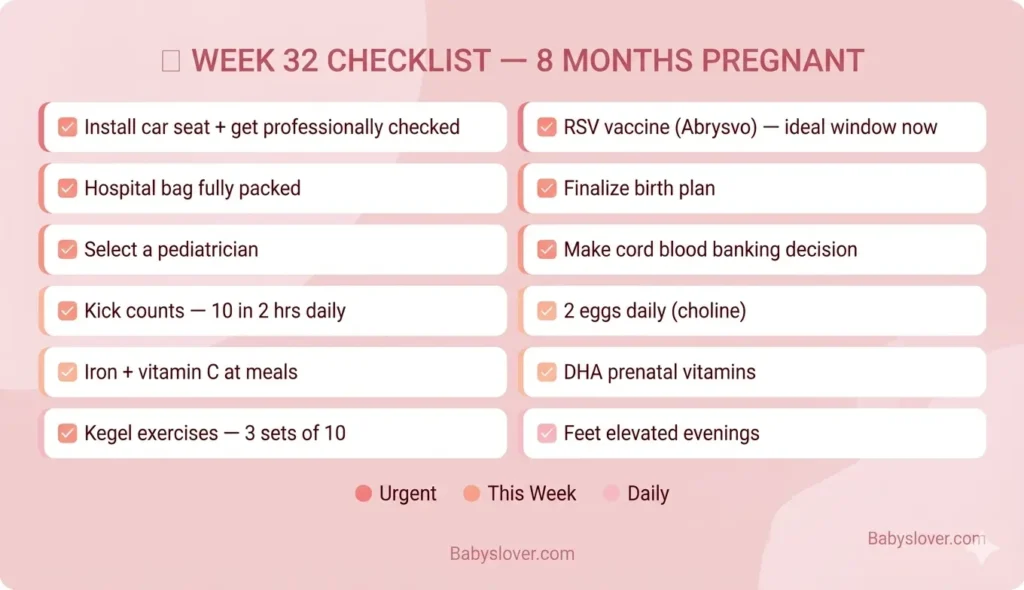
| Install car seat and get it professionally checked | URGENT – do this week |
| Get RSV vaccine (Abrysvo) if not done – ideal window is Weeks 32-36 | URGENT if not done |
| Hospital bag: aim for fully packed by this week | This week |
| Continue kick counts – 10 movements in 2 hours, daily | Daily |
| Ask provider about baby’s position at next appointment | Next appointment |
| Finalize birth plan this week | This week |
| Select a pediatrician – some have waitlists | This week |
| Have cord blood banking decision made | This week |
| Know GBS test is coming at Week 35-37 | Awareness |
| Dental checkup if not done during pregnancy | This week |
| Iron + vitamin C at every meal | Daily |
| 2 eggs daily for choline | Daily |
| DHA prenatal vitamins | Daily |
| Kegel exercises – 3 sets of 10 | Daily |
| Feet elevated evenings | Daily |
Frequently Asked Questions – 32 Weeks Pregnant
What trimester is 32 weeks pregnant?
32 weeks pregnant is the fifth week of the third trimester. Third trimester runs from Week 28 through Week 40. You have approximately 8 weeks remaining until your due date.
How many months is 32 weeks pregnant?
At 32 weeks pregnant, you are 8 months pregnant. The full 40-week pregnancy spans approximately 9.5 calendar months – which is why the common shorthand of ‘9 months’ slightly undercounts the full journey.
How much does a baby weigh at 32 weeks pregnant?
At 32 weeks pregnant, your baby weighs approximately 1.7 to 1.8 kg (about 3.7 to 4 lbs) and measures roughly 42 cm from head to heel – about the size of a pineapple or large cantaloupe. From here, baby gains approximately 200-250 grams per week until birth.
Can a baby survive at 32 weeks?
Yes. Survival rates for babies born at 32 weeks with NICU care are approximately 95-98%. Lungs are well enough developed that most 32-weekers breathe with some medical support, and long-term outcomes are generally very good. A large French study following premature babies born between 32 and 34 weeks found that approximately 1% developed cerebral palsy, and the vast majority had no significant long-term complications.
Is pregnancy brain real?
Yes – pregnancy brain is neurologically real. Research published in Nature Neuroscience showed measurable reductions in gray matter volume in the hippocampus during pregnancy, particularly in the third trimester. The changes are concentrated in areas linked to social cognition, which researchers believe is an adaptive preparation for parenting. Full recovery of hippocampal volume occurs within approximately two years of delivery in most women.
What is the RSV vaccine in pregnancy?
Abrysvo is an RSV vaccine approved by the FDA in 2023 and recommended by the CDC between Weeks 32 and 36 of pregnancy. It works the same way as the Tdap vaccine – producing antibodies that transfer across the placenta to protect your newborn from RSV (a leading cause of infant hospitalization) before they can be vaccinated themselves. It is given specifically after Week 32 because earlier timing showed a small signal of increased preterm birth risk.
When should I install my infant car seat?
Week 32 is the ideal time to install your infant car seat. This gives you 8 weeks before your due date to get it inspected by a certified child passenger safety technician, correct any errors, and practice reinstalling it. Approximately 46% of car seats are installed incorrectly. Free inspection stations are available at many fire stations, hospitals, and police departments – find one at the NHTSA website.
What is the Group B Strep test in pregnancy?
The Group B Streptococcus (GBS) swab test is performed at Weeks 35-37. It is a simple swab of the vagina and rectum that checks whether you carry GBS bacteria. Approximately 25% of healthy women carry GBS with no symptoms. If positive, you receive IV antibiotics during labor, which reduces the risk of passing GBS to your baby from about 1 in 200 to approximately 1 in 4,000.
How do I tell the difference between discharge and amniotic fluid?
Amniotic fluid is typically watery, colorless, and continuous – it does not stop. Discharge is thicker. If you are unsure, put on a clean pad and lie down for 30 minutes. If the pad is wet when you stand up, or if you feel a continuous trickle that does not stop, contact your provider or go to the hospital. Ruptured membranes at 32 weeks require immediate medical evaluation.
Looking Ahead: 33 Weeks Pregnant
At 33 weeks pregnant, your baby’s skull bones are continuing to harden, the immune system is receiving its final major antibody transfers, and the lungs are approaching full maturity. The last stretch of the third trimester is a week of increasing readiness – on both sides of the uterine wall.
Eight weeks. A fully formed skeleton. Lungs almost ready for their first breath. Keep going.
Follow our pregnancy week by week guide for every development from now to delivery