

If you have been playing music near your belly this pregnancy, something specific is happening in your baby’s brain right now.
A study published in PLoS ONE found that babies exposed to specific melodies in the womb showed measurable neural recognition of those melodies after birth – a response not seen in babies who had not heard them before delivery. At 34 weeks pregnant, your baby’s auditory cortex has enough neural density that these patterns are being encoded. The songs your baby hears now are being filed away.
Your baby’s skin is also being prepared for the outside world in a way that most pregnancy guides reduce to a single sentence. The vernix caseosa – the waxy coating that has been on your baby’s skin since around Week 20 – is thickening this week. That thickening is not incidental. It is the body completing a coating that serves three distinct functions simultaneously: thermal insulation at birth, passive immune protection, and physical lubrication for delivery.
And the amniotic fluid that has surrounded and protected your baby through this entire pregnancy has just reached its peak volume. From here, it gradually declines – making room for the baby who is almost ready to be born.
Six weeks from your due date. Here is everything happening at 34 weeks pregnant.

Quick Summary: 34 Weeks Pregnant
| Detail | Info |
| Baby size | Cantaloupe – ~45 cm, ~2.1-2.3 kg (4.7-5 lbs) |
| Trimester | Third trimester – Week 7 of T3 |
| Months pregnant | 8 months pregnant |
| Weeks remaining | 6 weeks to go |
| Top milestone | Amniotic fluid at peak + vernix thickening + music neural encoding |
| This week’s action | Start perineal massage + confirm GBS test timing with provider |
What’s Happening in Your Body at 34 Weeks Pregnant

At 34 weeks pregnant, your uterus sits approximately 5.5 inches above your belly button – the highest point it will reach. From here, as your baby begins descending toward the birth canal, the uterus may actually shift lower over the coming weeks. This descent – called lightening or engagement – will come with welcome relief for your diaphragm and stomach, though it brings a new level of pelvic pressure.
Amniotic fluid volume is at its lifetime maximum right now. The typical volume at 34 weeks is approximately 800 mL. From here, it begins a slow, gradual decline that continues until delivery. This is why movement starts to feel different – less padded, more direct. Elbows and heels pressing against your skin become increasingly visible from outside.
Your body is now gaining roughly half a pound per week – and approximately half of that goes directly to your baby. Every calorie you eat at this stage is doing meaningful work. Small, frequent, nutrient-dense meals are more effective than large ones given your compressed stomach capacity.
What to expect at your Week 34 appointment:
- Blood pressure and urine protein – preeclampsia monitoring
- Fundal height – should be approximately 32-36 cm
- Baby’s heartbeat
- Baby’s position – by Week 34, roughly 90-95% of babies are head-down
- Confirmation of vaccine status – Tdap and RSV
- Biophysical profile (BPP) if high-risk or ordered by your provider
- Reminder that GBS test is coming at Weeks 35-37
- Discussion of signs of labor – what to watch for in the coming weeks
Baby Development at 34 Weeks Pregnant

At 34 weeks pregnant, your baby measures approximately 45 cm from head to heel and weighs around 2.1 to 2.3 kg – roughly the size and weight of a cantaloupe.
| Detail | Measurement |
| Length | ~45 cm (about 17.7 inches) |
| Weight | ~2.1-2.3 kg (approx. 4.7-5 lbs) |
| Size comparison | Cantaloupe |
| Heart rate | 110-160 bpm |
| CNS status | Central nervous system fully mature this week |
Key developments this week:
- Central nervous system fully mature: The CNS – the brain and spinal cord – has completed its major development. Every major neural pathway is formed. This is a significant milestone: the system that will govern breathing, heart rate, temperature regulation, reflexes, and all conscious experience is fully assembled. What continues from here is refinement and myelination, not new construction.
- Vernix caseosa thickening: The waxy coating on your baby’s skin is reaching its maximum thickness. Research published in the Journal of Obstetrics and Gynaecology Research describes vernix as providing three simultaneous functions: thermal insulation for the temperature transition at birth, innate immune properties including antibacterial proteins, and mechanical lubrication during passage through the birth canal. Babies born at term may have traces on their skin – this vernix is beneficial and there is no need to wash it off immediately.
- Music neural encoding: Your baby’s auditory cortex has the neural density to encode and store specific sound patterns. Research shows that melodies heard in the final trimester can be recognized and responded to after birth. Songs you play now may genuinely calm your newborn in those early weeks.
- Boy babies: testicles fully descended: In male babies, the testicles have typically fully descended from the abdomen into the scrotum by Week 34. This is noted in the newborn examination – undescended testicles at birth in full-term babies prompt follow-up monitoring.
- Amniotic fluid at peak: Your baby is floating in the maximum fluid volume of the entire pregnancy. From this point, fluid begins its gradual decline – making room for the growing baby and, ultimately, for birth.
- Fingernails at fingertip length: Fingernails have grown to the ends of the fingers. Some babies are born needing a trim within the first week. Baby nail files – not clippers – are safest in the newborn period.
- Breathing movements regular: Practice breathing is now happening frequently and rhythmically. The diaphragm contracts, amniotic fluid moves in and out of the lungs, and the muscles needed for breathing after birth are being exercised. Babies born at 34 weeks today typically breathe with minimal medical support.
- Survival without extensive intervention: The American Academy of Pediatrics notes that babies born at 34 weeks typically survive outside the womb without extensive medical intervention. This is a meaningful threshold. While every additional week improves outcomes, Week 34 marks a point of genuine respiratory readiness.
The Vernix Caseosa at 34 Weeks – Three Functions Most Guides Miss
The vernix caseosa gets a sentence in most pregnancy guides: ‘a waxy coating protects your baby’s skin.’ That sentence is accurate but leaves out almost everything important about what vernix actually does.
Research published in the Journal of Obstetrics and Gynaecology Research identified three distinct biological functions of vernix at peak thickness – which is exactly where your baby is right now at 34 weeks pregnant:
| Function | What It Does | Why It Matters |
| Thermal insulation | Creates a barrier that reduces heat loss at birth – the transition from 37C womb to room temperature is significant | Helps baby maintain body temperature before skin-to-skin contact and warming measures |
| Innate immunity | Contains proteins including lysozyme, lactoferrin, and defensins – natural antibacterial agents | Provides passive immune protection at the moment of birth, before your newborn has any active immunity |
| Delivery lubrication | Reduces friction during passage through the birth canal | Protects baby’s skin from abrasion during labor and delivery |
This is why the WHO and most maternal care guidelines recommend delayed bathing for newborns – the vernix that remains on the skin after birth continues to perform these functions for hours to days. There is no benefit to washing it off immediately, and there is real benefit to leaving it in place.
Babies born earlier, before vernix reaches peak thickness, miss some of this protection. Term babies born at 39-40 weeks may have very little vernix remaining – it has been absorbed back into the amniotic fluid. The babies with the most visible vernix at birth are often those born just slightly early – at 34-37 weeks.
Music, Memory, and Your Baby at 34 Weeks
A 2013 study published in PLoS ONE by Partanen and colleagues followed babies whose mothers had played a specific short melody during pregnancy. After birth, these babies showed measurably stronger neural responses to the familiar melody than to unfamiliar control melodies. The response was not seen in control babies who had not been exposed to the melody in utero.
What this means practically: the music and voices your baby is regularly exposed to at 34 weeks pregnant are being encoded in the auditory cortex as familiar patterns. This encoding appears to persist beyond birth.
Parents have described playing a particular song throughout late pregnancy and finding it consistently calming for their newborn in those first chaotic weeks. While this is anecdotal, the neural basis for it appears to be real. The playlist you create at 34 weeks may genuinely be doing something useful.
Your voice is the single most important sound in this encoding. It has been the dominant, consistent auditory input for your baby’s entire prenatal experience. Research consistently shows that newborns distinguish their mother’s voice from other female voices within hours of birth – a recognition that begins with exactly this kind of prenatal encoding.
Talk to your baby. Read aloud. Sing, even off-key. The neural architecture being built at 34 weeks pregnant will carry this forward.
34 Weeks Pregnant Symptoms
Lightning Crotch – What It Is and Why It Happens
If you have experienced sudden, sharp, electric-feeling pain shooting through your pelvis, vagina, or inner thighs – lasting a second or two before vanishing completely – you have experienced lightning crotch. It is one of the most startling symptoms of late pregnancy, and most guides barely explain it.
The cause is direct nerve compression or stimulation. As your baby descends lower into the pelvis at 34 weeks pregnant, their head, shoulders, or limbs occasionally press against or brush the pudendal nerve or other pelvic nerves. The resulting sensation is exactly what you would expect from a nerve being suddenly compressed: a sharp, electric jolt that disappears the moment the pressure changes.
Lightning crotch is not dangerous and does not indicate labor. It is simply an increasingly baby-in-the-pelvis phenomenon. It tends to happen more during activity and may intensify as engagement progresses over the coming weeks.
When to call your provider: if the pain is prolonged (lasting more than a few seconds), rhythmic, or accompanied by bleeding or fluid, contact your provider. Transient sharp pelvic pain with no other symptoms is lightning crotch. Prolonged pain is something different.
Blurry Vision
Visual changes in the third trimester are common and usually benign. The causes include fluid retention affecting the shape and thickness of the cornea, hormonal effects on lens flexibility, and sleep deprivation impairing visual processing.
Most visual blurriness at 34 weeks pregnant is temporary, position-dependent, and improves after delivery as fluid levels normalize. However – and this is important – vision changes are also a symptom of preeclampsia.
| Vision Symptom | Likely Cause | What to Do |
| Mild blurriness, comes and goes | Fluid retention changing corneal shape – normal | Rest, stay hydrated, mention at next appointment |
| Blurry vision with headache + swelling | Possible preeclampsia signal | Call provider today – do not wait |
| Seeing spots, flashing lights, or aura | Possible preeclampsia – visual cortex involvement | Call provider immediately – this is urgent |
| Sudden vision loss in one or both eyes | Rare but serious – requires immediate evaluation | Go to hospital immediately |
| Difficulty with contact lens comfort | Corneal shape changes from fluid retention | Switch to glasses temporarily – resolves after birth |
Pelvic Pressure and Engagement
As your baby moves into a head-down position and descends toward the birth canal, pelvic pressure increases substantially. The sensation of carrying a heavy weight low in the pelvis – sometimes described as feeling like the baby might fall out – is normal and reflects the baby’s head engaging with the pelvic inlet.
Engagement relieves upper-body pressure – breathing becomes easier, heartburn may improve. But it intensifies everything below the belly button: increased frequency of urination, heightened pelvic pressure, and more lightning crotch episodes.
Not all babies engage before labor begins. First-time mothers tend to engage earlier (sometimes 2-4 weeks before delivery). Subsequent pregnancies often see the baby engage only when labor begins. Neither pattern is abnormal.
Shortness of Breath Improving
If your baby has dropped into the pelvis, you may notice a surprising improvement in your ability to breathe. Your diaphragm, which has been pushed up and compressed for weeks, suddenly has more room to move. Taking a full breath feels possible again.
This improvement – if it happens – typically occurs 2-4 weeks before labor for first-time mothers. It is one of the more welcome symptoms of late pregnancy. Enjoy it. The pelvic pressure that replaces it is a fair trade for being able to breathe.
Swollen Belly Button
By 34 weeks pregnant, an innie belly button may have become an outie – pushed out from the inside by the growing uterus. This is entirely normal and almost universally temporary. It typically retracts back after delivery, though it may not sit exactly as it did before pregnancy.
The skin around the belly button may also be more sensitive or itchy as it stretches. Unscented moisturizer helps with the itching. If the belly button area becomes red, swollen beyond normal stretch, or develops any discharge, mention it to your provider.
Perineal Massage – Why Week 34 Is When to Start
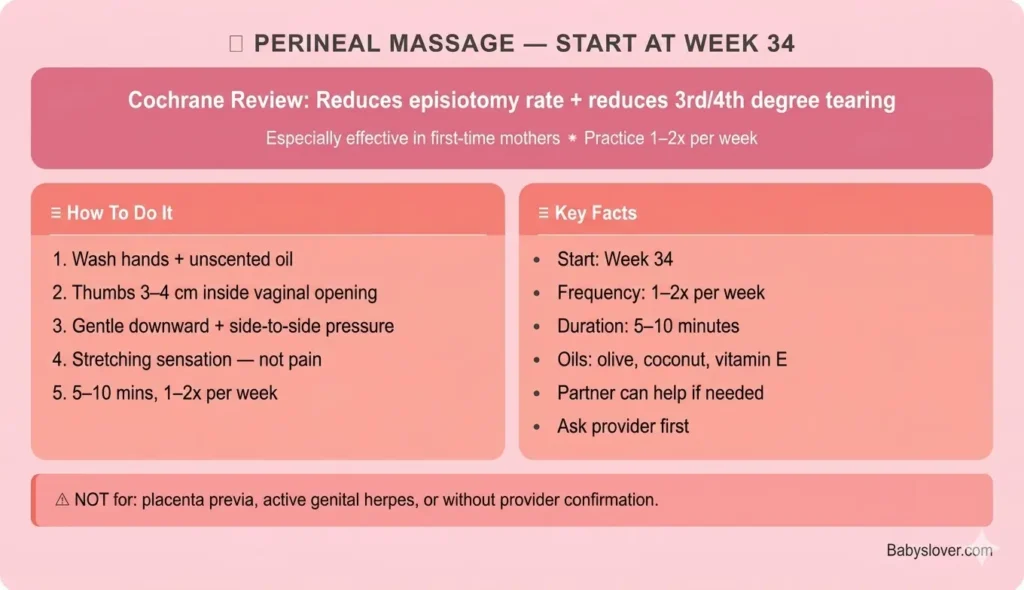
The American Pregnancy Association and most obstetric guidelines recommend beginning perineal massage at 34 weeks pregnant – specifically because it needs several weeks of consistent practice to produce its benefits before delivery.
The perineum is the tissue between the vaginal opening and the anus. During delivery, this tissue stretches significantly – and tears are common. Perineal massage does not guarantee a tear-free delivery, but research shows it can reduce the likelihood of severe tearing and episiotomy, particularly in first-time mothers.
What the research shows:
- A Cochrane Review (15 trials, 2,800+ women) found perineal massage in the final weeks of pregnancy reduced the rate of episiotomy in first-time mothers
- It also reduced the rate of third and fourth-degree tears
- Most benefit is seen when started at Weeks 34-36 and practiced 1-2 times per week
How to do it – the basics:
- Wash hands thoroughly. Use an unscented oil – olive oil, coconut oil, or vitamin E oil are commonly used
- Insert both thumbs about 3-4 cm into the vaginal opening
- Apply gentle downward and side-to-side pressure for 1-2 minutes
- The goal is a stretching sensation – not pain. If it is painful, reduce pressure
- Practice for 5-10 minutes, 1-2 times per week from Week 34 until delivery
Your partner can help with this if the position is difficult at this stage of pregnancy. Ask your provider for specific guidance at your next appointment – they can demonstrate correct technique and confirm this is appropriate for your specific situation.
Perineal massage is not recommended if you have placenta previa, active genital herpes, or certain other conditions. Confirm with your provider before starting.
Nutrition at 34 Weeks Pregnant
| Nutrient | Why It Matters at Week 34 | Daily Target and Best Sources |
| Protein | Baby gaining 200-250g of fat and muscle weekly – you need ~71g/day | Chicken, eggs, Greek yogurt, lentils, cottage cheese, fish |
| Iron | Baby’s liver iron stores being completed – your blood volume at peak | Red meat, lentils, spinach + vitamin C; supplement if provider recommends |
| DHA (Omega-3) | CNS maturation ongoing – myelination continuing | Salmon, sardines, eggs, prenatal vitamins with DHA |
| Calcium | Vernix production + bone hardening both require adequate calcium | Dairy, fortified plant milks, sardines with bones, almonds |
| Choline | Auditory cortex neural encoding – DHA and choline both required for dense neural connections | 2 eggs daily, beef liver, chicken, soybeans |
| Fiber + Water | Constipation at its worst in T3 – prevention critical for hemorrhoid management | Prunes, oats, beans, vegetables + 8-10 glasses water daily |
Appetite remains compressed. High-protein, high-nutrient snacks between small meals are more effective than trying to eat large volumes at once. A protein shake or Greek yogurt with fruit can bridge nutritional gaps when cooking feels impossible.
Partner Tips for Week 34
- Start perineal massage this week if she is comfortable with your help – ask her provider for guidance first
- The GBS test is coming at Week 35-37 – she may not need to do anything differently, but knowing what it is helps reduce anxiety when it happens
- Know that lightning crotch is real and completely unpredictable – a sudden gasp or stopped movement in public is almost always this
- Play music near her belly together – this is one of the most meaningful and neurologically real things you can do this week
- The hospital bag should be fully packed and near the door – not ‘mostly done’
- At the next appointment, ask about baby’s position – head-down confirmation is reassuring for everyone
- If she mentions blurry vision, headache, or swelling together – take it seriously and contact the provider
34 Weeks Pregnant Checklist
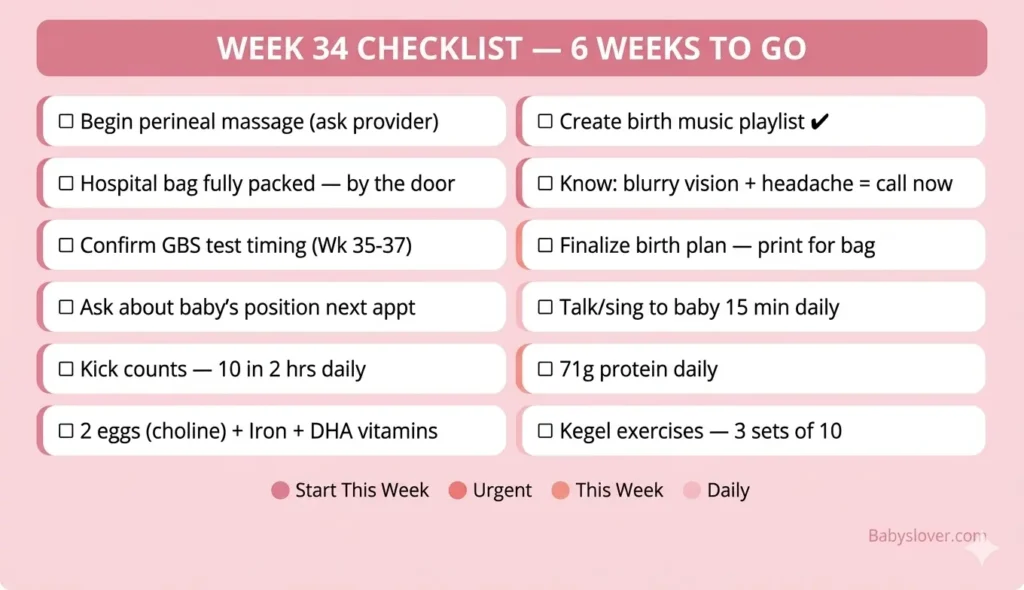
| Task | Priority |
| Start perineal massage – ask provider for confirmation first | Start this week |
| Confirm GBS test timing with your provider (Weeks 35-37) | This week |
| Hospital bag fully packed and by the door – not in progress | URGENT |
| Continue kick counts – 10 movements in 2 hours, daily | Daily |
| Know blurry vision + headache + swelling = call provider immediately | Know this now |
| Create a birth music playlist – plays at hospital and at home | This week – fun! |
| Baby’s position – ask at next appointment (90% are head-down by now) | Next appointment |
| Confirm birth plan is finalized and printed for hospital bag | This week |
| Talk or sing to your baby for at least 15 minutes – neural encoding is real | Daily |
| Protein: 71g daily goal – Greek yogurt, eggs, chicken at each meal | Daily |
| Iron + vitamin C at meals | Daily |
| 2 eggs daily for choline | Daily |
| DHA prenatal vitamins | Daily |
| Kegel exercises – 3 sets of 10 | Daily |
| Feet elevated evenings | Daily |
Frequently Asked Questions – 34 Weeks Pregnant
What trimester is 34 weeks pregnant?
34 weeks pregnant is the seventh week of the third trimester. Third trimester runs from Week 28 through Week 40. You have approximately 6 weeks remaining until your due date.
How many months is 34 weeks pregnant?
At 34 weeks pregnant, you are 8 months pregnant – approaching the end of your eighth month. Full-term pregnancy is 40 weeks, or approximately 9.5 calendar months.
How much does a baby weigh at 34 weeks pregnant?
At 34 weeks pregnant, your baby weighs approximately 2.1 to 2.3 kg (about 4.7 to 5 lbs) and measures around 45 cm from head to heel – roughly the size of a cantaloupe. Baby continues gaining approximately 200-250 grams per week until birth.
Can a baby survive at 34 weeks?
Yes – and the American Academy of Pediatrics specifically notes that babies born at 34 weeks typically survive without extensive medical intervention. Lungs are well-developed, the central nervous system is fully mature, and most 34-weekers breathe with minimal support. Short-term NICU support may still be needed, and outcomes continue to improve with every additional week of gestation.
What is lightning crotch?
Lightning crotch is a sudden, sharp, electric-feeling pain in the pelvis, vagina, or inner thighs that lasts only a second or two before disappearing. It is caused by the baby’s head, shoulders, or limbs pressing against pelvic nerves – particularly the pudendal nerve – as the baby descends into the pelvis. It is not dangerous and does not indicate labor. It tends to increase in frequency as engagement progresses. If the pain is prolonged, rhythmic, or accompanied by bleeding or fluid, contact your provider.
Is it safe to do perineal massage at 34 weeks?
For most uncomplicated pregnancies, yes – Week 34 is specifically when most providers recommend starting perineal massage. Research shows it reduces the rate of episiotomy and severe tearing in first-time mothers when practiced 1-2 times weekly from Weeks 34-36 until delivery. It is not recommended if you have placenta previa, active genital herpes, or certain other conditions – confirm with your provider before starting.
Does prenatal music exposure actually help newborns?
Research published in PLoS ONE showed that babies exposed to specific melodies in the womb showed measurable neural recognition of those melodies after birth – a response not present in unexposed control babies. The effect is attributed to the auditory cortex encoding familiar sound patterns during late pregnancy. Practically, songs played regularly from Week 34 onward may genuinely be recognized and responded to by your newborn. Your voice carries the strongest effect – consistent talking, reading, and singing creates the most robust prenatal sound encoding.
What does amniotic fluid peak at 34 weeks mean?
Amniotic fluid volume reaches its maximum at approximately 34-36 weeks of pregnancy – around 800 mL. After this peak, fluid volume gradually declines until delivery. This is a normal part of late pregnancy – the fluid decreases as the baby grows and requires more space, and as the body begins redirecting fluid in preparation for birth. The decline is the reason kicks feel sharper and body parts become more visible through the belly wall in the final weeks.
Looking Ahead: 35 Weeks Pregnant
At 35 weeks pregnant, your baby’s kidneys are fully developed, hearing is at near-adult sharpness, and the fat deposits that make newborns round and soft are in their final weeks of accumulation. The Group B Strep test will happen this week or next – and the weeks after will bring a shift from biweekly to weekly appointments.
Six weeks. Vernix thickening. A CNS that is fully assembled. Songs being stored. Keep going.
Follow our pregnancy week by week guide for every development from now to delivery