
Having insurance doesn’t automatically mean IVF is affordable — or even covered at all.
Whether you pay $0 or $15,000+ out of pocket depends heavily on your state, your employer’s plan type, and how your insurer defines “infertility.” Here’s what actually determines How Much Does IVF Cost With Insurance.
The Most Important Question: Is Your Plan Fully Insured or Self-Funded?
This single detail determines everything. <cite index=”24-1″>State insurance mandates never apply to self-insured group plans, and the majority of people with employer-sponsored health insurance in the US are covered under self-insured plans</cite>. That means even if you live in a state with a strong IVF mandate, your specific employer plan might not be required to follow it.
<cite index=”26-1″>Ask your HR department directly: “Is our health plan fully insured or self-insured?” This single question determines whether your state’s fertility mandate applies to you</cite>.
Which States Require IVF Coverage in 2026
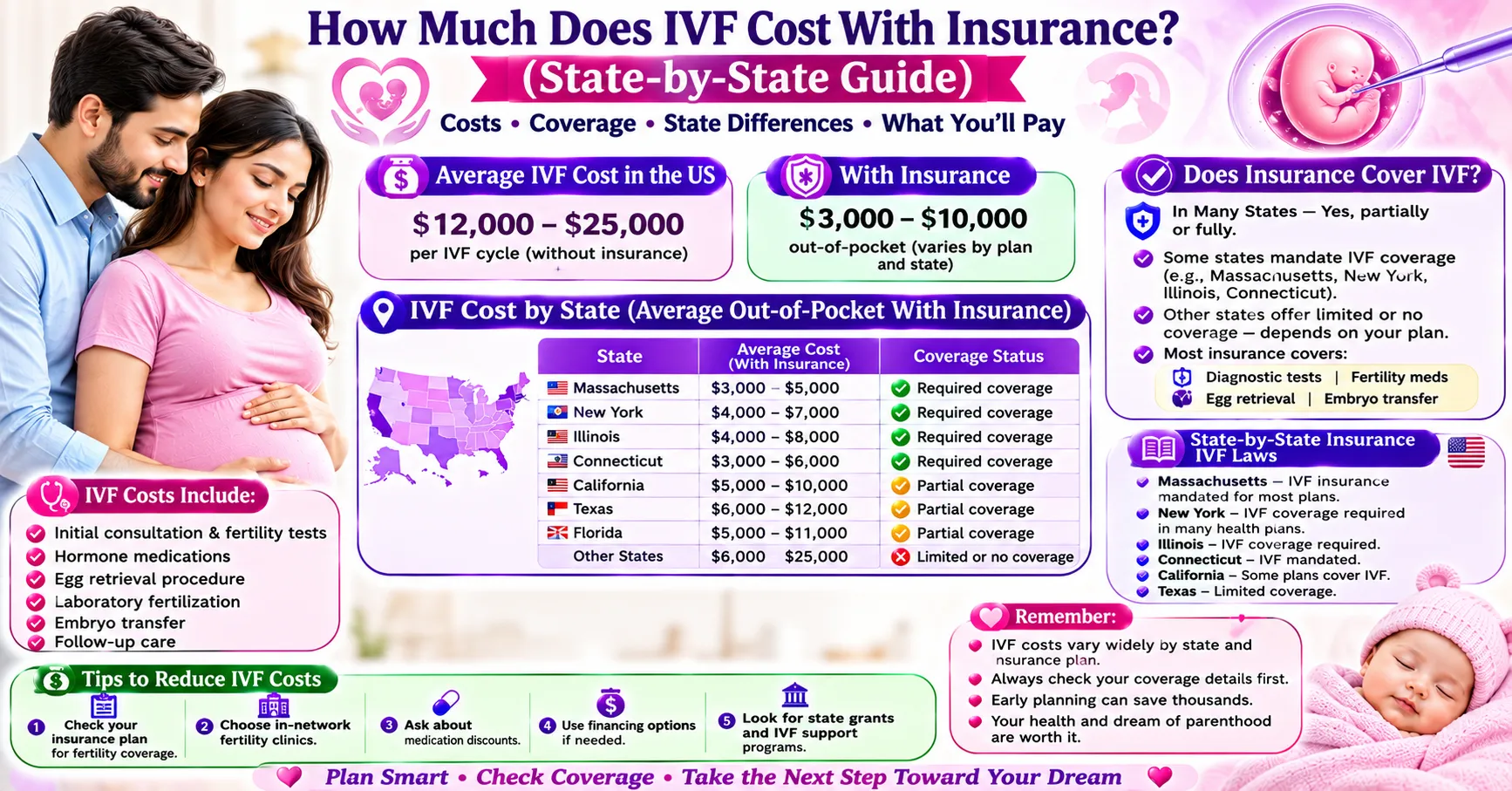
<cite index=”19-1″>As of 2026, 25 states have laws requiring at least some level of fertility care coverage, though the scope varies widely. Fifteen states plus Washington, D.C. specifically require IVF coverage</cite>: <cite index=”19-1″>Arkansas, California, Colorado, Connecticut, Delaware, Hawaii, Illinois, Maryland, Maine, Massachusetts, New Hampshire, New Jersey, New York, Rhode Island, and D.C.</cite>
Coverage strength varies a lot even within this group:
- Massachusetts: <cite index=”22-1″>Widely considered the strongest mandate in the country, with no cycle cap and no lifetime dollar limit, and it covers fertility medications alongside treatment</cite>
- New Jersey: <cite index=”22-1″>Covers up to four cycles and includes fertility preservation</cite>
- Connecticut: <cite index=”22-1″>Requires coverage for up to two IVF cycles, plus up to four cycles of ovulation induction and three cycles of IUI, applying to both individual and small group plans</cite>
- California: <cite index=”19-1″>Senate Bill 729, effective January 1, 2026, requires large group plans (100+ employees) to cover up to three completed egg retrievals with unlimited embryo transfers</cite>
- Washington, D.C.: <cite index=”22-1″>Requires coverage of infertility diagnosis, three rounds of IVF, embryo transfer to a surrogate if needed, and fertility preservation before treatments that could impair fertility</cite>
- Hawaii: <cite index=”21-1″>Limited coverage — patients are entitled to only one IVF cycle</cite>
- Arkansas: <cite index=”23-1″>Requires the patient and spouse to have a documented history of infertility, and specifically requires eggs to be fertilized with a spouse’s sperm, which excludes LGBTQ+ couples and single parents</cite>
What Insurance Typically Requires Before Covering IVF
Even in mandate states, coverage usually isn’t automatic. <cite index=”26-1″>Most mandates require a formal medical diagnosis of infertility — typically defined as 12 months of unprotected intercourse without conception, or 6 months for women over 35. Without this diagnosis, IVF coverage isn’t triggered even if your plan technically includes the benefit</cite>.
<cite index=”26-1″>Individual and marketplace plans are often exempt from IVF mandates even within mandate states, though they may still cover basic infertility diagnosis</cite>.
What About Medicaid?
<cite index=”26-1″>Government programs including Medicaid rarely cover IVF. Federal law actually exempts Medicaid from covering fertility medications specifically — unlike most other drug categories</cite>. If you’re on Medicaid, IVF coverage is the exception rather than the rule, regardless of which state you live in.
Real Cost Breakdown: With vs Without Insurance
| Scenario | Estimated Out-of-Pocket Cost |
|---|---|
| No coverage at all | $12,000–$17,000+ per cycle (plus $5,000–$10,000 for meds/testing) |
| Diagnosis-only coverage | Diagnostic testing covered; treatment still full-price |
| Partial mandate (1–2 cycles) | Copay/coinsurance only for covered cycles; full price after cap |
| Strong mandate (MA, NJ, D.C.) | Often low copay only, medications frequently included |
Even in the best-covered states, expect some out-of-pocket cost — copays, coinsurance, and anything beyond your plan’s cycle cap still comes out of your pocket.
New Developments Worth Knowing About
<cite index=”26-1″>As of May 2026, a federal fertility benefit rule has been proposed that could let employers offer fertility coverage as a standalone supplemental plan — including for the roughly 67% of employers running self-funded plans that state mandates currently can’t reach</cite>. This hasn’t taken effect yet, but it’s worth watching if your employer is self-insured and your state mandate doesn’t apply to you.
Several states have also expanded fertility preservation mandates recently — <cite index=”26-1″>California, New York, Illinois, Massachusetts, New Jersey, Colorado, D.C., Georgia, and Nevada all have or will soon have mandates covering egg, sperm, or embryo preservation for patients facing medical infertility risk, such as from cancer treatment</cite>.
How to Check Your Specific Coverage
- Ask HR whether your plan is fully insured or self-funded — this determines if your state’s law even applies
- Check your state’s specific mandate details — cycle caps, medication coverage, and eligibility rules vary significantly
- Confirm what counts as a qualifying infertility diagnosis under your plan
- <cite index=”19-1″>Ask your fertility clinic’s financial counseling team to verify your benefits directly with your insurer — they do this regularly and can often spot coverage details that aren’t obvious from your plan documents</cite>
Bottom Line
Whether IVF costs you $0 or $17,000+ per cycle depends almost entirely on three things: which state you live in, whether your employer’s plan is fully insured or self-funded, and whether you meet your plan’s specific infertility diagnosis requirement. Don’t assume coverage based on your state alone — verify directly with HR and your insurer before you budget for treatment, since the gap between “your state has a mandate” and “your specific plan is covered by it” is where most people get blindsided by cost.
FAQs
Which states require insurance to cover IVF?
Fifteen states plus Washington, D.C. specifically mandate IVF coverage: Arkansas, California, Colorado, Connecticut, Delaware, Hawaii, Illinois, Maryland, Maine, Massachusetts, New Hampshire, New Jersey, New York, Rhode Island, and D.C.
Does my state’s IVF mandate automatically apply to my insurance plan?
Not necessarily. State mandates don’t apply to self-insured employer plans, which cover the majority of people with employer-sponsored insurance. Check with HR to confirm your plan type.
Does Medicaid cover IVF?
Rarely. Federal law exempts Medicaid from covering fertility medications, and IVF coverage under Medicaid is uncommon regardless of state.
What’s required to qualify for IVF coverage even in a mandate state?
Most plans require a formal infertility diagnosis, typically 12 months of unprotected intercourse without conception (6 months if the woman is over 35).
Which state has the strongest IVF insurance mandate?
Massachusetts is generally considered the strongest, with no cycle cap, no lifetime dollar limit, and coverage of fertility medications alongside treatment.
How much does IVF cost if I have no insurance coverage at all?
Typically $12,000 to $17,000 per cycle, plus an additional $5,000 to $10,000 for medications, lab work, and genetic testing.