

Sleep training feels like one of the biggest decisions you’ll make as a parent. At Babyslover, we understand the exhaustion that comes with night after night of interrupted sleep. We also know that finding the right sleep training method can feel overwhelming—there are so many options out there, and you want to choose what’s best for your baby.
The pick up put down method is a gentler approach to sleep training that works with your baby’s needs rather than against them. If you’re looking for a method that lets you comfort your little one while teaching independent sleep, you’re in the right place. In this guide, we’ll walk you through everything you need to know about this approach, including step-by-step instructions, timelines, and practical tips to make it work for your family.
Contents
- 1 What Is the Pick Up Put Down Method?
- 2 Who Should Use the Pick Up Put Down Method?
- 3 How Does the Pick Up Put Down Method Work?
- 4 How to Do the Pick Up Put Down Method Step-by-Step
- 5 Best Age to Use the Pick Up Put Down Method
- 6 How Long Should You Hold Your Baby During Pick Up Put Down?
- 7 How Long Does the Pick Up Put Down Method Take to Work?
- 8 Signs the Pick Up Put Down Method Is Working
- 9 Pick Up Put Down Method Schedule Chart (Night + Naps)
- 10 What If Pick Up, Put Down Doesn’t Work?
- 11 Who Should NOT Use the Pick Up Put Down Method?
- 12 Common Mistakes to Avoid When Using the Pick Up Put Down Method
- 13 Pro Tips to Make the Pick Up Put Down Method Easier and More Effective
- 14 Conclusion
- 15 FAQs
- 15.1 Can I use the pick up put down method with a newborn?
- 15.2 Do I need to wait a certain amount of time before picking my baby up?
- 15.3 Is it okay to use the pick up put down method for naps and nighttime?
- 15.4 How many pick-ups per night is normal?
- 15.5 Can I use a pacifier with the pick up put down method?
What Is the Pick Up Put Down Method?
The pick up put down method is a sleep training technique where you help your baby learn to fall asleep independently by picking them up when they cry, soothing them until they calm down, and then putting them back in the crib while they’re still awake. You repeat this cycle as needed until your baby falls asleep on their own.
This method is different from cry-it-out approaches because you’re actively responding to your baby’s tears. It’s also different from methods that focus on gradually reducing parental involvement. Instead, it gives you a structured way to be present and supportive while your baby learns this important skill.
The philosophy behind pick up put down is simple: your baby learns that you’re there when they need you, but they also learn that they can calm themselves down and drift off to sleep. It’s about finding that sweet spot between comfort and independence.
Who Should Use the Pick Up Put Down Method?
This method works well for many families, especially if you:
- Want to stay actively involved in the sleep training process
- Have a baby who responds well to physical comfort
- Prefer a gentler approach than cry-it-out methods
- Don’t mind spending 30-60 minutes per session helping your baby learn
- Want to avoid methods that involve extended periods of crying
- Are willing to be patient with a slower progression
- Have the emotional capacity to repeat the same action many times
The pick up put down method is particularly popular with parents who value responsive parenting while still working toward independent sleep. It feels less harsh than some other methods, which many families appreciate.
How Does the Pick Up Put Down Method Work?
The core idea is beautifully simple: consistency plus comfort equals learning. Here’s what happens:
When you put your baby down awake and they cry, you pick them up. You hold them, comfort them, maybe rock them gently or pat their back. Once they’ve calmed down—even just a little—you put them back down while they’re still awake. If they cry again, you repeat the process.
Over time, your baby learns that crying brings comfort, not abandonment. They also learn that being put down doesn’t mean something is wrong. Eventually, they realize they can stay calm when you put them down, and that’s when sleep comes more easily.
The key is that you’re responding to each cry, which makes this feel less stressful than other methods. You’re not watching the clock or forcing yourself to ignore your baby’s needs. You’re actively helping them learn.
How to Do the Pick Up Put Down Method Step-by-Step
Ready to get started? Here’s exactly how to implement the pick up put down method:
Step 1: Create a Sleep-Friendly Environment
Before you begin, make sure the room is dark, cool, and quiet. A white noise machine helps. Remove any sleep props your baby is used to—so if they usually fall asleep with a pacifier or bottle, plan to phase those out. The goal is for your baby to learn to sleep without these tools.
Step 2: Follow Your Bedtime Routine
Do your normal wind-down routine: bath, story, cuddles, whatever works for your family. Keep it calm and consistent. This is not the time to introduce the pick up put down method—that comes next.
Step 3: Put Your Baby Down Awake
This is the crucial part. After your routine, place your baby in the crib while they’re drowsy but still awake. They should be able to recognize where they are. Don’t wait until they’re deeply asleep.
Step 4: Leave the Room (Optional)
Some parents leave immediately, others stay nearby. If you leave, stay close enough that you can hear and quickly return when needed.
Step 5: When Your Baby Cries, Wait Briefly
Many experts suggest waiting 30 seconds to a minute before picking up your baby. This gives them a moment to see if they can settle themselves. Some babies surprise you!
Step 6: Pick Your Baby Up
If the crying continues, pick your baby up promptly. Respond to their needs—there’s no “let them cry longer” component here. Hold them close and comfort them.
Step 7: Calm Your Baby Down
Rock them gently, pat their back, shush softly, or do whatever soothes them. Your goal is to get them calm—not fully asleep, just calmer.
Step 8: Put Them Back Down Awake
Once they’re calm, put them back in the crib while they’re still awake. This is important. If they fall fully asleep in your arms, you’re not teaching them the skill.
Step 9: Repeat as Needed
If your baby cries again, repeat steps 5-8. Some nights you might do this 5 times. Other nights, 30 times. That’s normal during the learning phase.
Step 10: Stay Consistent
Do this every night, same routine, same approach. Consistency is what makes this work.
Best Age to Use the Pick Up Put Down Method
The pick up put down method generally works best for babies between 3-6 months old, though some families use it with babies up to 12 months.
At 3 months, your baby is developmentally ready to begin learning independent sleep skills. They’re past the newborn stage where they need to eat frequently, and they have more stable sleep cycles. Around this age, many babies can also go longer between feeds at night, making night sleep training realistic.
Before 3 months, newborns are waking for feeds, and it’s harder to distinguish between hungry crying and just-learning-to-sleep crying. It’s generally recommended to focus on feeding and bonding during these early weeks rather than sleep training.
After 12 months, some developmental changes happen that can make this method less effective, though many families continue using it. If your baby is older than 12 months and you haven’t started sleep training yet, it’s worth speaking with your pediatrician about the best approach for your child’s age.
How Long Should You Hold Your Baby During Pick Up Put Down?
There’s no magic number here, and every baby is different. The goal is to hold your baby until they’re noticeably calmer—you’re aiming for a shift in their emotional state, not full sleep.
Typically, this takes anywhere from 30 seconds to 3-5 minutes. Some babies calm quickly and are ready to go back down in under a minute. Others need longer cuddles, and that’s okay. The point is you’re responding to their individual needs.
What matters most is that you’re putting them down before they fall fully asleep. Even if your baby is deeply drowsy, try to put them down so they’re aware of being placed in the crib. This is how they learn to transition to sleep on their own.
If you find yourself holding your baby for 10+ minutes before they calm down, that’s a sign that this method might not be working for your family right now—and that’s valuable information. It’s okay to try a different approach.
How Long Does the Pick Up Put Down Method Take to Work?
Here’s the honest answer: it varies, and patience is essential.
Some families see improvement within a few nights. Their baby learns the pattern quickly and starts settling with fewer pick-ups. These families feel encouraged and want to continue.
Other families need 2-4 weeks of consistent practice before seeing real progress. Their baby might still need to be picked up many times per night, but gradually, the number of pick-ups decreases. The crying might also reduce in intensity.
A few families find that after 4 weeks of consistent effort, this method simply isn’t clicking for their baby. That’s not a failure—it just means a different approach might work better.
The timeline also depends on whether you’re doing this for naps, nighttime, or both. Most parents focus on one first, usually nighttime, before tackling daytime sleep.
Expect the first week to be the hardest. You might feel like you’re doing endless repetitions. Weeks 2-3 often show gradual improvement. By week 4, many families see meaningful progress, though it might not be complete yet.
Signs the Pick Up Put Down Method Is Working
Progress with the pick up put down method isn’t always dramatic, but there are signs to watch for:
- Fewer pick-ups needed: You start with 20+ pick-ups per session and gradually it drops to 15, then 10, then 5.
- Faster calm-downs: Your baby cries for a few minutes, you pick them up, they calm in 20 seconds instead of 3 minutes.
- Reduced crying intensity: The crying becomes less desperate and more tired-sounding.
- Falls asleep faster: The gap between the last pick-up and sleep closes—from 10 minutes to 5 to 2.
- Fewer night wakings: Your baby wakes less frequently and falls back asleep more easily.
- Better mood overall: Your baby seems less frustrated during the day, as if they’re not exhausted from nighttime fighting.
Real progress is often gradual. You might not notice it day-to-day, which is why keeping a simple chart helps. Write down the number of pick-ups or approximate time to sleep each night. After two weeks, you’ll see the pattern clearly.
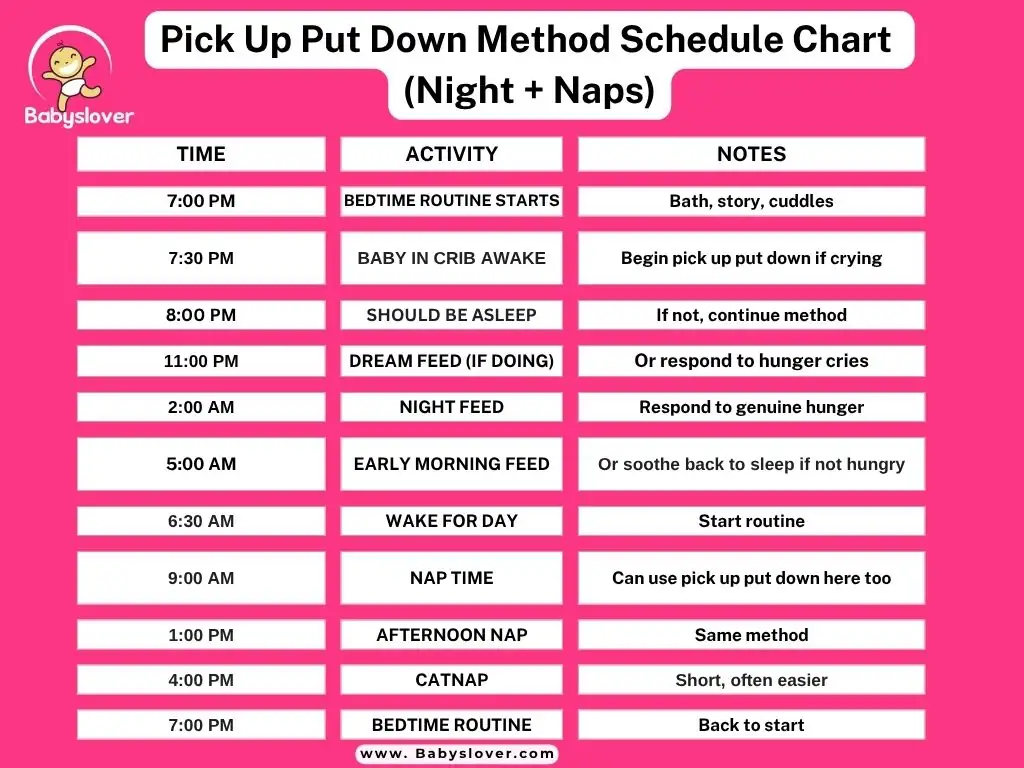
Pick Up Put Down Method Schedule Chart (Night + Naps)
Here’s a sample schedule to help you get started. Remember, this is a guide—your baby’s actual sleep times may differ.
Typical Schedule for a 4-6 Month Old:
| Time | Activity | Notes |
|---|---|---|
| 7:00 PM | Bedtime routine starts | Bath, story, cuddles |
| 7:30 PM | Baby in crib awake | Begin pick up put down if crying |
| 8:00 PM | Should be asleep | If not, continue method |
| 11:00 PM | Dream feed (if doing) | Or respond to hunger cries |
| 2:00 AM | Night feed | Respond to genuine hunger |
| 5:00 AM | Early morning feed | Or soothe back to sleep if not hungry |
| 6:30 AM | Wake for day | Start routine |
| 9:00 AM | Nap time | Can use pick up put down here too |
| 1:00 PM | Afternoon nap | Same method |
| 4:00 PM | Catnap | Short, often easier |
| 7:00 PM | Bedtime routine | Back to start |
Tracking Chart Template:
Date | Time to Sleep | Number of Pick-ups | Notes
-----|---------------|--------------------|-------
1/15 | 35 minutes    | 18                 | Very fussy
1/16 | 32 minutes    | 16                 | Slightly better
1/17 | 28 minutes    | 14                 | Good progress!
1/18 | 25 minutes    | 11                 | Continuing improvement
Track for at least 2 weeks. You’ll be amazed at the progress once you see it written down.
What If Pick Up, Put Down Doesn’t Work?
If after 4 weeks of consistent practice you’re not seeing progress, or if this method is simply exhausting you, it’s okay to try something different. At Babyslover, we believe the best sleep training method is the one that works for your family—and that varies from baby to baby.
Some alternatives to consider:
The Ferber Method is more structured than pick up put down. Instead of responding to every cry, you follow a timed schedule. You check on your baby at increasing intervals. Many families find this easier emotionally because there’s a clear plan. Learn more in our Ferber Method for Sleep Training with Chart guide.
The Cry It Out Method (also called extinction) involves putting your baby down and not returning until morning (or the next scheduled feed). This is the most hands-off approach and often works faster, but requires emotional resolve. Find out if this feels right for your family in our Cry It Out Method for Baby Sleep Training guide.
Bedtime Fading gradually moves bedtime later until your baby is naturally sleepy enough to fall asleep independently. It’s gentler and works well for some babies. Explore this option in our Bedtime Fading Sleep Training Method guide.
Gentler options like the chair method (gradually moving your chair away) or contact napping with a plan to transition work for families wanting minimal crying.
The key is that you’re listening to your gut. If pick up put down doesn’t feel right after a fair trial, trust that instinct and try something else.
Who Should NOT Use the Pick Up Put Down Method?
This method isn’t ideal for everyone, and that’s important to acknowledge:
- Parents who are exhausted: If you’re already running on fumes, doing this method 50+ times per night might break you. Choose something more passive.
- Babies with reflux or colic: If your baby has reflux, picking them up and putting them down repeatedly can trigger vomiting. Talk to your pediatrician.
- Single caregivers during the day: If you’re solo parenting during the day and this method leaves you exhausted, it’s not sustainable.
- Families living in small spaces: If you share a room with your baby or have thin walls, the repeated up-and-down cycle might be too disruptive.
- Babies with extreme separation anxiety: Some babies get more distressed being put down repeatedly. If that’s your baby, gentler transitions might work better.
- Parents who feel triggered by crying: Sleep training should not harm your mental health. If this method is causing you significant anxiety or resentment, choose a different path.
Your emotional wellbeing matters. Never force a method that feels wrong for your family.
Common Mistakes to Avoid When Using the Pick Up Put Down Method
Learning from what doesn’t work speeds up your success. Here are the most common pitfalls:
Mistake 1: Putting Baby Down Fully Asleep
If you rock your baby to deep sleep before putting them down, they’re not learning the skill. They wake up in a different state than they remember falling asleep in, which triggers crying all over again. Put them down drowsy but awake.
Mistake 2: Giving Up Too Soon
Night 1 you do 30 pick-ups. Night 2 you do 28. It feels like nothing is working. Actually, that’s progress! Give it at least 2 weeks before deciding it’s not working.
Mistake 3: Inconsistency
Monday you do pick up put down. Tuesday you let them cry. Wednesday you co-sleep. Thursday you’re back to pick up put down. Switching methods confuses your baby. Pick one and stick with it for at least 2 weeks.
Mistake 4: Not Waiting Long Enough
If your baby cries for 3 seconds and you immediately pick them up, you might be interrupting them just as they’re about to self-soothe. Wait 30-60 seconds before responding.
Mistake 5: Making It Too Complicated
Some parents add extra steps: pick up, walk around, bounce, put down. If it doesn’t work, they add shushing. Then patting. Pretty soon it’s this elaborate routine. Keep it simple.
Mistake 6: Not Adjusting for Hunger
If your baby hasn’t eaten in 3 hours and is crying, they might be hungry, not tired. Feed them. Don’t force pick up put down on a hungry baby.
Mistake 7: Doing It When You’re Frustrated
If you’re irritated or angry, your baby senses it. Reschedule your sleep training attempt. You need patience for this method to work.
Pro Tips to Make the Pick Up Put Down Method Easier and More Effective
These strategies make a real difference:
Tip 1: Have a Partner
If you have a partner, take turns. One person does Monday and Wednesday nights. The other does Tuesday and Thursday. Everyone gets rest, and your baby learns the method from both of you. Even one night off helps your resilience.
Tip 2: Start During a Calm Period
Don’t start this during a growth spurt, when your baby is teething, or during a stressful time for you. Pick a week when life feels relatively manageable.
Tip 3: Keep a Simple Log
Write down the number of pick-ups and approximate time to sleep. After one week, you’ll have data that shows progress—even if it feels endless in the moment.
Tip 4: Have Realistic Expectations
Expect 30-60 minutes for the first session. Expect you might be doing pick-ups for 45 minutes before your baby falls asleep. That’s normal.
Tip 5: Stay Calm and Patient
Your baby will pick up on your energy. If you’re frustrated, they sense it. Take deep breaths. Put on a podcast or calm music. This is temporary, and you’re doing something good for your baby’s sleep.
Tip 6: Use White Noise
White noise masks household sounds and creates a consistent auditory environment. Many babies find it soothing and sleep longer with it.
Tip 7: Optimize the Room
Make sure the room is dark (use blackout curtains), cool (around 68-72°F), and comfortable. A good sleep environment makes everything easier.
Tip 8: Have Backup Plans
Some nights, it’s just not working. Your baby is sick, you’re exhausted, or something is off. It’s okay to take a break and try again tomorrow. Flexibility helps you sustain this long-term.
Conclusion
At Babyslover, we believe that teaching your baby to sleep is one of the greatest gifts you can give them—and yourself. The pick up put down method offers a way to do this while staying responsive and connected to your little one.
Remember, this method isn’t a magic fix. It requires patience, consistency, and emotional energy. But for many families, it’s the perfect balance between being there for their baby and helping them learn independence.
The best sleep training method is the one that aligns with your values and works for your family. If pick up put down feels right, commit to it for at least 2 weeks. Track your progress. Celebrate small wins. And know that you’re doing something meaningful.
You’ve got this. Your baby is learning, and you’re both growing together. Reach out to your pediatrician if you have concerns, and remember—there’s no such thing as a perfect sleep-training parent, only your perfect way of helping your baby learn.
FAQs
Can I use the pick up put down method with a newborn?
It’s best to wait until your baby is at least 3 months old. Newborns wake for feeds and haven’t developed the capacity for this type of learning yet. Focus on feeding and bonding during those early weeks.
Do I need to wait a certain amount of time before picking my baby up?
Most experts recommend waiting 30-60 seconds to give your baby a moment to self-soothe. But there’s no hard rule. Some families wait longer, others pick up immediately. Find what feels right.
Is it okay to use the pick up put down method for naps and nighttime?
Yes, though many parents start with nighttime because there’s usually only one or two sleep cycles to work with, making it simpler. Once nighttime is established, you can apply the method to naps.
How many pick-ups per night is normal?
In the first week, expect 10-30+ pick-ups per session. By week 2-3, this often drops to 5-15. By week 4, many families are down to 0-5. Everyone is different though.
Can I use a pacifier with the pick up put down method?
If you use a pacifier, be prepared for it to fall out frequently, requiring more pick-ups. Many families wean the pacifier before starting this method. It’s personal preference.
2 thoughts on “Pick Up Put Down Method: Complete Sleep Training Guide + Chart”