
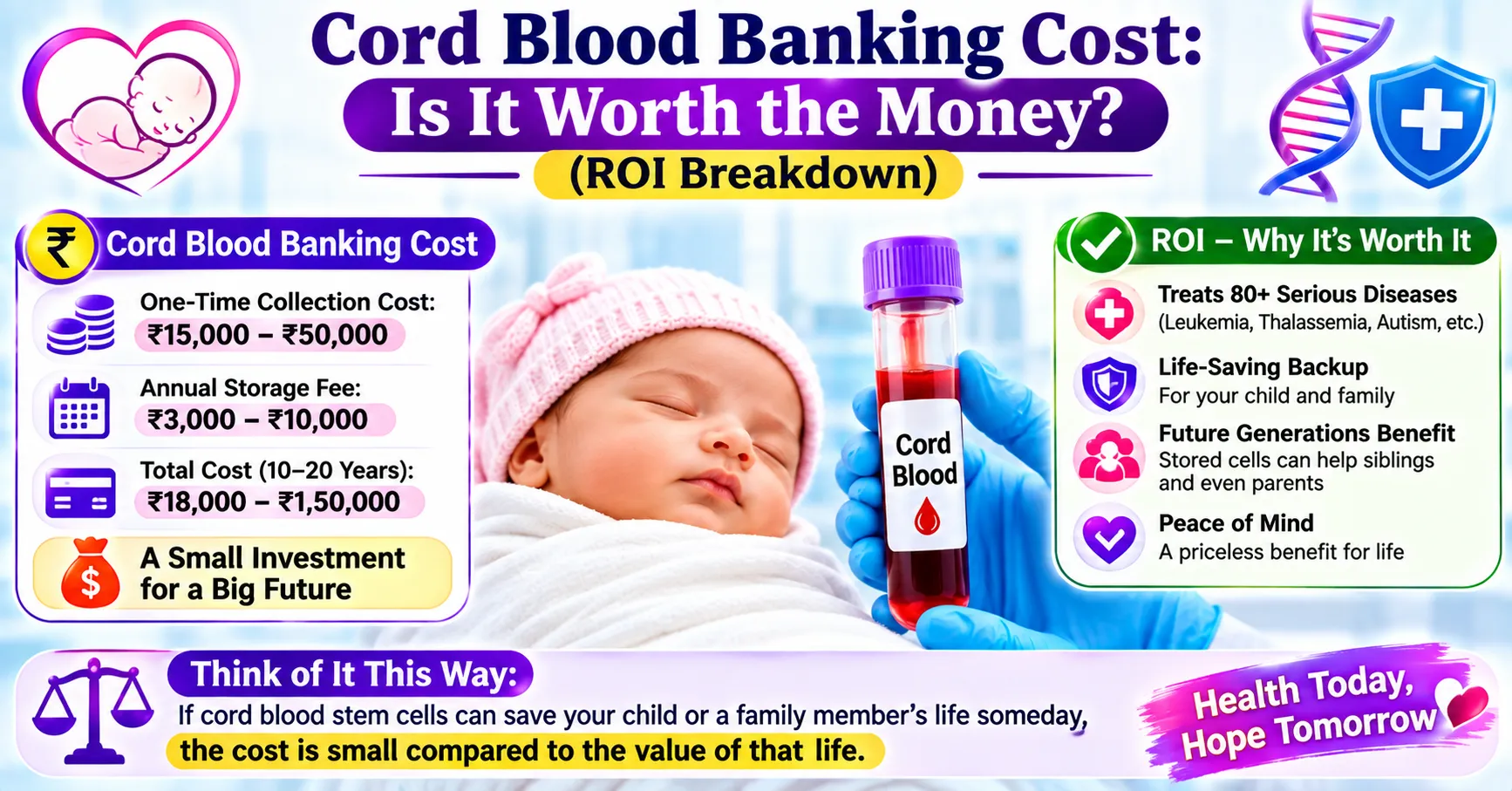
You’ve seen the pricing. You’ve compared the companies. Now comes the harder question: is private cord blood banking actually worth paying for, or is it an expensive form of peace of mind you’ll never use? Here’s an honest, numbers-based look at the real odds, the real costs, and who it actually makes financial sense for.
The Real Odds of Ever Using It
This is the number most marketing materials don’t lead with. Estimates on the probability of a child ever needing their own banked cord blood vary depending on the source, but they’re consistently low:
- One clinical estimate puts the odds at roughly <cite index=”17-1″>1 in 2,700 for using donated cord cells at all (public or private)</cite>
- <cite index=”19-1″>The American Academy of Pediatrics has cited odds as low as 1 in 200,000 for using one’s own privately banked cord blood specifically</cite>
- <cite index=”18-1″>Looking at all 80+ treatable conditions combined, the net probability a child will need any stem cell transplant by age 20 is about 3 in 5,000 — roughly 0.06%</cite>
The gap between these numbers exists because “using cord blood at all” (often for a sibling) and “using your own banked cord blood for yourself” are very different odds. For genetic conditions, a child’s own cord blood usually can’t be used on that same child anyway, since it carries the same genetic markers as the disease.
What Medical Bodies Actually Recommend
This is worth knowing before you spend thousands of dollars. <cite index=”19-1″>The American Academy of Pediatrics has stated that private storage of cord blood as “biological insurance” is unwise unless a family member has a current or potential need for a stem cell transplant</cite>. Most major medical organizations take a similar stance: private banking isn’t recommended for the general population, but it is recommended when there’s a known family risk factor.
Researchers have also flagged an industry-wide issue worth being aware of: <cite index=”22-1″>private cord blood bank marketing that promotes hypothetical future treatments can be misleading, since current medical evidence shows a genuinely low probability of ever using the stored material</cite>. This doesn’t mean banking has no value — it means the “buy this in case your child gets one of 80 diseases” pitch oversimplifies the real odds.
Doing the Actual Math
Here’s what the investment looks like over 18 years, using average industry pricing:
| Cost Component | Typical Range |
|---|---|
| Initial processing fee | $600–$2,000 |
| Annual storage (x18 years) | $1,800–$4,500 total |
| Total 18-year cost | $3,000–$6,500 |
| Odds of using it for your own child | Extremely low (varies by source, generally under 0.1%) |
If you invested that same $3,000–$6,500 instead — say, in a basic index fund over 18 years — it could realistically grow into a meaningful education or emergency fund, assuming average market returns. That’s the real financial trade-off: banking is a low-probability insurance policy, not an investment with expected returns.
When the ROI Actually Makes Sense
The math changes significantly if any of the following apply to your family:
- A sibling already has a condition treatable with stem cells (leukemia, sickle cell disease, certain immune disorders) — in this case, banking a new baby’s cord blood for that sibling has real, documented use cases
- A strong family history of blood cancers or inherited blood disorders that increases the realistic odds of needing a transplant
- Genetic conditions like thalassemia are prevalent in your family’s background — cord blood banking is more commonly used for this internationally for exactly this reason
For families in these situations, the odds of use jump considerably higher than the general population numbers above, and the cost can genuinely be worth it.
When Public Donation Makes More ROI Sense
If you don’t have a specific family risk factor, donating to a public cord blood bank — which costs nothing — arguably has a better “return” in the form of helping someone else’s family, since public banks supply real, ongoing transplants. You lose exclusive access to that unit, but you also don’t spend $3,000–$6,500 for statistically low odds you’ll ever need it yourself.
Bottom Line: Is It Worth the Money?
For the average healthy family with no relevant medical history, the numbers say private cord blood banking is a low-probability bet that costs several thousand dollars over 18 years. It’s not a scam, but it’s also not the “biological insurance” it’s often marketed as — most major pediatric health bodies actively caution against it for general use.
For families with a documented risk factor — a sibling’s illness, a strong family cancer history, or a known genetic blood disorder — the odds of use rise enough that the cost can be genuinely justified. The honest answer isn’t “always worth it” or “never worth it” — it’s entirely dependent on your specific family history.
FAQs
What are the real odds of using privately banked cord blood?
Estimates vary by source, but most put the odds at well under 1%, ranging from roughly 1 in 2,700 to as low as 1 in 200,000, depending on how the statistic is measured.
Do pediatric health organizations recommend private cord blood banking?
Generally, no — for average-risk families. Major medical bodies typically recommend it only when there’s a specific known family risk factor, not as routine “biological insurance.”
Is cord blood banking a good financial investment?
It’s not an investment in the traditional sense — there’s no expected financial return. It’s closer to insurance: you pay upfront for a low-probability future benefit.
When does private cord blood banking make the most sense?
It makes the most sense when a sibling has a condition treatable with stem cells, or when there’s a strong family history of blood cancers or inherited blood disorders.
Is public cord blood donation a better option than private banking?
For families without a specific risk factor, public donation is free and contributes to real, ongoing transplants for others, making it a reasonable alternative to paying for private storage.
Can I still bank cord blood if I don’t have a family history of disease?
Yes, it’s still an option, but the financial and medical case for doing so is weaker without a specific risk factor — it becomes a personal peace-of-mind decision rather than a data-backed one.