
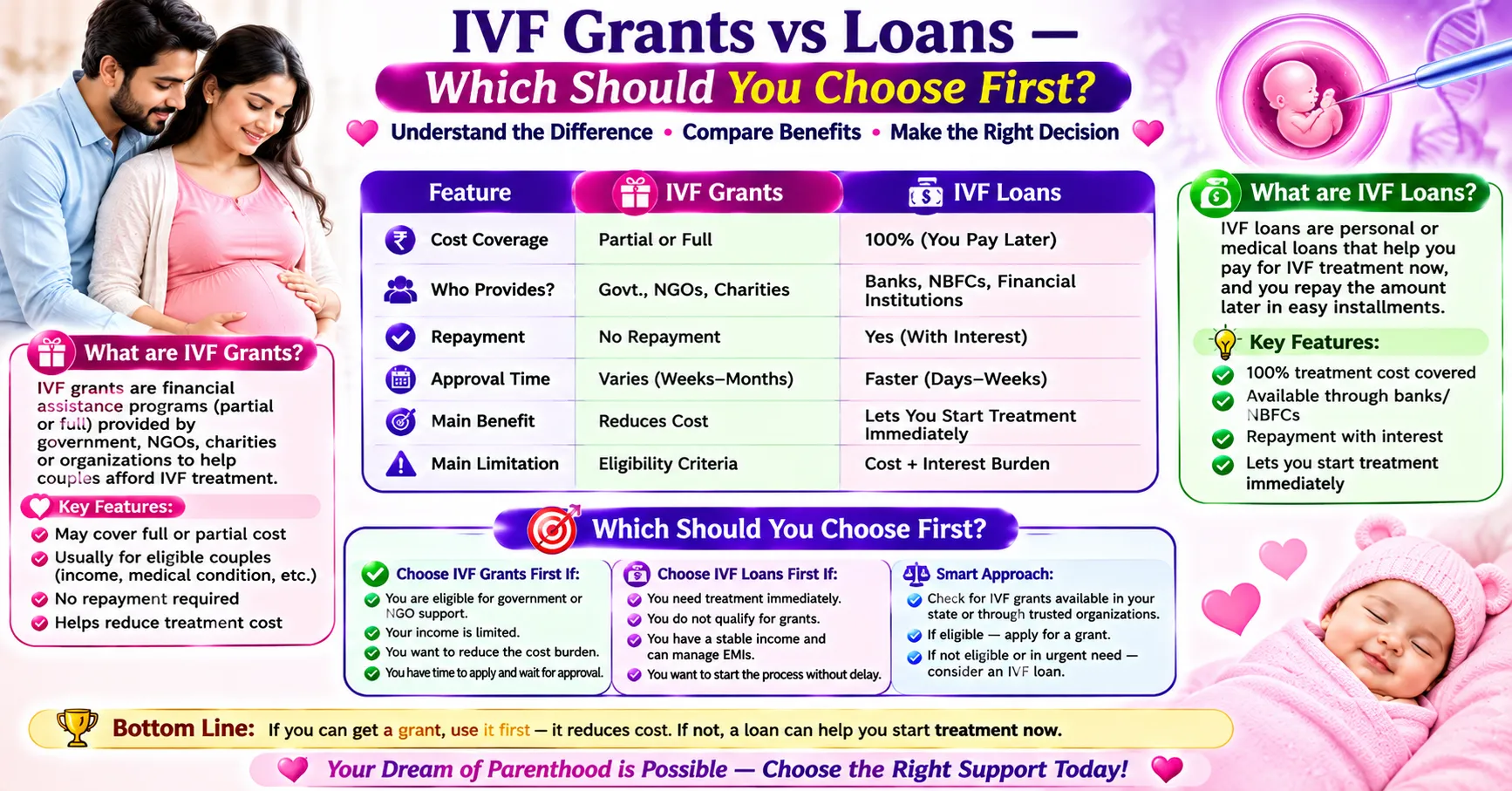
IVF Grants vs Loans : For most couples, the biggest barrier to starting a family through in vitro fertilization isn’t the medical process — it’s the price tag. A single IVF cycle in the United States can cost anywhere between $12,000 and $25,000, and many patients need more than one round to succeed. Naturally, the question that comes up again and again is: should I apply for an IVF grant, or should I take out an IVF loan?
Both options can help cover the cost of fertility treatment, but they work in very different ways. Grants are essentially free money that never has to be repaid, while loans are borrowed money that comes with interest and a repayment schedule. Choosing the wrong one first can cost you months of delay or thousands of dollars in unnecessary interest.
In this guide, we’ll break down exactly how IVF grants and IVF loans work, who qualifies for each, the pros and cons of both, and a simple decision framework to help you figure out which one you should pursue first.
What Is an IVF Grant?
An IVF grant is financial assistance awarded by a nonprofit organization, foundation, fertility clinic, or pharmaceutical company to help offset the cost of fertility treatment. Unlike a loan, a grant does not need to be repaid, which makes it the most attractive funding option — when you can get one.
Some of the most well-known IVF grant and scholarship programs include:
- Baby Quest Foundation — offers grants ranging from $2,000 to $16,000 for IVF, egg donation, and embryo adoption.
- CADE Foundation (Cade’s Foundation) — provides need-based IVF grants and maintains a directory of other assistance programs.
- Starfish Fertility Foundation — awards partial-cost grants to couples facing infertility.
- Ferring Pharmaceuticals’ Heart Beat Program — offers discounted medication and grant opportunities.
- Fertility clinic in-house grants — many large fertility centers run their own scholarship or discount programs for qualifying patients.
How IVF Grants Typically Work
Grant programs usually require applicants to submit an income statement, a personal essay describing their fertility journey, proof of a medical diagnosis, and sometimes letters of recommendation. Award amounts vary widely, and competition can be intense — some programs receive thousands of applications for only a handful of awards each cycle.
What Is an IVF Loan?
An IVF loan is borrowed money — either a personal loan, a medical credit line, or a specialized fertility loan — that you use to pay for treatment and repay over time with interest. Because approval is largely based on credit score and income rather than a competitive selection process, loans are far more predictable and faster to obtain than grants.
Common IVF financing options include:
- Fertility-specific lenders such as Future Family, CapexMD, and Sunfish, which package loans specifically for IVF, egg freezing, and surrogacy.
- Medical credit cards like CareCredit, which offer promotional zero-interest periods for medical expenses.
- Personal loans from banks or online lenders such as SoFi, LightStream, or local credit unions.
- Home equity loans or lines of credit (HELOC), which often carry lower interest rates but use your home as collateral.
- Clinic-arranged financing, where the fertility clinic partners directly with a lender to streamline approval.
How IVF Loans Typically Work
Most fertility loans require a credit check, proof of income, and sometimes a co-signer. Interest rates can range from around 6% for borrowers with excellent credit to over 25% for those with lower credit scores. Repayment terms usually run from 12 to 84 months.
IVF Grants vs Loans: Side-by-Side Comparison
| Factor | IVF Grants | IVF Loans |
|---|---|---|
| Repayment required | No | Yes, with interest |
| Approval speed | Slow (weeks to months) | Fast (often 24–72 hours) |
| Approval odds | Low — highly competitive | High — based on credit/income |
| Credit check needed | Usually not | Yes |
| Amount typically covered | Partial cost | Full cost possible |
| Application effort | High (essays, documentation) | Low to moderate |
| Best for | Patients who can wait and meet eligibility criteria | Patients who need funding quickly |
Which Should You Choose First? A Simple Decision Framework
Choose an IVF Grant First If:
- Your treatment isn’t urgent and you can wait 2–6 months for a decision.
- You meet specific eligibility criteria (income level, diagnosis type, location, military service, cancer-related infertility, etc.).
- You’re comfortable writing a personal essay and sharing your fertility story publicly or with a review committee.
- You want to avoid debt entirely, even if it means a smaller total amount.
Choose an IVF Loan First If:
- Your treatment window is time-sensitive (e.g., age-related fertility decline, upcoming surgery, or a clinic deadline).
- You have a stable income and reasonably good credit, making approval and manageable interest rates likely.
- You’ve already applied for grants and been rejected or are still waiting to hear back.
- You want certainty over your funding rather than relying on a competitive award.
The Smartest Strategy: Combine Both
Many patients don’t have to pick just one. A common approach is to apply for every relevant IVF grant first (since there’s no downside to applying), while simultaneously getting pre-approved for a loan as a backup. If the grant comes through, you can reduce the loan amount you actually draw down or cancel the loan application altogether. This “stacking” strategy maximizes free money while keeping your treatment timeline on track.
Additional Ways to Reduce IVF Costs
- Ask about multi-cycle refund programs, where clinics offer a partial refund if IVF is unsuccessful after a set number of cycles.
- Check employer fertility benefits — companies like Starbucks, Amazon, and many tech firms now offer IVF coverage or reimbursement.
- Look into IVF-friendly health insurance plans, especially in the 21 U.S. states that currently mandate some form of infertility coverage.
- Use a Health Savings Account (HSA) or Flexible Spending Account (FSA) to pay with pre-tax dollars.
- Consider IVF abroad, where treatment costs in countries like Mexico, Spain, or the Czech Republic can be 40–60% lower than in the U.S.
Additional Ways to Reduce IVF Costs
- Ask about multi-cycle refund programs, where clinics offer a partial refund if IVF is unsuccessful after a set number of cycles.
- Check employer fertility benefits — companies like Starbucks, Amazon, and many tech firms now offer IVF coverage or reimbursement.
- Look into IVF-friendly health insurance plans, especially in the 21 U.S. states that currently mandate some form of infertility coverage.
- Use a Health Savings Account (HSA) or Flexible Spending Account (FSA) to pay with pre-tax dollars.
- Consider IVF abroad, where treatment costs in countries like Mexico, Spain, or the Czech Republic can be 40–60% lower than in the U.S.
Frequently Asked Questions (FAQs)
Can I apply for an IVF grant and an IVF loan at the same time?
Yes. There’s no rule against applying for both simultaneously. In fact, many financial counselors recommend it so you don’t lose time waiting on a grant decision.
Do IVF grants cover the full cost of treatment?
Rarely. Most grants cover only a portion of the total cost — typically between $2,000 and $16,000 — so many recipients still need a loan or savings to cover the remainder.
What credit score do I need to qualify for an IVF loan?
Requirements vary by lender, but most fertility-specific lenders look for a credit score of 600 or higher for approval, with the best interest rates reserved for scores above 700.
Are IVF grants taxable income?
In most cases, grants awarded for medical treatment are not considered taxable income, but it’s best to confirm with a tax professional based on your specific situation.
How long does it take to hear back about an IVF grant?
Timelines vary by organization, but most grant programs take anywhere from 4 to 12 weeks to review applications and announce recipients.
Is IVF loan interest tax-deductible?
Personal loan interest is generally not tax-deductible, but the underlying medical expenses may qualify for a medical expense deduction if they exceed a certain percentage of your adjusted gross income. Consult a tax advisor for specifics.
What happens if I don’t get pregnant after taking out an IVF loan?
You’re still responsible for repaying the loan regardless of the treatment outcome. This is why some patients prefer multi-cycle refund programs or shared-risk plans that reduce financial risk if IVF is unsuccessful.
Can single parents or LGBTQ+ couples apply for IVF grants?
Yes. Many foundations, including Baby Quest and CADE, explicitly welcome applications from single parents by choice and LGBTQ+ individuals and couples.
Conclusion
There’s no one-size-fits-all answer to the IVF grants vs loans debate — the right choice depends on your timeline, financial situation, and eligibility for assistance programs.
If you have time on your side, start with grant applications since they offer real, repayment-free savings. If your treatment can’t wait, a loan gives you speed and certainty, even at the cost of interest. For most patients, the smartest path is to pursue both at once: apply widely for grants while securing loan pre-approval as a safety net, so your fertility journey never has to pause for funding.