
Breast cancer is not a single disease — it’s an umbrella term that covers several distinct types, each with its own behavior, growth pattern, and treatment approach. Understanding which type of breast cancer you or a loved one is dealing with is one of the most important steps in navigating a diagnosis, because it directly shapes decisions around surgery, chemotherapy, hormone therapy, and long-term prognosis.
In this guide, we’ll walk through the major types of breast cancer — from non-invasive conditions like DCIS to aggressive forms like triple-negative and inflammatory breast cancer — so you have a clear picture of what each diagnosis actually means.
How Breast Cancer Types Are Classified
Before diving into individual types, it helps to understand the two broad classification systems doctors use:
- Where the cancer starts — most breast cancers begin in either the milk ducts (ductal) or the milk-producing glands (lobular).
- Whether it has spread — cancer is classified as in situ (contained within the ducts or lobules) or invasive (spread into surrounding breast tissue).
Doctors also test tumors for specific receptors — estrogen receptor (ER), progesterone receptor (PR), and HER2 protein — because these determine which type of targeted or hormone therapy will be effective.
1. Ductal Carcinoma In Situ (DCIS)
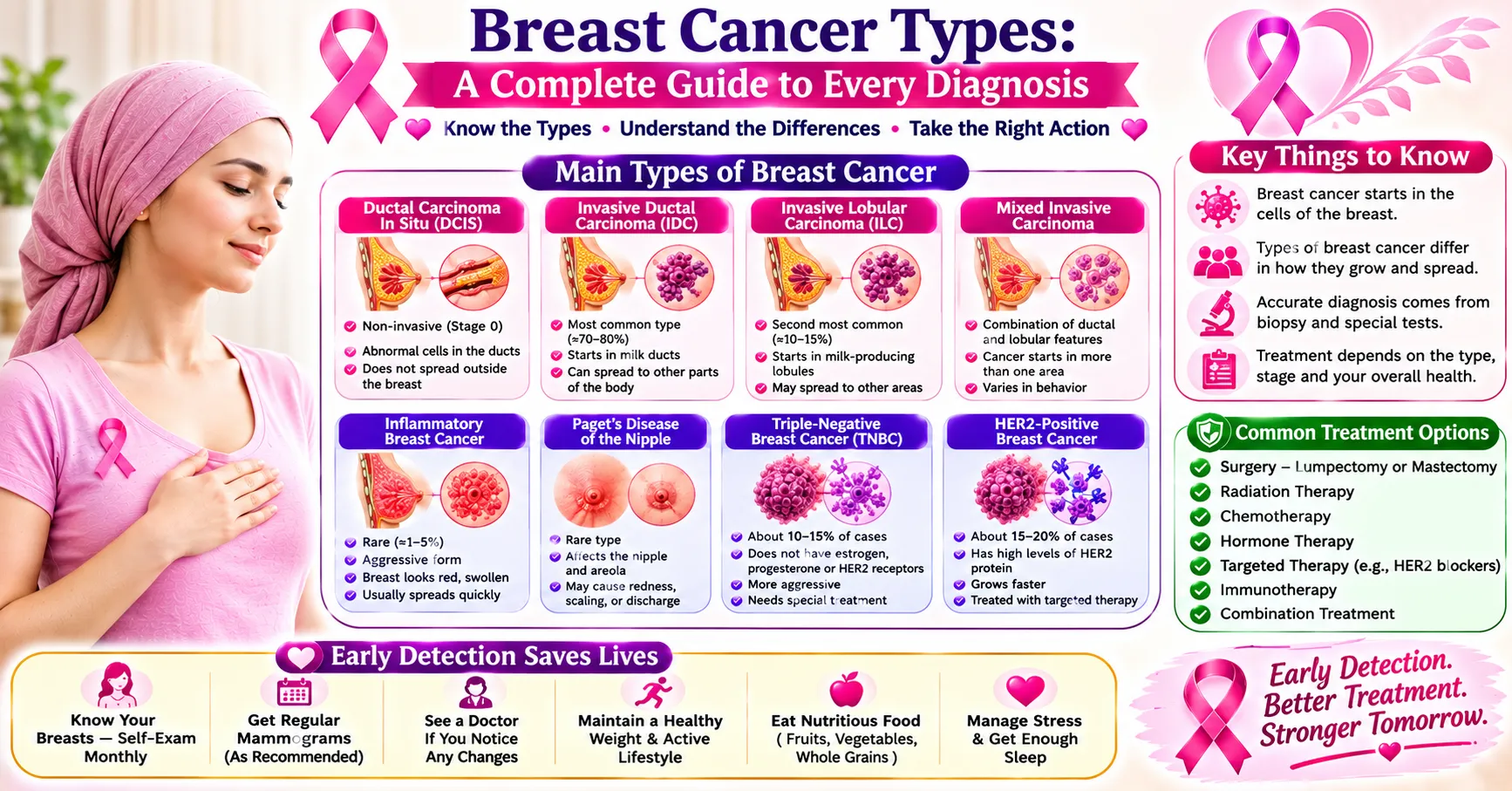
DCIS is considered the earliest possible stage of breast cancer. The abnormal cells are confined to the milk ducts and have not spread into nearby breast tissue, which is why it’s sometimes called “non-invasive” or “stage 0” breast cancer.
- How common: Accounts for roughly 1 in 5 new breast cancer diagnoses.
- Detection: Usually found via mammogram before any lump is felt.
- Outlook: Highly treatable, with survival rates near 100% when caught and treated early.
- Risk: If left untreated, DCIS can progress into invasive cancer over time.
2. Invasive Ductal Carcinoma (IDC)
IDC is the most common type of breast cancer, accounting for about 70–80% of all diagnoses. It begins in the milk ducts but breaks through the duct wall and invades surrounding breast tissue, giving it the potential to spread to lymph nodes and other parts of the body.
- Symptoms: Often presents as a hard, painless lump with irregular edges.
- Subtypes: Includes tubular carcinoma, medullary carcinoma, and mucinous (colloid) carcinoma — generally slower-growing variants of IDC.
- Treatment approach: Typically involves surgery combined with chemotherapy, radiation, or hormone therapy depending on stage and receptor status.
3. Invasive Lobular Carcinoma (ILC)
ILC begins in the lobules (the milk-producing glands) and spreads into surrounding tissue. It’s the second most common type, making up around 10–15% of invasive breast cancers.
- Unique characteristic: ILC often grows in a diffuse pattern rather than forming a distinct lump, making it harder to detect on a mammogram or during a physical exam.
- Detection challenge: MRI is sometimes more effective than mammography for spotting ILC.
- Tends to be: Hormone receptor-positive, meaning it often responds well to hormone therapy.
4. Triple-Negative Breast Cancer (TNBC)
Triple-negative breast cancer is one of the more aggressive and harder-to-treat forms of the disease. It’s called “triple-negative” because the tumor tests negative for all three common receptors: estrogen, progesterone, and HER2.
- How common: Makes up about 10–15% of breast cancers.
- Who it affects most: More frequently diagnosed in younger women, Black women, and those with a BRCA1 gene mutation.
- Why it’s harder to treat: Because it lacks the receptors targeted by hormone therapy and HER2-targeted drugs, treatment typically relies on chemotherapy, immunotherapy, and surgery.
- Recurrence risk: Tends to have a higher recurrence rate in the first few years after treatment compared to hormone receptor-positive cancers.
5. HER2-Positive Breast Cancer
HER2-positive breast cancer occurs when cancer cells produce excess HER2 protein, which fuels rapid tumor growth. It accounts for roughly 15–20% of breast cancer cases.
- Historically: Considered aggressive, but outcomes have improved dramatically with targeted therapies.
- Targeted treatment: Drugs like trastuzumab (Herceptin) and pertuzumab specifically target the HER2 protein, significantly improving survival rates.
- Can overlap: A tumor can be both HER2-positive and hormone receptor-positive, requiring a combination treatment approach.
6. Inflammatory Breast Cancer (IBC)
Inflammatory breast cancer is rare but aggressive, accounting for only 1–5% of all breast cancer cases. Unlike other types, it usually doesn’t form a distinct lump.
- Symptoms: Redness, swelling, warmth, and a pitted “orange peel” texture on the breast skin, often mistaken for an infection.
- Speed of progression: Tends to grow and spread rapidly, often diagnosed at a more advanced stage.
- Treatment: Usually requires a combination of chemotherapy, surgery, and radiation, often starting with chemotherapy to shrink the tumor first.
7. Metastatic (Stage 4) Breast Cancer
Metastatic breast cancer refers to cancer that has spread beyond the breast and nearby lymph nodes to distant organs such as the bones, liver, lungs, or brain. It can occur with any of the subtypes listed above.
- Not a separate type, but a stage: Any breast cancer type can become metastatic if it spreads.
- Treatment goal: Focused on controlling the disease, extending life, and maintaining quality of life rather than curing it outright.
- Ongoing research: New targeted and immunotherapy drugs continue to improve survival timelines for metastatic patients.
Breast Cancer Types Comparison Table
| Type | Invasive? | Receptor Status | Aggressiveness | Common Treatment |
|---|---|---|---|---|
| DCIS | No | Varies | Low | Surgery ± radiation |
| Invasive Ductal Carcinoma (IDC) | Yes | Varies | Moderate | Surgery, chemo, radiation, hormone therapy |
| Invasive Lobular Carcinoma (ILC) | Yes | Usually ER/PR-positive | Moderate | Hormone therapy, surgery |
| Triple-Negative (TNBC) | Yes | ER-, PR-, HER2-negative | High | Chemotherapy, immunotherapy, surgery |
| HER2-Positive | Yes | HER2-positive | Moderate-High | Targeted therapy (Herceptin), chemo |
| Inflammatory (IBC) | Yes | Varies | Very High | Chemo first, then surgery + radiation |
| Metastatic (Stage 4) | Yes | Varies | Depends on origin type | Systemic therapy, targeted drugs |
Frequently Asked Questions (FAQs)
What is the most common type of breast cancer?
Invasive ductal carcinoma (IDC) is the most common type, accounting for roughly 70–80% of all breast cancer diagnoses.
What is the most aggressive type of breast cancer?
Inflammatory breast cancer and triple-negative breast cancer are generally considered the most aggressive types due to their rapid growth and limited targeted treatment options.
Can DCIS turn into invasive breast cancer?
Yes, if left untreated, DCIS can progress into invasive ductal carcinoma over time, which is why early detection and treatment are important.
What does triple-negative breast cancer mean?
It means the tumor tests negative for estrogen receptors, progesterone receptors, and HER2 protein, which limits treatment to chemotherapy, immunotherapy, and surgery rather than hormone or HER2-targeted therapies.
Is HER2-positive breast cancer curable?
Many cases of HER2-positive breast cancer are highly treatable, especially when caught early, thanks to targeted therapies like trastuzumab that specifically attack the HER2 protein.
How is the type of breast cancer determined?
Doctors determine the type through a biopsy, followed by lab testing to check where the cancer originated, whether it’s invasive, and its hormone receptor and HER2 status.
Does breast cancer type affect survival rate?
Yes, significantly. Types like DCIS have near 100% survival rates when treated early, while inflammatory and triple-negative breast cancers tend to have lower survival rates due to their aggressive nature.
Can men get any of these types of breast cancer?
Yes, though rare, men can develop breast cancer — most commonly invasive ductal carcinoma — since men also have a small amount of breast tissue.
Conclusion
Breast cancer isn’t one disease but a group of related conditions, each with its own risk profile, growth pattern, and treatment path. From the earliest, most treatable stage — DCIS — to more aggressive forms like triple-negative and inflammatory breast cancer, understanding the specific type behind a diagnosis is the foundation for making informed treatment decisions.
If you or someone you know has been diagnosed, working closely with an oncologist to understand the exact type and receptor status is the most important next step toward the right treatment plan.