
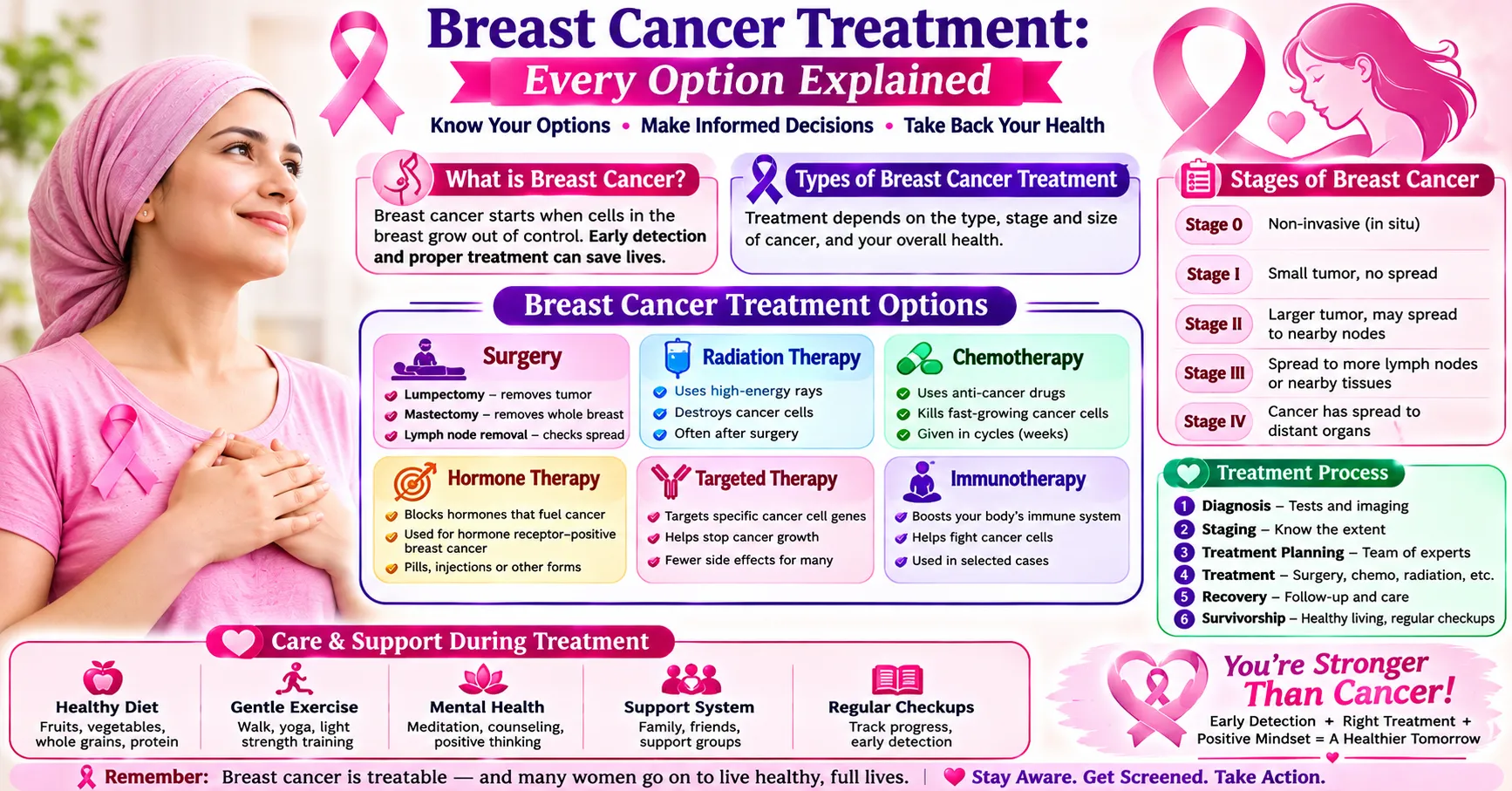
Once a breast cancer diagnosis is confirmed, the next question is almost always the same: what happens now? The answer depends heavily on the type of breast cancer, how far it has progressed, and factors like hormone receptor and HER2 status. Modern breast cancer treatment isn’t one-size-fits-all — it’s a combination of therapies tailored to the specific tumor and the patient’s overall health.
This guide breaks down every major treatment option available today, how doctors decide which combination to use, what recovery looks like, and what treatment typically costs.
How Doctors Decide on a Treatment Plan
Before recommending treatment, oncologists typically consider:
- Cancer stage (0 through IV)
- Tumor size and location
- Hormone receptor status (ER/PR-positive or negative)
- HER2 status (positive or negative)
- Whether cancer has spread to lymph nodes or distant organs
- Patient’s age, overall health, and personal preferences
Because of this, two patients with breast cancer can end up on completely different treatment paths — which is why understanding your specific symptoms and diagnosis matters before assuming a one-size-fits-all treatment plan.
1. Surgery
Surgery is the primary treatment for most early-stage breast cancers and generally falls into two categories:
Lumpectomy (Breast-Conserving Surgery)
Removes only the tumor and a small margin of surrounding tissue, preserving most of the breast. Usually followed by radiation therapy to reduce recurrence risk.
Mastectomy
Removes the entire breast. Options include:
- Total mastectomy — removes all breast tissue.
- Double mastectomy — removes both breasts, sometimes chosen preventively for high-risk (e.g., BRCA-positive) patients.
- Nipple-sparing mastectomy — preserves the nipple and areola where medically appropriate.
Lymph Node Surgery
Often performed alongside breast surgery to check whether cancer has spread:
- Sentinel lymph node biopsy — removes only the first few nodes cancer would likely reach.
- Axillary lymph node dissection — removes a larger number of lymph nodes if cancer is found in the sentinel nodes.
Reconstruction
Many patients choose breast reconstruction, either immediately after mastectomy or at a later date, using implants or tissue from another part of the body.
2. Chemotherapy
Chemotherapy uses drugs to kill fast-growing cancer cells and is often used:
- Before surgery (neoadjuvant chemo): To shrink a tumor and make surgery easier, common in triple-negative and inflammatory breast cancer.
- After surgery (adjuvant chemo): To kill any remaining cancer cells and reduce recurrence risk.
- For metastatic disease: To control cancer that has spread beyond the breast.
Common side effects include hair loss, fatigue, nausea, increased infection risk, and temporary changes to fertility — most side effects resolve after treatment ends.
3. Radiation Therapy
Radiation uses high-energy beams to destroy cancer cells and is typically used after a lumpectomy, or after a mastectomy in higher-risk cases.
- External beam radiation: The most common form, delivered over several weeks.
- Brachytherapy: Involves placing a radioactive source directly inside the breast for a shorter treatment course.
Side effects are generally localized and include skin irritation, fatigue, and mild swelling in the treated area.
4. Hormone (Endocrine) Therapy
For hormone receptor-positive breast cancers (ER/PR-positive), hormone therapy blocks or lowers estrogen levels to slow or stop cancer growth.
- Tamoxifen: Blocks estrogen receptors and is used in both pre- and post-menopausal patients.
- Aromatase inhibitors (e.g., letrozole, anastrozole): Lower estrogen production, typically used in post-menopausal patients.
- Duration: Often taken for 5–10 years to reduce long-term recurrence risk.
5. Targeted Therapy
Targeted therapy attacks specific proteins that fuel cancer growth, causing less damage to healthy cells compared to traditional chemotherapy.
- HER2-targeted drugs like trastuzumab (Herceptin) and pertuzumab, used for HER2-positive breast cancer.
- CDK4/6 inhibitors like palbociclib, often combined with hormone therapy for hormone receptor-positive cancers.
- PARP inhibitors, used for patients with BRCA mutations.
6. Immunotherapy
Immunotherapy helps the immune system recognize and attack cancer cells. It’s most commonly used for triple-negative breast cancer, particularly in combination with chemotherapy for advanced or high-risk cases.
Treatment by Stage (General Overview)
| Stage | Typical Treatment Approach |
|---|---|
| Stage 0 (DCIS) | Lumpectomy or mastectomy, sometimes with radiation |
| Stage I–II | Surgery + radiation, chemo and/or hormone therapy depending on receptor status |
| Stage III | Neoadjuvant chemo, surgery, radiation, targeted/hormone therapy |
| Stage IV (Metastatic) | Systemic therapy (chemo, hormone, targeted, or immunotherapy) focused on disease control |
How Much Does Breast Cancer Treatment Cost?
Treatment costs vary widely based on stage, treatment type, and location:
- Surgery alone: Can range from $15,000 to $50,000+ depending on the type of procedure and reconstruction.
- Chemotherapy: Often costs $10,000–$200,000 for a full course, depending on the specific drugs used.
- Radiation therapy: Typically ranges from $10,000 to $50,000 for a full course.
- Targeted therapy drugs like Herceptin can cost tens of thousands of dollars per year without insurance coverage.
Ways to manage costs:
- Most health insurance plans cover a significant portion of standard breast cancer treatment.
- Nonprofit organizations like the American Cancer Society, Susan G. Komen, and CancerCare offer financial assistance programs.
- Pharmaceutical patient assistance programs can reduce or eliminate the cost of targeted therapy drugs for eligible patients.
- Clinical trials, when appropriate, can provide access to cutting-edge treatment at reduced or no cost.
Recovery and Life After Treatment
Recovery timelines vary by treatment type — surgical recovery can take a few weeks, while chemotherapy and radiation courses often span several months. Many patients also work with:
- Physical therapists, especially after lymph node surgery, to manage swelling (lymphedema) and restore range of motion.
- Oncology counselors or support groups, to manage the emotional impact of diagnosis and treatment.
- Follow-up screening schedules, since regular monitoring continues for years after treatment ends to catch any recurrence early.
Frequently Asked Questions (FAQs)
What is the first treatment usually given for breast cancer?
For early-stage breast cancer, surgery (lumpectomy or mastectomy) is often the first treatment, though for aggressive types like triple-negative or inflammatory breast cancer, chemotherapy may come first to shrink the tumor
Is chemotherapy always required for breast cancer?
No. Whether chemotherapy is needed depends on the cancer’s stage, size, and receptor status — some early-stage, hormone receptor-positive cancers can be treated effectively with surgery and hormone therapy alone.
How long does breast cancer treatment usually take?
Active treatment (surgery, chemo, and/or radiation) often takes 6–12 months, while hormone therapy for receptor-positive cancers can continue for 5–10 years afterward.
What is the difference between a lumpectomy and a mastectomy?
A lumpectomy removes only the tumor and surrounding tissue while preserving the breast, whereas a mastectomy removes the entire breast; the right choice depends on tumor size, location, and personal preference.
Does insurance cover breast cancer treatment?
Most health insurance plans cover the majority of standard breast cancer treatments, though out-of-pocket costs vary based on your specific plan, deductible, and whether treatments are considered in-network.
What is targeted therapy and how is it different from chemotherapy?
Targeted therapy attacks specific proteins that fuel cancer growth, such as HER2, while traditional chemotherapy attacks all fast-growing cells in the body, which is why targeted therapy often has fewer side effects.
Can breast cancer come back after treatment?
Yes, recurrence is possible, which is why long-term hormone therapy and regular follow-up screenings are recommended for years after initial treatment ends.
Are there financial assistance programs for breast cancer treatment?
Yes. Organizations like the American Cancer Society, Susan G. Komen, and CancerCare, along with pharmaceutical patient assistance programs, offer grants and reduced-cost options for eligible patients.
Conclusion
Breast cancer treatment today is far more personalized than it was even a decade ago, combining surgery, chemotherapy, radiation, hormone therapy, targeted therapy, and immunotherapy based on each patient’s specific diagnosis.
While a diagnosis can feel overwhelming, understanding the full range of available options — and the financial resources that can help cover them — puts patients and their families in a stronger position to make informed decisions alongside their care team.