
most working parents, daycare isn’t just an expense — it’s often the single biggest line item in the family budget, sometimes bigger than rent. Here’s a real breakdown of what daycare actually costs in 2026, how it changes by your child’s age and state, and what can help bring that number down.
National Average Daycare Cost in 2026
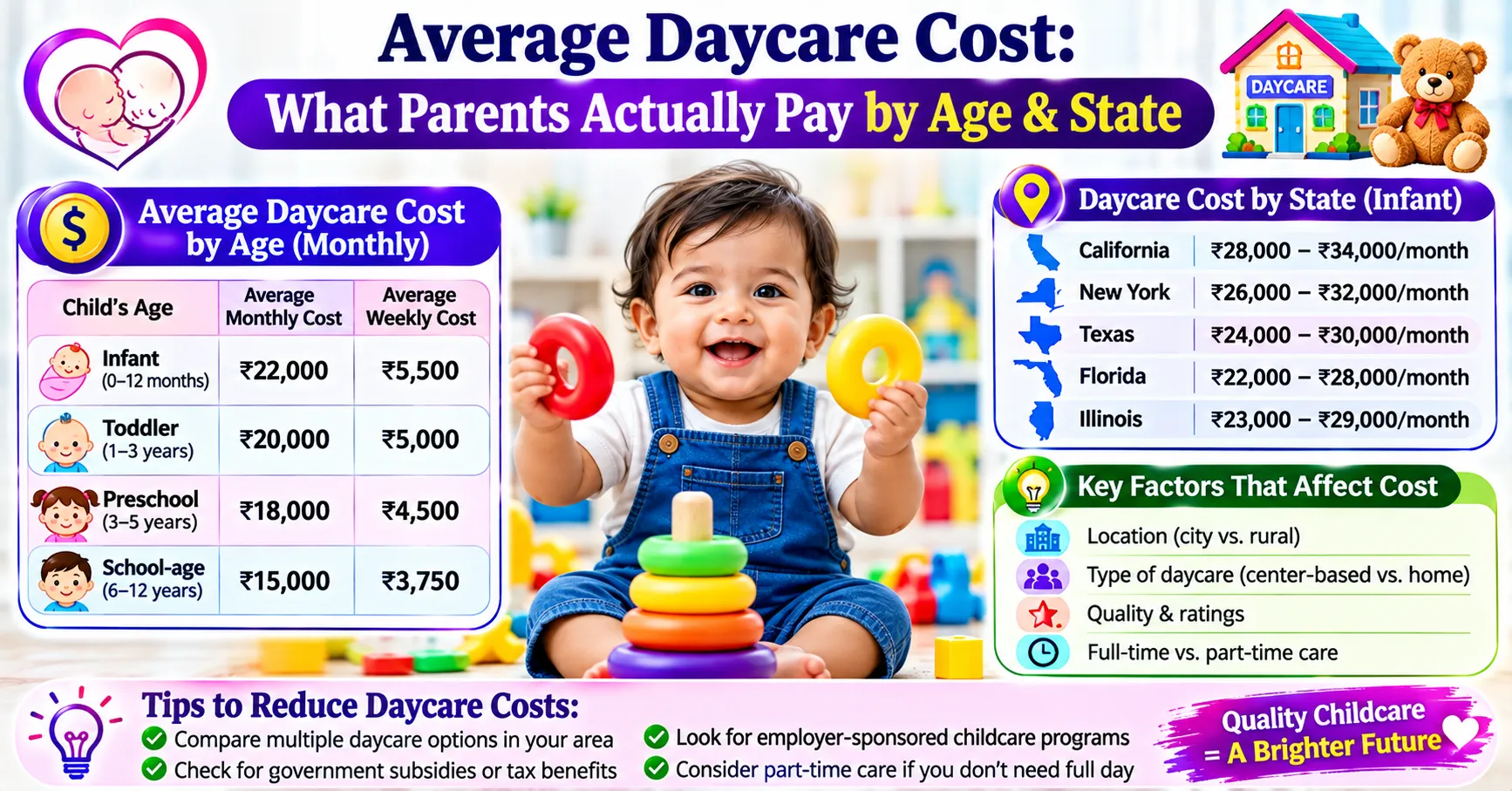
<cite index=”15-1″>Infant center-based daycare averages $1,230 per month nationally in 2026</cite>, which works out to roughly <cite index=”15-1″>$57 per day</cite>. Costs drop noticeably as your child gets older:
| Age Group | Average Monthly Cost |
|---|---|
| Infant | $1,230 |
| Toddler | $1,080 |
| Preschooler | $920 |
| School-age (after-care) | $770 |
<cite index=”17-1″>That’s a 5% jump from around $1,171 the year before</cite> — daycare costs have been rising consistently, generally outpacing general inflation.
Why Infant Care Costs So Much More
<cite index=”11-1″>Toddler rates typically run 15–25% less than infant rates, and preschool rates run 20–35% less</cite> at the same center. The reason comes down to staffing requirements, not just demand. <cite index=”17-1″>States set minimum caregiver-to-child ratios of around 1 adult per 3–4 infants, compared to 1 per 8–10 preschoolers</cite>. More staff per child means higher labor costs, and labor is the biggest line item on a daycare’s own budget.
Daycare Cost by State: The Real Range
This is where the national average becomes almost meaningless on its own — the gap between states is enormous. <cite index=”17-1″>Mississippi averages around $650 a month for infant care, while Washington DC charges $2,400 for the same type of care — nearly a 4x difference</cite>.
| Cost Tier | States | Monthly Range (Infant Care) |
|---|---|---|
| High-cost | MA, CA, NY, DC, WA | $2,000–$3,200 |
| Mid-cost | TX, FL, IL, GA | $1,100–$1,700 |
| Low-cost | MS, AR, AL, SD | $600–$1,000 |
<cite index=”11-1″>The national monthly average across all states falls between roughly $1,200 and $2,100</cite>, but where you live changes that number dramatically. Even within the same state, <cite index=”16-1″>costs can swing $400–$900 a month depending on the metro area</cite>, since urban centers in cities like Boston or San Francisco run well above rural rates in the same state due to rent and local wages, not different licensing rules.
Daycare vs Nanny vs Home-Based Care
Center-based daycare isn’t your only option, and the cost differences matter when you’re budgeting:
- Center-based daycare: $770–$1,230/month depending on age (national average)
- Home-based daycare: <cite index=”17-1″>Runs 20–30% less than center-based care at every age</cite>
- Nanny care: <cite index=”17-1″>Averages around $2,700 per month nationally</cite>, not including employer payroll taxes you may owe as a household employer
Home-based daycare is often the most budget-friendly licensed option, while nannies cost significantly more but offer one-on-one care and flexibility that group settings can’t match.
How to Actually Lower Your Daycare Bill
A few concrete ways to reduce what you’re paying:
1. Dependent Care FSA. A Dependent Care Flexible Spending Account lets you set aside pre-tax dollars specifically for childcare expenses, reducing your taxable income and effectively lowering your real cost.
2. Child and Dependent Care Tax Credit. <cite index=”17-1″>This federal tax credit lets you claim 20–35% of up to $3,000 in care expenses for one child, or $6,000 for two or more children</cite>.
3. Childcare assistance programs (CCDF). <cite index=”17-1″>About 1 in 6 families who are eligible for CCDF childcare assistance actually receive it</cite> — meaning a lot of eligible families never apply. If your childcare costs exceed 10% of your income, it’s worth checking your eligibility.
4. Employer dependent care benefits. Some employers offer direct subsidies or on-site care options that aren’t widely advertised — worth asking HR directly rather than assuming none exists.
When to Start Looking
Waitlists are one of the most overlooked parts of daycare planning. <cite index=”11-1″>Many quality infant care centers have waitlists of 6 to 18 months, so it’s worth contacting centers and joining multiple waitlists during pregnancy</cite> rather than waiting until after the baby arrives. <cite index=”11-1″>Some centers allow a deposit of $100–$500 to hold a spot, which typically goes toward your first month’s tuition if you accept it</cite>.
Bottom Line
Daycare costs vary so much by state and age that a single “average” number isn’t very useful for actually budgeting — a family in Mississippi and a family in Washington DC could be looking at a $1,750/month difference for the exact same type of care. What matters is checking your specific state’s numbers, understanding that infant care is always the most expensive stage, and stacking every available cost-reduction option — Dependent Care FSA, tax credits, and assistance programs — rather than relying on just one.
FAQs
What is the average cost of daycare per month in 2026?
The national average for infant center-based care is around $1,230 per month, dropping to about $1,080 for toddlers and $920 for preschoolers.
Why is infant daycare so much more expensive than toddler care?
Infant care requires stricter caregiver-to-child ratios (often 1 adult per 3–4 infants), which means higher staffing costs passed on to parents.
Which states have the cheapest and most expensive daycare?
Mississippi is among the most affordable at roughly $650/month for infant care, while Washington DC is among the most expensive at around $2,400/month.
Is home-based daycare cheaper than a daycare center?
Yes, home-based daycare typically costs 20–30% less than center-based care at every age group.
How can I reduce my daycare costs?
A Dependent Care FSA, the Child and Dependent Care Tax Credit, employer benefits, and state childcare assistance programs (CCDF) can all reduce your out-of-pocket costs.
When should I start looking for daycare?
Ideally during pregnancy — quality infant care centers often have waitlists of 6 to 18 months, so early planning matters more than most parents expect.